
Wise vs Wize is a common spelling confusion, especially because both words look and sound almost identical. If you’ve ever wondered whether wise or wize is correct, you’re definitely not alone.
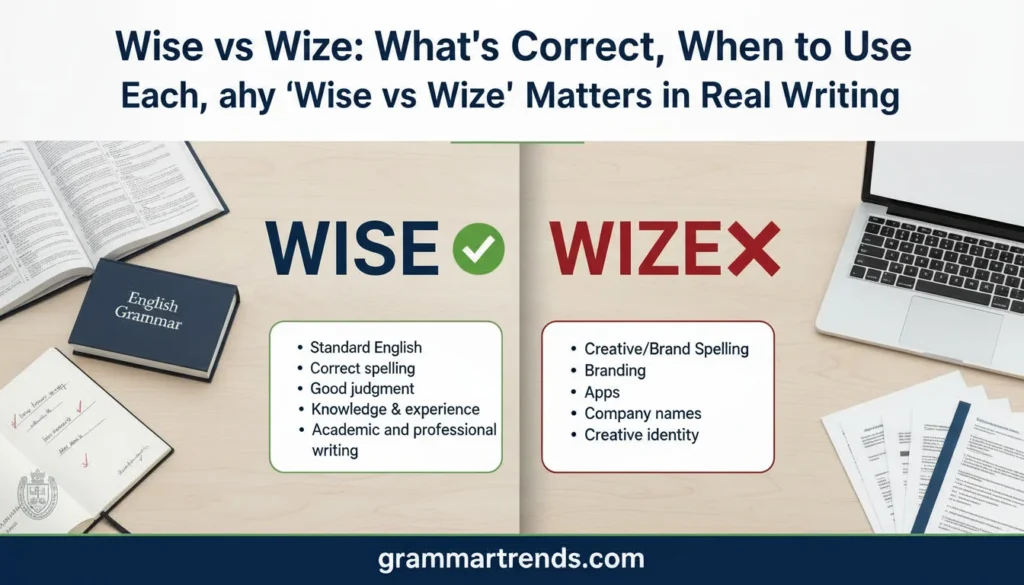
The answer is actually simple: wise is the correct spelling in standard English. It describes someone who has good judgment, knowledge, experience, or the ability to make thoughtful decisions. Wize, on the other hand, isn’t a standard English spelling. You may see it used creatively in brand names, apps, usernames, or other informal contexts, but that doesn’t make it the accepted spelling.
This small difference can have a noticeable effect on how your writing comes across. Using wize in an essay, professional email, resume, or formal article may look like a spelling mistake, while wise fits naturally in both everyday and professional English.
In this guide, we’ll take a closer look at wise vs wize, including their meanings, spelling differences, correct usage, common mistakes, and the situations where “Wize” might intentionally appear. By the end, you’ll know exactly which form to use and how to write with greater clarity and confidence.
Quick Answer
Here’s the simplest breakdown:
- Wise is the correct English word. You can use it in essays, emails, reports, and books.
- Wize is not standard English. You’ll mainly see it in brand names, apps, or creative spelling choices.
That’s it. No hidden rule. No complicated grammar trick.
However, the real challenge isn’t definition. It’s knowing when “wize” is acceptable without sounding incorrect or careless.
Let’s go deeper.
What “Wise” Means in English (And Why It’s So Powerful)
Wise vs Wize in meaning: starting with the real word
The word “wise” is an adjective. It describes someone or something with good judgment, experience, or strong understanding.
At its core, “wise” connects to decision-making and perception.
For example:
- A wise person thinks before acting.
- A wise decision avoids unnecessary risk.
- Wise advice helps you avoid mistakes.
Simple word. Big weight.
How “wise” actually works in everyday English
You’ll see “wise” in three major patterns:
- People-based wisdom
- She is wise beyond her years.
- Decision-based wisdom
- It was wise to leave early.
- Advice or guidance
- That’s wise advice.
The word always connects to judgment or thinking. That’s its identity.
Grammar role of “wise”
“Wise” functions as an adjective. That means it modifies nouns.
Here’s how it behaves:
- wise + noun → wise choice
- linking verb + wise → he is wise
- adverbial idea → act wisely (related form)
Notice something important: “wise” changes form depending on how you use it, but it never changes spelling.
That stability is why “wize” stands out so much.
Is “Wize” a Real Word in English?
This is where confusion usually starts.
Let’s be very clear.
Why “wize” is not standard English
If you open major dictionaries like Merriam-Webster or Oxford, you won’t find “wize” listed as an accepted spelling for “wise.”
That means:
- It is not a recognized spelling variant
- It is not used in formal writing systems
- It is not acceptable in academic grammar rules
So if you’re writing an essay, report, or professional email, “wize” is off the table.
So where does “wize” actually come from?
“Wize” exists because of one big reason: branding creativity.
Businesses and creators often change spelling to:
- Make names unique
- Secure domain names
- Stand out visually
- Avoid trademark conflicts
For example, you’ll often see patterns like:
- “Klassic” instead of “classic”
- “Lyte” instead of “light”
- “Wize” instead of “wise”
It’s not about grammar. It’s about identity.
Why brands love the letter “z”
The letter “z” has a visual punch. It feels:
- modern
- edgy
- tech-oriented
- memorable
That’s why “wize” appears in startups, apps, and online platforms more than in textbooks.
But here’s the catch: branding freedom does not equal grammar correctness.
Wise vs Wize: The Real Differences That Matter
Let’s put them side by side so it’s impossible to mix them up.
| Feature | Wise | Wize |
| Standard English word | Yes | No |
| Found in dictionaries | Yes | No |
| Safe for academic writing | Yes | No |
| Used in branding | Rare | Common |
| Meaning clarity | Always clear | Depends on context |
| Professional usage | Correct | Risky |
Now notice something important: the difference isn’t meaning. It’s legitimacy.
Both might point to the idea of “wisdom” in branding contexts. But only one survives grammar rules.
How to Use “Wise” Correctly in Real Sentences
Wise vs Wize in everyday writing
Let’s make this practical.
Here’s how “wise” naturally appears in real communication:
- It’s wise to double-check your work.
- She made a wise investment in her future.
- That wasn’t a wise move, honestly.
These sentences sound natural because they follow real speech patterns.
Wise in professional writing
In formal settings, “wise” shows up often in:
- Business decisions
- Academic analysis
- Financial planning
- Leadership communication
Example:
It is wise for companies to diversify revenue streams during uncertain economic cycles.
No fluff. Just clarity.
Common collocations you should remember
These word pairings show up repeatedly:
- wise decision
- wise choice
- wise investment
- wise counsel
- wise beyond years
Think of them like “ready-made blocks” of English.
When “Wize” Actually Makes Sense (And When It Doesn’t)
This is where nuance matters.

Wise vs Wize in branding environments
“Wize” can make sense when used intentionally in:
- Company names
- Product names
- App titles
- Domain names
- Social media handles
Example pattern:
- A learning app named “Wize”
- A financial tool branded “Wize”
- A tech startup choosing “Wize” for uniqueness
In these cases, the spelling is part of identity.
Why companies choose “Wize” over “Wise”
Here’s the real strategy behind it:
- Domain name availability: “wise.com” may be taken
- Trademark differentiation: unique spelling avoids legal overlap
- Visual branding: “z” looks sharper in logos
- Memorability: unusual spelling sticks in memory
So yes, it’s intentional. Not accidental.
When “wize” becomes a mistake
Problems start when people use it in:
- school essays
- professional emails
- resumes
- academic research
- formal articles
In those cases, “wize” signals one thing to readers: lack of attention to standard spelling rules
And that can quietly damage credibility.
Common Mistakes in Wise vs Wize Usage
Let’s break down where people usually slip.
Mistake: Using “wize” in formal writing
This is the most common issue.
Example:
- Incorrect: It was a wize decision.
- Correct: It was a wise decision.
One small letter changes how your writing is judged.
Mistake: Thinking “wize” is slang
It’s not slang. That’s important.
Slang changes meaning in informal speech. “Wize” doesn’t change meaning at all. It’s just a stylistic spelling choice.
Mistake: Copying branding into grammar
People often see a brand like “Wize” and assume it’s a valid spelling.
But here’s the rule:
Branding rules do not rewrite grammar rules.
Context Changes Everything in Wise vs Wize
This is where real understanding shows up.
Formal writing context
Use:
- Wise
Avoid:
- Wize
Why? Because formal writing values consistency and correctness.
Informal writing context
You still stick with:
- Wise
Even in casual writing, “wise” is safer and clearer.
Branding and creative context
This is the only place where “wize” works.
But even here, consistency matters more than creativity.
If you choose “wize,” stick with it everywhere in that brand identity.
Academic vs commercial intent
- Academic → always “wise”
- Commercial branding → “wize may appear”
- Mixed usage → stick with “wise” for safety
Real-World Style Breakdown (Case Studies)
Let’s look at how this plays out in practice.
Case study: academic writing scenario
A student writes:
“It is not wize to ignore climate data trends.”
Result: marked incorrect.
Why?
Because academic standards require correct spelling, not stylized branding.
Correct version:
“It is not wise to ignore climate data trends.”
Simple fix. Big difference in grading perception.
Case study: branding scenario
A startup names itself “Wize Finance.”
Why it works:
- Unique identity
- Strong memorability
- Domain availability
- Modern tech feel
But if the same startup writes:
“We provide wize financial advice.”
That becomes confusing and unprofessional in copywriting.
Correct internal writing should still use:
- wise financial advice
So branding and grammar split paths.
Case study: social media usage
Usernames often look like:
- @wize_tech
- @wize.money
That works because usernames are identity-based, not grammar-based.
But captions should still say:
- wise decision, not wize decision
Read more: Rule for Writing Out Numbers: A Complete Guide
How to Remember Wise vs Wize Easily
Here’s a simple mental trick that sticks:
Wise has meaning. Wize has marketing.
That’s the cleanest way to lock it in.
Another shortcut:
- Writing for school or work → always “wise”
- Naming something → “wize” might appear
If you follow that, you won’t go wrong.
Practice Section: Test Yourself
Try these quick corrections.
Choose the correct word
- That was a very ___ decision.
- She gave me ___ advice.
- The company is called ___ Solutions.
Answers:
- wise
- wise
- Wize (only if it’s a brand name)
Fix the sentence
- “He made a wize financial move.”
Correct:
- “He made a wise financial move.”
FAQs
1. Is “wise” or “wize” the correct spelling?
Wise is the correct spelling in standard English. Wize is generally a creative or nonstandard spelling and shouldn’t replace wise in formal writing.
2. What does “wise” mean?
Wise describes someone who has good judgment, knowledge, experience, and the ability to make thoughtful decisions. For example, She gave me some wise advice.
3. Is “wize” an acceptable English word?
Not as a standard spelling of wise. You may encounter Wize in company names, apps, usernames, or branding where the unusual spelling is intentional.
4. Can I use “wize” in an essay or professional email?
It’s best to avoid it. In academic, professional, and formal writing, use wise to follow standard English spelling conventions.
5. Why do people confuse “wise” and “wize”?
The two forms sound the same when spoken, so it’s easy to assume they’re interchangeable. The difference becomes important when you see them written down.
6. How can I easily remember the difference between wise and wize?
Use this simple memory trick: “Wise has wisdom; Wize has branding.” When you’re writing an essay, resume, email, or report, choose wise. If you’re referring to a specific brand or creative name spelled Wize, keep its original spelling.
Conclusion
The difference between wise vs wize is small on the page but important in your writing. Wise is the standard English spelling and is the word you should choose when you’re talking about good judgment, experience, or thoughtful decisions. Wize may look modern or catchy, but it generally belongs to creative branding rather than standard English.
When you’re writing an essay, resume, email, article, or professional document, there’s no reason to take a spelling risk—use wise. Once you connect wise with wisdom and good judgment, the correct choice becomes much easier to remember. In short, wise is for standard writing; Wize is mainly for intentional creative names.

Emma Brooke brings 15 years of experience in the Department of English Language and Literature at the University of California, Berkeley, where she has taught and mentored students across courses in British and American literary traditions, critical theory, and narrative form. Her expertise spans 19th- and 20th-century fiction, poetic prosody, postcolonial literatures, and digital humanities, with a focus on how narrative voice shapes cultural meaning. Emma’s work has been presented at international conferences and published in peer-reviewed venues, reflecting her deep commitment to rigorous literary scholarship and accessible teaching.