
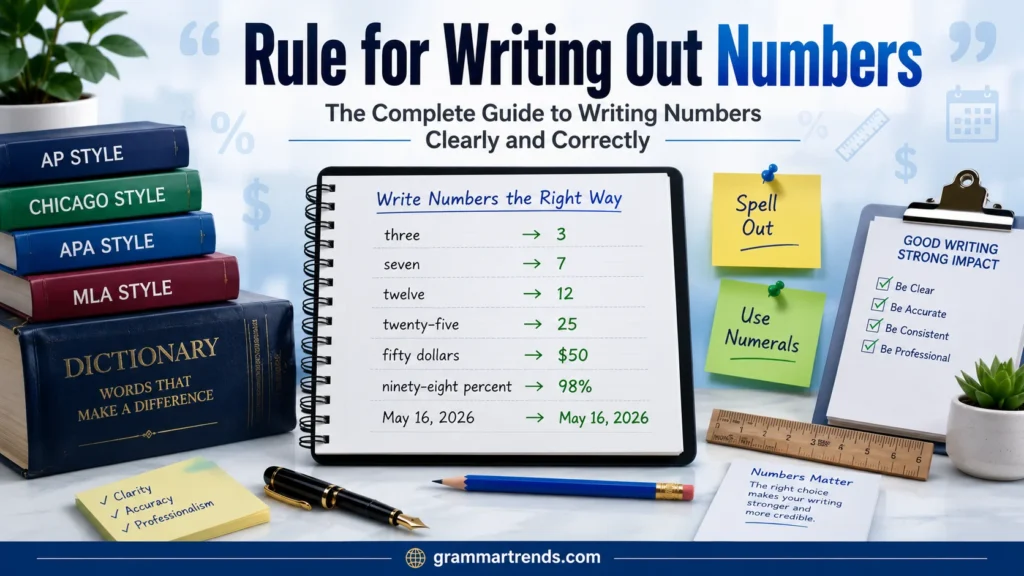
The rule for writing out numbers may seem simple, but many writers struggle to know when to spell out numbers and when to use numerals. The good news is that the rule becomes clear in practice. The key is consistency. Whether you’re writing a blog post, academic paper, business report, book, website content, or news article, using numbers consistently makes your writing easier to read, more professional, and more accurate.
For example, mathematics, statistics, measurements, dates, times, percentages, money, ages, addresses, rankings, sports scores, and Top 10 lists almost always use numerals because they improve clarity and make information easier to scan. By contrast, novels, essays, creative writing, and many forms of general prose often spell out smaller numbers to create a smoother reading experience.
Professional writers, editors, journalists, publishers, and content creators rely on established style manuals and editorial guidelines to decide whether to use words or figures. Following one style consistently across chapters, articles, reports, or websites prevents readers from becoming distracted by inconsistent formatting.
Learning the rule for writing out numbers isn’t just about memorizing grammar rules. It’s about communicating information clearly, improving readability, and matching the expectations of your readers. Once you understand the basic principles, you’ll know exactly when to write numbers as words, when to use numerals, and how to stay consistent throughout your writing.
Quick Answer
The rule for writing out numbers depends on the style guide you’re following, but the most important principle is consistency. In most writing, spell out numbers one through nine (or one through ten, depending on the style) and use numerals for larger numbers. Always use numerals for dates, times, ages, percentages, measurements, money, and statistics unless your chosen style guide says otherwise. If you’re writing for AP Style, Chicago Style, APA, or MLA, follow that guide’s specific rules and apply them consistently throughout your document.
Why the Rule for Writing Out Numbers Matters in Real Writing
Numbers shape meaning more than most people realize. A single change from words to numerals can shift tone, clarity, and even credibility.
For example:
- “I waited three hours” feels conversational
- “I waited 3 hours” feels direct and factual
Neither is wrong. But they feel different.
That’s the real reason writing rules exist. They don’t just control grammar. They control reader perception.
Why consistency matters more than perfection
Editors care less about strict correctness and more about consistency. If you mix styles like this:
- “She has 3 cats and two dogs”
…it immediately looks unpolished.
A consistent approach looks like:
- “She has 3 cats and 2 dogs”
or - “She has three cats and two dogs”
Same meaning. Different professionalism.
Core Rule for Writing Out Numbers in English
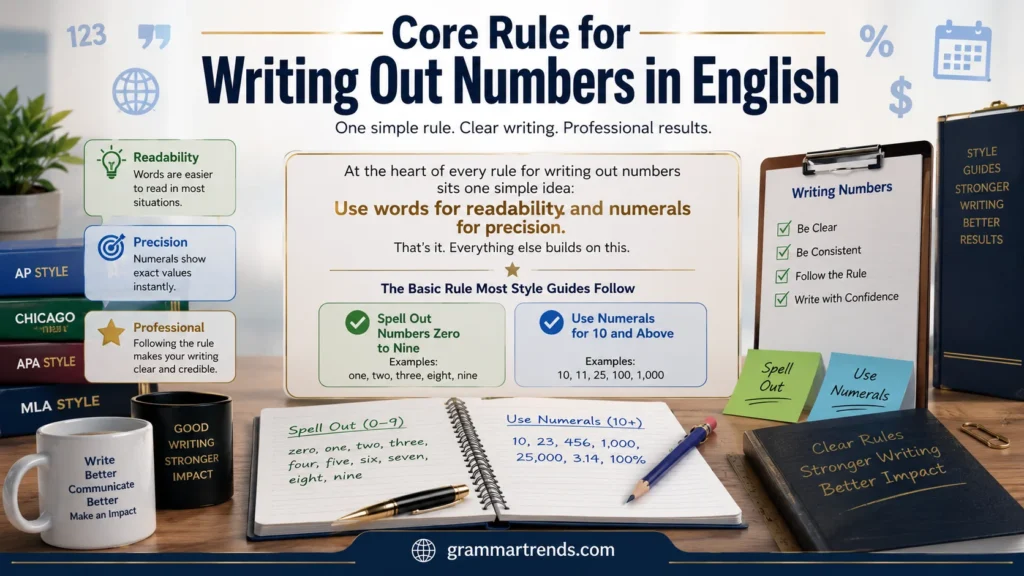
At the heart of every rule for writing out numbers sits one simple idea:
Use words for readability and numerals for precision.
That’s it. Everything else builds on this.
But let’s break it down further so you can actually apply it.
The basic working rule most style guides follow
- Spell out numbers zero to nine
- Use numerals for 10 and above
So you get:
- five apples
- 12 students
- 47 pages
- nine ideas
This rule appears in AP Style and many journalism contexts, but it’s not universal.
And that’s where things get interesting.
Writing Numbers Rules: When to Spell Out Numbers
The rule for writing out numbers changes depending on context, but certain situations almost always require words.
Numbers from zero to nine
Most formal writing systems agree here:
- one
- two
- three
- four
- five
- six
- seven
- eight
- nine
Why? Because reading small numbers as words improves flow. Your brain processes them faster in narrative text.
Numbers that start a sentence
Never begin a sentence with a numeral.
Instead of:
- “5 students missed class.”
Write:
- “Five students missed class.”
If the number feels awkward at the start, rewrite the sentence:
- “A total of 5 students missed class.”
Common phrases and expressions
Some expressions sound natural only when spelled out:
- “one in a million”
- “a thousand times better”
- “back to square one”
Even when numerals would be technically correct, words win here because tone matters more than precision.
When to Use Numerals Instead of Words
Now let’s flip it.
The rule for writing out numbers also clearly supports numerals in many situations.
Numbers 10 and above (general rule)
Most writing systems switch at 10:
- 10 books
- 25 students
- 100 pages
- 1,000 words
Why? Because numerals reduce visual clutter when numbers get larger.
Data, statistics, and measurements
Always use numerals when precision matters:
- 98%
- 3.5 kg
- 12 km
- 2026
Readers expect speed and clarity here. Words slow them down.
Money and currency
Use numerals in almost all cases:
- $5
- $50
- $1,200
Writing “fifty dollars” is fine in narrative writing, but numerals dominate in business, journalism, and finance.
AP Style vs Chicago Style: The Real Rule for Writing Out Numbers
If you want to master the rule for writing out numbers, you need to understand the two biggest systems in English writing.
They don’t always agree.
AP Style (Associated Press)
AP Style dominates journalism and news writing.
Core AP rules:
- Spell out one through nine
- Use numerals for 10 and above
- Always use numerals for:
- ages
- percentages
- money
- dates
Example:
- “She has 7 dogs and 12 cats.”
- “He is 5 years old.”
- “The stock rose 3%.”
AP Style prioritizes speed and clarity for readers scanning news.
Chicago Manual of Style
Chicago Style is common in books and academic writing.
Core Chicago rules:
- Spell out one through one hundred in many cases
- Use numerals for technical contexts
- Focus on readability in long-form writing
Example:
- “She has seven dogs and twelve cats.”
- “The experiment involved ninety-seven participants.”
Chicago Style feels more formal and literary.
AP vs Chicago comparison table
| Category | AP Style | Chicago Style |
| Small numbers | 1–9 spelled out | Often 1–100 spelled out |
| Large numbers | Numerals | Mixed depending on context |
| News writing | Standard | Rare |
| Books | Less common | Standard |
| Data-heavy content | Numerals | Flexible |
Special Cases in the Rule for Writing Out Numbers
Now let’s go deeper. This is where most writers get confused.
Large numbers (thousands, millions, billions)
You have two clean options:
Option 1: Numerals
- 1,000
- 25,000
- 2.5 million
Option 2: Words
- one thousand
- twenty-five thousand
- two and a half million
What works best?
- Use numerals for speed and clarity
- Use words for storytelling and narrative writing
Example:
- “The company earned $2.4 million in profit.” (business tone)
- “He had dreamed of making two million dollars since childhood.” (story tone)
Decimals and fractions
Decimals always use numerals:
- 3.5
- 0.75
- 12.8
Fractions depend on context:
- “one-half cup of sugar” (recipe style)
- “0.5 cups of sugar” (technical writing)
Percentages
The rule for writing out numbers in percentages is simple:
- Always use numerals + %
Correct:
- 5%
- 12%
- 100%
Incorrect in most formal writing:
- five percent
- twelve percent
Dates, time, and measurements
These always prefer numerals:
Dates
- May 16, 2026
Time
- 5 p.m.
- 12:30 a.m.
Measurements
- 10 km
- 3 kg
- 6 ft
These areas rely on clarity, not style.
Hyphenation Rules in Writing Numbers
Hyphens matter more than most people think.
They prevent confusion and improve flow.
Hyphenate compound numbers
- twenty-one
- forty-five
- ninety-nine
Hyphenate numbers used as adjectives
- a 12-year-old student
- a 5-mile run
- a 10-page report
Without hyphens, meaning becomes unclear fast.
Example:
- “a 12 year old student” → confusing
- “a 12-year-old student” → clear
Context-Based Rule for Writing Out Numbers
Different fields follow different instincts. Let’s break them down.
Academic writing
- Prioritize clarity and consistency
- Use numerals for data-heavy sections
- Spell out numbers in narrative explanations
Example:
- “The study included 45 participants, but only twelve completed all tasks.”
Business writing
Business writing loves speed and clarity.
- Financial figures use numerals
- Reports avoid spelling out numbers unnecessarily
Example:
- “Revenue increased by 18% in Q3.”
Creative writing
Creative writing bends the rules.
- Spell out numbers for mood
- Use numerals for impact
Example:
- “He waited three days and 3 nights.”
That contrast can create rhythm and emphasis.
Legal writing
Legal writing removes ambiguity entirely.
- Numbers appear in numerals and words together
Example:
- “100 (one hundred) dollars”
This prevents misinterpretation or fraud.
Read more: In Line vs Inline vs In-Line: The Complete Guide and Using
Common Mistakes in the Rule for Writing Out Numbers
Even experienced writers slip up here.
Mixing styles
Wrong:
- “She has 3 cats and seven dogs.”
Correct:
- “She has 3 cats and 7 dogs.”
or - “She has three cats and seven dogs.”
Overusing numerals in stories
Wrong:
- “He walked 5 miles to see 2 friends.”
Better:
- “He walked five miles to see two friends.”
Redundant currency
Wrong:
- “$50 dollars”
Correct:
- “$50”
Starting sentences with numbers
Wrong:
- “10 people arrived late.”
Correct:
- “Ten people arrived late.”
Decision Guide: How to Apply the Rule for Writing Out Numbers
When you’re stuck, follow this mental checklist:
- Is the number below 10?
- Is it starting a sentence?
- Is it data, money, or measurement?
- Does your style guide require AP or Chicago rules?
- Does clarity matter more than style?
If you’re unsure, rewrite for clarity instead of guessing.
Quick Reference Cheat Sheet
| Situation | Use Words | Use Numerals |
| 0–9 | ✔ | |
| 10+ | ✔ | |
| Start of sentence | ✔ | |
| Money | ✔ | |
| Dates/time | ✔ | |
| Percentages | ✔ | |
| Measurements | ✔ |
Real-World Case Study: Editing a Business Report
Let’s say a draft reads:
“Five employees completed 12 tasks each, generating 60 total reports.”
An editor revises it to:
“5 employees completed 12 tasks each, generating 60 reports.”
Why?
Because business writing values scanning speed. Numerals make data easier to process.
Now compare:
“Five employees completed twelve tasks each…”
That version feels slower, more narrative, less technical.
Same data. Different purpose. Different rule.
That’s the rule for writing out numbers in action.
FAQs
1. When should I write numbers in words?
You usually write numbers in words from zero to one hundred in most non-technical writing to keep text clean and readable.
2. When should I use numerals instead of words?
Use numerals for large numbers, statistics, measurements, and when clarity is more important than style.
3. What is the most important rule for writing numbers?
The key rule is consistency. Don’t mix words and numerals for the same type of number in one piece of writing.
4. Should I start a sentence with a number?
No, you should avoid starting a sentence with numerals. Write the number in words or rewrite the sentence.
5. Do style guides always agree on number rules?
No. Guides like AP Style and Chicago Manual of Style differ, especially for larger numbers and ranges.
6. How should I write large numbers?
Large numbers often use commas in American style (e.g., 746,372), but some systems like SI prefer spaces instead.
7. Are percentages written in words or symbols?
In informal writing, you can use “%”. In formal writing, it is better to spell it out as “percent”.
Conclusion
Mastering the rule for writing out numbers isn’t about memorizing every exception—it’s about understanding the purpose behind the rules. Numbers should make your writing clearer, not distract your readers. Once you choose a style guide, whether it’s AP, Chicago, APA, or MLA, stick with it throughout your document to maintain consistency and professionalism.
As a general rule, spell out numbers when the style guide calls for words and use numerals when they improve clarity, especially for dates, measurements, money, percentages, and large values. When you’re unsure, remember that readability always comes first.
The more you practice, the more natural these decisions become. Instead of stopping to wonder whether to write eight or 8, you’ll know which form best fits your audience and the type of content you’re creating. By applying these guidelines consistently, you’ll produce writing that looks polished, reads smoothly, and meets the expectations of both readers and professional editors.

Emma Rose has spent 15 years in the English Department at the University of California, Los Angeles (UCLA), guiding students through British and American literary classics, critical theory, and narrative techniques. Her scholarly focus includes 19th- and 20th-century fiction, the art of poetry, postcolonial writing, and digital humanities particularly how storytelling voice influences cultural perspectives. Emma has presented her research at major international conferences and published in respected academic journals, underscoring her dedication to both high-level scholarship and engaging teaching.