

When you review this article, you’ll learn that on top of that may sound informal in academic writing and professional communication; the 11 Formal Synonyms for “On Top of That” for Professional and Academic Writing help you choose a more formal tone.
In my experience, Furthermore, Additionally, Moreover, In addition, Besides, Apart from that, To add to that, In conjunction, On another note, On a similar note, Not only that but, and As well as can make your writing smoother and more polished. Choosing the right transition helps your ideas match the purpose of your message without sounding insincere or overly complicated. Another way to understand these expressions is to consider the information and relationship between ideas.
For example, Furthermore and Moreover can strengthen a point, while In addition simply introduces extra information. Additionally is useful in structured academic work, while Apart from that may feel less formal in certain contexts. On another note and On a similar note can shift or connect ideas, while In conjunction shows that things operate together. You can say these expressions professionally while keeping a clearer picture of your meaning. Even on the bright side can introduce a positive point, although it carries a different tone from the formal choices mentioned above.
Quick Answer
The best formal alternatives to “on top of that” are Furthermore, Moreover, Additionally, In addition, and What is more.
For academic writing, Furthermore and Moreover are strong choices. For professional emails and reports, Additionally and In addition sound clear and natural.
The project is behind schedule. Furthermore, the budget has been reduced.

What Does “On Top of That” Mean?
“On top of that” means in addition to something already mentioned. It introduces another piece of information that adds to the previous statement.
Consider this example:
The hotel was expensive. On top of that, the room was surprisingly small.
The speaker gives you two related complaints. The first concerns the price. The second adds another negative detail.
The expression can also introduce a positive addition:
The course is affordable. On top of that, it includes one-on-one tutoring.
Here, the second statement adds another advantage.
The phrase often carries a little more emotion than a neutral transition such as “additionally.” Depending on the context, it can suggest that the new information makes a situation better, worse, more surprising, or more important.
“On Top of That” vs. “On Top Of”
These expressions can look similar while functioning differently.
“On top of that” works as a sentence-level transition:
The project is behind schedule. On top of that, the budget has been reduced.
“On top of” can also work as a preposition:
On top of the original fee, customers must pay a service charge.
The second construction means in addition to something and normally connects directly to a noun or noun phrase.
Understanding this difference helps you choose the right formal alternative.
The 11 Best Formal Synonyms for “On Top of That”
Here’s a quick comparison before looking at each expression in detail.
| Formal Alternative | Best Use | Formality | Level of Emphasis |
| Furthermore | Academic and professional arguments | High | Strong |
| Moreover | Persuasive and analytical writing | High | Strong |
| Additionally | Reports and professional communication | High | Moderate |
| In addition | General formal writing | High | Moderate |
| Further | Reports, analysis, and formal prose | High | Moderate |
| What is more | Persuasive and polished writing | Medium-High | Strong |
| Beyond this | Analytical and academic contexts | High | Moderate |
| Notably | Important findings or details | High | Strong |
| Alongside this | Related or parallel factors | High | Moderate |
| In conjunction with this | Technical and formal contexts | Very High | Contextual |
| Over and above this | Emphatic formal writing | High | Strong |
These expressions don’t all perform exactly the same job. That’s why choosing the right one requires more than opening a thesaurus and picking the fanciest-looking word.
Furthermore
Furthermore is one of the safest formal alternatives to “on top of that.” It introduces another point that supports, extends, or strengthens the statement immediately before it.
You’ll often see it in academic essays, research papers, business reports, proposals, and formal arguments.
For example:
The new system reduces administrative costs. Furthermore, it improves data accuracy.
The second point supports the overall argument that the new system offers meaningful benefits.
When to Use “Furthermore”
Use furthermore when the additional information has a clear relationship with the previous point.
It’s especially effective when you’re building an argument step by step.
For example:
The policy could reduce energy consumption. Furthermore, it may lower long-term operating costs.
The writer isn’t simply throwing another unrelated fact into the paragraph. The second idea strengthens the first.
“Furthermore” in Academic Writing
Academic writing often relies on logical connections between ideas. Furthermore makes that relationship clear without sounding conversational.
For instance:
The study identified a significant decline in workplace errors. Furthermore, participants reported higher levels of confidence.
The transition signals that the second finding adds weight to the overall discussion.
“Furthermore” vs. “On Top of That”
Compare these sentences:
The software is expensive. On top of that, it requires specialized training.
The software is expensive. Furthermore, it requires specialized training.
Both are grammatically correct. The first sounds conversational. The second fits formal writing more naturally.
Best choice: Use furthermore when you want a polished transition that adds another supporting point.
Moreover
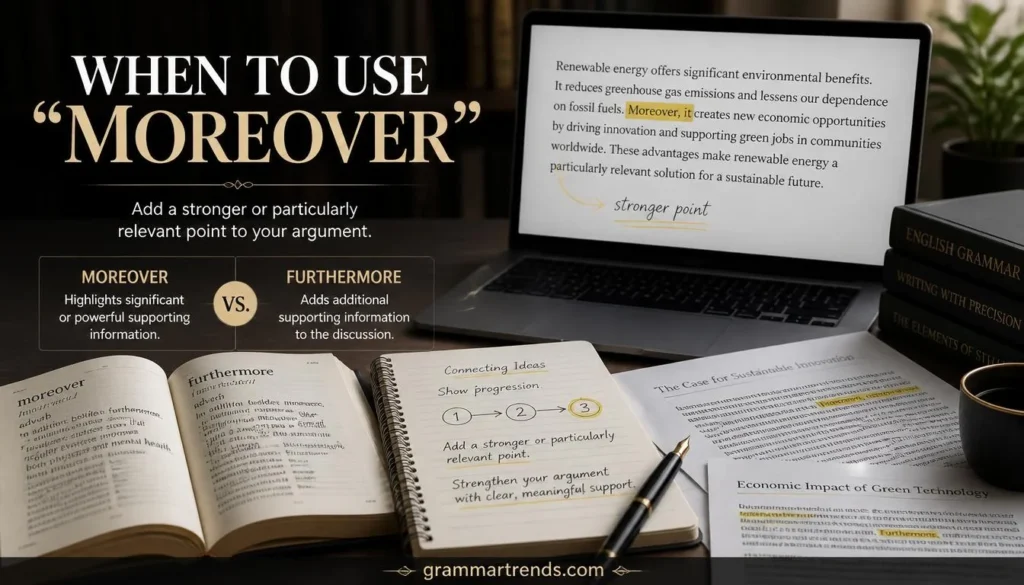
Moreover is another highly formal alternative. It resembles furthermore, but it often gives the additional statement a little more weight.
Think of it as saying, “There’s another important point that strengthens this argument.”
For example:
The proposal would reduce operating costs. Moreover, it would improve customer satisfaction.
The second benefit isn’t presented as an insignificant extra. It adds another reason to support the proposal.
When to Use “Moreover”
Moreover works particularly well in:
- Academic essays
- Persuasive writing
- Formal reports
- Editorial analysis
- Research discussions
- Policy documents
- Professional proposals
For example:
The measure would improve public safety. Moreover, it would reduce pressure on emergency services.
The second point reinforces the first.
Moreover vs. Furthermore
The two words overlap heavily. Still, a useful distinction exists.
Furthermore usually adds another supporting point.
Moreover often adds a point that feels particularly relevant or compelling.
Compare:
The building is energy efficient. Furthermore, it uses recyclable materials.
versus:
The building is energy efficient. Moreover, it significantly reduces annual energy costs.
Neither sentence is wrong. The second version gives the additional point greater rhetorical force.
Best choice: Choose moreover when the added information strengthens your argument in a noticeable way.
Additionally
Additionally offers one of the most flexible formal ways to say “on top of that.”
It simply tells the reader that another fact, feature, reason, or consideration follows.
Unlike moreover, it doesn’t necessarily suggest strong emphasis. That makes it particularly useful when you want your writing to sound professional without becoming overly dramatic.
Examples of “Additionally”
The report includes sales data for the previous quarter. Additionally, it provides regional comparisons.
Employees receive health coverage. Additionally, they can participate in professional development programs.
The application process is straightforward. Additionally, applicants can submit their documents online.
Each example adds information without suggesting that the second point carries extraordinary importance.
“Additionally” in Business Writing
Business communication often benefits from clarity and restraint. Additionally works well because it’s formal while remaining easy to understand.
For example:
Please review the attached proposal. Additionally, confirm whether the revised timeline meets your requirements.
That’s professional without sounding unnecessarily stiff.
Additionally vs. Furthermore
Use additionally when you simply want to add information.
Choose furthermore when the new point also helps develop or strengthen the argument.
That small distinction can make your writing feel much more deliberate.
In Addition
In addition is another straightforward formal synonym for “on top of that.” It works especially well when you want a neutral transition between related ideas.
For example:
The program offers flexible scheduling. In addition, participants receive access to online resources.
The phrase is common in academic and professional writing because its meaning remains clear.
“In Addition” vs. “In Addition To”
These two forms serve different grammatical purposes.
Use in addition when it introduces a new clause:
The company offers flexible hours. In addition, employees can work remotely.
Use in addition to before a noun, pronoun, or gerund:
In addition to flexible hours, the company offers remote work.
Another example:
In addition to attending the seminar, participants must complete a short assessment.
A common mistake involves treating these forms as interchangeable. They aren’t.
Why “In Addition” Works So Well
The expression doesn’t carry excessive emotional weight. It simply tells the reader that another point follows.
That makes it a dependable choice for:
- Essays
- Reports
- Emails
- Business documents
- Instructions
- Formal presentations
Best choice: Use in addition when you want a clear, professional replacement without changing the meaning too much.
Further
Further can introduce another point in formal prose, particularly in reports, analysis, and academic writing.
For example:
Further, the findings indicate that younger participants responded differently.
It can also appear naturally in phrases such as:
Further analysis revealed several inconsistencies.
The issue requires further investigation.
The researchers conducted further testing.
However, further isn’t always a direct replacement for “on top of that.” Its use depends heavily on sentence structure.
Further vs. Furthermore
These words are related but aren’t identical.
Furthermore functions as a transition meaning something like “in addition” or “moreover.”
Further has several grammatical roles and can mean additional, to a greater extent, or beyond the current point.
Compare:
Furthermore, the evidence supports the original conclusion.
Further analysis supports the original conclusion.
The first sentence uses a transition. The second uses further as an adjective modifying “analysis.”
That distinction matters when you’re aiming for precise formal English.
What Is More
What is more provides a slightly more expressive alternative to “on top of that.”
It means that another point adds further importance, interest, or strength to what you’ve already said.
For example:
The proposal would reduce costs. What is more, it would improve efficiency.
The expression sounds polished but less technical than furthermore.
When to Use “What Is More”
It works well in:
- Persuasive essays
- Opinion pieces
- Formal commentary
- Speeches
- Editorial writing
- Polished business prose
For example:
The new approach is easier to implement. What is more, it requires fewer resources.
The second point gives the first claim additional weight.
Is “What Is More” Very Formal?
It’s certainly more polished than “on top of that,” but it has a slightly more conversational rhythm than “moreover.”
That can actually be useful.
If furthermore feels too academic and on top of that feels too casual, what is more can sit comfortably between the two.
Beyond This
Beyond this can work as a formal transition when you want to move beyond the immediate point and consider another issue, implication, or dimension.
For example:
The reform could reduce administrative costs. Beyond this, it may improve transparency across the department.
The phrase suggests that the discussion is moving to something broader.
When to Use “Beyond This”
This expression fits particularly well in analytical writing where ideas develop from a specific observation toward a wider consideration.
For example:
The findings have implications for classroom instruction. Beyond this, they raise questions about how educational policies should be designed.
Here, the second idea isn’t simply another fact. It expands the scope of the discussion.
Why It Isn’t Always a Direct Synonym
Beyond this often suggests movement or extension.
Additionally simply adds information.
That difference makes beyond this better suited to analysis than ordinary list-like additions.
Notably
Notably is useful when the additional information deserves special attention.
It doesn’t simply mean “on top of that.” Instead, it tells the reader that the point you’re about to make is particularly significant, unusual, or worthy of notice.
For example:
The company reduced its operating expenses by 12%. Notably, customer satisfaction also increased during the same period.
The second fact receives emphasis.
When to Use “Notably”
Use notably when you want to highlight:
- An important finding
- A surprising result
- A significant exception
- A particularly relevant detail
- A striking comparison
- A major development
For example:
Several regions experienced declining sales. Notably, the western market recorded substantial growth.
The transition draws the reader toward the unusual result.
Notably vs. Additionally
This distinction is easy to remember:
Additionally = “Here is another piece of information.”
Notably = “Here is another piece of information that deserves your attention.”
Don’t replace every occurrence of “on top of that” with notably. Use it when emphasis actually matters.
Alongside This
Alongside this works well when two factors, developments, features, or circumstances exist together.
For example:
The organization introduced new training programs. Alongside this, it revised its employee evaluation process.
The phrase highlights parallel developments.
When to Use “Alongside This”
This expression fits naturally in:
- Business reports
- Policy analysis
- Research writing
- Project updates
- Professional presentations
For example:
The company expanded its online services. Alongside this, it invested in additional customer support staff.
The two developments happened as related parts of a broader change.
Alongside This vs. In Addition
In addition simply adds another point.
Alongside this emphasizes that two things exist or occur together.
That subtle difference gives the latter a more analytical feel.
In Conjunction With This
In conjunction with this is one of the most formal expressions on this list.
It means together with this or in combination with this.
For example:
The company introduced stricter quality controls. In conjunction with this, it expanded employee training.
The phrase suggests that the two measures operate together.
When to Use “In Conjunction With This”
This expression works especially well in:
- Technical documents
- Research writing
- Formal reports
- Policy documents
- Legal or administrative contexts
- Scientific discussions
For example:
The treatment was evaluated in conjunction with dietary modifications.
Here, the phrase shows that two elements were considered together.
Don’t Overuse It
Although in conjunction with this sounds formal, excessive formality can make writing harder to read.
Compare:
In conjunction with this, the organization implemented additional training measures.
Additionally, the organization implemented additional training measures.
The second sentence is shorter and easier.
Formal writing should be clear, not unnecessarily complicated.
Over and Above This
Over and above this means in addition to what has already been mentioned. It carries a stronger sense of something extra or additional.
For example:
The position offers a competitive salary. Over and above this, employees receive extensive professional development opportunities.
The expression emphasizes that the second benefit comes in addition to an already attractive offer.
When to Use “Over and Above This”
It can work in:
- Formal commentary
- Persuasive writing
- Business discussions
- Formal descriptions
- Some literary contexts
However, it’s less common in everyday professional writing than additionally or furthermore.
If your goal is maximum clarity, a simpler transition may be better.
Formal Synonyms for “On Top of That”: Side-by-Side Comparison
Choosing the right expression becomes easier when you compare their functions.
| Expression | Formality | Emphasis | Best Context | Key Idea |
| Furthermore | High | Strong | Academic, professional | Adds a supporting point |
| Moreover | High | Strong | Persuasive, academic | Strengthens an argument |
| Additionally | High | Moderate | Business, reports | Adds information |
| In addition | High | Moderate | General formal writing | Adds a related point |
| Further | High | Moderate | Reports, analysis | Extends discussion |
| What is more | Medium-High | Strong | Persuasive prose | Adds weight |
| Beyond this | High | Moderate | Analysis | Extends the discussion |
| Notably | High | Strong | Research, reports | Highlights importance |
| Alongside this | High | Moderate | Business, analysis | Shows parallel factors |
| In conjunction with this | Very High | Contextual | Technical writing | Shows combination |
| Over and above this | High | Strong | Formal commentary | Emphasizes something extra |
Which Formal Synonym Should You Choose?
There’s no single “best” replacement for every sentence. The strongest choice depends on what the next idea actually does.
Best Formal Synonyms for Academic Essays
For academic writing, the most useful choices include:
- Furthermore
- Moreover
- Additionally
- In addition
- Notably
Suppose you’re discussing the benefits of renewable energy:
Solar power reduces dependence on fossil fuels. Furthermore, it can lower long-term energy costs.
If the second point strongly reinforces your argument:
Solar power reduces dependence on fossil fuels. Moreover, it can provide a reliable source of energy for remote communities.
If you’re simply adding another fact:
Solar power reduces dependence on fossil fuels. Additionally, many systems can be installed at a relatively small scale.
Each transition creates a slightly different effect.
Best Formal Synonyms for Business Emails
Business emails usually benefit from simple professional language.
The strongest options are:
- Additionally
- In addition
- Furthermore
- Alongside this
For example:
The revised proposal includes the requested changes. Additionally, we’ve updated the implementation timeline.
That sounds professional without becoming stiff.
Best Formal Synonyms for Reports
Reports often need precise transitions that help readers follow several connected findings.
Good choices include:
- Additionally
- Furthermore
- In addition
- Further
- Notably
- Alongside this
For example:
Customer complaints decreased by 8% during the quarter. Notably, repeat purchases increased during the same period.
Here, notably works better than additionally because the second result deserves attention.
Best Formal Synonyms for Persuasive Writing
When you’re trying to convince your reader, stronger transitions can help.
Consider:
- Moreover
- Furthermore
- What is more
- Notably
For example:
The proposed policy would reduce administrative costs. Moreover, it would make the application process considerably faster.
The second point strengthens the argument rather than merely adding another detail.
Best Formal Synonyms for Technical Writing
Technical documents usually value precision over rhetorical flair.
Useful options include:
- Additionally
- Further
- In conjunction with this
- Alongside this
For example:
The device was tested under high-temperature conditions. Additionally, engineers evaluated its performance under increased humidity.
Clear language wins here.
“On Top of That” vs. Formal Alternatives
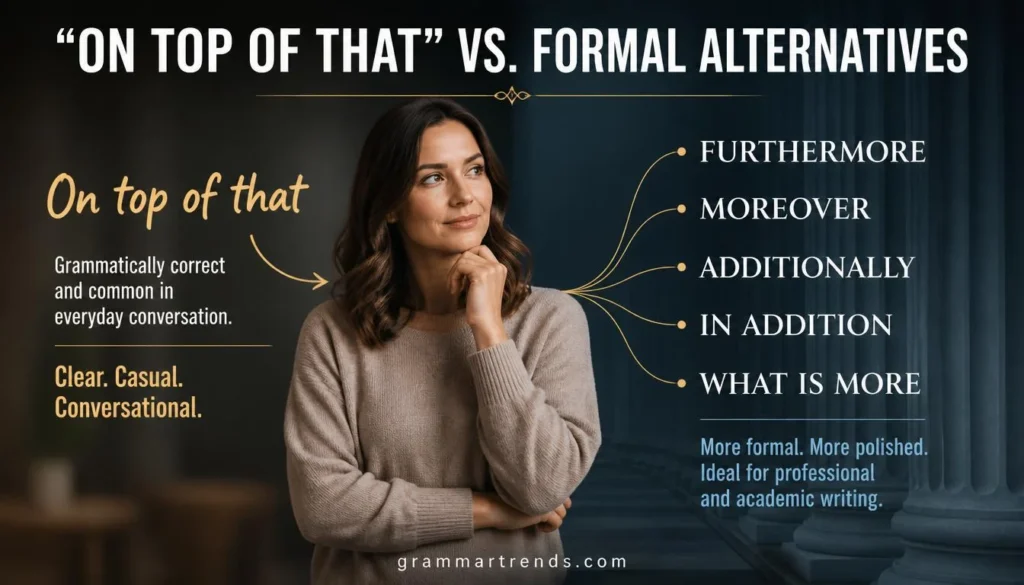
The expression “on top of that” isn’t incorrect. That’s an important point.
Its main limitation involves tone and context, not grammar.
In casual conversation, it sounds perfectly natural:
The restaurant was crowded. On top of that, the service was slow.
In a formal report, however, you might write:
The restaurant was crowded. Furthermore, the service was slow.
Here are more examples:
| Conversational Version | Formal Version |
| The service was slow. On top of that, it was expensive. | The service was slow. Furthermore, it was expensive. |
| The report contains several errors. On top of that, important data is missing. | The report contains several errors. Moreover, important data is missing. |
| The proposal meets the requirements. On top of that, it reduces costs. | The proposal meets the requirements. Additionally, it reduces costs. |
| The course is affordable. On top of that, students receive individual support. | The course is affordable. In addition, students receive individual support. |
| The system saves time. On top of that, it improves accuracy. | The system saves time. What is more, it improves accuracy. |
The key isn’t to eliminate natural language. It’s to match your wording to your audience.
Common Mistakes When Replacing “On Top of That”
Swapping one phrase for another sounds simple, but careless substitution can create awkward prose.
Using “Moreover” for Every Addition
Moreover has a strong formal flavor. If you use it repeatedly, your writing can start sounding mechanical.
For example:
The company expanded its services. Moreover, it hired new employees. Moreover, it opened another office. Moreover, it launched a new website.
The repetition quickly becomes distracting.
A better version varies the structure:
The company expanded its services. Additionally, it hired new employees and opened another office. The organization also launched a redesigned website.
Good writing doesn’t require a transition before every sentence.
Treating Every Synonym as Interchangeable
Words that appear in synonym lists often have different functions.
Notably emphasizes significance.
Alongside this emphasizes parallel developments.
In conjunction with this emphasizes combination.
Additionally simply adds information.
Using them correctly shows greater control over formal English.
Making Writing Unnecessarily Formal
A common mistake is assuming that longer words always produce better writing.
They don’t.
Consider:
The organization implemented a new system. In conjunction with this, it introduced revised procedures.
This is grammatically fine.
However:
The organization implemented a new system. Additionally, it introduced revised procedures.
The second version is cleaner.
Professional writing should sound confident, not inflated.
Using “In Addition” Incorrectly
Remember the difference:
In addition, the company provides training.
But:
In addition to training, the company provides mentoring.
Don’t remove “to” when a noun or gerund follows it.
Repeating the Same Transition
Even a good transition becomes dull when repeated too often.
Instead of writing:
Furthermore, the research found…
Furthermore, the participants reported…
Furthermore, the study revealed…
Vary your structure:
Furthermore, the research found…
The participants also reported…
Another important finding was that…
Sometimes the best transition is no transition at all.
How to Avoid Repeating “Furthermore,” “Moreover,” and “Additionally”
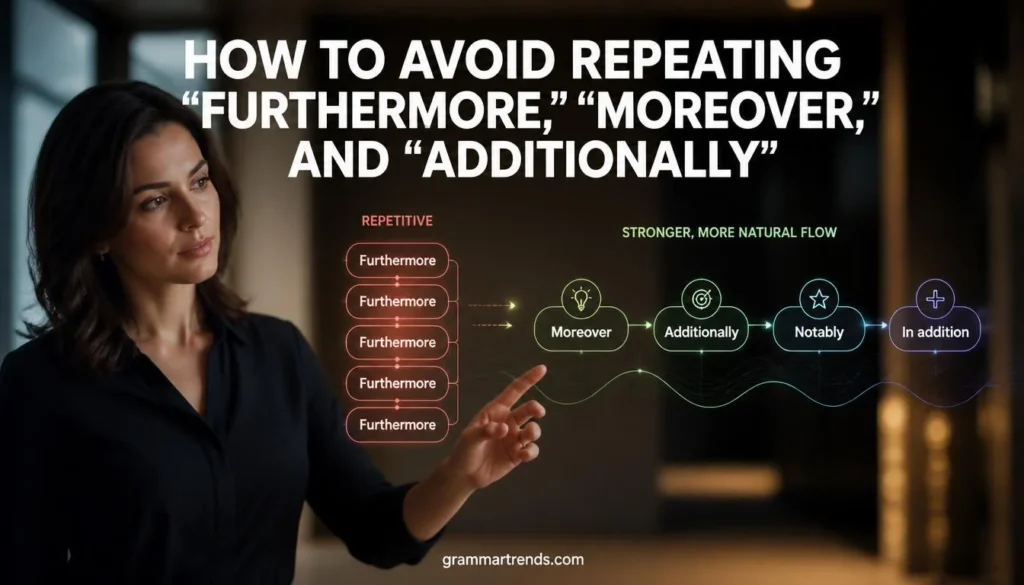
Strong writing doesn’t depend on a pile of transition words.
Instead, think about the relationship between your ideas.
Ask yourself:
Am I simply adding information?
Use additionally or in addition.
Am I strengthening an argument?
Use furthermore or moreover.
Am I highlighting an important finding?
Use notably.
Am I showing two developments happening together?
Use alongside this.
Am I showing that two factors operate together?
Use in conjunction with this.
This approach produces more natural writing because each transition has a purpose.
Before
The software reduces costs. Furthermore, it saves time. Furthermore, it improves accuracy. Furthermore, it simplifies reporting.
After
The software reduces costs while saving employees valuable time. Additionally, it improves accuracy and simplifies reporting.
The second version feels less repetitive because the ideas work together within a stronger sentence.
Read more: 12 Other Ways to Say “Glad to Have You Back”
A Practical Case Study: Choosing the Right Formal Alternative
Imagine you’re writing a report about a new employee training program.
The original paragraph says:
The program reduced onboarding time. On top of that, employees made fewer mistakes. On top of that, managers reported better communication.
The information is useful, but the repeated conversational phrase makes the paragraph sound informal.
A stronger version could read:
The program reduced onboarding time. Furthermore, employees made fewer mistakes during their first month. Notably, managers also reported improvements in team communication.
Notice what happened.
The first transition introduces another supporting result. The second highlights a particularly meaningful finding.
The writer didn’t simply replace every instance of “on top of that” with “furthermore.” Instead, each transition reflects the relationship between the ideas.
That’s the real skill behind effective formal writing.
Quick Guide to the Best Alternative
If you need a fast answer, use this guide:
- Most versatile: Additionally
- Best for academic arguments: Furthermore
- Best for strong emphasis: Moreover
- Best for neutral formal writing: In addition
- Best for important findings: Notably
- Best for parallel developments: Alongside this
- Best for connected factors: In conjunction with this
- Best for extending an argument: Further
- Best for polished persuasive writing: What is more
- Best for broader implications: Beyond this
- Best for emphatic additional information: Over and above this
When “Also” Is Better Than a Formal Synonym
Sometimes the best replacement for “on top of that” isn’t a sophisticated transition at all.
It may simply be also.
Consider:
The software is affordable. Also, it’s easy to use.
If the surrounding text already sounds professional, there’s nothing inherently wrong with this construction.
Likewise:
The study examined adults aged 18 to 65. It also considered differences between urban and rural participants.
That sentence is clear, concise, and professional.
Don’t force moreover or furthermore into every paragraph just because you’re writing formally.
Clarity beats ceremony.
How Formal Is “On Top of That”?
The expression generally belongs to informal or conversational English, especially when it introduces an additional complaint, advantage, or surprising circumstance.
However, its acceptability depends on the type of writing.
| Context | “On Top of That” |
| Casual conversation | Excellent |
| Text message | Excellent |
| Friendly email | Usually fine |
| Personal blog | Usually fine |
| Business email | Sometimes |
| Formal report | Better replaced |
| Academic essay | Usually replace |
| Research paper | Prefer a formal transition |
| Legal writing | Usually avoid |
| Technical documentation | Usually prefer a precise alternative |
This doesn’t mean formal writing must avoid every conversational expression. It simply means that transitions should suit the register.
Formal Synonyms for “On Top of That” in a Sentence
Seeing these expressions in context makes their differences easier to remember.
Furthermore
The policy would reduce costs. Furthermore, it could improve administrative efficiency.
Moreover
The treatment is affordable. Moreover, it requires minimal equipment.
Additionally
The report contains financial data. Additionally, it includes a detailed risk assessment.
In Addition
The facility offers modern equipment. In addition, users receive technical support.
Further
Further, the investigation revealed inconsistencies in the original records.
What Is More
The plan is practical. What is more, it can be implemented within the existing budget.
Beyond This
The findings affect current practice. Beyond this, they may influence future research.
Notably
Sales declined across most regions. Notably, the northern division achieved record growth.
Alongside This
The company expanded its services. Alongside this, it strengthened its customer support team.
In Conjunction With This
The equipment was tested independently in conjunction with a revised maintenance schedule.
Over and Above This
The position offers flexible hours. Over and above this, employees receive extensive training opportunities.
My Personal Experience as an English Specialist
As an English specialist, I’ve found that “on top of that” sounds natural in conversation but can feel too casual in academic or professional writing. I often recommend “furthermore,” “moreover,” “additionally,” or “in addition” for a more polished tone.
In my experience, the best choice depends on the meaning. “Additionally” simply adds information, while “moreover” or “furthermore” can strengthen an argument. I always encourage writers to choose clear and natural transitions instead of using complicated words unnecessarily.
FAQs
1. Is “on top of that” formal enough for academic writing?
Not usually. “On top of that” is common in everyday speech, but Furthermore, Moreover, and In addition often sound more suitable for academic writing.
2. What is the most professional synonym for “on top of that”?
Furthermore is one of the safest choices for professional and academic writing. It smoothly introduces an additional point that supports the previous idea.
3. Can I use “additionally” in a formal email?
Yes. Additionally works well in professional emails, reports, proposals, and other workplace communication when you need to introduce extra information.
4. Are “moreover” and “furthermore” interchangeable?
They’re very similar, but they can create slightly different emphasis. Moreover often adds weight to an existing argument, while furthermore commonly adds another supporting point.
5. Which synonym should I use in a research paper?
For a research paper, Furthermore, Moreover, and In addition are strong options. Choose the one that best matches the relationship between your ideas.
6. Can “besides” replace “on top of that”?
Sometimes, but context matters. Besides can introduce an additional reason or point, although it may sound less formal than Furthermore or Moreover in some academic contexts.
Conclusion
Choosing the right alternative to “on top of that” can make your writing sound clearer, more confident, and appropriate for the situation. In professional and academic settings, words such as Furthermore, Moreover, Additionally, and In addition usually create a smoother and more polished tone.
The best choice depends on how your ideas connect. Instead of replacing the phrase automatically, think about whether you’re adding information, strengthening an argument, or connecting related points. With the right transition, your writing can feel natural while still maintaining a professional standard.

Emma Rose has spent 15 years in the English Department at the University of California, Los Angeles (UCLA), guiding students through British and American literary classics, critical theory, and narrative techniques. Her scholarly focus includes 19th- and 20th-century fiction, the art of poetry, postcolonial writing, and digital humanities particularly how storytelling voice influences cultural perspectives. Emma has presented her research at major international conferences and published in respected academic journals, underscoring her dedication to both high-level scholarship and engaging teaching.