
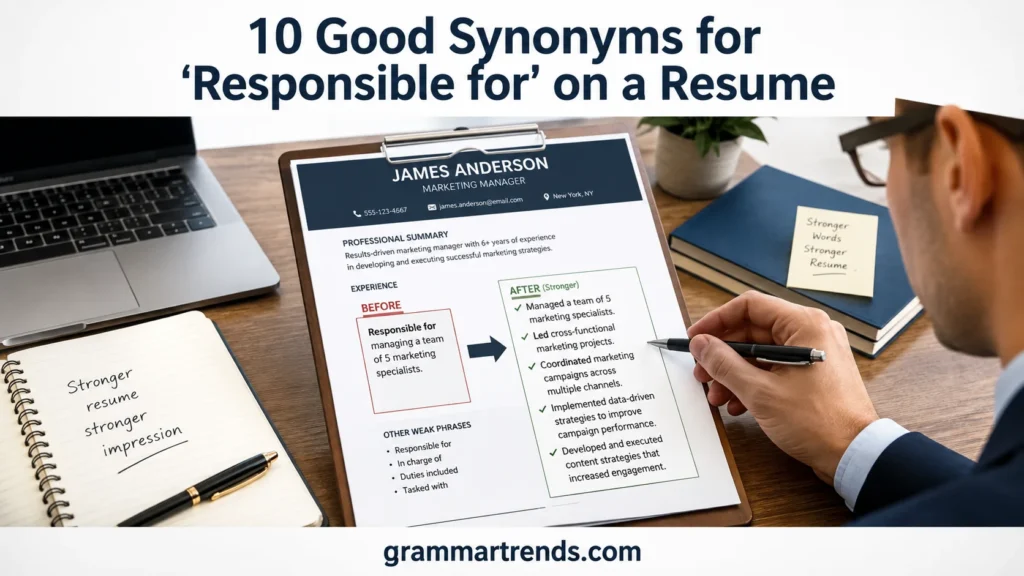
Using 10 Good Synonyms for “Responsible for” on a Resume can help you present your responsibilities clearly and show their importance to a prospective employer.
When I review a resume, I find that the phrase responsible for becomes stronger when you replace it with useful synonyms such as in charge of, at the helm of, in control of, or accountable for. These terms can help you describe your work, leadership, ownership, or decision-making more clearly while keeping your resume wording direct and professional.
The right verb should match the actual task you performed. For example, you can oversee a project, manage a team, supervise employees, conduct training, look after customer accounts, or organize daily operations. These examples help an employer understand your contribution without repeating responsible or responsible for throughout your resume. In my experience, choosing the right alternative makes your experience sound more direct, professional, and specific.
Quick Answer
The best alternatives to “responsible for” on a resume include managed, led, oversaw, directed, coordinated, supervised, executed, implemented, developed, and delivered. Choose the verb that accurately reflects your work and add a measurable result when possible.
Why “Responsible for” Can Weaken a Resume
The phrase itself isn’t wrong. It becomes weak when it appears repeatedly at the beginning of resume bullets.
For example:
- Responsible for managing daily operations
- Responsible for training employees
- Responsible for preparing reports
- Responsible for handling customer complaints
These statements sound more like a job description than evidence of performance.
A resume works harder when it tells the reader what you did, changed, created, improved, or achieved.
It Describes a Duty Instead of an Achievement
“Responsible for” usually introduces an area of responsibility. It doesn’t automatically communicate the outcome of that work.
Consider:
Before:
Responsible for managing inventory.
After:
Managed inventory for 4,000+ products and reduced stock discrepancies by 18%.
The second bullet gives the reader something concrete to evaluate. It tells them the scale of the work and the result.
It Buries the Main Action
Look at this phrase:
Responsible for managing a sales team
The strongest word is already sitting inside the sentence: managing.
Removing the unnecessary introduction makes the statement more direct:
Managed a sales team.
You can then add useful detail:
Managed a 10-person sales team and increased quarterly revenue by 18%.
The change isn’t complicated. You simply put the action first.
It Can Make Resume Bullets Sound Like Job Descriptions
A job description tells someone what a position involves. A resume should show how you performed that work.
That’s an important distinction.
A recruiter doesn’t just want to know that you handled reports. They want to understand whether you improved reporting accuracy, shortened reporting time, supported executive decisions, or handled a large volume of data.

10 Good Synonyms for “Responsible for” on a Resume
The best replacement depends on what you actually did. Managed works well for direct control, while coordinated fits situations involving multiple people or moving parts.
Here are 10 strong options to consider.
Managed
Managed is one of the strongest and most versatile alternatives to “responsible for.” Use it when you had direct control over people, operations, projects, budgets, accounts, or ongoing processes.
It works particularly well for leadership and operational positions.
Before:
Responsible for managing daily office operations.
Better:
Managed daily office operations, vendor relationships, and administrative workflows.
Achievement-focused:
Managed daily office operations and reduced supply costs by 15% through vendor negotiations.
Use managed when you genuinely had ownership or control. If you only helped someone else manage a project, choose a more accurate verb.
Best for:
- Teams
- Departments
- Budgets
- Operations
- Client accounts
- Projects
- Workflows
- Business processes
Led
Led emphasizes leadership. It works especially well when you guided people, projects, initiatives, or organizational changes.
For example:
Before:
Responsible for leading a software implementation project.
Better:
Led a software implementation project involving five departments.
Stronger:
Led a five-department software implementation that reduced processing time by 30%.
The word led suggests that you played a central role in moving something forward. Don’t use it simply because it sounds impressive.
If you participated in a project without directing it, a verb such as supported, contributed, or assisted may be more accurate.
Best for:
- Teams
- Projects
- Initiatives
- Change programs
- Cross-functional efforts
- Strategic projects
Oversaw
Oversaw is useful when you monitored or supervised an activity without necessarily performing every task yourself.
It can describe responsibility for operations, quality control, programs, employees, or processes.
Before:
Responsible for overseeing quality control.
Better:
Oversaw quality-control procedures across three production lines.
You can make the bullet stronger by adding an outcome:
Oversaw quality-control procedures across three production lines and reduced recurring defects by 12%.
There’s a useful distinction between managed and oversaw.
“Managed” often suggests direct control and active involvement. “Oversaw” can emphasize supervision, monitoring, and accountability.
Directed
Directed is a strong choice for senior-level responsibilities. It suggests that you guided an operation, department, program, or major initiative.
For example:
Before:
Responsible for the marketing department.
Better:
Directed the marketing department and managed annual campaign planning.
A result makes the statement more persuasive:
Directed marketing strategy across three regional markets and increased qualified leads by 28%.
Because directed implies authority, use it carefully. It shouldn’t appear on a resume simply to make a position sound more senior than it was.
Best for:
- Departments
- Major projects
- Strategic initiatives
- Regional operations
- Large programs
- Organizational planning
Coordinated
Use coordinated when your work involved bringing people, schedules, resources, or activities together.
It’s especially useful for administrative, project, event, logistics, healthcare, and operations roles.
Before:
Responsible for coordinating vendor projects.
Better:
Coordinated vendor projects across purchasing, operations, and finance teams.
A stronger version adds a result:
Coordinated 15 vendor projects across three departments and maintained 98% on-time completion.
Unlike “managed,” coordinated doesn’t necessarily imply that you had authority over everyone involved. That’s why it works well for cross-functional work.
Supervised
Supervised fits roles where you directly monitored employees and their day-to-day work.
For example:
Before:
Responsible for supervising customer service representatives.
Better:
Supervised 12 customer service representatives across daily operations.
You can make the bullet more useful by explaining what your supervision achieved:
Supervised 12 customer service representatives and improved first-response times by 20%.
Use supervised when employee oversight was a meaningful part of the job.
It can cover:
- Scheduling
- Training
- Performance monitoring
- Daily assignments
- Quality checks
- Employee support
- Team productivity
Executed
Executed emphasizes putting a plan into action.
It’s particularly useful for campaigns, strategies, projects, procedures, and initiatives.
Before:
Responsible for marketing campaigns.
Better:
Executed digital marketing campaigns across email, search, and social channels.
Even better:
Executed multi-channel campaigns that increased qualified leads by 32%.
The key idea is action. If someone else designed the strategy and you carried it out, executed can describe your role more accurately than developed or directed.
Implemented
Implemented works when you introduced something new or put a system, policy, process, or strategy into operation.
For example:
Before:
Responsible for implementing a new hiring process.
Better:
Implemented a standardized hiring process across four departments.
A measurable result adds credibility:
Implemented a standardized hiring process that reduced average time-to-hire by 20%.
This verb is particularly useful in technology, operations, HR, project management, and process-improvement resumes.
Best for:
- Software systems
- Policies
- Procedures
- Workflows
- Business processes
- Training programs
- Operational changes
- New strategies
Developed
Developed is ideal when you created, designed, or built something.
It can describe strategies, programs, systems, content, processes, training materials, and solutions.
Before:
Responsible for developing employee training materials.
Better:
Developed employee training materials for new customer-service hires.
Add scope or results:
Developed a 20-module training program that shortened new-hire onboarding by five days.
Don’t use “developed” merely because you were responsible for something. The word implies that you created or shaped it.
Delivered
Delivered focuses on completing work or producing an outcome.
It works particularly well for projects, client solutions, services, presentations, campaigns, and business results.
Before:
Responsible for delivering client projects.
Better:
Delivered client projects across multiple accounts while meeting defined deadlines.
A more compelling version might say:
Delivered 20+ client projects annually while maintaining a 95% on-time completion rate.
The verb can also work when the outcome matters more than the process.
For example:
Delivered a 22% reduction in operating costs through workflow improvements.
Quick Comparison of “Responsible for” Synonyms
| Synonym | Best Used For | What It Emphasizes |
| Managed | Teams, operations, budgets | Control and ownership |
| Led | Teams, initiatives, projects | Leadership |
| Oversaw | Operations, programs, processes | Supervision |
| Directed | Departments, major initiatives | Authority and strategy |
| Coordinated | Projects, schedules, teams | Organization |
| Supervised | Employees and daily work | Direct oversight |
| Executed | Plans, campaigns, strategies | Action |
| Implemented | Systems, processes, policies | Change |
| Developed | Programs, systems, strategies | Creation |
| Delivered | Projects, services, outcomes | Completion and results |
How to Choose the Right Synonym for “Responsible for”
Picking a synonym isn’t about finding the fanciest word. It’s about finding the most accurate word.
Ask yourself one question:
What did you actually do?
Your answer usually points toward the right verb.
If You Managed People
Choose words such as:
- Managed
- Led
- Supervised
- Directed
For example, if you had direct authority over 15 employees, “supervised” or “managed” may fit.
If you guided a temporary cross-functional initiative, “led” might work better.
If You Managed a Process
Consider:
- Managed
- Oversaw
- Coordinated
- Administered
- Monitored
Your level of involvement matters.
When you created something from the ground up, choose a verb that shows your direct contribution. Developed, designed, or built can make the achievement clearer and more specific.
If You Created Something
Choose:
- Developed
- Designed
- Built
- Created
- Established
For example:
Responsible for creating a new employee onboarding program.
can become:
Developed a new employee onboarding program for 50+ annual hires.
The second version clearly communicates your contribution.
If You Introduced a Change
Use:
- Implemented
- Launched
- Established
- Introduced
- Deployed
For example:
Responsible for a new inventory system.
is vague.
Instead:
Implemented a digital inventory system that improved stock visibility across two locations.
Now the reader understands what changed.
If You Completed a Project
Consider:
- Executed
- Delivered
- Completed
- Launched
- Implemented
The best choice depends on the nature of your contribution.
If you carried out an existing plan, executed works well. If you brought a project to completion, delivered may fit better.

How to Rewrite “Responsible for” Resume Bullets
A simple formula can turn a weak duty statement into a strong resume bullet:
Action Verb + What You Did + Scope + Result
You don’t always need all four parts. However, adding relevant detail makes your experience much easier to evaluate.
Example: Team Management
Weak:
Responsible for managing a customer service team.
Better:
Managed a 12-person customer service team.
Strong:
Managed a 12-person customer service team and reduced average response times by 25%.
The final version gives the reader both scope and impact.
Example: Project Coordination
Weak:
Responsible for coordinating multiple projects.
Better:
Coordinated six concurrent projects across three departments.
Strong:
Coordinated six concurrent projects across three departments and maintained 98% on-time completion.
Now the bullet answers several questions at once.
Example: Process Improvement
Weak:
Responsible for improving the hiring process.
Better:
Implemented a standardized hiring process.
Strong:
Implemented a standardized hiring process that reduced average time-to-hire by 20%.
The strongest version explains why the work mattered.
Example: Marketing
Weak:
Responsible for marketing campaigns.
Better:
Executed multi-channel marketing campaigns.
Strong:
Executed multi-channel marketing campaigns that increased qualified leads by 32%.
The action comes first. The result finishes the thought.
Example: Reporting
Weak:
Responsible for preparing monthly reports.
Better:
Developed monthly performance reports for leadership.
Strong:
Developed monthly performance reports that helped leadership track sales and operational KPIs.
The final bullet shows the purpose behind the work.
“Responsible for” Synonyms by Resume Situation
The following table can help you choose a replacement quickly.
| What You Actually Did | Strong Verb Choices |
| Managed employees | Managed, Led, Supervised |
| Controlled operations | Managed, Oversaw, Directed |
| Organized several teams | Coordinated, Organized |
| Created a system | Developed, Built, Designed |
| Introduced a process | Implemented, Established, Launched |
| Carried out a strategy | Executed, Delivered |
| Monitored performance | Oversaw, Supervised, Monitored |
| Improved a workflow | Streamlined, Optimized, Improved |
| Created reports | Prepared, Produced, Developed |
| Solved operational problems | Resolved, Corrected, Remediated |
| Built a program | Developed, Created, Established |
| Started an initiative | Launched, Initiated, Established |
Notice that not every useful alternative appears in the original list.
That’s intentional.
The best resume writing doesn’t force the same 10 words into every situation. Sometimes streamlined, optimized, launched, or resolved describes the work far better.
How to Add Results After Your Action Verb
Replacing “responsible for” is only the first step.
The bigger opportunity comes from showing what happened because of your work.
A strong resume bullet often answers three questions:
- What did you do?
- How much or how broadly did you do it?
- What changed as a result?
Add Numbers When You Have Them
Useful metrics include:
- Revenue generated
- Costs reduced
- Percentage growth
- Number of employees supervised
- Number of customers served
- Projects completed
- Time saved
- Error reduction
- Productivity gains
- Customer satisfaction
- Sales volume
- Project completion rates
For example:
Managed customer accounts.
is acceptable.
But:
Managed 40+ customer accounts and maintained a 96% client-retention rate.
provides much more evidence.
Show the Business Impact
Numbers don’t always need to represent money.
A strong result might involve:
- Faster processing
- Fewer errors
- Higher customer satisfaction
- Better employee retention
- Improved productivity
- Shorter turnaround times
- More efficient workflows
- Higher completion rates
For example:
Implemented a digital filing system that reduced document retrieval time by 40%.
The result demonstrates why the responsibility mattered.
Don’t Invent Numbers
A resume should never contain made-up metrics.
If you don’t know the exact percentage, use a truthful qualitative result.
Instead of inventing:
Increased productivity by 37%.
write:
Streamlined the reporting workflow and shortened monthly reporting cycles.
Accuracy beats fake precision every time.
When “Responsible for” Is Still Appropriate
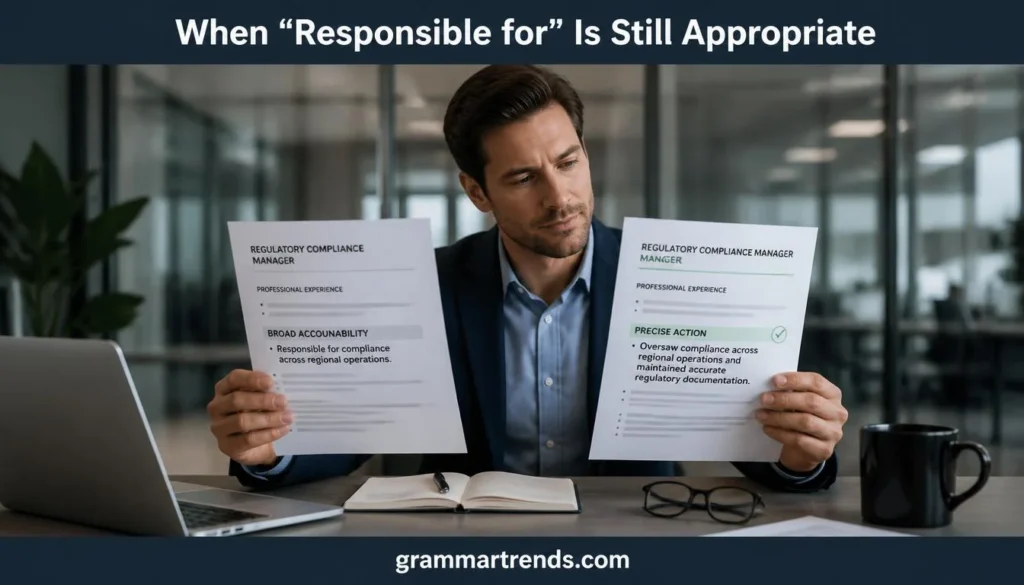
There’s no rule saying you must delete “responsible for” from your resume.
Sometimes it accurately communicates your role.
For example:
Responsible for compliance across regional operations.
If the point is to establish a broad area of accountability, the phrase may be reasonable.
However, when a stronger verb accurately describes the action, that verb usually makes the bullet more direct.
Compare:
Responsible for compliance across regional operations.
with:
Oversaw compliance across regional operations and maintained accurate regulatory documentation.
The second version gives the reader more information.
The goal isn’t to replace “responsible for” blindly. The goal is precision.
Common Mistakes When Replacing “Responsible for”
A stronger verb can improve your resume. The wrong verb can create a different problem.
Choosing a Verb That Overstates Your Role
Don’t turn participation into leadership.
If you assisted with a project, don’t automatically write:
Directed the project.
If you contributed to a team, don’t claim:
Led the initiative.
Your resume should present your experience confidently without stretching the truth.
Using Impressive Words Without Evidence
Words such as spearheaded, orchestrated, and transformed can sound powerful.
Used too often, however, they may feel inflated.
A simple verb such as managed, implemented, or developed often sounds more credible.
The strongest resume isn’t the one with the biggest vocabulary. It’s the one with the clearest evidence.
Repeating the Same Verb
Replacing every instance of “responsible for” with managed creates another problem.
A resume filled with:
- Managed
- Managed
- Managed
- Managed
quickly becomes repetitive.
Instead, choose verbs according to the actual work:
- Managed the team
- Coordinated vendor schedules
- Implemented a new system
- Developed training materials
- Reduced processing errors
- Delivered client projects
That variety feels more natural and communicates more information.
Forgetting the Result
Changing:
Responsible for managing inventory.
to:
Managed inventory.
is an improvement. But it still doesn’t tell the reader whether you managed 100 products or 100,000.
Whenever possible, add scope or impact.
Managed inventory across two warehouses and reduced stock discrepancies by 18%.
Now the bullet has substance.
Using Vague Language
Several phrases can create the same problem as “responsible for”:
- Was responsible for
- Tasked with
- Involved in
- Worked on
- Helped with
- Participated in
These phrases aren’t automatically wrong. They simply provide less information when you could use a more precise verb.
Instead of:
Worked on customer retention strategies.
try:
Developed customer retention strategies that increased repeat purchases.
The new version makes the contribution clearer.

“Responsible for” vs. Strong Action Verb: Side-by-Side Examples
Different careers require different verbs. Here’s how the transformation can work across common resume types.
Administrative Resume
Before:
Responsible for scheduling executive meetings.
After:
Coordinated executive meetings, travel schedules, and stakeholder communications.
Customer Service Resume
Before:
Responsible for handling customer complaints.
After:
Resolved customer complaints while maintaining high service-quality standards.
Marketing Resume
Before:
Responsible for social media campaigns.
After:
Executed social media campaigns that increased audience engagement by 30%.
Sales Resume
Before:
Responsible for managing client accounts.
After:
Managed 35+ client accounts and increased annual account revenue by 17%.
Management Resume
Before:
Responsible for supervising employees.
After:
Supervised 15 employees and improved team productivity through structured performance reviews.
IT Resume
Before:
Responsible for implementing software updates.
After:
Implemented software updates across 200+ workstations while minimizing operational disruption.
Healthcare Resume
Before:
Responsible for patient scheduling.
After:
Coordinated patient scheduling and streamlined appointment workflows to reduce delays.
Education Resume
Before:
Responsible for developing lesson materials.
After:
Developed instructional materials aligned with course objectives and student learning needs.
These examples demonstrate an important principle: the best synonym depends on the action behind the responsibility.
Read more: 11 Professional Ways to Say “Connect the Dots”
How to Make These Synonyms Work With ATS Keywords
Applicant tracking systems, commonly called ATS, help employers organize and filter applications.
That doesn’t mean you should stuff your resume with every possible synonym.
Instead, use relevant language naturally.
Suppose a job posting asks for experience in:
- Project management
- Team leadership
- Process improvement
- Vendor coordination
Your resume should describe those skills using accurate language.
For example:
Led cross-functional projects, coordinated vendor relationships, and implemented process improvements that reduced project delays.
This is stronger than forcing unrelated action verbs into the bullet.
Match the Job Description Without Copying It
Read the target job posting carefully.
Look for:
- Required skills
- Core responsibilities
- Software
- Industry terms
- Leadership expectations
- Technical qualifications
Then describe your actual experience using relevant terminology.
The goal isn’t to manipulate an ATS. It’s to make your qualifications easy for both software and people to understand.
A Simple Formula for Stronger Resume Bullets
Think of your resume bullet as a progression.
Weak
Responsible for + task
Example:
Responsible for managing inventory.
Better
Action verb + task
Example:
Managed inventory.
Strongest
Action verb + task + scope + measurable result
Example:
Managed 4,000+ inventory records and reduced stock discrepancies by 18%.
This structure works because it quickly communicates responsibility and evidence.
You don’t need to make every bullet long. A short, specific bullet can outperform a lengthy paragraph full of vague language.
Case Study: Turning a Duty-Based Resume Into an Achievement-Based Resume
Consider a fictional operations coordinator named Sarah.
Her original resume includes:
Coordinated vendors and maintained strong supplier relationships.
Managed inventory levels to support smooth daily operations.
Prepared accurate weekly reports for management review.
Improved office procedures to increase efficiency and streamline workflows.
The information isn’t useless. It simply doesn’t reveal enough.
A stronger version might read:
Coordinated 20+ vendor relationships and maintained consistent delivery schedules.
Managed inventory across two locations and reduced stock discrepancies by 15%.
Developed weekly performance reports for management decision-making.
Implemented revised office procedures that shortened routine processing times.
The revised version does something important.
It doesn’t merely replace four words. It changes the focus from obligation to contribution.
That’s the real purpose of finding a good synonym for “responsible for” on a resume.
A Practical Editing Checklist
Before submitting your resume, scan each bullet and ask:
- Does the bullet start with a clear action verb?
- Does the verb accurately describe your role?
- Have you removed unnecessary phrases?
- Does the bullet explain what you actually did?
- Can you add a number or useful scope?
- Can you show a measurable result?
- Are you repeating the same verb too often?
- Does the wording match the target job?
- Have you avoided exaggerating your authority?
- Does the bullet sound natural when read aloud?
If you answer “yes” to most of these questions, your resume bullets are probably much stronger.
Key Facts to Remember
A few principles are worth keeping in mind:
- “Responsible for” isn’t grammatically incorrect.
- Strong action verbs usually make resume bullets more direct.
- The best synonym depends on the actual responsibility.
- Managed suggests control and ownership.
- Led emphasizes leadership.
- Oversaw emphasizes supervision.
- Directed suggests higher-level authority.
- Coordinated highlights organization among multiple parties.
- Supervised focuses on direct employee oversight.
- Executed emphasizes carrying out a plan.
- Implemented shows that you introduced something.
- Developed indicates creation or design.
- Delivered emphasizes completion and outcomes.
- Specific results usually make a bullet more convincing.
- Never invent statistics to make a resume sound stronger.
My Personal Experience as an English Specialist
As an English specialist, I’ve noticed that one of the simplest ways to improve a resume is to replace repetitive phrases like “responsible for” with precise action verbs. When I help review resumes, I often see candidates describing their duties without showing what they actually contributed. A small wording change can make a noticeable difference.
For example, changing “responsible for managing a team” to “managed a 10-person team” immediately makes the statement more direct. Adding a result makes it even stronger: “Managed a 10-person team and improved productivity by 20%.” From my experience, this approach helps a resume sound more confident while still keeping the wording natural and truthful.
I also encourage job seekers not to replace every instance of “responsible for” with the same synonym. The right verb should reflect the actual work. Managed can show ownership, led can highlight leadership, coordinated can demonstrate organization, and implemented can show that you introduced a new process or system.
What I find most important is accuracy. A strong resume doesn’t need complicated vocabulary or exaggerated claims. It needs clear verbs, specific responsibilities, and measurable results when available. If you choose an action verb that genuinely represents your experience, your resume becomes easier for recruiters to understand and more persuasive overall.
FAQs
1. What is a better way to say “responsible for” on a resume?
Use strong action verbs such as managed, supervised, oversaw, organized, or conducted. These words show what you actually did.
2. Is “responsible for” professional on a resume?
Yes, but repeating it can make your resume sound generic. More specific action verbs can make your experience clearer and more engaging.
3. What can I say instead of “responsible for managing a team”?
You could say managed a team, supervised employees, or led a team. Choose the phrase that best matches your actual role.
4. Can I use “accountable for” on my resume?
Yes. Accountable for works well when you had ownership of an outcome, project, task, or business responsibility.
5. Should I replace every “responsible for” on my resume?
Not necessarily. The goal isn’t to remove the phrase completely. Instead, vary your wording where a stronger and more precise action verb fits.
6. Which synonym for “responsible for” is best for leadership roles?
Managed, supervised, oversaw, and in charge of can work well for leadership positions. Pick the one that accurately reflects your level of authority.
Conclusion
Choosing better alternatives to “responsible for” can make your resume clearer, stronger, and more professional. Words like managed, supervised, oversaw, organized, and accountable for show your actual contribution instead of simply listing duties. The best choice depends on what you did, how much ownership you had, and the results you achieved. By using precise action words and avoiding repetition, you can give employers a stronger reason to notice your experience.

Emma Brooke brings 15 years of experience in the Department of English Language and Literature at the University of California, Berkeley, where she has taught and mentored students across courses in British and American literary traditions, critical theory, and narrative form. Her expertise spans 19th- and 20th-century fiction, poetic prosody, postcolonial literatures, and digital humanities, with a focus on how narrative voice shapes cultural meaning. Emma’s work has been presented at international conferences and published in peer-reviewed venues, reflecting her deep commitment to rigorous literary scholarship and accessible teaching.