
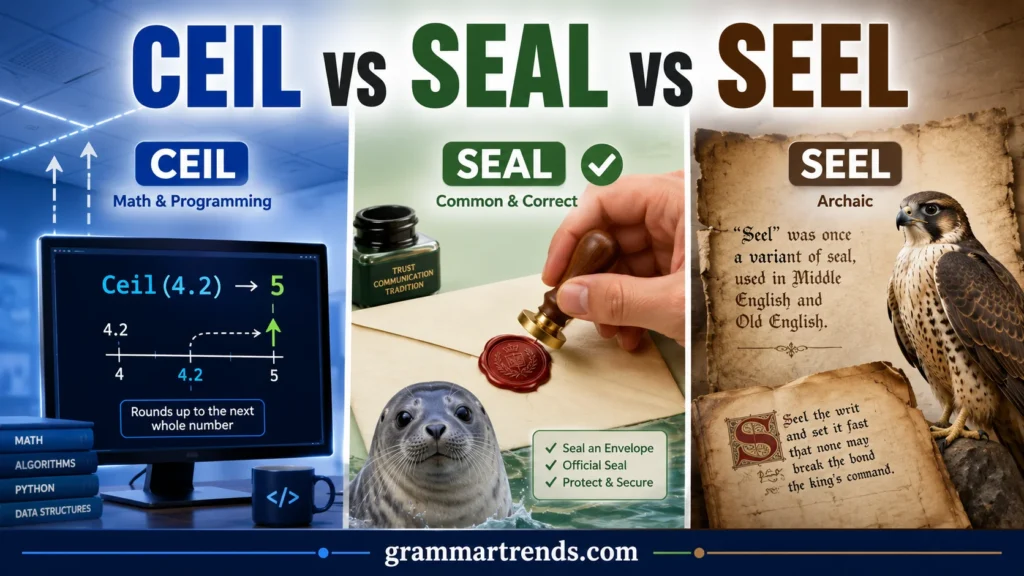
Some English words are confusing for a simple reason: they sound almost exactly the same, but their meanings have little in common. Ceil, seal, and seel are a perfect example. When you hear them in conversation, it can be difficult to know which spelling is correct. On the page, however, the difference becomes important.
Seal is the word you’ll encounter most often. It can describe closing something tightly, confirming or authenticating something, or even a sea animal. Ceil is much less common and has a more specialized or historical connection to ceilings and limits. Seel is even rarer today, appearing mainly in older English and historical discussions of falconry.
So, why do these words cause so much confusion? Their similar pronunciation hides three very different stories. In this guide, we’ll break down Ceil vs Seal vs Seel, including their meanings, pronunciation, origins, examples, and correct usage, so you can quickly tell them apart when reading or writing.
Quick Answer
Ceil, seal, and seel sound alike but have different meanings. Seal is the common modern word for closing, securing, or authenticating something, and it can also mean a marine animal. Ceil is rare and mainly historical, while seel is an archaic term associated with falconry. In everyday English, seal is the spelling you’ll most likely need.
Ceil vs Seal vs Seel: Quick Overview of Differences
Before we go deep, here’s a simple snapshot you can use as a mental shortcut.
| Word | Type | Meaning | Common Usage | Modern Use Level |
| Ceil | Mathematical term | Rounds a number up | Programming, math | Medium (technical) |
| Seal | Noun + Verb | Animal, stamp, or to close something | Everyday English | Very high |
| Seel | Archaic verb | To close eyes (historical/falconry) | Old literature | Very rare |
Now here’s the key idea.
Ceil calculates. Seal closes or represents. Seel belongs to history.
That one line alone clears most confusion.
What “Ceil” Means in Ceil vs Seal vs Seel Differences
When people see ceil, they often think it is a typo for ceiling. That’s a mistake.
In reality, ceil comes from mathematics and computer science.
Definition of Ceil
The word ceil refers to the ceiling function in math.
It means:
The smallest integer that is greater than or equal to a given number.
Let’s make it real.
- Ceil of 4.2 → 5
- Ceil of 7.01 → 8
- Ceil of 10 → 10
You always round upward, even if the decimal is tiny.
Where You Actually See “Ceil”
You won’t hear this word in casual talk. You will see it in:
- Programming languages like Python, JavaScript, C++
- Data science formulas
- Algorithms and numeric processing
- Software engineering logic
Think of it as a tool inside a toolbox, not a word you say at dinner.
Example of Ceil in Action
- “The system uses ceil to round up pricing calculations.”
- “We applied ceil to ensure no partial units were ignored.”
- “Ceil(2.3) returns 3 in most programming libraries.”
Common Confusion With Ceil
People often confuse it with:
- ceiling (real-world roof)
- seal (because of pronunciation similarity in fast speech)
Here’s a simple memory trick.
Ceil lives in code, not construction.
What “Seal” Means in Ceil vs Seal vs Seel Differences
Now we move to the most versatile word of the three.
Seal shows up everywhere in English.
It works as:
- a noun
- a verb
- a symbol
- an animal
Let’s unpack it clearly.

Seal as an Animal
A seal is a marine mammal that lives in cold coastal waters.
You’ll often see them:
- Swimming in oceans
- Resting on ice
- Moving in groups called colonies
Example:
- “The seal jumped out of the water near the boat.”
Simple. Visual. Easy.
Seal as a Symbol or Emblem
This meaning connects to authority and trust.
A seal can be:
- A wax stamp on letters
- An official government mark
- A certification symbol
Example:
- “The document carried the royal seal.”
Think of it like a “proof sticker” for authenticity.
Seal as a Verb (Most Common Use)
This is where seal becomes very powerful in everyday English.
It means:
To close something tightly or make something official.
Examples:
- “Seal the envelope before mailing it.”
- “The company sealed the deal.”
- “The team sealed their victory in the final minute.”
Notice something important.
Seal often implies finality.
Once something is sealed, it feels done.
Seal in Idioms and Expressions
Seal also appears in common phrases:
- Seal the deal → finalize an agreement
- Seal of approval → official acceptance
- Sealed fate → unavoidable outcome
Example:
- “That performance sealed her promotion.”
Mini Case Study: Seal in Real Life
Imagine a business negotiation.
Two companies agree on terms. One executive says:
“Let’s sign this and seal it today.”
At that moment, seal transforms from a simple verb into a moment of closure and certainty.
That’s why this word dominates professional English.
What “Seel” Means in Ceil vs Seal vs Seel Differences
Now we reach the rarest and most confusing word.
Seel is not common English anymore.
Definition of Seel
Historically, seel means to close the eyes of a bird, especially in falconry.
Yes. That specific.
It comes from old hunting traditions.
Historical Usage of Seel
Falconers used seel to calm birds during training.
They would gently stitch or cover a bird’s eyes to reduce stress.
Example from historical writing style:
- “The falconer did seel the hawk before transport.”
This word appears in:
- Old English literature
- Falconry manuals
- Poetic texts
Why You Rarely See Seel Today
Modern English replaced seel with simpler explanations like:
- blindfold
- cover
- calm
So today, seel survives mostly in:
- dictionaries
- historical discussions
- literary analysis
Modern Confusion Around Seel
Most modern appearances of “seel” come from:
- typing errors
- autocorrect mistakes
- confusion with “seal”
Simple truth:
If you see “seel” in modern writing, check twice. It is often a mistake.
Ceil vs Seal vs Seel: Side-by-Side Comparison
Let’s bring everything together in one clear table.
| Feature | Ceil | Seal | Seel |
| Meaning | Rounds numbers up | Close, animal, or stamp | Close eyes (archaic) |
| Field | Math, coding | General English | Historical falconry |
| Modern usage | Technical | Very common | Rare |
| Spoken English | Rare | Very common | Almost never |
| Example context | “Ceil(2.1)=3” | “Seal the box” | “Seel the hawk” |
How to Use Ceil, Seal, and Seel Correctly in Sentences
Understanding is one thing. Using them correctly is where most people struggle.
Using Ceil Correctly
Use ceil only when dealing with:
- numbers
- rounding logic
- programming
Examples:
- “We applied ceil to avoid undercounting items.”
- “Ceil converts 3.2 into 4.”
Do not use it in casual writing unless you talk about math or code.
Using Seal Correctly
This is your everyday powerhouse word.
You can use seal in:
- conversations
- business writing
- storytelling
- science
- law
Examples:
- “Seal the container tightly.”
- “They sealed the agreement after weeks of talks.”
- “The seal rested on the rock.”
Using Seel Correctly
Use seel only when:
- discussing history
- analyzing literature
- referencing falconry
Examples:
- “Medieval trainers would seel birds during travel.”
- “The text references the act to seel a hawk.”
In most modern writing, avoid it unless required.
Read more: Auxiliary vs Auxillary: The Complete Guide to Meaning
Common Mistakes in Ceil vs Seal vs Seel Differences
Let’s fix the real errors people make.
Mistake: Mixing Ceil and Seal
This happens because they sound similar.
Wrong:
- “Seal the number up to 5.”
Correct:
- “Ceil the number to 5.”
Mistake: Thinking Seal Only Means Animal
Many learners stop at the animal meaning.
Reality:
Seal has multiple meanings, and the verb form is actually more common.
Mistake: Using Seel in Modern Writing
This usually comes from confusion or autocorrect.
Wrong:
- “I will seel the package.”
Correct:
- “I will seal the package.”
Tips to Avoid Confusion
- Link ceil → math
- Link seal → everything practical
- Link seel → history only
Simple mental system. Works fast.
Memory Tricks for Ceil vs Seal vs Seel Differences
Let’s make this stick.
Ceil = Ceiling Math Trick
Think:
- Ceiling always goes up
- Ceil also goes up
So ceil = upward rounding.
Seal = “Close It or Animal” Trick
Seal closes things.
They also swims in water.
Two clear images.
Seel = “Sleepy Old Bird” Trick
Imagine an old falcon with covered eyes.
That’s seel.
Context Matters: Where Each Word Belongs
Words behave differently depending on environment.
Math and Programming Context (Ceil)
Use when:
- working with numbers
- writing code
- handling data
Everyday Communication (Seal)
Use when:
- talking
- writing emails
- describing animals
- discussing agreements
Historical Writing (Seel)
Use when:
- analyzing old texts
- studying language history
Practice Exercises for Ceil vs Seal vs Seel Differences
Let’s test your understanding.
Fill in the blanks
- We must ___ the envelope before mailing it.
- The function returns the ___ of 4.3.
- Medieval trainers would ___ birds during transport.
Answers:
- seal
- ceil
- seel
Correct the sentence
- “I will ceil the box shut.”
Correct version:
- “I will seal the box shut.”
Quick Challenge
Which word fits?
- “Round numbers upward in code.”
Answer:
- ceil
FAQs
1. What is the main difference between ceil, seal, and seel?
Ceil is a rare or historical word related to covering or lining a ceiling. Seal is a common English word meaning to close, secure, or authenticate something, and it can also refer to a marine animal. Seel is an archaic word mainly associated with falconry.
2. Is “ceil” a commonly used English word?
No. Ceil is uncommon in modern everyday English. You’re more likely to encounter it in historical, literary, or specialized writing than in ordinary conversation.
3. What does “seal” mean in English?
Seal has several meanings. As a verb, it can mean to close something securely, such as seal an envelope. It can also mean to confirm or finalize something. As a noun, a seal can refer to a marine mammal or an official mark used for authentication.
4. What does “seel” mean?
Seel is an old English word that’s rarely used today. It was historically connected with falconry, referring to the practice of closing or stitching a bird’s eyelids. You’ll mostly find it in older texts or discussions of historical language.
5. Are ceil, seal, and seel pronounced the same?
In common English pronunciation, ceil, seal, and seel are generally pronounced alike. They’re therefore homophones, meaning they have the same or nearly the same pronunciation but different spellings and meanings.
6. Which word should I use: ceil, seal, or seel?
It depends on what you mean. For closing, securing, or authenticating something, use seal. Ceil and seel are much rarer and generally appear in specialized or historical contexts. When you’re unsure, check the meaning of the sentence before choosing the spelling.
Conclusion
At first glance, ceil, seal, and seel may seem like three spellings of the same word. They aren’t. Their similar sounds are what make them tricky, while their meanings and histories set them apart. Seal is the word you’ll use in everyday English, whether you’re talking about closing an envelope, confirming an agreement, or describing a sea animal. Ceil is uncommon, and seel belongs mostly to older English and historical falconry.
The easiest way to remember Ceil vs Seal vs Seel is to focus on meaning rather than sound. Once you connect each spelling with its specific use, the confusion becomes much easier to avoid. A little attention to context can make a big difference in choosing the right word.

Mia Rose brings fifteen years of experience at The University of Edinburgh’s English Literature department, leading students through explorations of classic and contemporary texts, literary theory, and narrative design. Her academic interests center on Victorian and modernist fiction, poetic rhythms, postcolonial storytelling, and digital approaches to literary study—with a keen eye on how voice and perspective frame cultural dialogue. Mia has delivered talks at prestigious global conferences and authored articles in scholarly journals, showcasing her commitment to meaningful research and lively classroom engagement.