
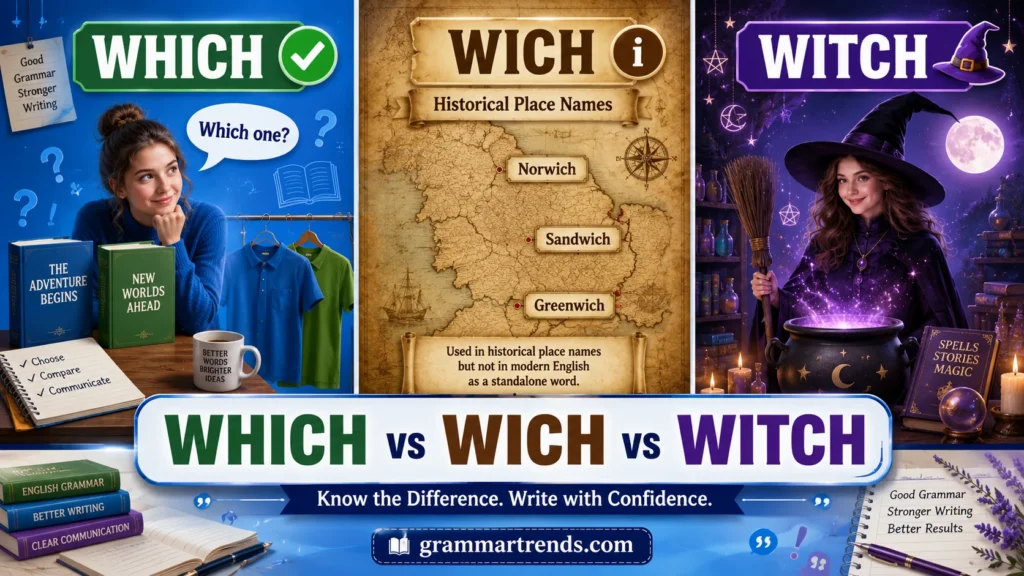
Which vs Wich vs Witch is one of those English word confusions that can catch you off guard because the words look so similar at first glance. When you’re writing quickly, replying to an email, completing an assignment, or typing a sentence online, it’s easy to focus on how a word sounds rather than what it actually means. That small mistake can change the meaning of your sentence and make otherwise clear writing look careless.
The good news is that these three words don’t have complicated meanings once you separate them properly. Which is a common English word used when choosing between possibilities or adding information about something. Wich, however, isn’t normally accepted as a standard English word and is often simply a misspelling of which. Witch is completely different: it’s a noun traditionally used for a person believed to practice magic or witchcraft.
The confusion usually comes from pronunciation and fast writing. If you hear the words without seeing them, their differences can be easy to miss. But when you put them into a sentence, their roles become much clearer. Understanding the meaning behind each spelling is therefore more useful than trying to memorize the words separately.
In this guide, we’ll break down Which vs Wich vs Witch in a simple and practical way. You’ll learn their meanings, correct spellings, pronunciation, examples, and common mistakes. Whether you’re improving your grammar, preparing for an exam, or simply trying to write more accurately, this comparison will help you recognize the right word with confidence.
Why “Which vs Wich vs Witch” Confuses So Many People
At first glance, these words feel like spelling variations of the same idea. That’s the trap.
But they don’t belong to the same category at all.
- “Which” = grammar word used for choices or clauses
- “Witch” = noun tied to magic and folklore
- “Wich” = usually not a modern word at all (except in names and history)
Here’s the real problem: your brain processes them by sound first, spelling second. And since which and witch sound nearly identical, your fingers often guess.
Now add fast typing, autocorrect, and speech-to-text tools, and mistakes multiply.
However, once you understand their origins and functions, everything clicks into place.
What “Which” Means in Real English Usage
Let’s start with the one you’ll use the most: which.
“Which” acts as a question word and a relative pronoun. It helps you choose, identify, or add extra information.
Think of it as the word that helps you narrow things down.
For example:
- Which phone do you want?
- Which color looks better?
It always connects you to options or details.
“Which” in Questions (Choosing Between Options)
When you ask a question, “which” helps you select from a known group.
You already know the options exist. You’re just choosing one.
Examples:
- Which shirt should I wear, the blue one or the black one?
- Which route is faster to the city?
- Which movie do you want to watch tonight?
Notice something important here: you’re not asking a general question. You’re narrowing choices.
That’s what makes “which” different from words like “what.”
“Which” in Relative Clauses (Adding Detail)
Here’s where things get slightly more advanced, but still easy.
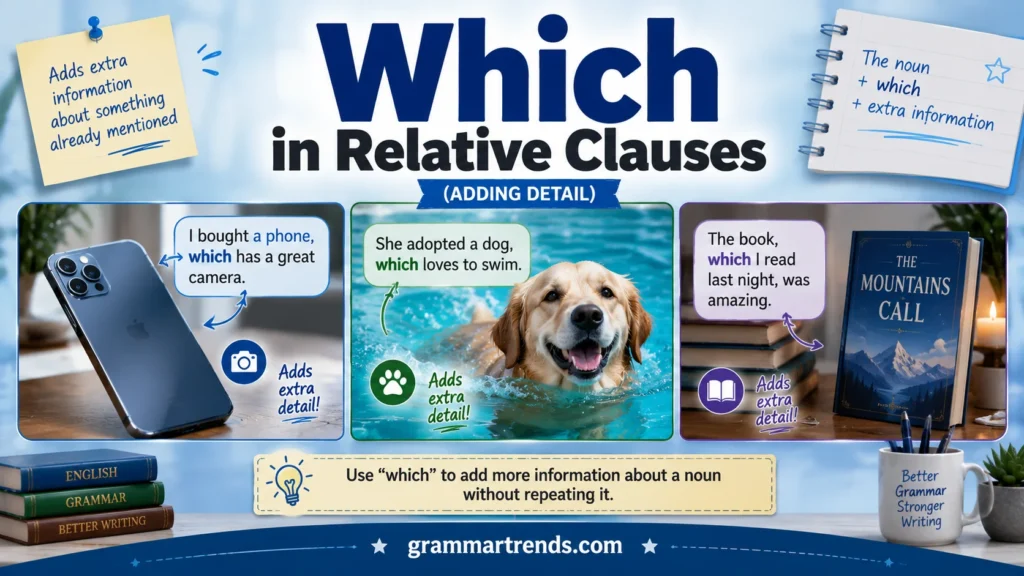
“Which” also introduces extra information about something already mentioned.
Examples:
- I bought a phone, which has a great camera.
- She adopted a dog, which loves to swim.
- The book, which I read last night, was amazing.
That extra phrase after “which” adds detail. It doesn’t change the main idea.
Think of it like adding a side note in your conversation.
Quick Tip to Remember “Which”
If you can replace it with “what one” or “what option”, you’re probably using it correctly.
What “Witch” Means (and Why It’s Completely Different)
Now let’s move to witch.
This word has nothing to do with grammar choices. It’s a noun that refers to a person associated with magic, folklore, or supernatural powers.
Historically, a witch was believed to:
- Cast spells
- Use magical rituals
- Communicate with spirits or nature forces
In modern usage, the word shows up in stories, movies, and idioms.
Literal Meaning of “Witch”
A witch is typically portrayed as someone who practices magic, often in folklore traditions.
Examples:
- The witch brewed a potion in her cauldron.
- The village feared the witch in the forest.
Modern Cultural Meaning
Today, “witch” shows up everywhere:
- Halloween costumes
- Fantasy novels
- Movies like Harry Potter or The Witch
- Symbolic identity in modern spiritual movements
Some people even use “witch” positively to describe personal spiritual practice.
Read more: Is a Bachelor’s Degree Capitalized? Complete Guide
Idioms and Figurative Use
English also uses “witch” in phrases:
- Witch hunt → unfair targeting or blaming
- Sea witch → mythological figure tied to oceans
- Witching hour → traditionally midnight, a time of supernatural activity
These expressions show how deeply the word lives in storytelling.
What “Wich” Really Is (and Why It’s Almost Never a Word You Need)
Here’s where most confusion clears up fast.
In modern English, “wich” is not a standard standalone word.
If you see it, it usually falls into one of two categories:
- A spelling mistake
- A historical or place-name element
The Historical Meaning of “-wich”
The suffix “-wich” comes from Old English “wic”, meaning:
- Settlement
- Trading place
- Dwelling area
That’s why you see it in city names like:
- Norwich
- Sandwich
- Harwich
These names survived for centuries, even though the original meaning faded.
Why “Wich” Confuses Modern Readers
You see it in proper nouns, but not in grammar.
So your brain tries to treat it like a modern word.
However:
- You don’t use “wich” in sentences like “which one do you want”
- You only see it in historical or geographical names
Common Mistake: Typing “wich” Instead of “which”
This is the most frequent error online.
Why it happens:
- Fast typing
- Autocorrect mistakes
- Speech-to-text mishearing
Fix: slow down and check context. If you’re choosing something, it’s always which.
Side-by-Side Breakdown of Which vs Wich vs Witch
Let’s simplify everything in one clear comparison.
| Word | Type | Meaning | Example |
| Which | Pronoun | Choice or clause connector | Which one do you prefer? |
| Witch | Noun | Magical or folklore figure | The witch flew on a broomstick |
| Wich | Suffix / error | Historical place name element | Norwich, Sandwich |
This table alone solves most confusion.
How to Use Each Word Correctly in Real Sentences
Let’s bring this into real-life usage so it sticks.
Using “Which” Naturally
You’ll see “which” constantly in daily English.
Examples:
- Which bus goes downtown?
- I can’t decide which job offer to take.
- The car, which I just bought, already needs fuel.
It always signals choice or extra detail.
Using “Witch” Correctly
Use “witch” only when talking about:
- Magic or fantasy
- Folklore stories
- Symbolic or cultural references
Examples:
- The witch cast a spell on the kingdom.
- She dressed like a witch for Halloween.
When You See “Wich” in Real Life
You’ll mostly encounter it in:
- City names
- Historical references
- Brand names or creative spelling
Example:
- “Sandwich” literally means “sand wich” → a settlement by the sand
Common Mistakes People Make (and Why They Happen)
Let’s talk about real errors you’ll actually see.
Mistake #1: “wich” Instead of “which”
This happens when typing quickly.
Fix: Ask yourself, Am I choosing something? If yes, use which.
Mistake #2: Mixing “witch” and “which” in speech-to-text
Voice tools often confuse them because they sound identical.
Fix: Always review before sending.
Mistake #3: Thinking “wich” is always wrong
Not always.
It’s valid in place names like:
- Norwich
- Greenwich (pronounced differently, but same origin family)
Context decides everything.
Memory Tricks That Actually Work
Let’s make this easy to remember.
- Which = choice → “Which one?” sounds like picking options
- Witch = magic → think broomstick, spells, Halloween
- Wich = watch for towns → it hides in geography
Here’s a fun mental image:
- A witch flies away
- You choose which way to go
- You visit Sandwich for lunch
That’s how your brain locks it in.
Practice Exercises: Test Your Understanding
Try these without overthinking.
Fill in the Blanks
- ___ color do you like best?
- The ___ brewed a potion.
- I visited a town called Sand___.
Sentence Completion
- I don’t know ___ option is cheaper.
- The story about the ___ scared the children.
- Norwich is a city in England that ends in ___.
Answer Key
- Which
- Witch
- wich (as part of name)
FAQs
1. What is the difference between which, wich, and witch?
Which is a standard English word used when referring to a choice or adding information. Wich is generally a misspelling and doesn’t have a common meaning in modern English. Witch is a noun traditionally referring to a person believed to use magic or supernatural powers.
2. Is “wich” a correct English word?
In most everyday English writing, wich is considered incorrect when you mean which. If you’re asking about a choice, use which, not wich. The spelling wich can appear in some proper names or historical place-name elements, but that’s different from using it as the normal English word.
3. How do you use “which” in a sentence?
Use which when selecting between options or referring back to something already mentioned. For example: Which book do you want to read? You can also use it to provide additional information: The laptop, which I bought last year, still works perfectly.
4. What does “witch” mean?
A witch is traditionally described as a person believed to practice magic or witchcraft. In modern English, the word can also appear in fictional stories, movies, games, and Halloween-related contexts.
5. Are which and witch pronounced the same?
In many varieties of English, which and witch are pronounced differently, although some speakers pronounce them very similarly. The spelling and meaning remain different regardless of pronunciation.
6. How can I remember which spelling is correct?
Think about the meaning before you type.Use which when you’re asking about a choice. Choose witch when referring to magic or witchcraft. If you’ve written wich, double-check whether you actually meant which.This simple meaning-based check can prevent most mistakes.
Conclusion
Which, wich, and witch may look like close relatives on the page, but they don’t belong to the same meaning family. Which is the useful everyday word for choices and additional information, witch refers to a person associated with magic or witchcraft, and wich is usually just a spelling mistake when you mean which.
The easiest way to avoid this confusion is to pause for a second and ask what you’re actually trying to say. Once you connect each spelling with its meaning, choosing the right word becomes almost automatic. So, whether you’re writing an email, answering an exam question, or typing quickly online, let meaning—not sound—guide your spelling.

Emma Rose has spent 15 years in the English Department at the University of California, Los Angeles (UCLA), guiding students through British and American literary classics, critical theory, and narrative techniques. Her scholarly focus includes 19th- and 20th-century fiction, the art of poetry, postcolonial writing, and digital humanities particularly how storytelling voice influences cultural perspectives. Emma has presented her research at major international conferences and published in respected academic journals, underscoring her dedication to both high-level scholarship and engaging teaching.