
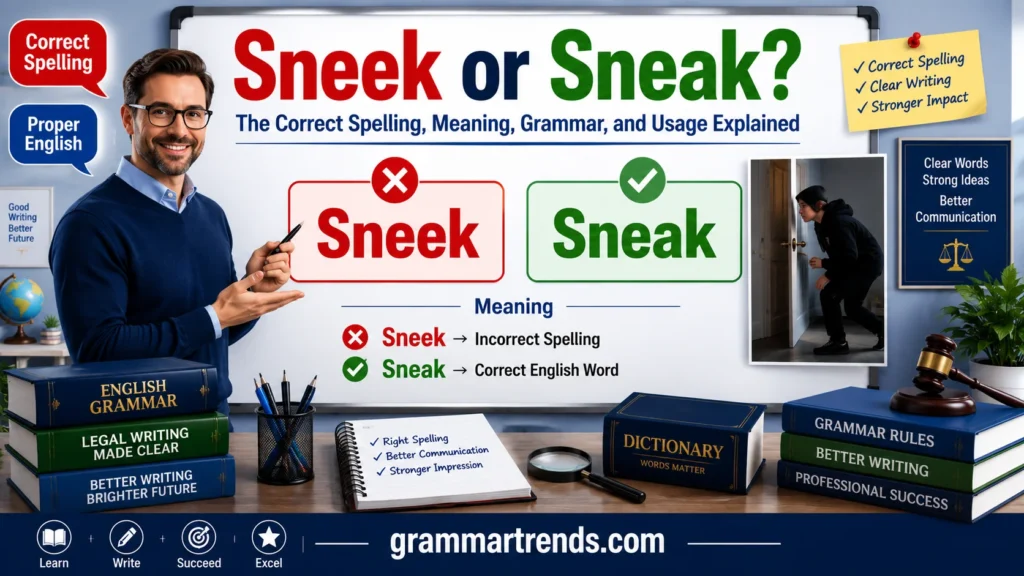
Sneek or Sneak creates confusion in English spelling among learners, writers, and professionals.
At first glance, both Sneek and Sneak look like similar words, so many people assume they are interchangeable.
In my experience while checking student drafts, this is a common question where even native speakers feel confused and make spelling mistakes or use the wrong form. The problem becomes stronger because words do not always follow simple patterns, and predictable patterns sometimes break into unpredictable patterns, especially with peek, seek, and week, which use “ee” and mislead writers into thinking sneek correct might exist instead of sneak correct spelling.
This is why understanding this small difference is essential for clear communication and professional communication, whether in informal writing, articles, blogs, emails, or social media posts. The Sneak correct word is the reality, while Sneek misspelling frequently appears in online searches and affects writing perception. Learning Sneek vs Sneak helps build confidence, maintain accuracy, and improves clarity, while reducing less credible or unprofessional results and improving content quality. It also helps avoid mistake situations where even a small mistake matters in standard English, British English (UK), and American English (US).
Quick Answer
✅ Sneak is the correct spelling in English.
❌ Sneek is not a real English word. It is a common misspelling.
Sneak means to move quietly or secretly, while Sneek has no meaning in standard English.
Examples:
✅ He tried to sneak into the room.
✅ We got a sneak peek of the new movie.
❌ He tried to sneek into the room.
Remember: Think of the phrase “sneak peek.” If you can remember that expression, you’ll always remember the correct spelling.
Sneek or Sneak: Which Spelling Is Correct?
The correct spelling is sneak.
The word “sneek” does not exist in standard English dictionaries. It’s simply a spelling mistake people make because the pronunciation sounds similar to words spelled with “ee.”
Quick Comparison Table
| Word | Correct? | Meaning | Should You Use It? |
| Sneak | Yes | Move secretly or quietly | Yes |
| Sneek | No | Misspelling of sneak | No |
If you’re writing:
- an essay
- an email
- a blog post
- a caption
- a resume
- a social media post
…you should always use sneak.
Even casual writing benefits from correct spelling. Small mistakes can make polished writing look rushed. Think of spelling like a handshake. People notice it instantly.
What Does “Sneak” Mean?
The word sneak usually means moving quietly or secretly so nobody notices you.
However, the meaning changes slightly depending on how the word gets used.
Sneak as a Verb
Most commonly, sneak works as a verb.
Definition:
To move quietly, secretly, or without permission.
Examples:
- He tried to sneak into the movie theater.
- The dog snuck into the kitchen.
- She sneaked out before the meeting ended.
The word often carries a sense of secrecy. Someone sneaking around usually doesn’t want attention.
That’s why the term appears constantly in:
- spy movies
- school stories
- sports commentary
- gaming culture
- workplace conversations
Common Verb Phrases
| Phrase | Meaning |
| Sneak in | Enter secretly |
| Sneak out | Leave quietly |
| Sneak away | Escape unnoticed |
| Sneak past | Move beyond someone quietly |
| Sneak up on | Approach secretly |
Sneak as a Noun
Less commonly, sneak can describe a person.
Example:
- Don’t trust him. He’s a sneak.
Here, the word means:
- dishonest person
- secretive person
- someone who acts behind others’ backs
This noun form sounds slightly old-fashioned today. Still, you’ll hear it occasionally in movies, books, or casual speech.
Modern Uses of “Sneak”
Language evolves constantly. Modern English uses “sneak” in several popular expressions.

Sneak Peek
A secret preview.
Example:
- The studio released a sneak peek of the new movie.
Sneak Attack
A surprise attack.
Example:
- The team launched a sneak attack late in the game.
Sneak Diss
An indirect insult.
Common in:
- internet culture
- rap discussions
- social media debates
Sneaker
Interestingly, the word “sneaker” comes from “sneak.”
Rubber-soled shoes allowed people to move quietly compared to hard leather footwear. That’s how the term developed.
Why People Misspell “Sneak” as “Sneek”
This mistake isn’t random. English spelling patterns create the confusion.
The “EE” Sound Problem
English contains many words where the long “e” sound uses “ee.”
Examples:
- week
- seek
- peek
- creek
- sleek
Because of those patterns, people naturally assume “sneek” should exist too.
But English loves exceptions. It bends rules like a gymnast.
Phonetic Spelling Habits
Many people spell words exactly as they sound.
That approach works sometimes. Other times, English throws a curveball.
For example:
- believe
- receive
- ceiling
- seize
They all sound similar yet follow different spelling patterns.
“Sneak” falls into that same unpredictable category.
Fast Typing and Autocorrect Mistakes
Phones contribute heavily to spelling errors.
People:
- type quickly
- skip proofreading
- rely on autocorrect
- trust predictive text too much
As a result, “sneek” appears everywhere online.
Ironically, search engines now recognize the typo because millions of users repeat it. That doesn’t make it correct though.
The Origin and History of the Word “Sneak”
The word sneak has been around for centuries.
Linguists trace it back to older Northern European language influences, especially variations connected to Dutch and Middle English speech patterns.
Historical Meaning
Originally, the word described:
- crawling secretly
- moving stealthily
- behaving dishonestly
The negative tone has stayed remarkably consistent through history.
Even today, calling someone “sneaky” rarely sounds flattering.
How the Spelling Became Standard
English spelling became more standardized after dictionaries gained popularity.
Writers, teachers, and publishers eventually settled on:
- sneak = correct
- sneek = incorrect
Once printing became widespread, consistency mattered more. That locked “sneak” into modern English permanently.
Sneak Grammar Guide: Every Form of the Word
Grammar trips people up almost as often as spelling.
Here’s the complete breakdown.
Verb Conjugation Table
| Tense | Form | Example |
| Base Form | sneak | I sneak in quietly |
| Present Simple | sneaks | She sneaks around |
| Present Participle | sneaking | They are sneaking out |
| Past Tense | sneaked/snuck | He snuck away |
| Past Participle | sneaked/snuck | They had sneaked inside |
Present Tense
Examples:
- I sneak snacks into the theater.
- She sneaks out after midnight.
Short. Clean. Easy.
Present Participle
Examples:
- They are sneaking around backstage.
- Someone is sneaking into the building.
The “-ing” form appears constantly in conversational English.
Past Tense: Sneaked or Snuck?
Now we hit the grammar battlefield.
Both forms exist:
- sneaked
- snuck
But they carry different tones.
Sneaked vs Snuck — Which One Should You Use?
This debate sparks arguments among grammar enthusiasts constantly.
Here’s the practical answer:
Both “sneaked” and “snuck” are grammatically correct today.
Still, context matters.
Why “Snuck” Became Popular
“Snuck” exploded in American English because it sounds natural in conversation.
People often prefer irregular verbs:
- stick → stuck
- strike → struck
- sneak → snuck
Your brain likes patterns. “Snuck” feels smoother to many speakers.
Examples:
- He snuck into the concert.
- They snuck past security.
These sound conversational and modern.
When “Sneaked” Sounds Better
Formal writing often favors sneaked.
Especially in:
- academic papers
- business reports
- journalism
- professional communication
Examples:
- The employee sneaked confidential files out.
- The child sneaked downstairs quietly.
“Sneaked” sounds more traditional and polished.
Sneaked vs Snuck Comparison Table
| Word | Tone | Common Region | Formality |
| Sneaked | Traditional | UK and formal US writing | Higher |
| Snuck | Conversational | American English | Casual |
Common Expressions That Use “Sneak”
Understanding phrases matters just as much as understanding the word itself.
Sneak Peek
This phrase means:
a secret preview or early look
Example:
- Fans got a sneak peek of the new game trailer.
This phrase dominates:
- marketing
- entertainment
- YouTube culture
- product launches
Sneak Attack
A surprise move against someone.
Examples:
- The army launched a sneak attack.
- The competitor made a sneak attack in the market.
The phrase works literally and metaphorically.
Sneak Out
Quietly leaving without permission.
Example:
- Teenagers sometimes sneak out at night.
Movies use this phrase constantly because it creates tension instantly.
Sneak In
Quietly entering somewhere.
Example:
- We tried to sneak in through the back door.
Sneak Peek vs Sneak Peak Explained
This mistake rivals “sneek” in popularity.
The Correct Phrase: Sneak Peek
“Peek” means:
a quick look
Correct Example:
- Here’s a sneak peek of the new design.
Why “Sneak Peak” Is Wrong
“Peak” means:
- mountain top
- highest point
- maximum level
So “sneak peak” technically creates nonsense.
Imagine secretly climbing a mountain peak. Funny visual. Wrong phrase.
Comparison Table
| Phrase | Correct? | Meaning |
| Sneak peek | Yes | Secret preview |
| Sneak peak | No | Incorrect phrase |
British vs American English Usage
English changes depending on region.
American English Preferences
American English strongly embraces:
- snuck
- conversational usage
- informal speech patterns
You’ll hear “snuck” constantly in:
- TV shows
- podcasts
- movies
- casual conversation
British English Preferences
British English leans more traditional.
That means:
- sneaked appears more often
- formal constructions dominate
- conservative grammar remains common
Still, both forms are understood internationally.
Read more: Flake vs Hake: The Real Difference Between Them
Which Version Sounds Better Internationally?
If you want the safest global option:
- use sneak
- use sneaked in formal writing
For conversational American tone:
- “snuck” works perfectly
Real-Life Examples of “Sneak” Used Correctly
Examples help grammar stick faster than abstract explanations.
Everyday Conversation Examples
- I tried to sneak past the dog quietly.
- She snuck extra candy into the cart.
- Don’t sneak up on people like that.
Workplace Examples
- Someone sneaked confidential information outside the company.
- The developer sneaked a last-minute feature into the update.
- He tried to sneak out early before the meeting ended.
School Examples
- Students sometimes sneak phones into exams.
- The child sneaked notes into class.
- They snuck into the gym after hours.
Entertainment and Media Examples
- The studio released a sneak peek trailer.
- Reporters sneaked behind the scenes.
- The actor snuck into the audience during the premiere.
Social Media Examples
- “Sneak peek dropping tomorrow 👀”
- “I snuck out for tacos.”
- “Trying to sneak through life unnoticed.”
Words Commonly Confused With “Sneak”
English contains several similar-looking or related words.
Sneak vs Peek
| Word | Meaning |
| Sneak | Move secretly |
| Peek | Take a quick look |
Example:
- I sneaked in for a quick peek.
Sneak vs Steal
Sneaking doesn’t always involve theft.
Stealing means taking something illegally.
Sneaking simply means moving secretly.
Sneak vs Creep
Both involve quiet movement. However:
- creep = slow and cautious
- sneak = secretive intention
Sneak vs Sneaky
“Sneaky” is the adjective form.
Examples:
- That was a sneaky move.
- He acted sneaky during negotiations.
Sneak vs Sneaker
A sneaker is a shoe.
The word developed because rubber soles allowed quiet movement.
Language history gets surprisingly fun sometimes.
Synonyms for “Sneak” and Their Meaning Differences
Not every synonym creates the same emotional tone.
Quiet Movement Synonyms
| Word | Tone | Best Context |
| Tiptoe | Gentle | Quiet walking |
| Creep | Tense | Horror or suspense |
| Slink | Ashamed | Emotional retreat |
| Slip | Quick | Fast unnoticed movement |
Secretive Action Synonyms
| Word | Meaning |
| Smuggle | Move illegally |
| Infiltrate | Enter secretly |
| Evade | Avoid detection |
| Hide | Stay unseen |
How Spellcheck Tools Handle “Sneek”
Technology helps but doesn’t solve everything.
Grammarly
Usually flags:
- sneek
- sneak peak
It also suggests contextual corrections.
Microsoft Word
Word catches “sneek” quickly in most versions.
However, informal writing sometimes slips through depending on settings.
Google Docs
Google Docs includes reliable spellcheck support.
Browser Spellcheck Tools
Chrome, Safari, and Edge all detect “sneek” most of the time.
Still, no tool replaces proofreading.
Spellcheck catches mechanics. Humans catch meaning.
Why “Sneek” Gets So Many Searches
Three main reasons drive the search volume:
Typing Speed
People search before proofreading.
Phonetic Assumptions
The “ee” sound feels logical.
Autocomplete Behavior
Search engines learn from repeated user mistakes.
Should You Use “Sneek” in Content?
Yes — but strategically.
SEO writers often include:
- sneek or sneak
- is sneek correct
- sneek meaning
because users search those phrases directly.
However, stuffing the typo repeatedly looks unnatural and spammy.
Balance matters
Easy Tricks to Remember the Correct Spelling of Sneak
Memory tricks work because the brain loves associations.
The “EA” Rule
Think:
- sneak
- speak
- steal
- dream
Many English words use “ea” together.
The Sneak Peek Trick
You already know:
- sneak peek = correct
Once you memorize the phrase, the spelling sticks naturally.
Sound Association Method
Imagine someone saying:
“Sneak away quietly.”
Visual memory strengthens spelling recall surprisingly fast.
Quick Recap: Sneek vs Sneak
Here’s the short version.
| Question | Answer |
| Correct spelling? | Sneak |
| Is sneek a real word? | No |
| Correct phrase? | Sneak peek |
| Past tense options? | Sneaked or snuck |
| Best formal option? | Sneaked |
| Best casual option? | Snuck |
Case Study: How Small Spelling Mistakes Affect Credibility
A marketing agency once tested two nearly identical email campaigns.
The only difference?
One email included:
“Get a sneek peek of our new product.”
The corrected version used:
“Get a sneak peek of our new product.”
The properly spelled email received:
- higher click-through rates
- better engagement
- fewer negative replies
Why?
Because readers associate clean spelling with professionalism and trust.
Tiny details shape perception. Like it or not, language acts as social signaling.
Common Mistakes to Avoid
Writing “Sneek”
Wrong:
- I will sneek into the room.
Correct:
- I will sneak into the room.
Writing “Sneak Peak”
Wrong:
- Here’s a sneak peak.
Correct:
- Here’s a sneak peek.
Overusing “Snuck” in Formal Writing
“Snuck” sounds natural conversationally.
However, some professional editors still prefer “sneaked” in formal publications.
Know your audience.
Helpful Writing Tips for Using “Sneak” Naturally
In Formal Writing
Use:
- sneak
- sneaked
In Casual Writing
Use:
- sneak
- snuck
In Headlines
Short phrases perform best:
- Sneak Peek Released
- Sneak Attack Strategy
- Sneak Preview Available
FAQs
1. What is the correct spelling: Sneek or Sneak?
The correct spelling is Sneak. Sneek is a common misspelling that often appears in informal writing and online searches.
2. Why do people get confused between Sneek and Sneak?
People get confused because both words look similar and follow English spelling patterns that seem to include “ee,” like peek, seek, and week.
3. Is Sneek ever used in standard English?
No, Sneek is not used in standard English. It is only seen as a wrong form or spelling mistake.
4. Does Sneak have the same meaning as Sneek?
No. Sneak is the only valid word, while Sneek has no accepted meaning in English dictionaries.
5. Why do learners often write Sneek instead of Sneak?
Learners often assume spelling patterns are predictable. Because many “ee” words exist, they incorrectly assume Sneek correct spelling might exist.
6. Can using Sneek affect writing quality?
Yes, using Sneek misspelling can reduce credibility, affect writing perception, and make content look unprofessional.
7. How can I remember the correct spelling?
You can remember that Sneak correct word is the only valid form in English spelling, even though it sounds like “ee” words such as peek, seek, and week.
Conclusion
Understanding the difference between Sneek or Sneak is a small but important step in improving your writing. Many learners, writers, and even native speakers make this mistake because English spelling does not always follow predictable patterns. However, once you clearly remember that only Sneak is correct, you can avoid one of the most common spelling errors in informal and professional writing. This small correction helps improve clarity, accuracy, and overall writing confidence, making your communication stronger and more reliable in everyday use.

Mia Rose brings fifteen years of experience at The University of Edinburgh’s English Literature department, leading students through explorations of classic and contemporary texts, literary theory, and narrative design. Her academic interests center on Victorian and modernist fiction, poetic rhythms, postcolonial storytelling, and digital approaches to literary study—with a keen eye on how voice and perspective frame cultural dialogue. Mia has delivered talks at prestigious global conferences and authored articles in scholarly journals, showcasing her commitment to meaningful research and lively classroom engagement.