

Have you ever stopped while writing an HR report, business email, or company presentation because you weren’t sure whether to write headcount or head count? You’re not alone. This spelling question is common among HR professionals, managers, business students, recruiters, and anyone who writes about employees or workforce planning.
The confusion exists because you’ll find both forms in dictionaries, articles, and workplace documents. However, they aren’t used equally in modern English. Today, headcount (one word) is the standard spelling in business, human resources, finance, and corporate communication. It refers to the total number of employees or people in an organization. Head count (two words) still appears occasionally, but it’s far less common and is usually reserved for more general or literal contexts.
Choosing the right form matters because it makes your writing look more professional and consistent. Whether you’re preparing an HR report, discussing recruitment plans, analyzing workforce data, or writing an academic paper, using the preferred spelling helps you communicate clearly.
In this guide, you’ll learn the difference between headcount and head count, their meanings, correct usage, regional preferences, common mistakes, and plenty of real-world examples. By the end, you’ll know exactly which spelling to use and when to use it with confidence.
Quick Answer
Here’s the short answer:
- Headcount is the standard modern spelling when used as a noun.
- Head count usually appears when referring to the act of counting people.
In professional writing, especially in HR and corporate communication, headcount is overwhelmingly preferred.
Correct Examples
- The company increased its headcount by 15%.
- HR approved additional headcount for the sales team.
- Teachers performed a head count before leaving the museum.
- Flight attendants must head count passengers during boarding.
If you write for business, HR, recruiting, finance, or operations, use headcount almost every time.
What Does “Headcount” Mean?
The word headcount refers to the total number of people in a group, organization, department, or event.
Businesses use it constantly because companies need to track workforce size for hiring, budgeting, forecasting, and compliance.
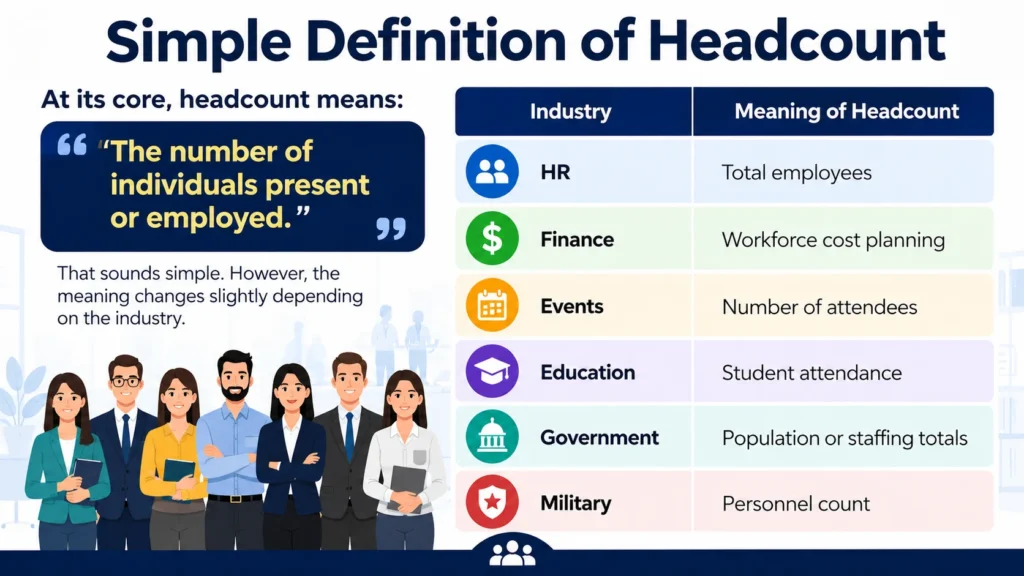
Simple Definition of Headcount
At its core, headcount means:
“The number of individuals present or employed.”
That sounds simple. However, the meaning changes slightly depending on the industry.
| Industry | Meaning of Headcount |
| HR | Total employees |
| Finance | Workforce cost planning |
| Events | Number of attendees |
| Education | Student attendance |
| Government | Population or staffing totals |
| Military | Personnel count |
Headcount as a Noun vs Head Count as a Verb Phrase
This is where most confusion starts.
When “Headcount” Functions as a Noun
As a noun, headcount acts like a single unit.
Examples:
- Our startup doubled its headcount this year.
- The engineering headcount reached 250 employees.
- Budget cuts reduced departmental headcount.
Here, the word refers to a measurable total.
When “Head Count” Functions as an Action
The two-word form usually works as a verb phrase.
Examples:
- Security staff must head count visitors before entry.
- Camp counselors head count children after lunch.
- The tour guide paused to head count everyone.
In these examples, someone performs the action of counting people.
Think about it this way:
- Headcount = the number itself
- Head count = the act of counting heads
That tiny spacing changes the grammar completely.
Why People Confuse “Headcount” and “Head Count”
English compound words evolve constantly. Some begin as two separate words before merging into one permanent form.
The process usually follows three stages:
| Stage | Example |
| Open Compound | Head count |
| Hyphenated Compound | Head-count |
| Closed Compound | Headcount |
The same transformation happened with many everyday words.
| Old Version | Modern Version |
| Web site | Website |
| Data base | Database |
| Log in | Login |
| On line | Online |
| Head count | Headcount |
Language naturally compresses frequently used phrases over time. Business communication accelerated this shift because shorter writing improves speed and readability.
Today, headcount dominates professional English.
Headcount vs Head Count: The Real Difference
The distinction becomes crystal clear once you separate grammar from usage.
Use “Headcount” When Referring to a Number
This is the modern standard.
Common Business Examples
- Employee headcount
- Global headcount
- Workforce headcount
- Department headcount
- Staffing headcount
Example Sentences
- The company’s global headcount exceeded 10,000 employees.
- Quarterly reports showed declining headcount in retail stores.
- HR increased engineering headcount after securing funding.
In each sentence, the word acts as a noun.
Use “Head Count” When Describing an Action
This version appears less often because most business writing uses the noun form.
Example Sentences
- Teachers performed a head count before boarding the bus.
- Event organizers must head count attendees at the gate.
- Soldiers conducted a quick head count after training.
The phrase describes physically counting people.
Side-by-Side Comparison Table
| Usage | Correct Form | Example |
| Employee total | Headcount | The company’s headcount grew. |
| Counting attendees | Head count | Volunteers did a head count. |
| HR reporting | Headcount | Headcount costs increased. |
| School attendance | Head count | Teachers performed a head count. |
| Corporate metrics | Headcount | Finance reviewed the headcount report. |
| Manual counting | Head count | Staff head count visitors daily. |
Is “Headcount” One Word in American English?
Yes. In modern American English, headcount is the accepted standard spelling.
Corporate America uses it everywhere.
You’ll see it in:
- SEC filings
- HR software
- Hiring dashboards
- Annual reports
- Earnings calls
- Recruiting platforms
- Workforce analytics tools
In fact, many Fortune 500 companies use the word dozens of times in investor documents.
Why American Businesses Prefer “Headcount”
Three major reasons explain the shift:
Faster Communication
Shorter words improve readability in reports and dashboards.
Consistency
Large organizations standardize terminology to avoid confusion.
Software and Analytics
Modern HR systems classify workforce data under “headcount” metrics.
Platforms like:
- Workday
- SAP SuccessFactors
- BambooHR
- ADP
- Oracle HCM
all use “headcount” as a standard workforce term.
British English vs American English Usage
Some writers assume British English prefers “head count.” That assumption isn’t accurate anymore.
Both American and British business writing strongly favor headcount.
British Usage Trends
UK businesses commonly use:
- Headcount planning
- Employee headcount
- Headcount reduction
- Headcount growth
The one-word version appears throughout:
- UK government reports
- British HR publications
- Recruitment agencies
- Corporate filings
The difference between UK and US usage is now minimal.
The Evolution of the Word “Headcount”
Language changes because people value efficiency.
When a phrase becomes common enough, writers compress it into one word. Over time, dictionaries adopt the newer spelling.
Why Compound Words Merge
Three forces usually drive the change:
Frequent Repetition
Businesses constantly discuss staffing numbers.
Faster Reading
One-word compounds reduce visual clutter.
Digital Communication
Emails, dashboards, spreadsheets, and software interfaces reward brevity.
That’s why “headcount” eventually overtook “head count.”
How HR Teams Use the Word “Headcount”
In human resources, headcount has a highly specific meaning.
It refers to the total number of employees employed by a company or department.
However, HR professionals often separate headcount into categories.
Types of Headcount in HR
| Type | Meaning |
| Active Headcount | Current employees actively working |
| Budgeted Headcount | Approved hiring capacity |
| Global Headcount | Worldwide workforce |
| Department Headcount | Employees in one team |
| Temporary Headcount | Contract or seasonal workers |
| Approved Headcount | Positions authorized for hiring |
Headcount vs Full-Time Equivalent (FTE)
Many people incorrectly assume these terms mean the same thing.
They don’t.
Headcount Counts Individuals
Every employee equals one person.
Example:
- 10 employees = 10 headcount
Even part-time workers count as individual heads.
FTE Measures Workload
FTE calculates labor hours rather than individuals.
Example:
| Employees | Hours Worked | FTE |
| 2 Part-Time Employees | 20 hours each | 1.0 FTE |
| 1 Full-Time Employee | 40 hours | 1.0 FTE |
This distinction matters in budgeting and workforce planning.
A company may have:
- 100 headcount
- 82 FTE
Those numbers are completely possible.
Why Companies Track Headcount
Headcount data drives business decisions.
Without accurate staffing numbers, organizations struggle with budgeting, forecasting, and operations.
Major Reasons Companies Monitor Headcount
Hiring Forecasts
Businesses estimate future recruiting needs.
Payroll Budgeting
Employee costs usually represent a company’s largest expense.
Productivity Analysis
Leadership evaluates staffing efficiency.
Investor Reporting
Public companies often disclose workforce changes.
Compliance Requirements
Governments may require employee reporting data.
Resource Allocation
Managers decide where additional staffing is needed.
Common Corporate Phrases Using “Headcount”
Business language creates dozens of variations around the word.
Frequently Used Terms
- Headcount planning
- Headcount growth
- Headcount reduction
- Headcount freeze
- Headcount approval
- Headcount allocation
- Headcount forecast
- Headcount budget
- Headcount analysis
- Headcount optimization
These phrases dominate HR and finance communication.
Read more: Ceil vs Seal vs Seel: Meaning and Differences
Real-World Examples of Correct Usage
Seeing the word in context makes everything easier.
Business Examples
- The startup increased engineering headcount after raising Series A funding.
- Finance requested updated headcount projections for Q4.
- HR approved additional sales headcount.
School Examples
- Teachers conducted a head count before entering the stadium.
- Camp staff performed a final head count at sunset.
Event Management Examples
- Security teams must head count attendees during evacuation procedures.
- Event planners confirmed the final headcount exceeded expectations.
Government Examples
- Census workers updated regional population headcount estimates.
- The military performed a rapid head count after deployment.
Common Mistakes With “Headcount”
Even experienced writers misuse the word occasionally.
Using “Head Count” in Corporate Reports
This looks outdated in modern business writing.
Less Preferred
- The company’s head count increased.
Better
- The company’s headcount increased.
The one-word form appears more polished and professional.
Using “Headcount” as a Verb
This sounds awkward.
Incorrect
- We need to headcount attendees.
Better
- We need to conduct a head count.
- We need to count attendees.
Mixing Both Versions in One Document
Consistency matters.
If you choose “headcount” as the business noun, keep using it throughout the document.
Switching back and forth creates unnecessary friction for readers.
Grammar Rules Behind Compound Words
Understanding compound words helps eliminate confusion permanently.
Closed Compounds
Closed compounds merge into one word.
Examples:
- Notebook
- Keyboard
- Headcount
- Website
These forms dominate modern English.
Open Compounds
Open compounds remain separate.
Examples:
- Living room
- High school
- Real estate
Sometimes these compounds eventually merge.
Hyphenated Compounds
These sit in the middle stage.
Examples:
- Long-term
- Decision-making
- Editor-in-chief
Language evolves unpredictably. Some hyphenated compounds eventually become closed compounds.
What Dictionaries Say About “Headcount”
Major dictionaries strongly support the one-word spelling.
Dictionary Comparison Table
| Dictionary | Preferred Form | Notes |
| Merriam-Webster | Headcount | Standard noun |
| Cambridge Dictionary | Headcount | Business usage |
| Oxford English Dictionary | Headcount | Modern standard |
| Collins Dictionary | Headcount | Internationally accepted |
The evidence is remarkably consistent.
Headcount in Business and Corporate Reporting
Corporate reporting accelerated the rise of “headcount.”
Why?
Because companies constantly discuss workforce size.
Examples From Real Business Communication
Public companies routinely mention:
- Workforce reductions
- Hiring expansion
- Staffing optimization
- Labor costs
- Global employee totals
Instead of writing:
“Total number of employees”
they simply write:
“Headcount”
The term saves space while staying precise.
Case Study: How HR Departments Use “Headcount”
Imagine a technology company with 1,500 employees.
The HR department may track:
| Department | Headcount |
| Engineering | 520 |
| Sales | 310 |
| Marketing | 120 |
| Customer Support | 240 |
| Finance | 85 |
| HR | 40 |
Now suppose the company plans aggressive expansion.
Leadership might approve:
- +100 engineering headcount
- +40 sales headcount
- Hiring freeze elsewhere
In this context, “headcount” functions as a strategic business metric rather than a casual word.
That’s why the one-word spelling dominates corporate environments.
Google Trends and Search Popularity
Search data strongly favors “headcount.”
Why?
Because businesses, recruiters, and HR professionals overwhelmingly use the closed compound version.
Headcount Synonyms and Related Terms
Sometimes you may want variety in your writing.
Several alternatives exist.
Common Synonyms
| Word | Typical Usage |
| Workforce | Company employees collectively |
| Staff size | Informal workforce total |
| Employee count | HR reporting |
| Personnel | Formal organizational term |
| Team size | Small groups or startups |
When Synonyms Don’t Work
Some alternatives lose precision.
For example:
- “Workforce” sounds broader
- “Personnel” feels formal
- “Team size” sounds casual
In HR analytics, headcount remains the clearest option.
FAQs
1. Is headcount one word or two words?
In modern English, headcount is the preferred one-word spelling. It’s widely used in HR, business, finance, and corporate writing. While head count is still understood, it appears much less often in professional documents.
2. What does headcount mean in HR?
In HR, headcount refers to the total number of employees working for an organization. Companies use headcount to plan hiring, budgeting, workforce allocation, and organizational growth.
3. Is “head count” incorrect?
No. Head count isn’t incorrect, but it’s considered less common than headcount. Most style guides and business publications favor the one-word version for formal writing.
4. Should I use headcount in business reports?
Yes. Headcount is the standard choice for business reports, HR dashboards, annual reports, presentations, and corporate emails because it matches current professional usage.
5. Does headcount only refer to employees?
Not always. Although it’s most commonly used for employees in business settings, headcount can also refer to the total number of people in a group, event, class, or organization when counting individuals.
6. Which spelling should students and professionals use?
If you’re writing in modern English, choose headcount. It’s the widely accepted spelling in workplaces, academic writing, and professional communication, making your writing clearer and more consistent.
Conclusion
Although headcount or head count share the same basic meaning, they aren’t equally common in modern English. Today, headcount is the preferred spelling in HR, business, finance, and professional writing because it’s concise, consistent, and widely recognized. You’ll see it in company reports, hiring plans, workforce analytics, and corporate communications.
The two-word form, head count, is still acceptable in certain contexts, particularly when referring to the literal act of counting people. However, it appears far less frequently in contemporary business and workplace writing.
When in doubt, choose headcount. It aligns with current usage, looks more professional, and helps your writing stay clear and consistent. Whether you’re preparing an HR report, writing a business email, or discussing workforce planning, using the standard spelling will ensure your message is accurate and polished.

Emma Brooke brings 15 years of experience in the Department of English Language and Literature at the University of California, Berkeley, where she has taught and mentored students across courses in British and American literary traditions, critical theory, and narrative form. Her expertise spans 19th- and 20th-century fiction, poetic prosody, postcolonial literatures, and digital humanities, with a focus on how narrative voice shapes cultural meaning. Emma’s work has been presented at international conferences and published in peer-reviewed venues, reflecting her deep commitment to rigorous literary scholarship and accessible teaching.