
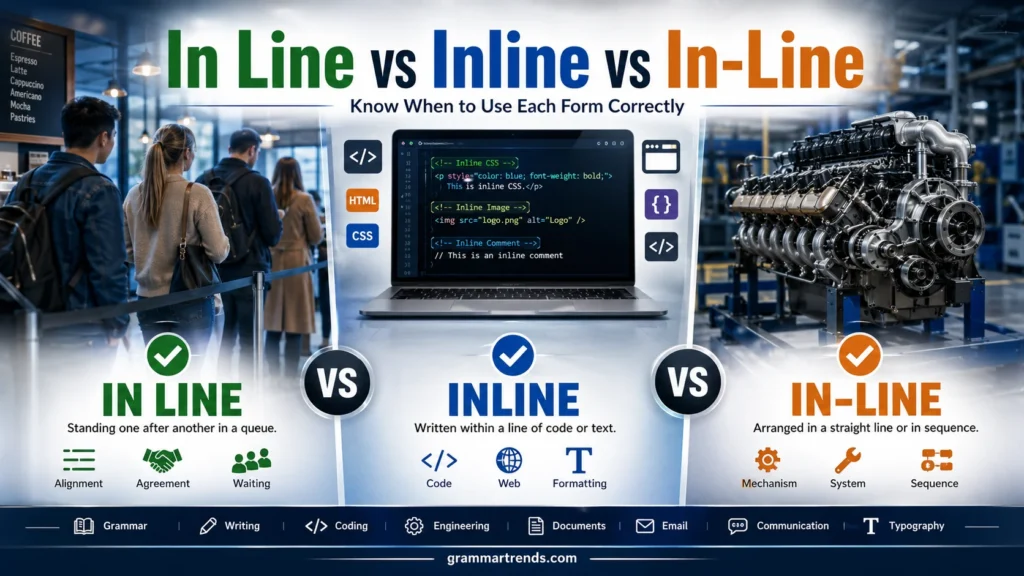
In Line vs Inline vs In-Line writers often get confused in emails, code, reports, and writing, unsure which form to use by context clearly. Choosing between In Line, Inline, and In-Line depends on situation, whether you are working in writing, code, or emails. These similar-looking terms often confuse people mid-sentence, but each version has a different role in professional communication.
In code and technical systems, inline usually means something placed within a line of logic or function, while in line describes alignment or arrangement in normal writing. The hyphenated in-line often works as an adjective in mechanical or structured descriptions. Many writers stop mid-sentence wondering which spelling is correct, but understanding context solves most confusion. Using the wrong version can weaken clarity and accuracy in reports or documentation. Always choose the form based on whether you are describing structure, alignment, or technical usage. Once you learn the simple difference, your writing becomes more polished, professional, and consistent across all formats.
Quick Answer
Here’s the simplest way to get it right without overthinking:
- In line → use for queues, alignment, or agreement
- In-line → use when describing something directly before a noun
- Inline → use for tech, coding, web design, and modern digital writing
That’s the core distinction. Everything else builds from it.
Now let’s unpack why these three forms exist and how English ended up here.
Why “In Line or Inline or In-Line” Creates So Much Confusion
English doesn’t evolve through strict rules. It evolves through usage. People start using phrases casually, then industries reshape them, and finally style guides try to organize the chaos.
That’s exactly what happened here.
Three forces shaped these variations
- Everyday speech created “in line”
- Grammar structure introduced “in-line” as a compound adjective
- Technology and coding culture pushed “inline” as a single word
Over time, all three forms survived because they serve different purposes. Instead of replacing each other, they specialized.
Think of it like three siblings. Same origin, different jobs.
In Line Meaning — How “In Line” Works in Real English
Let’s start with the most common version: in line.
This is the form you’ll see in everyday writing and speech.
What “In Line” Actually Means
“In line” usually expresses two ideas:
- Physical positioning in a queue
- Figurative alignment with rules, expectations, or ideas
You can think of it as “positioned along a line,” either physically or conceptually.
How “In Line” Works in Sentences
“In line” behaves like a prepositional phrase. It doesn’t describe a noun directly. Instead, it explains location or alignment.
It often follows verbs like:
- stand
- wait
- fall
- bring
- keep
Real-life usage patterns
- You wait in line at the grocery store
- The decision falls in line with company values
- The report keeps in line with previous findings
Where You See It Most
You’ll find “in line” in:
- Everyday conversations
- Business communication
- Academic writing
- Government documents
It stays simple, clear, and universal.
Quick insight
If you can replace it with “in a queue” or “in agreement,” you’re using it correctly.
In-Line Meaning — Why the Hyphen Still Exists
Now things get more precise. The hyphen changes everything.
What “In-Line” Means Grammatically
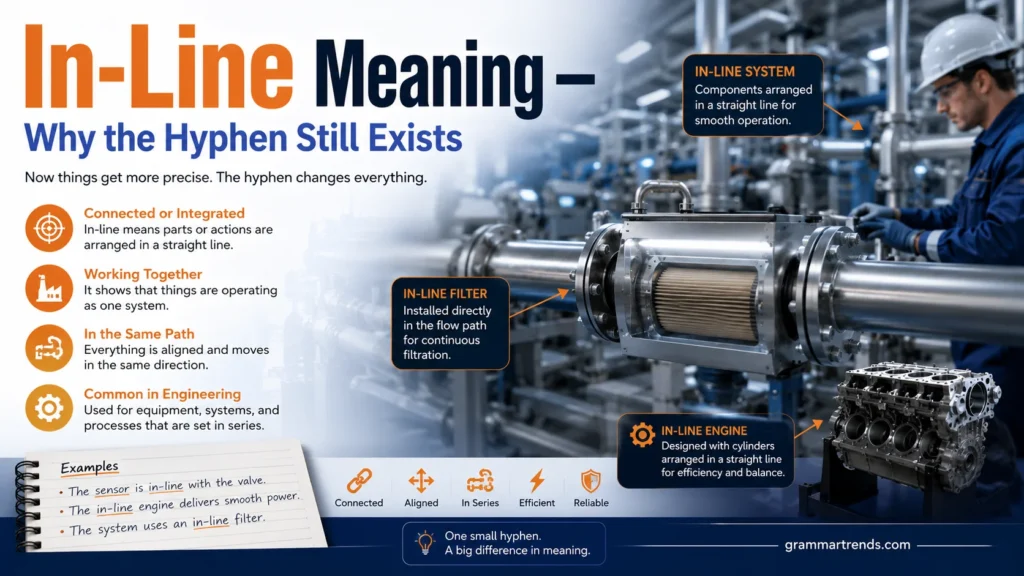
“In-line” works as a compound adjective. It describes a noun directly.
That hyphen acts like glue. It binds the words so they function as one idea.
When You Need the Hyphen
Use “in-line” when:
- It appears before a noun
- You describe a technical or structured object
- You want clarity in complex descriptions
Where You See “In-Line” in Real Life
This form appears in specific fields:
- Engineering
- Automotive design
- Manufacturing
- Sports equipment
Example usage
- The engine uses an in-line cylinder layout
- The factory installed in-line inspection systems
- He prefers in-line skating over hockey skates
Why the hyphen matters
Without it, readers might misread the sentence. The hyphen removes ambiguity and improves readability.
For example:
- Correct: in-line engine design
- Confusing: in line engine design
The second version forces the reader to re-interpret mid-sentence.
Inline Meaning — The Modern Digital Version
Now we enter the world of tech.
“Inline” became popular because developers and designers needed a faster, cleaner way to describe embedded elements.
What “Inline” Means Today
Inline refers to something that appears inside a structure instead of outside it.
It usually shows up in:
- Code
- Web design
- Document formatting
- Software architecture
How technology changed the word
Instead of writing “in line style,” programmers shortened it to “inline” for efficiency. Over time, that spelling became standard in tech communities.
Common technical uses
- Inline CSS styles
- Inline JavaScript execution
- Inline images in HTML
- Inline functions in programming languages
Real examples in tech
- Inline CSS styles apply directly to elements
- Inline scripts run without external files
- Inline SVG graphics render inside HTML documents
Why developers prefer it
Developers value speed and clarity. One word reduces clutter and keeps code readable.
In Line or Inline or In-Line — Key Differences Explained Clearly
Let’s compare them side by side so you can lock in the difference.
Comparison Table
| Form | Function | Context | Example |
| In line | Phrase (queue/alignment) | Everyday English | You stood in line |
| In-line | Compound adjective | Descriptive nouns | In-line engine |
| Inline | Technical term | Coding/web design | Inline CSS |
Simple breakdown
- “In line” = where or agreement
- “In-line” = describing something before a noun
- “Inline” = embedded or integrated in systems
Decision shortcut
Ask yourself:
- Am I talking about waiting or agreement? → in line
- Am I describing a noun? → in-line
- Am I dealing with code or formatting? → inline
Common Phrases Using In Line or Inline or In-Line
Some expressions confuse even advanced writers.
“In line with”
This means agreement or consistency.
- The policy aligns in line with industry standards
- The decision stays in line with regulations
“Fall in line”
This means to conform or follow rules.
- Employees eventually fall in line with company policy
- The team fell in line after new leadership changes
“Out of line”
This means inappropriate or misaligned behavior.
- His comment was out of line
- That request feels out of line with expectations
Important note
Never write:
- fall inline ❌
- fall in-line ❌
Only “fall in line” works.
Common Mistakes People Make With In Line or Inline or In-Line
Even experienced writers slip up. Here are the most frequent errors.
Mistake: Using “inline” in everyday speech
Wrong:
- I stood inline at the store
Correct:
- I stood in line at the store
Mistake: Overusing hyphens
Wrong:
- The team stood in-line at the entrance
Correct:
- The team stood in line at the entrance
Mistake: Mixing technical and casual meanings
Wrong:
- The store has inline customers waiting
Correct:
- The store has customers waiting in line
Mistake: Ignoring noun placement
Before noun → hyphen needed
After verb → no hyphen
Read more: Check in vs Check-in: Stop Getting It Wrong
Case Study — Why Context Changes Everything
Let’s look at a real-world writing scenario.
Scenario: A software company documentation error
A tech company published onboarding docs with inconsistent usage:
- “Inline CSS improves performance”
- “The system uses in line scripts”
- “Apply in-line styling rules”
What went wrong
The inconsistency confused new developers. Some interpreted “in line scripts” as queue-based processing instead of embedded scripts.
Fix applied
They standardized:
- Inline → for all code and web usage
- In-line → removed unless describing physical systems
- In line → reserved for general English
Result
- Developer onboarding time dropped
- Documentation clarity improved
- Support tickets decreased
This shows how small grammar decisions affect real-world understanding.
Memory Tricks to Never Mix Them Again
Let’s simplify it so you don’t second guess yourself again.
The “Queue vs Code” trick
- Queue or alignment → in line
- Code or digital systems → inline
The “Before the noun” trick
If it comes before a noun:
- use in-line
Example:
- in-line inspection system
The “Tech shortcut” trick
If it involves:
- programming
- websites
- digital tools
Then “inline” is almost always correct.
Style Guide Insights — How Experts Treat These Forms
Different writing authorities handle these forms slightly differently.
General writing standards
Most modern guides prefer:
- fewer hyphens
- simpler wording
- consistency over variation
Business writing trend
Companies increasingly favor:
- in line (for clarity)
- inline (for digital systems)
They avoid unnecessary hyphenation unless clarity demands it.
Technical writing standards
In programming and web development:
- inline is the dominant standard
- hyphens rarely appear
FAQs
When should I use in line instead of inline?
Use in line when referring to alignment, position, agreement, or waiting in a queue. For example, “The employees stood in line for registration” or “Her ideas are in line with company policy.”
Is inline one word or two?
In technical and digital contexts, inline is usually written as one word. It describes something placed within the same line of text, code, or content, such as inline CSS, inline images, or inline comments.
What does in-line with a hyphen mean?
In-line is a hyphenated adjective that appears in some technical, engineering, or publishing contexts. It describes something designed or arranged in a straight sequence, such as an in-line engine or in-line filter.
Can I use inline in everyday writing?
Yes, but only when discussing technical concepts like programming, web development, editing, or digital documents. For general writing about alignment or agreement, in line is the correct choice.
Why are in line, inline, and in-line often confused?
They look and sound similar, but each serves a different purpose. The confusion comes from their shared pronunciation, while their spelling changes depending on whether you’re discussing alignment, technology, or a descriptive technical term.
How can I remember the difference?
Think of in line as position or agreement, inline as technology or code, and in-line as a hyphenated adjective used before certain technical nouns. Checking the context before writing makes choosing the correct form much easier.
Conclusion
Although in line vs inline vs in-line look almost identical, they are not interchangeable. In line is the standard choice for alignment, order, or agreement in everyday English. Inline is the preferred spelling in computing, web development, and digital publishing, where it refers to something placed within a line of text or code. In-line remains useful in certain technical and engineering contexts as a hyphenated adjective. By understanding the purpose of each form and paying attention to context, you can avoid common mistakes and produce writing that is clear, accurate, and professional.

Emma Brooke brings 15 years of experience in the Department of English Language and Literature at the University of California, Berkeley, where she has taught and mentored students across courses in British and American literary traditions, critical theory, and narrative form. Her expertise spans 19th- and 20th-century fiction, poetic prosody, postcolonial literatures, and digital humanities, with a focus on how narrative voice shapes cultural meaning. Emma’s work has been presented at international conferences and published in peer-reviewed venues, reflecting her deep commitment to rigorous literary scholarship and accessible teaching.