
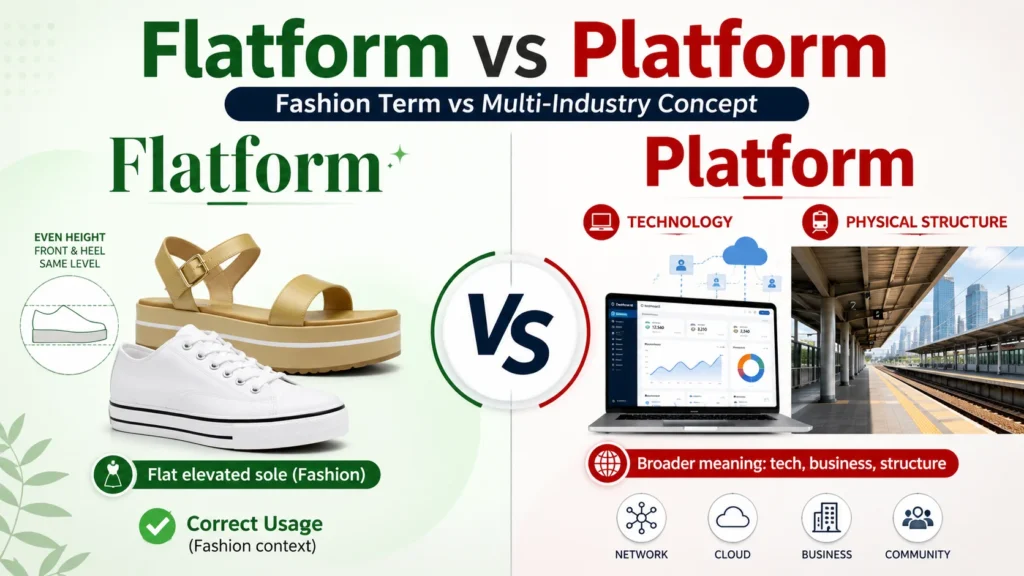
Flatform vs Platform confusion appears in fashion and technology system where words sound similar but differ in meaning, shoe or raised surface context shapes use.
Many writers and shoppers feel confused, unsure when to use correctly in daily life situations, affecting clear knowledge and communication ideas.
People often typed, wondered, and found both terms interchangeable two words, yet they carry different meanings across footwear, software, and business everyday life contexts.
This confusion creates confusion, leading to unprofessional writing, but understanding difference helps users choose correct term every time with plain language clarity.
Flatform vs Platform: The Quick Answer
If you only need the short version, here it is:
A flatform is a type of platform shoe with a sole that remains relatively even in height from heel to toe. A platform is a broader term that can refer to shoes, structures, technology systems, transportation areas, or communication frameworks.
Think of it like this:
Every flatform belongs to the platform family, but not every platform is a flatform.
That small distinction matters.
Quick Comparison Table
| Feature | Flatform | Platform |
| Primary meaning | Footwear style | Broad term used across industries |
| Main usage | Fashion | Fashion, technology, business, transportation |
| Sole structure | Flat elevated sole | Elevated sole or raised structure |
| Heel difference | Minimal | May vary greatly |
| Context flexibility | Limited | Wide |
| Interchangeable? | No | No |
What Does Flatform Mean?
The word flatform combines two words:
- Flat
- Platform
Fashion designers blended these terms to describe shoes that provide extra height while keeping the sole level.
Traditional heels create an angle where the heel sits much higher than the front of the foot. Flatforms remove much of that slope.
Picture standing on a thick hardcover book instead of balancing on stilts. That’s the basic idea.
Key Characteristics of Flatform Shoes
Flatform shoes usually include several defining traits:
- Even sole thickness
- Minimal heel elevation
- Additional height
- Casual or fashion-focused design
- More balanced weight distribution
For example:
A typical sneaker sole might raise you by 1 inch.
A flatform sneaker may raise you by:
- 1.5–3 inches
- evenly across the shoe
That changes appearance without creating the steep angle found in high heels.
Common Types of Flatform Footwear
Fashion brands use flatform designs in many styles.
Common examples include:
Flatform sandals
These remain popular during warm seasons because they provide height without forcing your foot into a dramatic incline.
Flatform sneakers
Streetwear brands frequently use chunky flatform soles.
Flatform boots
Boots often combine thicker soles with modern styling.
Flatform espadrilles
These pair woven materials with elevated flat soles.
What Does Platform Mean?
The word platform has existed for centuries and carries multiple meanings.
At its core, a platform is:
A raised surface or a supporting structure used for activity, operation, or interaction.
That definition expands across many industries.
Unlike flatform, which stays largely within fashion, platform appears almost everywhere.
Platform in Physical Structures
Many people first learn the word through physical spaces.
Examples include:
- Train platforms
- Construction platforms
- Stage platforms
- Loading platforms
- Observation platforms
Imagine standing at a railway station.
You wait for your train while standing on an elevated area beside the tracks.
That surface is the platform.
Platform in Technology
Technology transformed the word into something much larger.
Today, a platform often means:
- A software environment
- A service ecosystem
- A system supporting applications
Examples include:
- Mobile platforms
- Streaming platforms
- Cloud platforms
- Development platforms
Popular examples:
- Android
- Windows
- iOS
Developers create apps that operate on these systems.
Platform in Business and Communication
Businesses use platforms to connect people and services.
Examples:
- Ecommerce platforms
- Marketing platforms
- Learning platforms
- Collaboration platforms
Think of a platform as a digital marketplace or meeting place.
Instead of bricks and walls, it uses software and networks.
Platform in Politics
Politics uses the term differently.
A political platform represents:
- Goals
- Policies
- Principles
- Campaign promises
Politicians run campaigns based on these ideas.
Platform in Footwear
Fashion also uses platform in footwear.
Platform shoes have thicker soles that elevate the foot.
Unlike flatforms, platform shoes may include:
- Tall heels
- wedges
- dramatic height differences
Flatform vs Platform: The Actual Difference
Now the important part.
The distinction becomes much easier once you compare the two directly.
Structure Difference Between Flatform and Platform
Flatform shoes distribute height evenly.
Platform shoes can vary.
Here’s a simple visual:
Flatform
Toe █████
Middle █████
Heel █████
Platform shoe
Toe ███
Middle ████
Heel ███████
The heel section often creates the largest difference.
Read more: Inflexible vs Unflexible: Which Word Is Correct?
Purpose Difference
Flatforms and platforms also exist for different reasons.
| Purpose | Flatform | Platform |
| Fashion style | Yes | Yes |
| Height increase | Yes | Yes |
| Technology use | No | Yes |
| Business systems | No | Yes |
| Physical structures | No | Yes |
Usage Difference
Flatform has narrow usage.
Platform has broad usage.
You might hear:
“The company launched a cloud platform.”
You would never hear:
“The company launched a cloud flatform.”
That sentence instantly feels wrong.
Visual Breakdown: Flatform vs Platform Shoes
Understanding shoe construction helps remove confusion.
Flatform Design
Characteristics:
- Uniform elevation
- Reduced foot angle
- Casual comfort
- Stable appearance
Platform Shoe Design
Characteristics:
- Elevated heel
- Height emphasis
- Strong fashion statement
- Wider variety of designs
Why the Shape Matters
Small design changes affect comfort.
Height distribution changes:
- walking mechanics
- pressure points
- balance
- posture
Footwear researchers have found that greater heel elevation often shifts body weight toward the front of the foot.
Flatforms distribute weight more evenly.
That does not automatically make every flatform comfortable though.
Material matters too.
Why People Confuse Flatform and Platform
Several factors create confusion.
Similar Spelling
Only two letters separate the words.
Your brain naturally groups them together.
Similar Appearance
From a distance:
- thick sole shoes
- chunky sneakers
- elevated sandals
can appear nearly identical.
Shared Fashion Usage
Fashion frequently overlaps terminology.
A shoe may be marketed as:
- platform sandal
- flatform sandal
- elevated sandal
Sometimes brands blur distinctions.
Limited Context Understanding
People often learn words by seeing them repeatedly.
If someone sees “platform shoes” more often, they may assume all elevated shoes belong there.
How to Use Flatform Correctly in a Sentence
Because flatform is highly specific, using it correctly becomes simple.
Use it only when discussing the footwear style.
Examples of Correct Flatform Usage
- She paired white flatform sandals with a summer dress.
- The new collection includes chunky flatform sneakers.
- Black flatform boots became a major streetwear trend.
- The designer introduced leather flatform loafers.
- Her flatform shoes added two inches without feeling like heels.
How to Use Platform Correctly in a Sentence
Platform changes meaning depending on context.
Physical Structure Examples
- Passengers waited on the train platform.
- Workers repaired the elevated platform.
Technology Examples
- The software runs on multiple platforms.
- Developers built the application for mobile platforms.
Business Examples
- The company launched an online selling platform.
- The learning platform supports thousands of users.
Fashion Examples
- She wore silver platform heels.
- Platform sandals became popular again.
Context Changes the Meaning of Platform
Context acts like a steering wheel.
The same word turns in different directions depending on where you use it.
Platform in Fashion
Meaning:
Elevated shoe design.
Example:
“She bought platform boots.”
Platform in Technology
Meaning:
Software or operating environment.
Example:
“The application supports several platforms.”
Platform in Transportation
Meaning:
Raised passenger area.
Example:
“Passengers moved toward Platform 4.”
Platform in Politics
Meaning:
Set of campaign positions.
Example:
“The candidate announced a new policy platform.”
Platform in Business
Meaning:
A system connecting users and services.
Example:
“The company built a subscription platform.”
Common Mistakes and How to Avoid Them
People repeatedly make the same errors.
Fortunately, they are easy to fix.
Mistake: Using Flatform Outside Fashion
Incorrect:
“The company launched a cloud flatform.”
Correct:
“The company launched a cloud platform.”
Remember:
Flatform belongs almost entirely to footwear.
Mistake: Assuming Platform Has One Meaning
Many readers think platform only means shoes.
The word actually stretches across multiple industries.
Mistake: Treating Every Raised Shoe as a Flatform
Not every thick sole creates a flatform.
Pay attention to:
- heel angle
- sole shape
- height distribution
Quick Memory Trick
Remember this:
Flatform = Flat + Platform
Platform = Broad support system or elevated structure
Simple memory tricks stick better than long explanations.
Case Study: How Fashion Changed Flatform Popularity
Fashion trends often behave like ocean tides.
They disappear for years before returning stronger.
During the 1990s, chunky platform shoes exploded in popularity.
Designers later refined the idea.
Instead of steep elevation and dramatic heels, brands moved toward more wearable designs.
Flatforms became attractive because they offered:
- height
- balance
- casual comfort
- everyday styling flexibility
Consumers liked getting extra inches without feeling like they were walking on stilts.
That helped flatforms move into:
- sneakers
- sandals
- boots
- everyday footwear
Interesting Facts About Platform and Flatform Terms
Facts About Platform
- The word originates from French and Old French roots.
- The term existed long before computers.
- Technology later expanded its meaning.
Facts About Flatform
- Flatform is a modern compound word.
- Fashion primarily uses the term.
- The term gained popularity through footwear marketing.
FAQs on Flatform vs Platform
1. What is the main difference between flatform and platform?
A flatform is a flat-soled shoe with height, while a platform usually refers to a raised sole or a base structure in fashion or technology.
2. Are flatforms and platform shoes the same?
No. Flatforms have a completely flat sole, while platform shoes often have a curved or elevated heel area.
3. Why do people get confused between flatform and platform?
Because both terms relate to footwear height and sound very similar in everyday speech.
4. Is “platform” only used in fashion?
No. It is also widely used in technology, like a software system or digital platform.
5. Where are flatform shoes commonly used?
They are popular in casual fashion, especially among style lovers who prefer comfort with added height.
6. Can using the wrong word cause misunderstanding?
Yes, especially in writing. It can confuse readers or make communication less clear.
7. How can I remember the difference easily?
Think: flatform = flat fashion shoe, platform = raised base or system.
Conclusion
Understanding flatform vs platform helps you avoid common mistakes in both fashion and general writing. While flatform is mainly about a flat-style shoe, platform has broader uses in shoes, technology, and everyday language. Knowing this difference improves clarity, boosts confidence, and makes your communication more accurate.

Emma Brooke brings 15 years of experience in the Department of English Language and Literature at the University of California, Berkeley, where she has taught and mentored students across courses in British and American literary traditions, critical theory, and narrative form. Her expertise spans 19th- and 20th-century fiction, poetic prosody, postcolonial literatures, and digital humanities, with a focus on how narrative voice shapes cultural meaning. Emma’s work has been presented at international conferences and published in peer-reviewed venues, reflecting her deep commitment to rigorous literary scholarship and accessible teaching.