
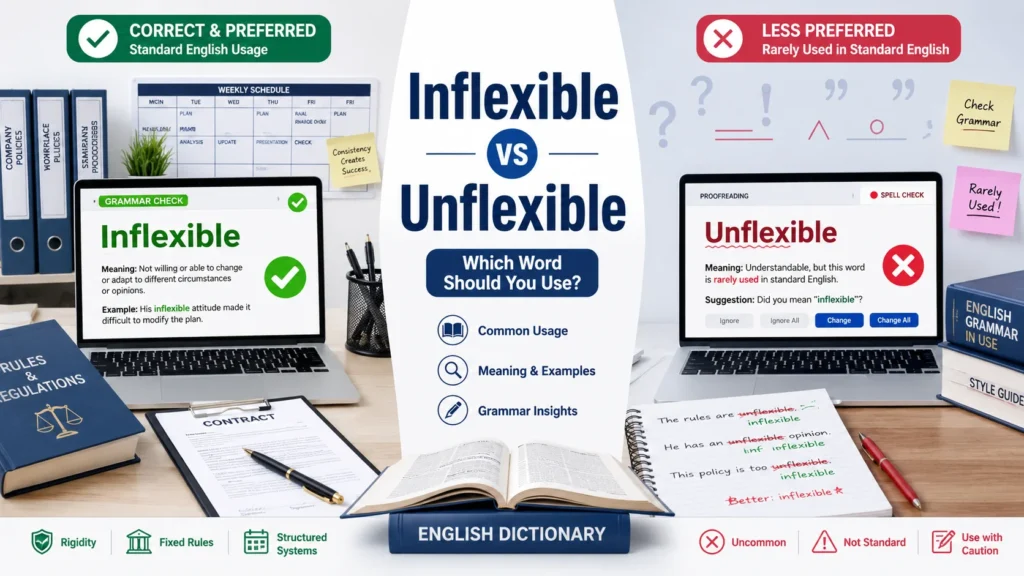
While learning English, noticed how small differences between similar words can create real confusion for many people. One pair often mixed up is inflexible vs unflexible.
From my experience, learning English, I have noticed learners get confused when they use the word inflexible and unflexible. At first glance, both look like synonyms, but their usage, correctness, and overall meaning clearly differ in different contexts. The article helps to explore their differences with better clarity, so readers can understand the right term and choose the proper word in formal writing, everyday speaking, and professional communication. Both are valid words in the English language, and are commonly used, but inflexible feels more natural in modern language and fits better with grammar patterns.
In real writing, I have seen learners often mix up these terms because they seem to carry the same meaning and both refer to something unable to change, adapt, or adjust to new circumstances. Such situations may appear rigid, stiff, or not flexible enough. However, unflexible is still considered a less proper option, even if it is not technically wrong.
When you compare both in real modern usage, most writers, editors, and teachers prefer inflexible because it is more established in standard English language. From a teaching experience, I always delve deeper into impact of word choice, because even small differences in word selection can help you confidently avoid mistakes in different proper context situations.
Quick Answer: Is It “Inflexible” or “Unflexible”?
If you want the safest and most natural choice, use inflexible.
You’ll see it in:
- Books
- Academic writing
- Newspapers
- Business communication
- Legal documents
- Everyday speech
Meanwhile, unflexible appears only occasionally. Most native English speakers either avoid it completely or view it as unnatural wording.
Here’s a quick comparison.
| Feature | Inflexible | Unflexible |
| Common in modern English | Yes | Rare |
| Accepted in professional writing | Yes | Usually no |
| Sounds natural to native speakers | Yes | Often awkward |
| Found in dictionaries | Yes | Sometimes |
| Recommended for students and writers | Yes | No |
In practical terms, choosing unflexible instead of inflexible is like showing up to a business meeting wearing flip-flops. Technically allowed in some places. Still not the best choice.
What Does “Inflexible” Mean?
The word inflexible describes something that does not bend, change, adjust, or compromise easily.
Depending on the context, it can describe:
- Physical objects
- Rules
- Schedules
- Systems
- Personality traits
- Attitudes
The word works both literally and figuratively.
Literal Meaning of Inflexible
In its physical sense, inflexible refers to something rigid or hard to bend.
For example:
- Steel beams
- Thick plastic pipes
- Concrete structures
- Hard protective materials
Example Sentences
- The material became too inflexible in cold weather.
- Engineers needed a less inflexible design.
- The protective shell remained rigid and inflexible under pressure.
In manufacturing and engineering, the term often implies durability or resistance to movement.
Figurative Meaning of Inflexible
This is where the word appears most often.
When describing people, policies, or behavior, inflexible means unwilling to adapt or compromise.
Examples
- An inflexible manager refuses new ideas.
- An inflexible policy allows no exceptions.
- An inflexible schedule creates stress.
The tone can sometimes sound negative because it suggests stubbornness or rigidity.
However, context matters.
An inflexible commitment to safety standards can actually sound positive because consistency matters in that situation.
Common Situations Where “Inflexible” Appears
You’ll hear or read the word frequently in these settings:
| Context | Example |
| Workplace | inflexible deadlines |
| Education | inflexible grading systems |
| Business | inflexible pricing |
| Law | inflexible regulations |
| Personality | inflexible attitude |
| Engineering | inflexible materials |
Because the word works across multiple industries, it has become deeply rooted in modern English.
Does “Unflexible” Mean the Same Thing?
Technically, yes.
Both inflexible and unflexible attempt to express the opposite of “flexible.”
Still, English is not purely logical. Usage matters more than perfect symmetry.
That’s why one word sounds natural while the other feels clumsy.
Why “Unflexible” Sounds Strange to Native Speakers
English tends to pair certain prefixes with specific root words.
For instance:
| Base Word | Common Negative Form |
| active | inactive |
| legal | illegal |
| regular | irregular |
| possible | impossible |
| flexible | inflexible |
Native speakers learn these patterns naturally over time. As a result, unflexible breaks the rhythm people expect.
Even though listeners understand the meaning instantly, the wording still sounds “off.”
It’s similar to hearing someone say:
- “dishappy” instead of unhappy
- “unpossible” instead of impossible
The meaning survives. The phrasing doesn’t.
Is “Unflexible” Grammatically Wrong?
Not entirely.
Some dictionaries list the word because people have used it occasionally throughout history. However, dictionary inclusion does not automatically make a word standard or recommended.
That distinction matters.
A word can be:
- understandable
- technically formed correctly
- historically documented
…and still sound unnatural in everyday English.
That’s exactly what happened with unflexible.
Read more : Sleave vs Sleeve: Which Spelling Is Correct?
Inflexible vs Unflexible: The Real Difference
The biggest difference comes down to acceptance and frequency.
| Feature | Inflexible | Unflexible |
| Standard English usage | Yes | Rare |
| Preferred by editors | Yes | No |
| Common in speech | Yes | Rare |
| Seen in major publications | Frequently | Almost never |
| Recommended in essays | Yes | No |
If you search books, newspapers, and academic databases, inflexible dominates by a massive margin.
That dominance shaped modern expectations.
Today, using unflexible can distract readers because the word looks unfamiliar.
Why One Word Won
Language evolves through repeated usage.
The forms people use most often eventually become “correct” in practice.
Several factors helped inflexible take over:
Historical Influence
Latin-based prefixes heavily shaped English vocabulary. The prefix in- already paired naturally with many adjectives.
Pronunciation Flow
“Inflexible” rolls smoothly in speech.
“Unflexible” feels heavier and less rhythmic.
Publishing Standards
Editors, teachers, and dictionaries consistently favored inflexible over time.
Once schools adopted it widely, the pattern became permanent.
The Origins of “Inflexible” and “Unflexible”
Understanding the history behind these words makes the difference much clearer.
Etymology of “Inflexible”
The word traces back to Latin roots:
- in- = not
- flectere = to bend
Over centuries, the term evolved into the English adjective inflexible, meaning “unable to bend.”
Originally, the word described physical rigidity before expanding into personality and behavioral descriptions.
Where “Unflexible” Came From
English speakers later tried forming an opposite using the familiar prefix un-.
That process makes logical sense because English commonly uses:
- unhappy
- unclear
- unfair
- uncomfortable
Still, languages rarely follow pure logic.
The alternative never caught on widely.
How English Decides Which Words Survive
Words survive through repetition and acceptance.
Several forces shape modern vocabulary:
- Schools
- Publishing houses
- Dictionaries
- Media
- Public speech
- Literature
If enough people adopt a word naturally, it becomes standard.
If usage remains weak, the word slowly fades into obscurity.
That’s precisely what happened with unflexible.
Why “Inflexible” Sounds More Natural in English
Some words simply fit the sound patterns of English better.
Native speakers often recognize correct phrasing instinctively long before they understand grammar rules.
The Role of Prefixes in English
English borrowed many prefixes from Latin.
That influence created familiar combinations.
| Prefix Pattern | Example |
| in- | inflexible |
| im- | impossible |
| il- | illegal |
| ir- | irregular |
These forms became deeply embedded in written and spoken English.
As a result, alternatives can sound unnatural even when logically constructed.
Why “Unflexible” Feels Clunky
Three major reasons explain the awkwardness.
Pronunciation
The transition between “un” and “flex” feels heavier in speech.
Familiarity
People rarely hear the word, so it sounds unusual.
Reading Flow
Readers process familiar vocabulary faster. Unexpected wording interrupts rhythm and comprehension.
Professional writers avoid unnecessary friction whenever possible.
How To Use “Inflexible” Correctly in Sentences
The word adapts easily across many contexts.
Inflexible for People
When describing people, the term usually implies stubbornness or unwillingness to compromise.
Examples
- The director remained inflexible during negotiations.
- Her parents were strict and emotionally inflexible.
- An inflexible leader often struggles with innovation.
In workplace environments, the word can signal poor adaptability.
Inflexible for Rules and Systems
Organizations frequently use the word to describe rigid structures.
Examples
- Employees complained about the company’s inflexible vacation policy.
- The university maintained an inflexible attendance requirement.
- Customers disliked the airline’s inflexible refund rules.
This usage appears heavily in business writing.
Inflexible for Physical Objects
The literal meaning still appears regularly in technical industries.
Examples
- The pipe became too inflexible after exposure to heat.
- Carbon fiber creates strong yet relatively inflexible components.
- The protective layer formed an inflexible outer shell.
Real Sentence Examples of “Inflexible”
Seeing the word naturally helps reinforce proper usage.
Everyday Conversation Examples
- My boss has an incredibly inflexible schedule.
- The material feels stiff and inflexible.
- Their travel plans were too inflexible for last-minute changes.
Professional Writing Examples
- The contract contained several inflexible conditions.
- Investors criticized the company’s inflexible pricing model.
- The healthcare system struggled because of outdated and inflexible procedures.
Academic and Technical Examples
- Researchers observed an inflexible structural response under stress.
- The software architecture proved too inflexible for future scaling.
- An inflexible framework limits adaptive learning models.
Should You Ever Use “Unflexible”?
In most situations, no.
Professional editors almost always replace it with inflexible.
Still, there are rare exceptions.
Cases Where You Might See “Unflexible”
Non-Native English Writing
Language learners sometimes apply the “un-” prefix logically.
Informal Internet Usage
Online forums occasionally contain unconventional wording.
Historical or Experimental Writing
Older texts and stylistic experiments may use alternative forms intentionally.
Why Most Editors Replace It
Editors prioritize:
- clarity
- familiarity
- readability
- audience expectations
Using uncommon wording when a standard option exists usually weakens writing.
That’s why professional publications overwhelmingly choose inflexible.
Better Alternatives to “Inflexible”
Sometimes another word fits the situation better.
Here are strong alternatives and when to use them.
| Word | Best Use |
| rigid | physical stiffness or strict behavior |
| stubborn | personality traits |
| strict | rules and authority |
| fixed | schedules or systems |
| uncompromising | negotiations or beliefs |
| firm | decisions or policies |
Choosing the Right Synonym by Context
Different words create different emotional tones.
“Rigid”
Often sounds harsher and more critical.
“The teacher had a rigid attitude.”
“Firm”
Feels more balanced and professional.
“The company remained firm on pricing.”
“Stubborn”
Usually sounds personal or emotional.
“He was too stubborn to listen.”
Word choice changes reader perception dramatically.
Common Mistakes Writers Make With These Words
Many writers accidentally create confusion when discussing inflexible vs unflexible.
Here are the most common mistakes.
Assuming “Unflexible” Is Completely Fake
It’s uncommon, not imaginary.
That distinction matters.
Some dictionaries acknowledge rare historical usage.
Still, recognition does not equal recommendation.
Using “Rigid” Incorrectly
“Rigid” often implies severity or harshness.
“Inflexible” can sound slightly softer depending on context.
Compare
- rigid discipline
- inflexible schedule
The emotional tone shifts subtly.
Confusing Formal English With Understandable English
People often assume:
“If readers understand it, the word must be fine.”
That’s not always true.
Professional writing values:
- smooth readability
- natural phrasing
- audience familiarity
Those factors influence credibility.
Inflexible in American vs British English
Both American and British English strongly prefer inflexible.
The variation is not regional.
Instead, it reflects standard modern usage across English-speaking countries.
These references overwhelmingly support inflexible as the standard form.
What Grammar Experts and Style Guides Say
Professional style guides prioritize clarity and convention.
That’s why editors almost universally recommend inflexible.
Editorial Preference in Professional Writing
You’ll rarely encounter unflexible in:
- newspapers
- academic journals
- legal writing
- business reports
- professional publishing
Editors aim for language readers recognize instantly.
Unexpected wording slows comprehension.
Quick Usage Guide: Which Word Should You Choose?
Here’s the simplest decision chart possible.
| Goal | Best Choice |
| Sound natural | inflexible |
| Write professionally | inflexible |
| Follow modern English standards | inflexible |
| Avoid distracting readers | inflexible |
| Experiment stylistically | unflexible (rarely) |
Sometimes English behaves like a crowded highway. You can technically drive a tractor in the fast lane. That doesn’t mean you should.
Case Study: How Word Choice Affects Professional Writing
Imagine two versions of the same sentence.
Version A
“The company maintained an inflexible return policy.”
Version B
“The company maintained an unflexible return policy.”
Both communicate meaning.
Still, Version A sounds polished and authoritative.
Version B sounds unfamiliar enough to distract many readers.
That tiny distraction matters in:
- marketing
- journalism
- legal writing
- business communication
Professional writing succeeds when readers focus on ideas instead of unusual wording.
Common Collocations With “Inflexible”
Certain phrases appear frequently in natural English.
Popular Examples
- inflexible schedule
- inflexible rules
- inflexible policy
- inflexible personality
- inflexible structure
- inflexible leadership
- inflexible deadline
- inflexible mindset
Learning these combinations improves fluency quickly.
Why Native Speakers Rarely Notice the Rule
Most native speakers never consciously study this distinction.
They absorb it through repeated exposure.
That’s how language usually works.
Children hear:
- impossible
- irregular
- inflexible
…thousands of times before adulthood.
As a result, the patterns become automatic.
That’s also why uncommon alternatives immediately sound strange.
The Psychology Behind “Correct-Sounding” Words
Humans process familiar language faster.
Research in psycholinguistics shows readers prefer predictable word patterns because they reduce mental effort.
In simple terms:
Familiar wording feels trustworthy.
That’s one reason standard English matters in professional environments.
Readers associate smooth language with competence.
FAQs on Inflexible vs Unflexible
1. What does “inflexible” mean?
It means someone or something that cannot easily change, adapt, or adjust to new situations.
2. What does “unflexible” mean?
It also means not flexible, but it is used less often in modern English.
3. Are inflexible and unflexible the same in meaning?
Yes, both have the same basic meaning, but their usage differs in real English writing.
4. Which word is more commonly used?
“Inflexible” is the commonly used and more accepted form in English language.
5. Is “unflexible” grammatically correct?
It is understandable, but it is considered less proper and rarely used.
6. When should I use “inflexible”?
Use it in formal writing, exams, professional communication, and daily English.
7. Why do people get confused between these words?
Because they look similar and both describe something that cannot change or adapt.
Conclusion
In simple terms, both inflexible and unflexible describe something that cannot easily change or adjust. However, in real English usage, inflexible is the preferred and more natural choice. If you want to sound correct and confident in writing or speaking, it is better to stick with inflexible in most situations.

Emma Rose has spent 15 years in the English Department at the University of California, Los Angeles (UCLA), guiding students through British and American literary classics, critical theory, and narrative techniques. Her scholarly focus includes 19th- and 20th-century fiction, the art of poetry, postcolonial writing, and digital humanities particularly how storytelling voice influences cultural perspectives. Emma has presented her research at major international conferences and published in respected academic journals, underscoring her dedication to both high-level scholarship and engaging teaching.