
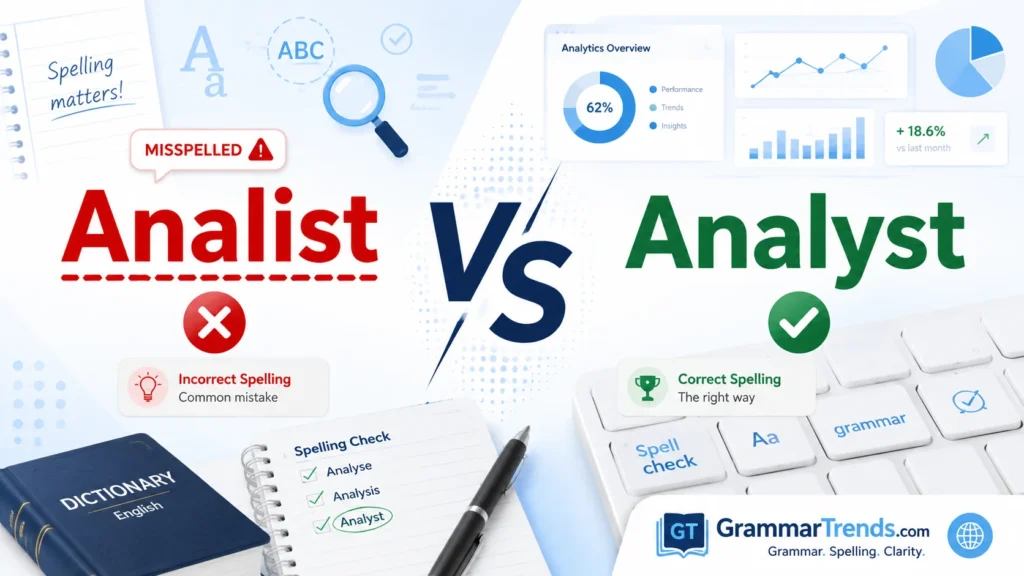
Analyst vs Analist shows correct writing use in data analysis, chats, and dialogues where dictionaries confirm proper spelling choice here
Analyst work in professional meaning and real usage across financial, computer based, and systems fields where a person who observes, analyzes, and interprets data helps solve problems and give insights and solutions. The term comes from Greek and Latin, confirmed by Collins, Miriam Webster, and Online Etymology sources. In finance, marketing, research, studies, and critical fields, a job title like market, financial, or research analyst is used for clear communication and accurate work outcomes. It explains how we break down complex systems, improve thinking, and ensure correct spelling, avoiding confuse, while maintaining formal writing, strong skills, and professional tasks.
Language Use, Meaning, and Interpretation
In everyday writing, people may still think analist and analyst are the same because of homophones, but dictionaries like Collins English Dictionary, English Dictionary, Miriam Webster, and Online Etymology Dictionary clearly set the correct term. We explore the topic by using etymology platform knowledge, showing how usage is established in communication and how word meaning breaks into closer level elements. Each word can be parsed, separated, and understood in parts, leading to better insight of the subject and object. Although some people in casual scenarios still use the wrong form, it is incorrect, and only analyst with y is supported, ensuring clear results, better understanding, and proper language use in every context.
Analyst vs Analist: Which One Is Correct in English?
The short answer is straightforward:
| Word | Correct in English? | Meaning |
| Analyst | Yes | A person who analyzes information or data |
| Analist | No | Incorrect spelling in English |
The correct spelling is always analyst when writing in English.
For example:
- She works as a financial analyst.
- The company hired a data analyst.
- He became a cybersecurity analyst after graduation.
Using “analist” in professional writing can make your work appear careless. That matters more than people think. Employers, professors, clients, and recruiters often judge credibility within seconds.
A single spelling mistake can quietly damage trust.
Think of it this way: showing up to a job interview with “analist” on your resume is like wearing mismatched shoes. People notice immediately.
Is “Analist” a Real Word?
This question causes a surprising amount of confusion online.
Technically, “analist” exists in some non-English languages. However, it is not accepted as the correct spelling in modern English.
That distinction matters.
Why “Analist” Appears Online So Often
Several factors explain the mistake.
Phonetic confusion
English pronunciation tricks people constantly. “Analyst” sounds very close to “analist” when spoken quickly.
Many people simply spell the word the way it sounds.
Autocorrect problems
Phones and browsers sometimes fail to catch the error, especially when:
- Multiple languages are installed
- English isn’t the default keyboard
- Regional dictionaries interfere
ESL writing patterns
Many non-native English speakers transfer spelling rules from their native language into English.
For example:
| Language | Spelling |
| English | Analyst |
| Dutch | Analist |
| Indonesian | Analis / Analist variants |
| Turkish | Analist |
That cross-language overlap creates confusion online.
What Does “Analyst” Mean?
An analyst is someone who studies information, interprets patterns, and helps people make decisions.
The core job stays the same across industries:
Analysts turn raw information into useful insights.
That sounds simple. In reality, analysts influence billion-dollar business moves, cybersecurity defenses, medical research, sports strategy, and government policy.
Simple Definition of Analyst
An analyst:
- Collects information
- Studies patterns
- Evaluates data
- Identifies problems
- Suggests solutions
You’ll find analysts almost everywhere today because modern industries run on information.
Data drives decisions now.
Common Industries That Use Analysts
The term “analyst” covers dozens of careers.
Here are the most common.
| Analyst Type | Main Responsibility |
| Financial Analyst | Studies investments and budgets |
| Data Analyst | Interprets datasets |
| Business Analyst | Improves business systems |
| Cybersecurity Analyst | Protects digital systems |
| Market Research Analyst | Studies consumer behavior |
| Systems Analyst | Evaluates IT infrastructure |
| Research Analyst | Investigates trends and findings |
| Sports Analyst | Examines athletic performance |
Some analysts work with spreadsheets all day. Others handle live security threats or predictive AI systems.
Different tools. Same core mission.
Find meaning in information.
Read more: Tapped vs. Taped: Which One Should You Use?
Analyst vs Analist: The Key Difference Explained
The difference between the two words is spelling accuracy.
That’s it.
Still, spelling matters because language signals professionalism.
Pronunciation Comparison
Both words sound nearly identical:
- Analyst → “AN-uh-list”
- Analist → Often pronounced the same way
That similarity tricks writers constantly.
English contains many confusing sound patterns like this:
| Correct Word | Common Mistake |
| Definitely | Definately |
| Separate | Seperate |
| Analyst | Analist |
| Principal | Principle |
| Occasion | Ocassion |
Your ears don’t always help with spelling.
Why Correct Spelling Matters in Professional Writing
Spelling affects credibility faster than most people realize.
A recruiter may scan your resume for 10 seconds. During that short window, small mistakes create strong impressions.
Resume and LinkedIn Impact
Imagine reading this headline:
“Experienced Data Analist”
Immediately, trust drops.
Fair or unfair, spelling mistakes suggest:
- Lack of attention to detail
- Weak communication skills
- Poor proofreading habits
That becomes especially damaging for analytical roles where precision matters.
Academic Writing Consequences
In universities, repeated spelling errors can lower grades because they affect:
- Clarity
- Professional tone
- Readability
- Technical accuracy
Professors expect correct terminology.
How To Use “Analyst” Correctly in a Sentence
Seeing real examples helps the rule stick.
Everyday Examples Using Analyst
- My brother works as a business analyst in Chicago.
- The sports analyst predicted the upset correctly.
- She became a data analyst after learning SQL.
- The company hired another cybersecurity analyst.
- Every analyst on the team reviewed the report.
Short. Clear. Natural.
Professional Writing Examples
Resume Example
Correct:
Senior Financial Analyst with 5+ years of forecasting experience.
Incorrect:
Senior Financial Analist with 5+ years of forecasting experience.
One version looks polished. The other looks careless.
Cover Letter Example
As a market analyst, I specialize in identifying consumer behavior trends and translating them into actionable strategies.
That sentence sounds authoritative because the terminology is correct.
Business Email Example
Our lead analyst completed the quarterly performance review yesterday.
Simple writing often works best.
Incorrect Examples Using “Analist”
Here are mistakes people commonly make.
| Incorrect Sentence | Correct Version |
| She is a data analist. | She is a data analyst. |
| The analist reviewed the file. | The analyst reviewed the file. |
| He applied for an analist role. | He applied for an analyst role. |
| Our financial analist resigned. | Our financial analyst resigned. |
Once you see the pattern repeatedly, the error becomes easier to spot instantly.
Common Types of Analysts
The analyst profession has exploded during the digital economy.
Companies collect more data than ever before. Someone has to interpret it.
That’s where analysts come in.
Business Analyst
Business analysts help organizations improve operations.
They act like translators between:
- Management
- Technical teams
- Stakeholders
- Customers
Typical Responsibilities
- Identifying workflow problems
- Improving efficiency
- Documenting requirements
- Supporting software implementation
Common Skills
- Communication
- Problem-solving
- Data interpretation
- Process mapping
Business analysts often sit at the center of major company decisions.
Data Analyst
Data analysts transform raw data into understandable insights.
Without them, businesses drown in numbers.
Core Responsibilities
- Cleaning datasets
- Building reports
- Finding trends
- Creating dashboards
- Supporting decision-making
Popular Tools
| Tool | Purpose |
| Excel | Data organization |
| SQL | Database querying |
| Python | Automation and analysis |
| Tableau | Visualization |
| Power BI | Business reporting |
Data analysts remain among the fastest-growing careers globally.
Financial Analyst
Financial analysts study money, investments, and market performance.
Banks, corporations, hedge funds, and startups all rely on them.
Main Tasks
- Forecasting revenue
- Evaluating investments
- Monitoring budgets
- Analyzing risk
Average Work Environment
Financial analysts commonly work in:
- Investment firms
- Banks
- Insurance companies
- Corporate finance departments
High-performing analysts can influence million-dollar decisions.
Pressure comes with the territory.
Cybersecurity Analyst
Cybersecurity analysts protect digital systems from attacks.
As cybercrime rises globally, demand keeps growing rapidly.
What They Do
- Monitor threats
- Detect suspicious activity
- Respond to breaches
- Strengthen system defenses
Common Threats They Handle
- Ransomware
- Phishing attacks
- Data leaks
- Malware infections
Modern businesses depend heavily on cybersecurity analysts because a single breach can destroy trust overnight.
Market Research Analyst
These analysts study customer behavior.
They help companies understand:
- What consumers want
- Why people buy
- Which trends are growing
- How competitors perform
Real-World Example
Imagine a coffee brand launching a new flavor.
Market research analysts may:
- Conduct surveys
- Analyze social media reactions
- Study competitor pricing
- Predict demand
Without that research, companies essentially guess.
Guessing gets expensive quickly.
Systems Analyst
Systems analysts bridge business needs and technology solutions.
They evaluate existing systems and recommend improvements.
Their Work Often Includes
- Software evaluation
- Infrastructure planning
- Workflow optimization
- Technical documentation
Many systems analysts work closely with software developers.
Why People Misspell “Analyst”
Spelling mistakes rarely happen randomly.
Usually, patterns exist underneath them.
Phonetic Confusion
English spelling rules can feel chaotic.
“Analyst” sounds like it should end with “-list,” not “-lyst.”
That mismatch creates problems.
The same issue appears in words like:
- Rhythm
- Colonel
- Wednesday
- Queue
English pronunciation doesn’t always follow spelling logic.
Influence From Other Languages
Global internet usage increased spelling crossover dramatically.
Someone speaking Dutch may naturally write “analist” because that spelling is correct in Dutch.
The brain transfers familiar patterns automatically.
That’s normal.
Fast Typing Habits
Typing speed creates errors constantly.
People often:
- Skip letters
- Rearrange vowels
- Rely on muscle memory
Once a typo repeats enough times, it starts looking “correct.”
That’s how spelling habits form.
Analyst in Grammar and English Usage
Grammar confusion often appears alongside spelling confusion.
Let’s clear that up too.
Singular and Plural Forms
| Form | Example |
| Singular | The analyst wrote the report. |
| Plural | The analysts reviewed the data. |
Simple rule:
- One analyst
- Multiple analysts
Possessive Forms
Possessives confuse many writers.
Singular Possessive
The analyst’s report was accurate.
Meaning: the report belongs to one analyst.
Plural Possessive
The analysts’ meeting lasted three hours.
Meaning: the meeting involved multiple analysts.
Tiny apostrophes change meaning fast.
Related Word Forms
Many related words come from the same root.
| Word | Part of Speech | Meaning |
|—|—|
| Analyze | Verb | To examine closely |
| Analysis | Noun | Detailed examination |
| Analyst | Noun | Person performing analysis |
| Analytical | Adjective | Related to logic or examination |
| Analytics | Noun | Systematic computational analysis |
Learning the word family makes spelling easier.
Analyst vs Similar Confusing Words
People often mix these terms together.
Here’s the difference.
Analysis vs Analyst
Analysis
The process.
Analyst
The person.
Example:
The analyst completed the analysis yesterday.
That sentence uses both correctly.
Analytics vs Analyst
This confusion appears constantly in tech.
| Word | Meaning |
| Analyst | Human professional |
| Analytics | Data analysis systems/tools |
For example:
- A data analyst uses analytics software.
- Google Analytics is a platform.
- The analyst interprets the data.
Analyze vs Analyst
Another common mix-up.
| Word | Function |
| Analyze | Verb |
| Analyst | Noun |
Example:
Analysts analyze information.
Easy memory trick. Hard to forget.
How To Remember the Correct Spelling
Memory tricks work surprisingly well.
Easy Memory Trick
Use this sentence:
An analyst analyzes analysis.
All related words keep the “y” pattern.
That visual connection helps many people remember the correct spelling instantly.
Spelling Breakdown
The “-lyst” ending comes from historical language roots connected to analysis.
That’s why:
- analyst
- analysis
- analytical
all share similar spelling patterns.
“Analist” breaks that family connection.
Quick Visual Comparison
Correct: Analyst
Incorrect: Analist
Sometimes simplicity wins.
Real-World Case Study: A Resume Mistake That Cost an Interview
A hiring manager shared an interesting recruiting story online.
Two applicants applied for the same junior data analyst position.
Both had similar qualifications:
- Comparable GPA
- Similar internships
- Matching technical skills
However, one resume repeatedly used “data analist.”
Guess who didn’t receive the interview?
The recruiter explained the decision clearly:
“If attention to detail matters in the role, spelling errors become part of the evaluation.”
Harsh? Maybe.
Realistic? Absolutely.
Precision matters in analytical careers.
Quick Practice Quiz
Test yourself.
Fill in the Blank Exercise
Choose the correct word.
- The financial ______ prepared the investment report.
- Our data ______ built a new dashboard.
- She works as a cybersecurity ______.
- The market ______ studied consumer behavior.
- Every business ______ attended the meeting.
Answers
- Analyst
- Analyst
- Analyst
- Analyst
- Analyst
Hopefully that one felt easy by now.
Choose the Correct Spelling
Question 1
Which is correct?
- A. Data Analist
- B. Data Analyst
Correct Answer: B
Question 2
Which sentence is accurate?
- A. The analist reviewed the budget.
- B. The analyst reviewed the budget.
Correct Answer: B
Question 3
Which spelling belongs in professional English writing?
- A. Analyst
- B. Analist
Correct Answer: A
7 FAQs on Analyst vs Analist
1. What is the correct spelling: analyst or analist?
The correct spelling is analyst. The word analist is incorrect in formal English writing.
2. Why do people confuse analyst and analist?
People confuse them because they are homophones and sound similar when spoken.
3. What does an analyst do?
An analyst studies data, observes patterns, and gives insights and solutions.
4. Is analist accepted in dictionaries?
No, major dictionaries like Collins and Merriam-Webster do not accept analist.
5. Where is the word analyst used?
It is used in finance, marketing, research, computer systems, and many other fields.
6. What is the origin of the word analyst?
It comes from Greek and Latin, meaning to break down or analyze something.
7. How can I remember the correct spelling?
Remember that analyst ends with “y”, which is always correct in professional writing.
Conclusion
The difference between analyst vs analist is simple but important. Only analyst is correct in English, and it is widely used in professional, academic, and technical fields. Dictionaries and linguistic sources consistently confirm this spelling, making it the standard choice for clear and credible communication.
By understanding the meaning, origin, and correct usage of the word, writers can avoid common mistakes and maintain accuracy in every context where data, interpretation, and analysis matter.

Emma Rose has spent 15 years in the English Department at the University of California, Los Angeles (UCLA), guiding students through British and American literary classics, critical theory, and narrative techniques. Her scholarly focus includes 19th- and 20th-century fiction, the art of poetry, postcolonial writing, and digital humanities particularly how storytelling voice influences cultural perspectives. Emma has presented her research at major international conferences and published in respected academic journals, underscoring her dedication to both high-level scholarship and engaging teaching.