
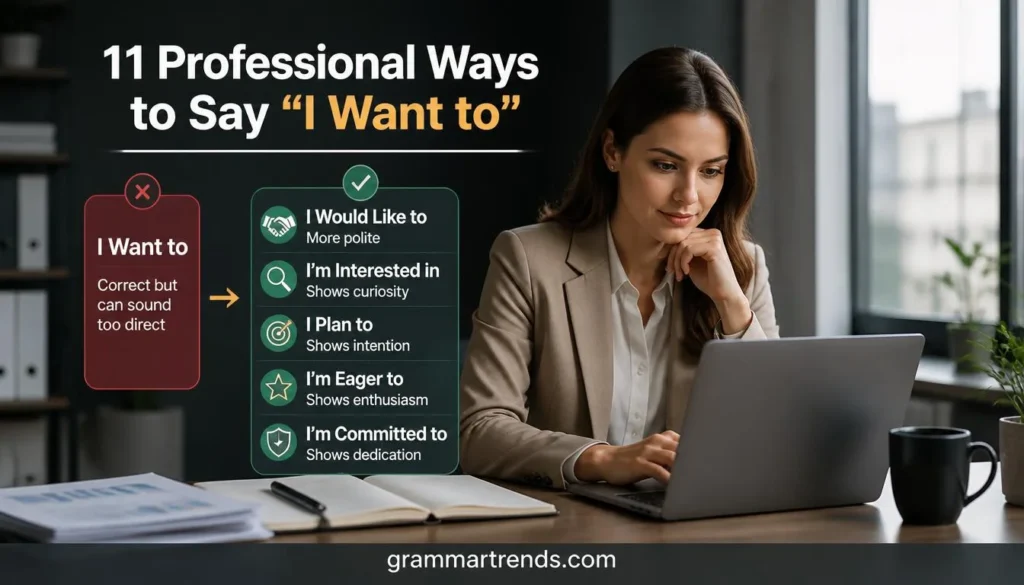
When expressing what you want or intend, the right phrase can make your communication more professional and less overly formal. For 11 Professional Ways to Say “I Want to” Without Sounding Too Direct, choose ways to say “I want to,” in an email, message, or conversation with a polite request.
I would like to sounds thoughtful and considerate, while I’m eager to, I’m motivated to, I’m inclined to, I am interested in, I am keen on, I’m enthusiastic about, I am committed to, I’m determined to, I’m dedicated to, and I am intent on create different tone and warmth. In my practical experience, each individual synonym can add confidence and personality without making your writing repetitive.
In sales, the same approach works during a cold call. Rather than begin with “I just wanted to,” which can sound like a common phrases pattern showing a lack of confidence or feeling disingenuous, be genuinely clear and truthful about your opening. Instead of “I just wanted to see if you might be interested,” use a stronger sales conversation with a direct, respectful statement. You can also replace “I just wanted to follow up with you” with language that shows real engagement. These other ways help you say what you mean professionally while keeping your messages authentic, engaging, and polite. I would like to remains useful for a softer approach, but it’s important to understand how each synonym is used so the person receiving your message can better understand your purpose. Care about how your words are received, and avoid JUST adding soft words that weaken your meaning.
Quick Answer
For most professional situations, “I would like to” is the safest and most versatile alternative.
For example:
I want to discuss the project.
becomes:
I would like to discuss the project.
Cambridge Dictionary explains that “would like” is used to say politely what someone wants, especially when making offers and requests. It also notes that would like is followed by the to-infinitive when referring to an action.
However, “I would like to” isn’t the only option. The right expression depends on what you actually mean.
| What you want to express | Professional alternative |
| Polite desire | I would like to… |
| Interest | I’m interested in… |
| Hope | I’m hoping to… |
| A future plan | I plan to… |
| Firm intention | I intend to… |
| Enthusiasm | I’m eager to… |
| A current objective | I’m looking to… |
| A specific goal | I aim to… |
| Strong dedication | I’m committed to… |
| Willingness and enthusiasm | I’m keen to… |
| Strong resolve | I’m determined to… |
The important thing is that these phrases aren’t perfect synonyms. Each one adds a slightly different shade of meaning.
Is “I Want to” Professional and Correct?
Yes. “I want to” is grammatically correct.
Cambridge Dictionary explains that want can express wishes and desires and can be followed by a to-infinitive. For example, “I want to leave” and “She wants to learn” follow a standard English pattern.
So why do people sometimes recommend replacing it?
The answer is tone.
“I want to” puts your desire directly on the table. In a casual conversation, that’s perfectly normal:
I want to grab some coffee.
Learning more about the software is something I’d like to do.
I’d also like to talk about the schedule.
At work, however, the same wording can occasionally sound more direct than necessary, particularly when you’re speaking to a client, making a request, or writing a formal email.
Consider:
I want to speak with you about the contract.
This isn’t rude. Still, it can sound quite direct.
Now compare:
I would like to speak with you about the contract.
The second version creates more distance and courtesy. It doesn’t weaken the message. It simply wraps the request in a more diplomatic form.
Professional communication is a little like adjusting the volume on a speaker. You don’t always need to speak more softly. You just need to choose the right level for the room.
11 Professional Ways to Say “I Want to”
I Would Like to…
If you need one dependable replacement for “I want to,” start here.
“I would like to” expresses a desire or intention in a polite way. It’s especially useful when you’re making a request or introducing something you want to discuss.
I would like to discuss the revised proposal.
Scheduling a meeting for next week would be helpful.
I’d also like to thank everyone for their support.
This expression works particularly well in:
- Business emails
- Client communication
- Job interviews
- Formal requests
- Meetings
- Professional introductions
- Customer service situations
The grammar is straightforward:
I would like to + base verb
Examples:
I would like to discuss this issue.
Scheduling a call would be helpful as well.
Learning more about the position is another thing I’d like to do.
Don’t write “I would like discussing” when you mean a present desire or request. The normal structure is would like + to-infinitive. Cambridge specifically identifies this pattern in its grammar guidance.
Best use: When you want a polite, broadly professional version of “I want to.”
I’m Interested in…
Use “I’m interested in” when you want to show curiosity, involvement, or a desire to learn more.
For example:
I’m interested in discussing the position further.
Learning more about your services is something I’d also like to do.
Exploring a possible partnership is another opportunity I’m interested in.
This phrase is especially useful when you aren’t necessarily making a firm commitment yet.
That’s an important distinction.
If you say:
I plan to join the program.
you’re describing a plan.
If you say:
I’m interested in joining the program.
you’re expressing interest without necessarily saying you’ve made a final decision.
Cambridge defines interested as wanting to give your attention to something and discover more about it. Its grammar guidance also confirms that interested in is followed by a noun or an -ing form when a verb follows it.
So write:
I’m interested in applying for the position.
Not:
I’m interested in apply for the position.
Best use: Job applications, networking, business opportunities, courses, partnerships, and situations where you want to show genuine interest without making a firm promise.
I’m Hoping to…
“I’m hoping to” works when you want something to happen but don’t completely control the outcome.
For example:
I’m hoping to schedule a meeting next week.
Hearing from the hiring team soon would be great.
Completing the project before Friday is another goal I’m hoping to achieve.
The expression sounds softer because it presents the action as a desired possibility rather than a fixed demand.
Cambridge explains that hope refers to wanting something to happen while usually having some reason to think it might happen. It can also take the to-infinitive, as in “We hope to see you soon.”
This makes “I’m hoping to” particularly useful when circumstances remain uncertain.
Compare:
I want to meet with the director next week.
I’m hoping to meet with the director next week.
The first sounds definite about your desire. The second acknowledges that the meeting still depends on scheduling or approval.
Best use: Requests, scheduling, follow-ups, interviews, uncertain plans, and polite workplace communication.
I Plan to…
Sometimes you don’t want to express a desire at all. You want to explain a plan.
That’s where “I plan to” works better than “I want to.”
I plan to submit the report tomorrow.
Contacting the client this afternoon is also on my agenda.
Completing the training this month is another goal I’m working toward.
Cambridge defines plan as thinking about and deciding what you’re going to do. It also uses plan + to-infinitive to describe an intended action or future event.
The distinction is subtle but valuable:
I want to improve my presentation skills.
This tells the reader about your desire.
I plan to improve my presentation skills by practicing twice a week.
Now you’ve introduced an actual course of action.
That extra sense of direction can make your professional writing sound more purposeful.
Best use: Project updates, career goals, schedules, work plans, and future actions.
I Intend to…
“I intend to” expresses a stronger or more deliberate intention.
Completing the project within the agreed timeframe is another goal I intend to achieve.
We intend to expand our services next year.
Cambridge defines intend as having something as a plan or purpose. The dictionary also gives intend + to-infinitive as a standard grammatical pattern.
Compared with “I plan to,” “I intend to” can sound more formal and deliberate.
Compare:
I plan to contact the supplier tomorrow.
I intend to contact the supplier tomorrow.
Both communicate a future action. The second sounds more official and purposeful.
Because of that, don’t sprinkle “I intend to” into every casual workplace conversation. It can feel unnecessarily weighty when a simpler expression would do.
Best use: Formal statements, official communication, business plans, commitments, and situations requiring a firm tone.
I’m Eager to…
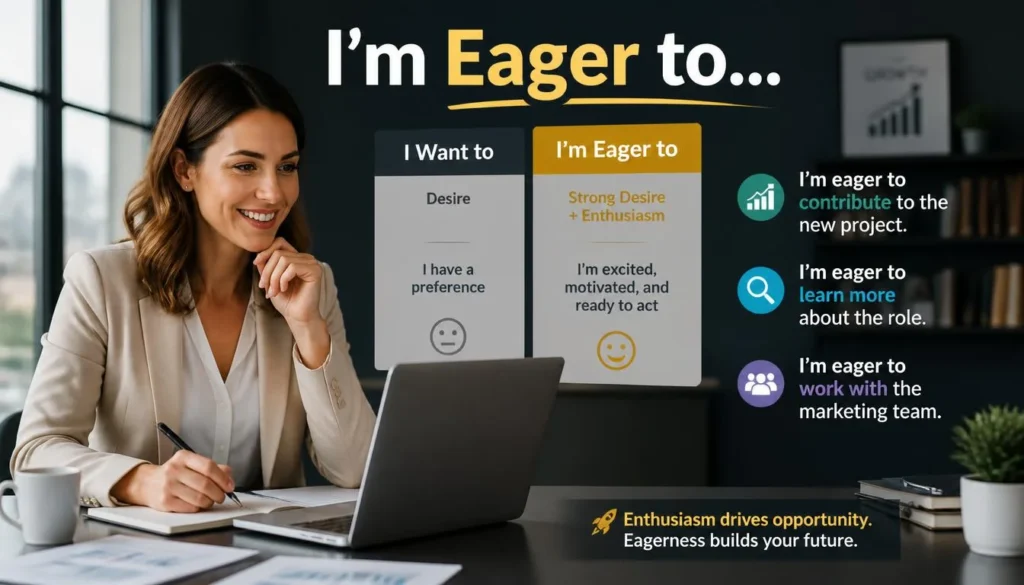
When you want to show enthusiasm, “I want to” doesn’t always carry enough energy.
That’s where “I’m eager to” comes in.
I’m eager to contribute to the new project.
Learning more about the role is something I’m also eager to do.
Working with the marketing team is another opportunity I’m excited about.
Cambridge defines eager as wanting very much to do or have something, particularly something interesting or enjoyable. It commonly takes the to-infinitive.
This makes the phrase especially effective in job interviews.
Instead of:
I want to grow with your company.
Try:
I’m eager to grow with your company and contribute to its long-term goals.
The second sentence does more than express desire. It signals enthusiasm.
There’s a useful distinction here:
Want = desire
Eager = strong desire plus enthusiasm
That difference can make your professional communication feel much more energetic.
Best use: Job interviews, applications, new opportunities, teamwork, professional development, and enthusiastic responses.
I’m Looking to…
“I’m looking to” is a natural way to describe a current objective or something you’re planning to pursue.
Improving our customer support process is another goal I’m currently pursuing.
We’re looking to hire an experienced project manager.
Cambridge’s Business English entry defines be looking to do something as planning to do something.
This phrase appears frequently in professional and business contexts because it sounds purposeful without becoming overly formal.
Compare:
I want to find a new position.
I’m looking to find a new position.
The second sounds more career-oriented and objective.
However, don’t confuse “I’m looking to” with “I’m looking at.”
I’m looking to expand the team.
= I’m planning or hoping to expand it.
I’m looking at the sales figures.
= I’m examining the figures.
That small preposition changes the meaning significantly.
Best use: Career conversations, recruiting, business strategy, networking, planning, and professional discussions.
I Aim to…
When the emphasis falls on a goal or desired result, use “I aim to.”
I aim to improve customer satisfaction this year.
We aim to reduce response times by improving our support process.
I aim to complete the certification by December.
Cambridge defines aim as intending to do something and gives aim + to-infinitive as a standard structure. In Business English, “aim to do something” refers to planning or hoping to achieve something.
This expression shifts attention away from personal desire and toward an objective.
Compare:
I want to improve customer service.
I aim to improve customer service.
The first tells readers what you want.
The second tells them what you’re trying to achieve.
That makes “I aim to” particularly useful in performance reviews, business plans, professional development statements, and goal-setting documents.
Best use: Objectives, targets, professional goals, strategic plans, and performance statements.
I’m Committed to…
This phrase is considerably stronger than “I want to.”
“I’m committed to” tells readers that you’re prepared to dedicate effort, time, or resources to something.
I’m committed to improving the customer experience.
We’re committed to delivering reliable service.
I’m committed to developing my leadership skills.
Cambridge defines commit in this context as promising or giving your loyalty, time, or money to a principle, person, or plan of action.
There’s also an important grammar point here.
Use:
I’m committed to improving the process.
Not:
I’m committed to improve the process.
Why? In committed to, the word to functions as a preposition. A gerund follows it.
So:
committed to + noun / -ing form
Examples:
Committed to quality
Dedicated to providing better service
Focused on improving efficiency
This expression should carry genuine weight. Don’t use it merely because it sounds impressive. If you’re describing a casual preference, “I would like to” is more accurate.
Best use: Long-term goals, company values, leadership statements, serious professional commitments, and performance discussions.
I’m Keen to…
“I’m keen to” expresses strong interest or willingness.
Exploring new opportunities is something I’m also keen to do.
We’re keen to work with your organization.
Cambridge defines keen to as being very interested, eager, or wanting to do something very much. It also lists the construction in Business English.
There is one useful American English consideration.
The phrase is completely understandable in the United States, but “keen” is more strongly associated with British usage when it means eager or enthusiastic. In American professional writing, “I’m eager to” or “I’m very interested in” may sound more familiar.
That doesn’t make “keen” incorrect. It simply makes audience awareness important.
Best use: Professional discussions, collaboration, opportunities, and situations where you want to express enthusiasm.
I’m Determined to…
When you want to communicate strong resolve, “I want to” is too weak.
Use:
I’m determined to finish the project on time.
I also want to improve my performance and continue developing my skills.
Most importantly, I’m committed to finding a solution that works.
Cambridge defines determined as wanting to do something very much and refusing to let difficulties stop you. It commonly takes the to-infinitive.
This expression carries more force than most alternatives.
Compare:
I want to solve the problem.
I’m determined to solve the problem.
The first communicates desire.
The second communicates resolve.
That makes it useful when discussing difficult targets, career challenges, deadlines, or situations where persistence matters.
However, don’t use it for routine tasks unless you genuinely want to emphasize determination. Saying “I’m determined to send the email” sounds strangely dramatic unless the email involves some Herculean battle with your inbox.
Best use: Difficult goals, major challenges, ambitious targets, and situations requiring strong resolve.
How the 11 Alternatives Differ in Meaning
These expressions may look like interchangeable substitutes, but they’re not.
Think of them as different tools in a toolbox.
| Expression | Core meaning | Strength | Typical tone |
| I would like to | Polite desire | Medium | Polite and professional |
| I’m interested in | Curiosity or interest | Low–Medium | Professional and open |
| I’m hoping to | Desired possibility | Medium | Soft and diplomatic |
| I plan to | Future plan | Medium–Strong | Neutral and practical |
| I intend to | Firm intention | Strong | Formal and deliberate |
| I’m eager to | Strong enthusiasm | Strong | Positive and energetic |
| I’m looking to | Current objective | Medium | Natural and businesslike |
| I aim to | Goal or target | Strong | Purposeful |
| I’m committed to | Dedication | Very strong | Serious and confident |
| I’m keen to | Interest and enthusiasm | Strong | Positive and engaged |
| I’m determined to | Resolve despite difficulty | Very strong | Forceful and confident |
The table reveals something important: professional English isn’t simply about sounding more formal.
It’s about choosing the expression that matches your intended meaning.
“I Want to” vs. “I Would Like to”
This is the comparison most English learners need to understand.
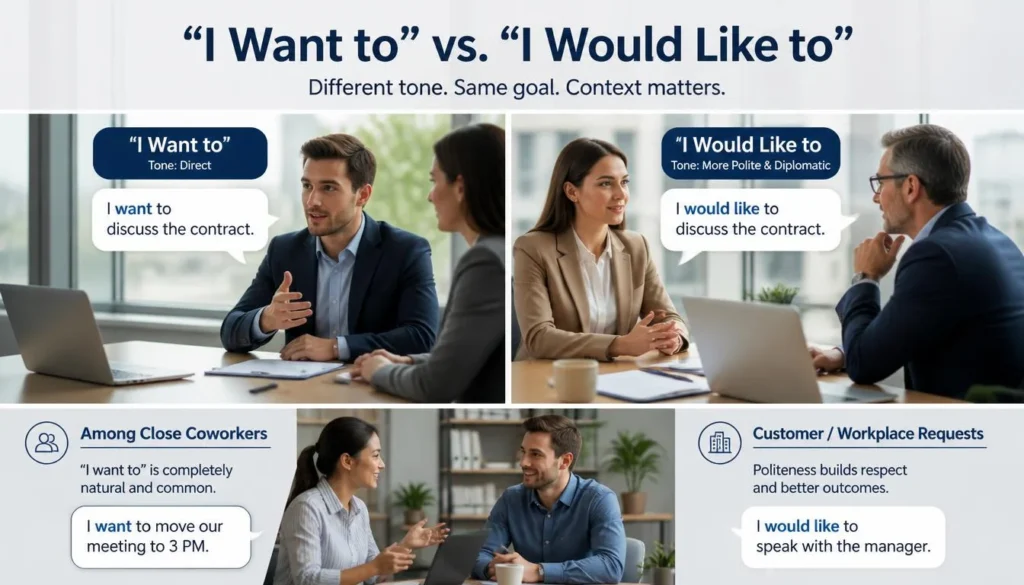
“I want to”
Tone: Direct
I want to discuss the contract.
The sentence is correct and clear. It doesn’t automatically sound rude.
“I would like to”
Tone: More polite and diplomatic
I would like to discuss the contract.
The second version is often more appropriate when you’re making a request or communicating with someone you don’t know well.
Cambridge specifically describes would like as a polite way to express what someone wants.
The difference becomes especially noticeable in requests:
I want to speak with the manager.
I would like to speak with the manager.
The first can sound demanding in some customer-service situations. The second creates a more courteous impression.
Still, context matters.
Among close coworkers, this may be perfectly natural:
I want to talk about the new schedule.
You don’t need to turn every workplace conversation into a formal ceremony.

Choose the Phrase Based on What You Actually Mean
A simple meaning-based approach makes these expressions much easier to remember.
If you mean “This is what I politely want”
Use:
I would like to discuss the issue.
If you mean “This interests me”
Use:
I’m interested in discussing the opportunity.
If you mean “I hope this happens”
Use:
I’m hoping to schedule a meeting next week.
If you mean “This is my plan”
Use:
I plan to submit the report tomorrow.
If you mean “This is my firm intention”
Use:
I intend to complete the work on schedule.
If you mean “I’m excited about this”
Use:
I’m eager to contribute to the project.
If you mean “This is something I’m pursuing”
Use:
I’m looking to develop my leadership skills.
If you mean “This is my goal”
Use:
I aim to improve our response time.
If you mean “I’m seriously dedicated to this”
Use:
I’m committed to improving the process.
If you mean “I’m very enthusiastic”
Use:
I’m keen to explore the opportunity.
If you mean “I won’t give up”
Use:
I’m determined to find a solution.
Once you think about meaning first, choosing the phrase becomes much easier.
Professional Examples for Emails
The difference between these expressions becomes clearer in real workplace writing.
Asking for a meeting
Direct:
I want to discuss the project with you.
Polished:
I would like to discuss the project with you.
Softer:
I’m hoping to discuss the project with you sometime this week.
Each version has a slightly different effect.
The first is direct. The second is polite. The third leaves room for scheduling.
Showing interest in a job
Instead of:
I want to learn more about the position.
Try:
I’m interested in learning more about the position.
This sounds natural in a professional email because it communicates curiosity without sounding demanding.
Explaining a work plan
Instead of:
I want to send the report tomorrow.
Use:
I plan to send the report tomorrow.
Now the sentence communicates an actual plan rather than simply a desire.
Expressing enthusiasm
Instead of:
I want to join the team.
Try:
I’m eager to join the team and contribute to the project.
The second version gives the reader more information about your attitude.
Showing commitment
Instead of:
I want to improve the customer experience.
Use:
I’m committed to improving the customer experience.
The second statement carries significantly more weight because commitment implies dedication and action.
Professional Alternatives in Job Interviews
Job interviews are one of the clearest situations where word choice matters.
You don’t need to avoid “I want to” completely. However, stronger alternatives can help you communicate your professional motivation more precisely.
Consider this answer:
I want to grow professionally and learn new skills.
It’s understandable. But it focuses mainly on personal desire.
Now consider:
I’m eager to grow professionally, develop new skills, and contribute to the team’s goals.
The second answer connects your ambition with the value you can bring.
Useful expressions for interviews include:
- I’m eager to…
- I’m interested in…
- I’m looking to…
- I aim to…
- I’m committed to…
- I plan to…
A useful interview formula
You can often strengthen an answer by combining goal + action + contribution.
For example:
I aim to develop my project-management skills by taking on larger responsibilities and supporting the team on complex assignments.
That sounds stronger than:
I want to become better at project management.
The difference isn’t about fancy vocabulary. It’s about specificity.
Professional Alternatives in Business Emails
Different email situations call for different expressions.
| Situation | Less polished | Better choice |
| Requesting a discussion | I want to discuss this | I would like to discuss this |
| Showing interest | I want to know more | I’m interested in learning more |
| Describing a plan | I want to send it Friday | I plan to send it Friday |
| Explaining intention | I want to address this | I intend to address this |
| Showing enthusiasm | I want to join | I’m eager to join |
| Describing a goal | I want to improve sales | I aim to improve sales |
| Showing dedication | I want to improve service | I’m committed to improving service |
This approach keeps your writing natural because you’re not replacing words just for the sake of sounding formal.
Common Mistakes When Replacing “I Want to”
Replacing “I want to” can create new problems if you choose an expression without understanding its grammar or meaning.
Treating “I want to” as incorrect
This is the biggest mistake.
“I want to” is correct English. It expresses a wish, desire, or intention.
The question isn’t:
Is “I want to” correct?
The better question is:
Does “I want to” fit the tone and meaning I need?
Using “I’m interested in” with the wrong grammar
Correct:
I’m interested in learning more.
Incorrect:
I’m interested in learn more.
When interested in comes before a verb, use the -ing form.
Confusing a plan with a desire
I want to complete the report.
I plan to complete the report.
These aren’t identical.
The first describes desire. The second describes a planned action.
Using “I’m committed to” casually
Commitment implies seriousness.
I’m committed to improving customer service.
This sounds strong.
But:
I’m committed to getting coffee at 10 a.m.
sounds unnecessarily grand unless you’re joking.
Choose words that match the size of the idea.
Using “I’m eager to” when you need certainty
“I’m eager to” expresses enthusiasm. It doesn’t necessarily promise that the action will happen.
Compare:
I’m eager to join the project.
I plan to join the project.
The first emphasizes enthusiasm. The second emphasizes intention.
Making every sentence overly formal
Professional English doesn’t mean replacing ordinary words with complicated ones.
A sentence such as:
I intend to avail myself of the opportunity to communicate my desire to participate.
is technically understandable, but nobody needs that much linguistic furniture.
A simple sentence works better:
I would like to participate.
Clarity wins.
When You Should Keep “I Want to”
Sometimes the best professional choice is to keep “I want to.”
If you’re talking to a familiar coworker, a straightforward sentence may sound more natural:
I want to check the numbers before we send the report.
There’s nothing wrong with that.
You might also use it when emphasizing a personal preference:
I want to make sure everyone understands the changes.
Or when you need directness:
I want to clarify one important point.
In fact, constantly replacing “I want to” can make your writing sound unnatural. Professional communication should feel clear and confident, not like you’re trying to impress a dictionary.
The goal isn’t to sound more formal at every opportunity.
The goal is to sound appropriate.
A Simple Decision Guide
When you’re unsure which alternative to use, ask yourself one question:
What exactly am I trying to communicate?
Do you want to make a polite request?
→ I would like to…
Do you want to show interest?
→ I’m interested in…
Do you want something to happen but aren’t certain?
→ I’m hoping to…
Do you have a future plan?
→ I plan to…
Do you have a firm intention?
→ I intend to…
Do you feel enthusiastic?
→ I’m eager to…
Are you pursuing a current objective?
→ I’m looking to…
Are you focused on a goal?
→ I aim to…
Are you making a serious commitment?
→ I’m committed to…
Are you showing strong interest or enthusiasm?
→ I’m keen to…
Are you emphasizing determination?
→ I’m determined to…
This gives you a practical mental map instead of a list you have to memorize word for word.
Case Study: Turning a Direct Workplace Message Into a Professional One
Imagine an employee needs to contact a manager about a new project.
The first draft says:
I want to talk about the project, discuss changing the timeline, and consider adding another person to the team.
Nothing here is grammatically wrong. However, the repeated “I want to” makes the message sound centered on the employee’s demands.
A more polished version could be:
I would like to discuss the project timeline. I’m hoping we can consider a small adjustment to the schedule. I also think adding another team member could help us meet the deadline.
Notice what happened.
The writer didn’t simply replace every “I want to” with a more formal synonym.
Instead, the writer changed the structure and meaning:
- I would like to introduces the discussion politely.
- I’m hoping we can makes the proposed change collaborative.
- I think introduces a professional recommendation.
- The result sounds confident without sounding demanding.
That’s the real skill behind professional English.
Read more: 11 Professional Ways to Say “I Want to” in English
Case Study: Choosing the Right Phrase in a Job Application
Imagine someone applying for a marketing position.
A basic sentence might say:
I want to develop my marketing skills.
That’s fine, but it doesn’t reveal much.
A stronger version could be:
I’m eager to develop my marketing skills while contributing to campaigns that support the company’s growth.
Now the sentence combines enthusiasm with contribution.
Another option:
I aim to strengthen my marketing skills by working on data-driven campaigns and customer-focused strategies.
This version focuses on a goal.
Neither sentence is universally “better.” They simply communicate different things.
Eager emphasizes enthusiasm.
Aim emphasizes a target.
That is why professional alternatives shouldn’t be treated as interchangeable synonyms.
The Most Useful Alternatives at a Glance
If you only remember a handful of these expressions, remember these five:
I would like to
The safest general-purpose choice.
I would like to discuss the proposal.
I’m interested in
Best for showing interest without making a firm commitment.
I’m interested in learning more about the position.
I plan to
Best for describing a future action.
I plan to submit the report tomorrow.
I’m eager to
Best for expressing enthusiasm.
I’m eager to contribute to the team.
I’m committed to
Best for expressing serious dedication.
I’m committed to improving our service.
These five cover a huge portion of professional situations.
FAQs
1. Is “I want to” professional?
Yes, “I want to” is grammatically correct and can sound professional in the right context. However, softer alternatives may work better in formal emails or polite conversations.
2. What is the most polite alternative to “I want to”?
“I would like to” is one of the safest and most natural alternatives. It expresses your intention without sounding too demanding.
3. How can I sound confident without saying “I want to”?
Try phrases such as “I’m eager to,” “I’m interested in,” or “I’m committed to.” These show confidence while keeping your tone professional.
4. Is “I just wanted to” a weak phrase?
It can be. In sales calls and professional conversations, “I just wanted to” may make your opening sound less confident than a clear, direct statement.
5. What can I say instead of “I just wanted to follow up”?
You can say “I’m following up regarding…” or “I’m reaching out to discuss…” These alternatives sound clearer, more confident, and purposeful.
6. Which alternative should I use in a professional email?
It depends on your purpose. “I would like to” works well for polite requests, while “I’m interested in” suits inquiries and “I’m committed to” shows strong intention.
Conclusion
Choosing a better alternative to “I want to” isn’t about making every sentence sound formal. It’s about matching your words with your purpose, confidence, and relationship with the reader. “I would like to,” “I’m eager to,” and “I’m interested in” can soften your message, while stronger phrases such as “I’m determined to” or “I’m committed to” show clear intention.
The key is to avoid phrases that make you sound uncertain when you actually know what you want. In emails, sales conversations, and everyday professional communication, a natural and confident opening can make your message feel more genuine, respectful, and engaging.

Mia Rose brings fifteen years of experience at The University of Edinburgh’s English Literature department, leading students through explorations of classic and contemporary texts, literary theory, and narrative design. Her academic interests center on Victorian and modernist fiction, poetic rhythms, postcolonial storytelling, and digital approaches to literary study—with a keen eye on how voice and perspective frame cultural dialogue. Mia has delivered talks at prestigious global conferences and authored articles in scholarly journals, showcasing her commitment to meaningful research and lively classroom engagement.