
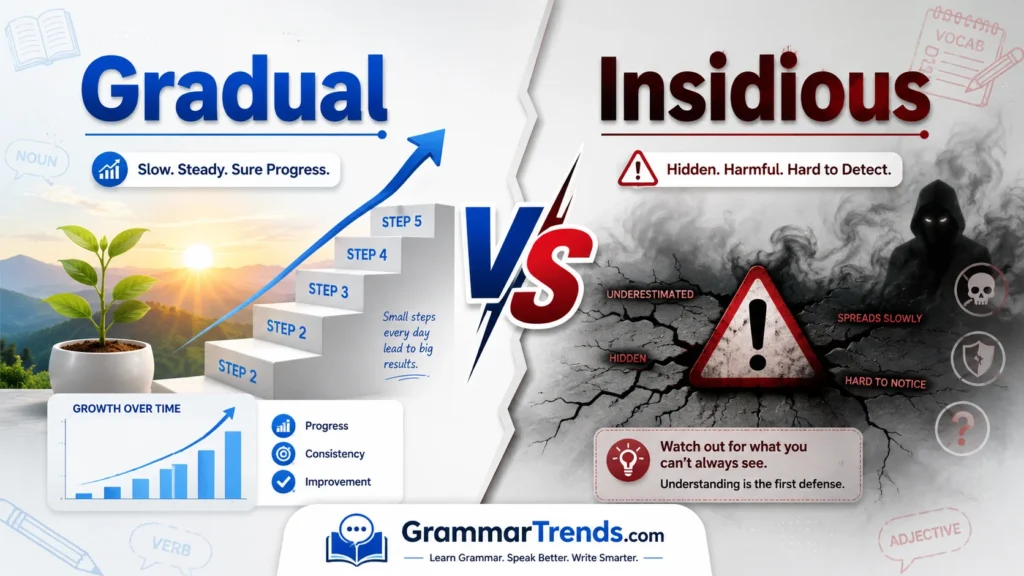
Gradual vs. Insidious shows how change can be slow and visible or hidden and harmful. Although the two words may seem similar at first, they have very different meanings and are used in different contexts.
I once felt confident writing a sentence about gradual and insidious, but I realized that understanding their differences required simple explanations and clear examples. Both words describe change, yet choosing the wrong one can completely change the meaning of a sentence.
A gradual change happens slowly, step by step, over time. It is usually neutral or positive and is commonly used in business, health, education, and writing. Phrases like gradual growth, gradual improvement, and gradual changes describe steady progress that people can observe and understand. Such changes often feel deliberate, intentional, and well-managed.
An insidious change, however, is hidden, harmful, and difficult to notice. It spreads quietly without attracting attention until the problem becomes serious. Examples include an insidious disease, insidious effects, or the insidious spread of misinformation. Because these changes develop subtly, they are often detected only after reaching an advanced stage.
In writing and everyday speech, understanding the context is essential. A gradual approach involves small, visible steps that build on one another over time, such as a company gradually reducing its carbon footprint or improving its operations. In contrast, insidious changes in pollution, misinformation, or disease symptoms are subtle, dangerous, and difficult to detect in their early stages.
Knowing the difference helps make writing clearer and more precise while avoiding common vocabulary mistakes. Whether describing a gradual increase, a gradual shift, or an insidious negative change, selecting the correct word ensures that your message accurately reflects the nature of the change and communicates your intended meaning.
Why People Confuse “Gradual” and “Insidious”
The confusion comes from one shared idea: both words often involve progression over time.
For example:
- A disease may develop gradually.
- A disease may also spread in an insidious way.
Those sentences sound similar. However, they focus on different qualities.
- Gradual focuses on the speed of change.
- Insidious focuses on the hidden harmful nature of change.
Think of it this way:
| Word | Focus | Emotional Tone |
| Gradual | Pace or progression | Neutral |
| Insidious | Hidden damage or danger | Negative |
A sunrise is gradual.
A scam is insidious.
One unfolds slowly. The other quietly causes harm.
That’s the heart of the difference.
Gradual vs. Insidious at a Glance
Quick Comparison Table
| Feature | Gradual | Insidious |
| Meaning | Happening slowly over time | Causing harm subtly |
| Tone | Neutral or positive | Negative |
| Focus | Speed of change | Hidden danger |
| Common Contexts | Learning, recovery, growth | Disease, corruption, manipulation |
| Emotional Impact | Calm or patient | Suspicious or alarming |
| Example | “The improvement was gradual.” | “The influence was insidious.” |
One-Line Memory Trick
Gradual = slow progression
Insidious = hidden harm
Simple. Easy to remember. Surprisingly useful.
What Does “Gradual” Mean?
The word gradual describes something that happens little by little rather than all at once.
Simple Definition of Gradual
Gradual means:
- Slow
- Step-by-step
- Incremental
- Developing over time
It does not automatically imply anything negative.
Examples:
- Gradual healing
- Gradual improvement
- Gradual decline
- Gradual adaptation
Notice something interesting there?
The word itself carries almost no emotional judgment. Context decides whether the situation feels good or bad.
The Origin of “Gradual”
The word comes from the Latin gradus, meaning “step.”
That origin explains the modern meaning perfectly. A gradual process moves forward one step at a time.
It’s the linguistic equivalent of climbing stairs instead of jumping floors.
Common Contexts Where “Gradual” Works Naturally
You’ll see this word everywhere because life itself tends to move gradually.
Health and Recovery
Doctors frequently describe healing as gradual because the body rarely changes overnight.
Example:
“After surgery, her strength returned gradually over several months.”
Learning and Education
Language learning, skill development, and memory improvement usually happen incrementally.
Example:
“His confidence grew through gradual practice.”
Business Growth
Companies rarely explode into success instantly.
Example:
“The startup experienced gradual revenue growth during its first year.”
Environmental Change
Climate scientists often discuss gradual shifts in weather patterns.
Example:
“The region experienced a gradual increase in temperature.”
Common Collocations With “Gradual”
Some word pairings appear so often they sound instantly natural.
| Common Phrase | Meaning |
| Gradual increase | Slow rise |
| Gradual decline | Slow decrease |
| Gradual improvement | Slow positive progress |
| Gradual transition | Step-by-step change |
| Gradual recovery | Slow healing process |
Using these combinations makes your writing sound smoother and more fluent.
What Does “Insidious” Mean?
Now things get darker.
The word insidious describes something harmful that spreads or develops subtly, quietly, or deceptively.
Unlike gradual, this word almost always carries a negative tone.
Clear Definition of Insidious
Insidious means:
- Dangerous in a hidden way
- Gradually harmful
- Deceptive
- Sneaky or subtle
An insidious problem often appears harmless at first. That’s what makes it dangerous.
Example:
“The addiction had an insidious effect on his relationships.”
At first, the damage barely shows. Over time, it becomes serious.
The Origin of “Insidious”
The word comes from the Latin insidiae, meaning “ambush.”
That origin reveals everything.
An insidious threat does not attack openly. It hides. It creeps forward quietly. Then it strikes.
Why “Insidious” Almost Always Sounds Negative
The word carries built-in emotional weight.
When readers see “insidious,” they immediately expect:
- Harm
- Manipulation
- Corruption
- Hidden danger
That’s why using it incorrectly sounds unnatural.
You would never naturally say:
“She made insidious progress in piano lessons.”
That sentence feels bizarre because progress itself is not secretly harmful.
Common Situations Where “Insidious” Fits Perfectly
Disease and Medical Conditions
Many illnesses begin subtly before becoming severe.
Example:
“The disease had an insidious onset.”
Doctors especially use this phrase when symptoms appear slowly and deceptively.
Psychological Manipulation
Toxic behavior often starts small.
Example:
“The cult used insidious emotional tactics.”
The danger hides beneath normal interaction.
Corruption and Propaganda
Political manipulation frequently works through gradual exposure.
Example:
“The article warned about the insidious spread of misinformation.”
Addiction
Addiction rarely destroys lives instantly.
That’s exactly why the word fits.
Example:
“Social gambling can become insidious over time.”
Common Collocations With “Insidious”
| Common Phrase | Meaning |
| Insidious threat | Hidden danger |
| Insidious disease | Disease with subtle progression |
| Insidious influence | Harmful unseen impact |
| Insidious behavior | Manipulative actions |
| Insidious effect | Damage that develops quietly |
These phrases appear constantly in journalism, medicine, and academic writing.
The Core Difference Between Gradual and Insidious
This is where most people finally “get it.”
Gradual Describes Speed
The word answers:
“How fast is this happening?”
Example:
“The transition was gradual.”
That sentence tells us the pace was slow.
Nothing more.
Insidious Describes Hidden Harm
The word answers:
“Is this secretly dangerous?”
Example:
“The transition had insidious consequences.”
Now the sentence emphasizes concealed damage.
Can Something Be Both Gradual and Insidious?
Absolutely.
In fact, many dangerous things work that way.
Examples of Gradual and Insidious Problems
| Situation | Gradual? | Insidious? | Why |
| Addiction | Yes | Yes | Builds slowly and causes hidden harm |
| Debt accumulation | Yes | Yes | Small changes become destructive |
| Burnout | Yes | Yes | Damage develops quietly |
| Climate change | Yes | Sometimes | Long-term hidden consequences |
| Learning guitar | Yes | No | Slow but not harmful |
This overlap explains why people confuse the two words so often.
How to Use “Gradual” Correctly in Sentences
Using gradual naturally is surprisingly easy once you focus on pace.
Natural Sentence Formula
A simple structure works well:
gradual + noun
Examples:
- gradual improvement
- gradual decline
- gradual shift
- gradual adaptation
Everyday Examples of “Gradual”
Health
“His recovery was gradual but steady.”
Career Development
“She made gradual progress toward becoming a manager.”
Technology
“The company introduced AI tools through a gradual rollout.”
Relationships
“Trust developed gradually over time.”
Formal Writing Examples
Academic and professional writing frequently uses gradual because it sounds precise without sounding dramatic.
Examples:
- “The economy experienced gradual expansion.”
- “Researchers observed gradual behavioral changes.”
- “There was a gradual reduction in costs.”
Incorrect Uses of “Gradual”
Some sentences technically work but sound awkward.
Weak Example:
“The criminal organization used gradual tactics.”
The issue here is clarity. “Gradual” does not explain whether the tactics were dangerous.
Better:
“The criminal organization used insidious tactics.”
Now the sentence communicates hidden harm.
Read more: Seal vs Seel: What’s the Difference?
How to Use “Insidious” Correctly in Sentences
The key is recognizing hidden damage.
What Makes Something Insidious?
An insidious problem usually:
- Starts subtly
- Avoids immediate detection
- Causes long-term harm
- Manipulates perception
That hidden nature matters.
Everyday Examples of “Insidious”
Social Media
“The app’s insidious design encouraged endless scrolling.”
Workplace Culture
“Burnout spread through the company in insidious ways.”
Relationships
“The manipulation was subtle and insidious.”
Professional and Academic Examples
Medicine
“Type 2 diabetes can develop through insidious metabolic changes.”
Journalism
“The report explored the insidious effects of online extremism.”
Psychology
“Insidious emotional abuse often damages self-esteem gradually.”
Notice how hidden harm remains central every time.
Incorrect Uses of “Insidious”
Incorrect:
“The garden showed insidious growth during spring.”
Plants are not secretly dangerous in this context.
Better:
“The garden showed gradual growth during spring.”
Gradual vs. Insidious in Real-Life Contexts
Understanding context sharpens your vocabulary dramatically.
Health and Medicine
Medicine uses both words constantly.
Gradual Recovery
A patient may slowly regain strength after surgery.
Example:
“Her mobility improved gradually.”
Insidious Disease Progression
Some illnesses begin with almost invisible symptoms.
Example:
“The condition had an insidious onset.”
Doctors use this phrase for diseases that quietly worsen before diagnosis.
Examples include:
- High blood pressure
- Diabetes
- Osteoporosis
- Certain cancers
Psychology and Human Behavior
Human behavior often changes slowly.
Sometimes harmlessly. Sometimes dangerously.
Gradual Habit Formation
Good habits usually form step by step.
Example:
“Meditation produced gradual improvements in focus.”
Insidious Emotional Abuse
Toxic relationships often start with small manipulations.
The danger builds quietly.
Example:
“The abuse became increasingly insidious over time.”
Business and Marketing
Businesses love gradual change.
Consumers usually hate insidious manipulation.
Gradual Market Expansion
Companies scale carefully to reduce risk.
Example:
“The brand pursued gradual international growth.”
Insidious Marketing Tactics
Some advertising exploits insecurity or addiction.
Example:
“Critics called the strategy insidious.”
Dark-pattern design in apps is a classic example.
Politics and Media
Language becomes especially important here.
Gradual Policy Change
Governments often introduce reforms slowly.
Example:
“The administration implemented gradual tax reforms.”
Insidious Propaganda
Propaganda hides behind emotional messaging.
Example:
“The documentary exposed insidious misinformation campaigns.”
Technology and Social Media
Modern tech creates perfect examples of both concepts.
Gradual Adoption
Most people adopt technology incrementally.
Example:
“AI entered workplaces through gradual integration.”
Insidious Data Collection
Many apps gather user data quietly.
Example:
“Privacy advocates warned about insidious tracking systems.”
Common Mistakes Writers Make
Even experienced writers misuse these words occasionally.
Using “Insidious” as a Fancy Version of “Gradual”
This mistake happens constantly.
People think “insidious” simply means slow.
It doesn’t.
Incorrect:
“The team made insidious improvements.”
Unless the improvements secretly harmed people, the word is wrong.
Correct:
“The team made gradual improvements.”
Assuming “Gradual” Means Negative
Slow change is not automatically harmful.
Incorrect Thinking:
- gradual = dangerous
- insidious = sophisticated version of gradual
That misunderstanding causes muddy writing.
Overusing “Insidious” for Drama
Writers sometimes choose dramatic words unnecessarily.
Weak:
“The insidious rain continued all afternoon.”
Rain is not secretly plotting against anyone.
Better:
“The steady rain continued all afternoon.”
Precision beats exaggeration every time.
Synonyms for Gradual
Using varied vocabulary keeps writing fresh.
| Synonym | Best Context |
| Incremental | Business, data |
| Progressive | Development |
| Steady | Informal writing |
| Slow-moving | Casual tone |
| Step-by-step | Educational content |
Synonyms for Insidious
| Synonym | Difference |
| Subtle | Not always harmful |
| Sneaky | More informal |
| Deceptive | Focuses on dishonesty |
| Corrupting | Emphasizes moral damage |
| Manipulative | Focuses on control |
Choose carefully because each word shifts tone slightly.
Grammar and Usage Notes
Small grammar details make your writing sharper.
Is “Insidiously” a Real Word?
Yes.
It’s the adverb form of insidious.
Example:
“The misinformation spread insidiously through social platforms.”
Can “Gradual” Be Used as a Noun?
Not directly.
However, you can use:
- gradualism
- gradualness
These forms appear less often in everyday writing.
Adjective vs. Adverb Forms
| Adjective | Adverb |
| Gradual | Gradually |
| Insidious | Insidiously |
Examples:
- “The change was gradual.”
- “The change happened gradually.”
Mini Quiz: Test Your Understanding
Fill in the Blank
Sentence 1
“The company experienced a ______ increase in profits.”
Answer: gradual
Sentence 2
“The article warned about the ______ effects of misinformation.”
Answer: insidious
Sentence 3
“His confidence improved through ______ practice.”
Answer: gradual
Sentence 4
“The disease spread in an ______ way.”
Answer: insidious
Quick Practice Table
| Situation | Correct Word |
| Slow healing | Gradual |
| Hidden manipulation | Insidious |
| Step-by-step learning | Gradual |
| Quiet psychological harm | Insidious |
Expert Writing Tips for Choosing the Right Word
Professional writers often pause and ask one simple question:
“Am I describing pace or hidden danger?”
That single distinction solves most confusion.
Think About Emotional Tone
Gradual Feels:
- Calm
- Neutral
- Patient
- Controlled
Insidious Feels:
- Threatening
- Sneaky
- Disturbing
- Manipulative
Tone matters more than people realize.
Read the Sentence Out Loud
This trick works surprisingly well.
If the sentence suddenly sounds melodramatic, “insidious” may be the wrong choice.
If the sentence lacks clarity about danger, “gradual” may be too weak.
Avoid Random Thesaurus Swaps
A thesaurus helps with variety. It should never replace understanding.
“Insidious” is not a smarter version of “gradual.”
They perform different jobs entirely.
FAQs: Gradual vs. Insidious
1. What does “gradual” mean?
Gradual means something that happens slowly over time, step by step, without sudden changes.
2. What does “insidious” mean?
Insidious means something harmful that develops slowly and quietly, often without being noticed at first.
3. Are gradual and insidious the same?
No, they are not the same. Gradual is usually neutral or positive, while insidious is negative and harmful.
4. Can gradual change be good?
Yes. Gradual change is often positive, like improving health, learning skills, or growing a business over time.
5. Why is insidious dangerous?
Because it hides. It can look normal at first but becomes serious or harmful later.
6. How can I remember the difference easily?
Think of “gradual” as slow progress and “insidious” as hidden harm.
7. Where are these words commonly used?
They are often used in health, business, environment, writing, and discussions about change over time.
Conclusion
Understanding Gradual vs. Insidious helps you choose the right word for clear and accurate communication. A gradual change develops slowly in a steady, noticeable way and may be positive, negative, or neutral. An insidious change also develops over time but remains hidden, often causing harm before people recognize it. Knowing this distinction improves English vocabulary, strengthens writing, and helps avoid common word confusion in both everyday conversations and professional communication.

Mia Rose brings fifteen years of experience at The University of Edinburgh’s English Literature department, leading students through explorations of classic and contemporary texts, literary theory, and narrative design. Her academic interests center on Victorian and modernist fiction, poetic rhythms, postcolonial storytelling, and digital approaches to literary study—with a keen eye on how voice and perspective frame cultural dialogue. Mia has delivered talks at prestigious global conferences and authored articles in scholarly journals, showcasing her commitment to meaningful research and lively classroom engagement.