
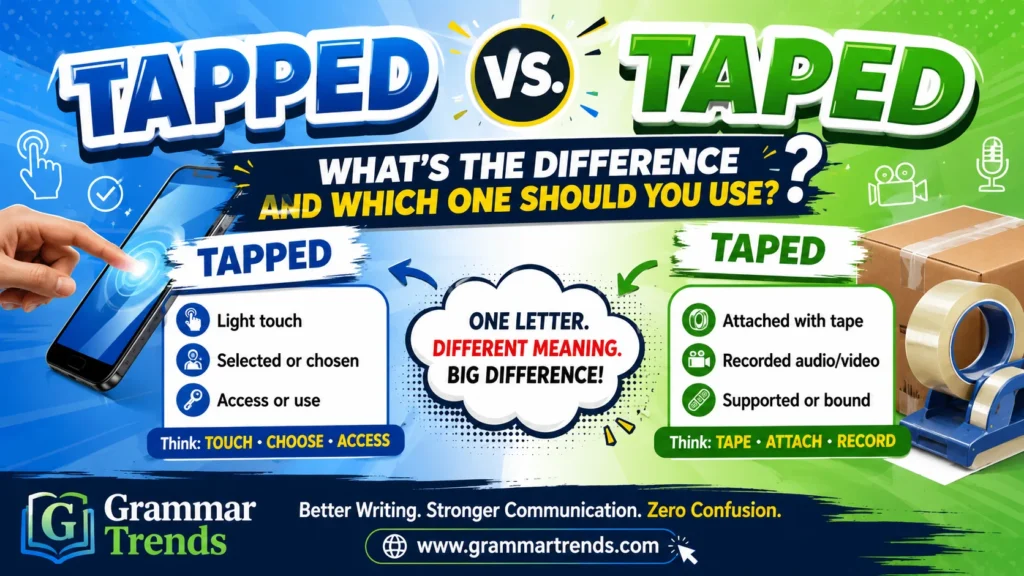
Tapped vs. Taped explores two similar sounding words with different meanings, helping learners use them correctly in context and writing now.
The dataset focuses on how people often confuse the words “tapped” and “taped” because they sound almost identical when spoken, but they serve completely different purposes in English usage. This confusion is common among learners, especially in writing, where small spelling differences can change the entire meaning of a sentence.
“Tapped” generally refers to lightly hitting, touching, or selecting something, such as tapping a screen, foot, keyboard key, or even being chosen for a role or opportunity. On the other hand, “taped” refers to securing, binding, or attaching something using adhesive tape, such as sealing a package, fixing paper on a wall, or recording something using tape.
Understanding this difference improves writing accuracy, strengthens communication skills, and helps prevent common grammar mistakes among learners and writers. Even in professional and academic writing, mixing these two words can lead to misunderstanding, so knowing their correct usage is important for clarity and precision.
In practical usage, “tapped” is often linked with motion, rhythm, interaction, or selection, while “taped” is connected to physical attachment, sealing, fixing, or recording. Real-life examples make the difference clearer—for instance, a person might tap a phone screen to open an app, but they would tape a broken box to close it securely. These simple comparisons make it easier for students, writers, and English learners to confidently choose the correct word depending on context.
Tapped vs. Taped: The Quick Answer
Here’s the fastest way to understand the difference:
| Word | Meaning | Example |
| Tapped | Lightly touched, selected, or hit | “She tapped the phone screen.” |
| Taped | Attached with tape or recorded | “He taped the package shut.” |
The confusion usually happens because:
- The words look alike
- Fast pronunciation blurs the vowel sound
- Autocorrect changes one into the other
- People type quickly on phones
Still, the meanings live in completely different worlds.
Think of it this way:
- Tapped = touch
- Taped = tape
Simple. Clean. Easy to remember.
What Does “Tapped” Mean?
The word tapped is the past tense of tap.
In modern English, “tap” has several meanings depending on context. Most involve a light touch, gentle strike, selection, or access.
Definition of “Tapped”
The verb tap usually means:
- To touch lightly
- To strike gently
- To choose someone
- To access resources
- To select something digitally
When changed into past tense, it becomes tapped.
Example:
“She tapped the table impatiently.”
The action already happened. That’s why “tapped” appears instead of “tap.”
Common Uses of “Tapped”
Light Physical Touch
This is the oldest and most traditional meaning.
Examples:
- He tapped my shoulder.
- She tapped the glass twice.
- The teacher tapped the desk with a pen.
The movement stays gentle. Nobody slams or punches during a tap.
Smartphone and Touchscreen Usage
Modern technology exploded the popularity of the word “tapped.”
Today, millions of people use it daily.
Examples:
- I tapped the app icon.
- She tapped “Accept.”
- He tapped the screen repeatedly.
In digital environments, “tapped” often replaces “clicked” on mobile devices.
Selecting or Choosing Someone
Organizations often “tap” people for roles or responsibilities.
Examples:
- The company tapped her for leadership.
- He was tapped as team captain.
- The president tapped a new advisor.
Here, “tapped” means selected or appointed.
Accessing Resources or Potential
This meaning appears often in business writing.
Examples:
- The startup tapped new markets.
- Scientists tapped underground water supplies.
- She tapped into her creativity.
In this context, “tapped” means gaining access.
Examples of “Tapped” in Real Sentences
Understanding grammar becomes easier when you see natural examples.
Everyday Conversation Examples
- She tapped the counter while waiting.
- I tapped his arm to get attention.
- The child tapped the window excitedly.
Workplace Examples
- Management tapped Sarah for the project.
- He tapped company resources carefully.
- The CEO tapped emerging markets in Asia.
Technology Examples
- I tapped the wrong notification.
- She accidentally tapped “Delete.”
- He tapped the payment terminal.
Notice how every sentence involves touching, selecting, or accessing.
Common Phrases With “Tapped”
English speakers use several popular expressions with “tapped.”
| Phrase | Meaning |
| Tapped on the shoulder | Asked or selected |
| Tapped into potential | Accessed ability or opportunity |
| Tapped for the role | Officially chosen |
| Tapped out | Exhausted or finished |
| Tapped the screen | Touched digitally |
These phrases appear everywhere from casual conversation to corporate writing.
What Does “Taped” Mean?
Now let’s look at the other side of the puzzle.
The word taped is the past tense of tape.
Unlike “tap,” this verb connects directly to adhesive material or recorded media.
Definition of “Taped”
The verb tape means:
- To attach using tape
- To fasten something
- To record audio or video
- To support muscles with athletic tape
Past tense becomes taped.
Example:
“He taped the broken box.”
Common Uses of “Taped”
Using Adhesive Tape
This remains the most common meaning.
Examples:
- She taped the package securely.
- He taped the poster to the wall.
- They taped the wires together.
The action involves physical tape.
Recording Audio or Video
Before digital recording took over, people used magnetic tape.
The phrase survived even after tapes disappeared.
Examples:
- The interview was taped yesterday.
- They taped the TV show live.
- She taped the podcast episode.
Interestingly, younger generations still use “taped” even though actual cassette tapes barely exist anymore.
Language loves holding onto old habits.
Sports and Medical Usage
Athletes frequently tape joints or muscles for support.
Examples:
- The trainer taped his ankle.
- She taped her wrist before practice.
- The fighter taped his hands.
In sports culture, “taped” appears constantly.
Examples of “Taped” in Real Sentences
Home and Office Examples
- He taped the envelope shut.
- She taped a reminder to the fridge.
- They taped loose cables under the desk.
Sports and Medical Examples
- The doctor taped the injured finger.
- The athlete taped both knees.
- She taped her shoulder before lifting weights.
Media and Recording Examples
- We taped the interview last night.
- The network taped the episode early.
- He taped the lecture for later review.
Every example connects to fastening or recording.
Common Phrases With “Taped”
| Phrase | Meaning |
| Taped shut | Closed using tape |
| Pre-taped interview | Recorded earlier |
| Taped ankle | Supported with athletic tape |
| Duct-taped | Attached using duct tape |
| Taped to the wall | Fastened physically |
Tapped vs. Taped: Side-by-Side Comparison
Here’s the clearest comparison possible.
| Feature | Tapped | Taped |
| Base verb | Tap | Tape |
| Main meaning | Light touch or selection | Attach or record |
| Common context | Phones, gestures, appointments | Packaging, sports, recording |
| Physical action | Gentle contact | Securing with tape |
| Technology use | Touchscreens | Video/audio recording |
| Example | “She tapped the icon.” | “He taped the box.” |
One letter changes the entire meaning.
That tiny difference matters more than most writers realize.
Why People Confuse “Tapped” and “Taped”
The confusion doesn’t happen randomly. Several language patterns cause it.
Similar Pronunciation
When people speak quickly, vowel sounds blur together.
For example:
- tapped
- taped
In casual speech, they can sound surprisingly close.
Regional accents increase the confusion even more.
Typing and Autocorrect Errors
Phones constantly sabotage writers.
You type quickly. Autocorrect guesses wrong. Suddenly “tapped” becomes “taped.”
This happens constantly in:
- Text messages
- Emails
- Social media posts
- Online comments
Tiny keyboards create giant grammar mistakes.
Context Overlap in Casual Writing
Modern technology also created overlap.
Consider these:
- “I tapped the screen.”
- “I taped the screen protector.”
Both sentences involve phones. That makes mental confusion easier.
However, the actions differ completely.
One involves touching. The other involves adhesive tape.
When to Use “Tapped”
The easiest way to choose “tapped” is to ask one question:
Does the sentence involve touching, selecting, or accessing?
If yes, “tapped” is probably correct.
Physical Touch or Light Contact
Examples:
- He tapped the microphone.
- She tapped the table.
- The student tapped his pencil nervously.
These actions stay gentle and light.
Technology and Smartphones
Modern digital writing heavily favors “tapped.”
Examples:
- I tapped the login button.
- She tapped the notification.
- He tapped the payment app.
Using “taped” here would sound completely wrong.
Choosing Someone for a Role
Professional environments frequently use this structure.
Examples:
- They tapped him for promotion.
- The board tapped a new director.
- Coaches tapped her as captain.
This version sounds formal yet natural.
Accessing Resources or Potential
Business writers love this phrasing.
Examples:
- The company tapped fresh talent.
- Researchers tapped new funding sources.
- The brand tapped younger audiences.
Here, “tapped” suggests strategic access.
When to Use “Taped”
Use “taped” whenever the sentence involves tape, fastening, or recording.
Using Adhesive Tape
Examples:
- She taped the note to the mirror.
- He taped the cardboard box.
- They taped decorations across the room.
If literal tape appears, “taped” belongs there.
Recording Video or Audio
Even in the streaming era, this wording survives.
Examples:
- The show was taped live.
- We taped the interview yesterday.
- She taped the seminar.
The phrase remains standard English.
Medical and Athletic Use
Sports medicine uses “taped” constantly.
Examples:
- The boxer taped his hands.
- She taped her ankle before running.
- Trainers taped the athlete’s shoulder.
This usage appears in schools, gyms, and professional sports.
Read more: Hide or Hyde: Common English Confusion
Real-Life Examples That Make the Difference Obvious
Sometimes grammar clicks instantly through context.
Office Examples
Correct
- She tapped the keyboard impatiently.
- He taped the shipping label securely.
Incorrect
- She taped the keyboard impatiently.
- He tapped the shipping label securely.
The wrong versions sound awkward immediately.
Classroom Examples
Correct
- The student tapped the desk quietly.
- The teacher taped posters to the wall.
Incorrect
- The student taped the desk quietly.
- The teacher tapped posters to the wall.
Context exposes the mistake fast.
Sports Examples
Correct
- The athlete taped his wrist.
- She tapped the coach on the shoulder.
Incorrect
- The athlete tapped his wrist.
- She taped the coach on the shoulder.
One sentence sounds medical. The other sounds bizarre.
Technology Examples
Correct
- I tapped the app icon.
- He taped the webcam cover.
Incorrect
- I taped the app icon.
- He tapped the webcam cover.
Different actions. Different verbs.
Home Repair Examples
Correct
- Dad taped the cracked pipe temporarily.
- Mom tapped the thermostat screen.
Even simple household situations clarify the difference.
Common Grammar Mistakes to Avoid
Tiny errors damage writing credibility fast.
Let’s eliminate the most common ones.
Using “Tapped” Instead of “Taped”
Incorrect
“I tapped the package closed.”
Correct
“I taped the package closed.”
Why?
Because tape physically seals the package.
You don’t lightly touch a box shut.
Using “Taped” Instead of “Tapped”
Incorrect
“She taped the app icon.”
Correct
“She tapped the app icon.”
The action involves touching a screen. No adhesive tape exists.
Confusing Verb Meaning With Context
Many people choose words based on sound instead of meaning.
That creates chaos.
Always focus on the action itself.
Ask:
- Is someone touching lightly?
- Is someone securing something with tape?
- Is someone selecting digitally?
- Is someone recording media?
Meaning always beats pronunciation.
Simple Memory Tricks to Remember the Difference
Grammar becomes easier when your brain has shortcuts.
“Tap” Involves Touch
The word “tap” feels quick and light.
Think:
- tap a shoulder
- tap a phone
- tap a button
Every example involves touch.
“Tape” Involves Adhesive or Recording
Picture duct tape immediately.
That mental image solves most confusion.
Think:
- tape a box
- tape a poster
- tape a TV show
Now the difference sticks instantly.
Easy Word Association Techniques
| Word | Memory Trick |
| Tapped | Touch action |
| Taped | Tape object |
| Tapped | Finger movement |
| Taped | Adhesive material |
Simple associations work surprisingly well.
Tapped vs. Taped in Digital Communication
Technology changed language dramatically.
These two words evolved alongside it.
Text Messages
People type incredibly fast in chats.
That creates endless errors like:
- “I taped the button.”
- “She tapped the gift shut.”
Autocorrect often worsens the problem.
Social Media Captions
Short-form writing increases grammar mistakes.
Users focus on speed instead of precision.
Examples:
- Instagram captions
- TikTok comments
- X posts
- Facebook updates
One wrong vowel changes the entire meaning.
Workplace Emails
Professional writing demands accuracy.
Imagine receiving this email:
“Please ensure the file is tapped securely.”
That sounds strange immediately.
Correct version:
“Please ensure the file is taped securely.”
Small grammar errors affect professionalism more than people think.
Voice-to-Text Errors
Speech recognition software struggles with similar sounds.
That’s why dictation tools often confuse:
- tapped
- taped
Always proofread voice-generated text.
Machines still make hilarious mistakes.
Regional and Industry-Specific Usage
English changes across industries and countries.
These words sometimes shift slightly depending on context.
American vs. British English Usage
Both American and British English use:
- tapped
- taped
in nearly identical ways.
However, pronunciation differences can increase confusion in spoken conversation.
Technology Industry Usage
Tech companies heavily use “tapped.”
Examples:
- tapped the screen
- tapped the notification
- tapped the feature
Mobile-first culture made this wording standard.
Sports and Medical Terminology
Athletic trainers frequently use “taped.”
Examples:
- taped ankle
- taped wrist
- taped shoulder
Sports medicine relies on compression and support tape constantly.
Mini Quiz: Can You Pick the Correct Word?
Test yourself.
Fill-in-the-Blank Questions
Question 1
She ______ the package shut.
Answer: taped
Question 2
He ______ the app icon twice.
Answer: tapped
Question 3
The trainer ______ the athlete’s ankle.
Answer: taped
Question 4
The manager ______ her for the leadership role.
Answer: tapped
Multiple Choice Examples
Which sentence is correct?
A. She tapped the cardboard box closed.
B. She taped the cardboard box closed.
✅ Correct Answer: B
Which sentence is correct?
A. He taped the touchscreen icon.
B. He tapped the touchscreen icon.
✅ Correct Answer: B
Answer Key With Explanations
| Situation | Correct Word | Why |
| Touchscreen | Tapped | Involves touch |
| Adhesive sealing | Taped | Uses tape |
| Selecting a leader | Tapped | Means chosen |
| Recording a show | Taped | Means recorded |
Frequently Asked Questions (FAQs)
What is the difference between tapped and taped?
Tapped means lightly touching or hitting something, while taped means securing something using adhesive tape.
When should I use the word tapped?
Use tapped when referring to actions like touching a screen, hitting lightly, or selecting something.
When should I use the word taped?
Use taped when something is fixed, sealed, or attached using tape, or when something is recorded.
Why do people confuse tapped and taped?
People confuse them because both words sound similar, but their meanings and usage are completely different.
Can tapped and taped be used in technology contexts?
Yes. Tapped is often used for screen interactions, while taped can refer to recorded audio or video content.
Does tapped always mean physical touch?
Not always. It can also mean selecting or choosing something, especially in digital contexts.
How can I easily remember the difference between tapped and taped?
Remember: tapped = touch, taped = tape (stick/record).
Conclusion
In conclusion, the difference between tapped vs taped is small in spelling but very important in meaning. Tapped is mainly related to light touch, interaction, or selection, while taped refers to securing, attaching, or recording using tape. Understanding this distinction helps improve writing clarity, reduces grammar mistakes, and strengthens overall English usage skills. With simple examples and regular practice, learners can easily master the correct use of both words in everyday communication.

Emma Rose has spent 15 years in the English Department at the University of California, Los Angeles (UCLA), guiding students through British and American literary classics, critical theory, and narrative techniques. Her scholarly focus includes 19th- and 20th-century fiction, the art of poetry, postcolonial writing, and digital humanities particularly how storytelling voice influences cultural perspectives. Emma has presented her research at major international conferences and published in respected academic journals, underscoring her dedication to both high-level scholarship and engaging teaching.