
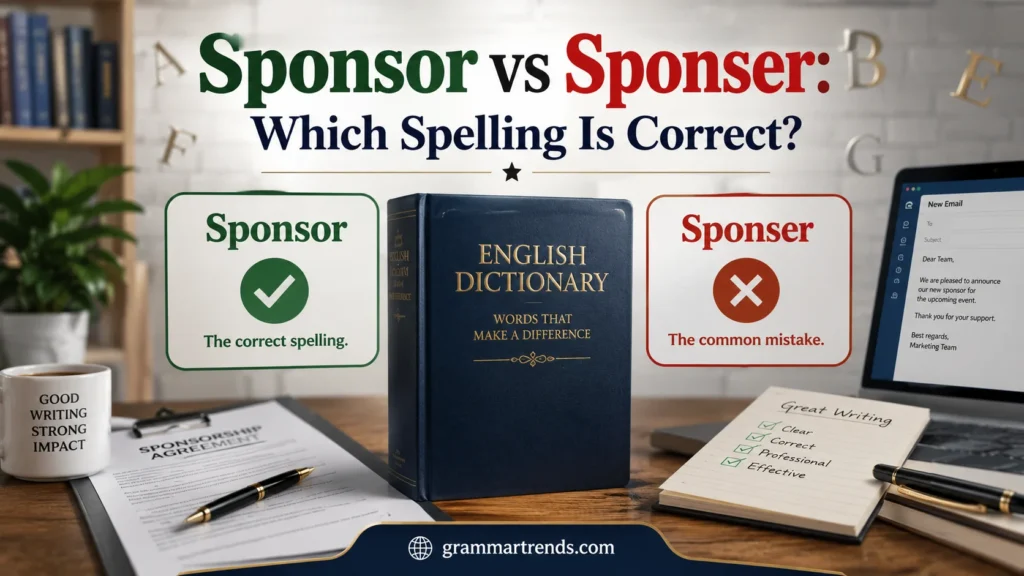
Sponsor vs Sponser is a spelling issue that often appears in emails, business writing, and school work. Many people search this term because it feels spelling feels confusing and the words sound spoken quickly with an o sound that is not very clear, leading to a guess spelling and common misspelling.
Sponsor vs Sponser people often pause and wonder which word is the correct form, especially when a person writes in a professional or formal situations setting where even a small mistake can look careless and affect the message clarity. The correct spelling is important because writing matters, especially in business writing and official article usage where clarity must stay clear and professional.
The confusion usually comes from how sponsor sounds, especially with the -ser ending influence. Many people write wrong way without realizing it, but learning the correct spelling, meaning, usage, and examples helps avoid common mistakes. With simple tips, it becomes easy to say, remember easily, and by the end you will never confuse this word again in real writing situations.
Quick answer
Let’s not drag this out.
The correct spelling is:
👉 Sponsor
The spelling “sponser” is:
👉 Incorrect in standard English
That’s the rule in modern dictionaries, academic writing, legal documents, and professional communication.
But here’s the part most explanations skip: English doesn’t just decide spellings randomly. It follows patterns, history, and pronunciation rules that shape why “sponser” feels right even though it isn’t.
So let’s go deeper.
What “Sponsor” actually means in real life
The word sponsor shows up everywhere—from sports jerseys to visa paperwork to YouTube ads. But its meaning stretches across a few key roles.
At its core, a sponsor is someone who provides support, funding, or backing to another person, group, or event.
That support can be:
- Financial (money)
- Institutional (approval or endorsement)
- Professional (guidance or responsibility)
- Promotional (marketing visibility)
Now let’s unpack it properly.
Sponsor meaning (noun) explained simply
As a noun, a sponsor is the “supporting party.”
Think of:
- A company funding a football team
- A brand paying for a YouTuber’s content
- A person supporting someone’s immigration application
- An organization backing a research project
In every case, the sponsor stands behind someone or something and provides resources or credibility.
Example:
- Nike acts as a sponsor for major athletes.
- A university sponsor funds student scholarships.
Sponsor meaning (verb) in action
As a verb, “to sponsor” means to support or fund something actively.
It usually appears in formal or structured situations:
- To sponsor an event
- To sponsor a visa application
- To sponsor a bill in government
- To sponsor a local charity drive
Example:
- The company sponsored the marathon.
- She sponsored her brother’s immigration application.
Real-world breakdown table: sponsor in context
| Context | Who the sponsor is | What they do |
| Sports | Brand or company | Pays for team exposure |
| Education | Institution or donor | Funds scholarships |
| Immigration | Citizen or company | Provides legal/financial backing |
| Business | Corporation | Sponsors marketing/events |
| Government | Lawmaker | Introduces legislation |
This word isn’t just grammar. It’s structure. It defines relationships of support in modern systems.
Why “Sponser” is wrong but feels so natural
Here’s where things get interesting.
Even though “sponser” looks believable, English simply doesn’t recognize it as correct.
The spelling breakdown that explains everything
The confusion comes from pronunciation. When people say “sponsor,” the ending sounds soft and quick—almost like “spon-sir” in fast speech.
That leads the brain to assume:
👉 “-ser” ending = correct
But English didn’t build this word that way.
The correct structure keeps:
👉 -or ending (not -er or -ser)
The origin of the word explains the spelling
The word comes from Latin:
- Latin root: spondere (meaning “to promise”)
- Old French adaptation: sponsor
- English adoption: sponsor
Notice something important?
The ending stayed consistent with many Latin-derived agent nouns.
That’s why we get words like:
- actor
- doctor
- professor
- sponsor
Not “doctser” or “professer.”
English preserved the “-or” pattern for formal roles and agents.
Why people keep writing “sponser” anyway
Let’s be honest. Mistakes don’t happen randomly.
Here’s what actually causes it:
- Sound-based spelling: people write what they hear
- Overgeneralization: many English words end in “-er”
- Typing speed errors: the “e” sits right near “o” on keyboards
- Auto-correct influence: systems sometimes “learn” the wrong input
- Social media repetition: mistakes spread fast online
Once enough people repeat a wrong spelling, it starts looking normal—even when it isn’t.
How to use “sponsor” correctly in real sentences
Now let’s turn theory into practice. Because knowing the rule means nothing if you can’t use it naturally.
Sponsor as a noun in everyday use
When you use “sponsor” as a noun, think of a supporting entity or person.
Natural examples:
- The company became the main sponsor of the festival.
- Her sponsor helped cover tuition fees for college.
- The event organizers thanked every sponsor publicly.
- A sports sponsor can change a team’s financial future overnight.
Notice how the sponsor always provides backing—not action.
Sponsor as a verb in real-world action
When you switch to verb form, the word becomes active.
Examples:
- The bank sponsors community education programs.
- A tech company sponsors coding bootcamps.
- He sponsored his cousin’s visa application.
- The brand sponsored three major music events this year.
Here, the focus shifts to the act of supporting.
Natural sentence comparison table
| Incorrect Usage | Correct Usage |
| The company sponsered the event | The company sponsored the event |
| She is a sponser of the program | She is a sponsor of the program |
| They will sponser the campaign | They will sponsor the campaign |
One letter changes everything.
Common confusions around sponsor vs similar terms
English loves confusing learners. “Sponsor” doesn’t stand alone—it sits in a family of related words.
Sponsor vs sponsorship
These two often get mixed up, but they play different roles.
- Sponsor = the person or organization
- Sponsorship = the arrangement or relationship
Example:
- Red Bull is the sponsor.
- Red Bull’s sponsorship covers the entire event.
Think of it like this:
👉 Sponsor = person
👉 Sponsorship = contract or relationship
Sponsor vs sponsee
A sponsee is the person receiving support.
You’ll often see this in:
- mentorship programs
- recovery groups
- immigration cases
Example:
- The sponsor filed the application.
- The sponsee received financial support.
Simple relationship:
- Sponsor gives
- Sponsee receives
Sponsor vs endorser
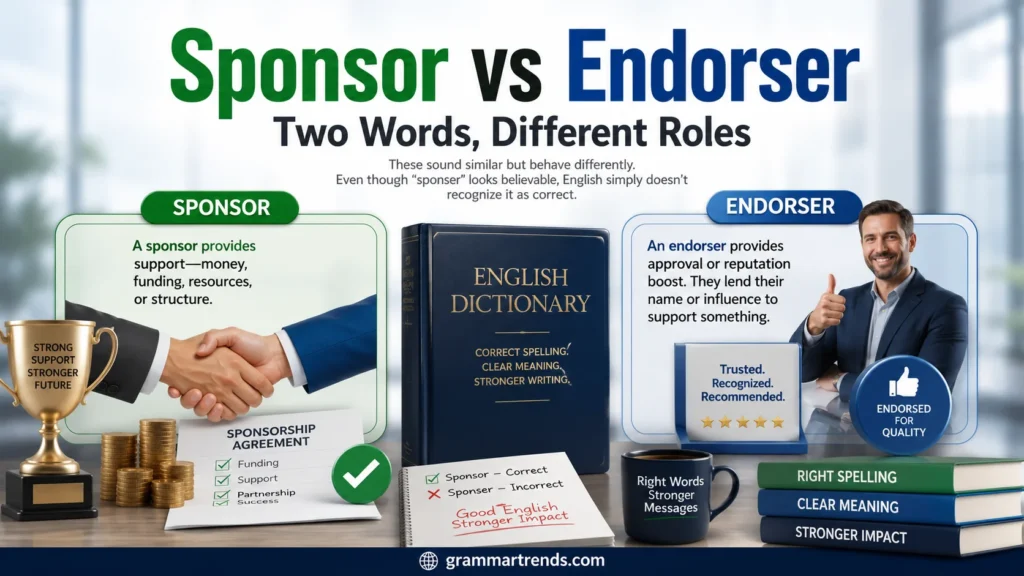
These sound similar but behave differently.
- A sponsor provides support (money, funding, structure)
- An endorser provides approval or reputation boost
Example:
- A company sponsors a marathon.
- A celebrity endorses a shoe brand.
One pays. The other promotes.
Why spelling “sponsor” correctly actually matters
This isn’t just about grammar tests.
Correct spelling affects:
- Professional credibility
- Academic grading
- Job applications
- Legal documentation
- Business communication
One small spelling error can quietly reduce trust in formal writing.
Imagine a sponsorship proposal with “sponser” written repeatedly. It immediately looks less polished, even if the idea is strong.
Memory tricks to never misspell sponsor again
Let’s make this stick.
Simple memory hook that works
Remember this:
👉 Sponsor contains “OR” because a sponsor offers support OR help
That tiny association locks the spelling into memory.
Pattern recognition trick
English often uses “-or” endings for roles:
- actor
- mentor
- director
- investor
- sponsor
So when you see a role or supporter word, “-or” is usually your safe bet.
Quick mental shortcut
Ask yourself:
“Is this someone who supports something?”
If yes → use sponsor
Never “sponser.”
Read more: Village vs Subdivision: Meaning and Differences
Real-world contexts where sponsor plays a huge role
The word isn’t just grammar—it drives industries.
Business and marketing sponsorships
Companies use sponsorships to:
- Build brand awareness
- Reach new audiences
- Associate with events or lifestyles
Example:
A sports drink company sponsoring a marathon links its brand with endurance and fitness.
Sports sponsorships
Sports teams often rely heavily on sponsors.
They provide:
- Uniform branding
- Stadium advertising
- Event funding
Without sponsors, many professional teams would struggle financially.
Immigration sponsorship
In immigration systems, a sponsor:
- Guarantees financial support
- Takes legal responsibility
- Helps applicants meet requirements
This creates accountability between parties.
Common mistakes people make (and how to fix them fast)
Let’s make this practical.
Mistake: using “sponser” in writing
Fix it instantly:
- Slow down when typing the word
- Remember the “OR” rule
- Use spellcheck intentionally, not blindly
Mistake: confusing sponsor with sponsorship
Fix it like this:
- Ask: “Is it a person or a concept?”
- Person → sponsor
- Concept → sponsorship
Mistake: overusing “sponsor” in formal writing
Sometimes writers repeat it too much.
Instead of:
- “The sponsor sponsored the event and sponsored the team…”
Use:
- “The sponsor funded the event and supported the team…”
Cleaner. More natural.
Case study: how spelling affects professional perception
Let’s look at a real-world communication scenario.
A small startup once submitted a sponsorship proposal to a major tech company. The proposal had strong ideas and solid financial projections.
But it repeatedly used “sponser” instead of “sponsor.”
Result?
The proposal didn’t get rejected because of spelling alone, but reviewers noted it looked “less polished and rushed.”
That small detail reduced perceived professionalism.
Lesson?
👉 Good ideas still lose impact if spelling breaks trust.
Quick practice section
Try these in your head.
Choose the correct spelling:
- The company is a sponser of the event
- The company is a sponsor of the event
Correct answer: Sponsor
Fix the sentence:
- She will sponser the program next year
Correct:
- She will sponsor the program next year
FAQs
1. Which is correct: Sponsor or Sponser?
Sponsor is the correct spelling in English. Sponser is a common misspelling and should not be used in professional, academic, or everyday writing.
2. Why do so many people write “Sponser”?
People often spell it as Sponser because the second vowel isn’t strongly pronounced when spoken. As a result, many writers guess the spelling based on how the word sounds rather than how it’s actually written.
3. Can “Sponsor” be used as both a noun and a verb?
Yes. As a noun, a sponsor is a person or organization that provides support or funding. As a verb, it means to financially support or officially back an event, person, or project.
4. Is “Sponser” accepted in any English dictionary?
No. Standard English dictionaries recognize only Sponsor. If you use Sponser, it will be considered a spelling mistake.
5. How can I remember the correct spelling of “Sponsor”?
A simple trick is to remember that Sponsor begins with “spo,” just like sport. Since companies often sponsor sporting events, this connection makes the correct spelling easier to remember.
6. Why is correct spelling important in business writing?
Correct spelling builds trust and professionalism. Writing Sponsor correctly shows attention to detail, while using Sponser can leave readers with a poor impression and reduce the credibility of your message.
Conclusion
The difference between Sponsor vs Sponser is straightforward once you know the rule. Sponsor is the only correct spelling in English, whether you’re writing an email, preparing a business proposal, completing schoolwork, or publishing online content. Sponser is simply a spelling mistake that often happens because of pronunciation.
When you remember that Sponsor is the accepted spelling in dictionaries and professional writing, you’ll avoid a common error that can affect your credibility. A quick proofread and regular practice are all it takes to build the habit. From now on, whenever you need to refer to someone who supports an event, organization, or project, you’ll know that Sponsor is the correct choice every time.

Mia Rose brings fifteen years of experience at The University of Edinburgh’s English Literature department, leading students through explorations of classic and contemporary texts, literary theory, and narrative design. Her academic interests center on Victorian and modernist fiction, poetic rhythms, postcolonial storytelling, and digital approaches to literary study—with a keen eye on how voice and perspective frame cultural dialogue. Mia has delivered talks at prestigious global conferences and authored articles in scholarly journals, showcasing her commitment to meaningful research and lively classroom engagement.