
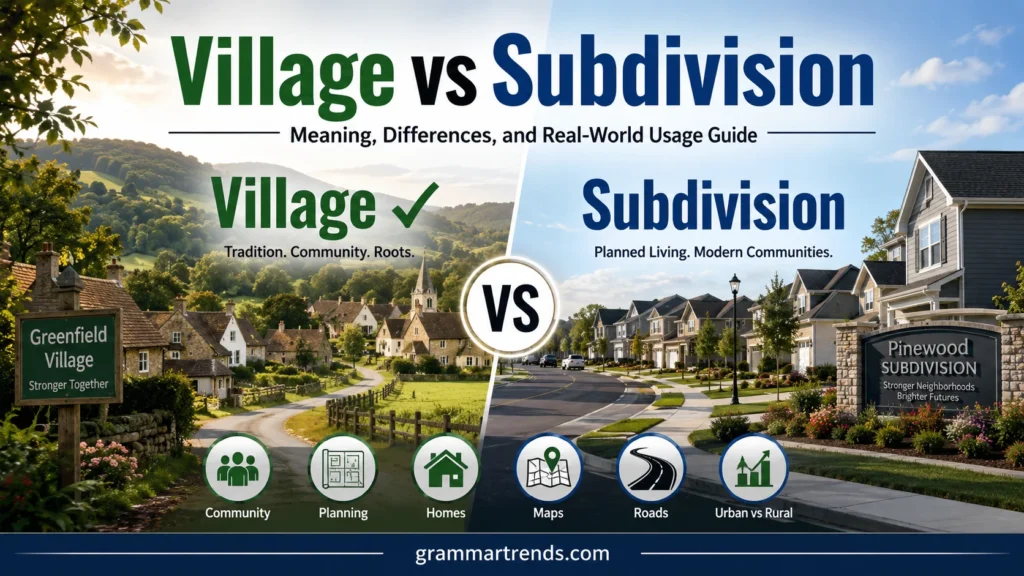
Village vs Subdivision shows Understanding of difference when people choose lifestyle in rural or urban areas.
However, understanding the village and subdivision difference is important when we compare how people living in rural or urban areas choose their lifestyle over time. In many communities, a village is usually small, with homes, houses, peaceful air, even cows, grass, and a close-knit community where neighbors know each other. It feels naturally simple, sometimes a debate for those confused by vs identity, because everything seems identical, mix of old and new, stick to tradition, and think carefully before making a decision about growth, modern change, or staying the same over time.
On the other hand, a Subdivision is a planned development by developers, with clearly planned structure, housing, and organized planning that includes parks, playgrounds, amenities, resources, and centers. It is governed by a council or homeowners system, often urban, sometimes semi-rural, offering larger options for housing, making a strong contrast with villages and their limited features. This article helps explain the meaning and explore how communities work for better understanding, especially when choosing a place to live, where development, population, size, and matters for every family, homebuyer, and type that shapes daily life.
Quick answer
A village is a naturally developed community that grows over time, often with a strong local culture and history. A subdivision is a planned residential area built by developers with organized roads, utilities, and modern amenities. The main difference is that villages evolve naturally, while subdivisions are carefully designed before construction begins.
What a Village Actually Is in Village vs Subdivision Context
Core definition of a village
A village is a small human settlement that usually forms organically over time. It grows around agriculture, water sources, trade routes, or cultural centers.
Unlike modern developments, nobody “designs” a village on paper first. It evolves naturally.
A village often includes:
- A small population
- Local governance or municipal oversight
- Traditional housing patterns
- Strong community identity
Think of it like a tree growing freely in soil. It expands where life supports it.
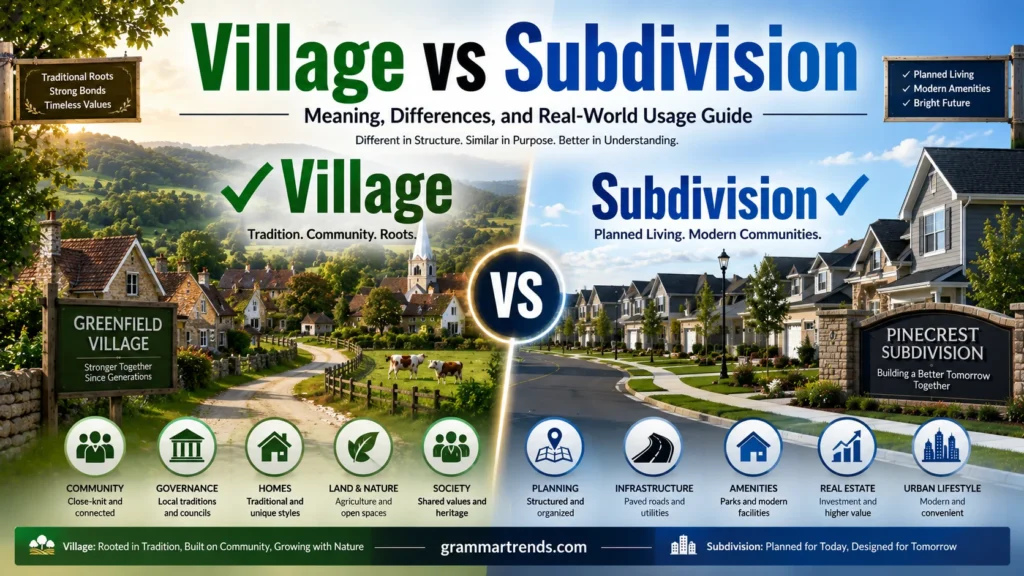
Village in geography, governance, and society
In geography, a village sits between a hamlet and a town. It is larger than a hamlet but smaller than a town.
In governance, villages may fall under:
- Local councils
- Rural municipalities
- Union councils (in countries like Pakistan)
- Parish or township systems (in other regions)
The structure depends heavily on the country.
For example:
- In South Asia, villages often function under union councils with strong agricultural economies.
- In Europe, villages may have centuries-old administrative boundaries.
- In the United States, “village” can also mean an incorporated municipality, depending on the state.
Rural vs urban villages
Not all villages look the same today.
You’ll find two main types:
Rural villages
- Agriculture-based economy
- Lower population density
- Traditional housing materials
- Limited infrastructure
Urban villages
- Surrounded by cities
- High-density housing
- Mixed informal and formal economy
- Rapid transformation due to urban expansion
A quote often used by urban planners explains it well:
“A village is less about size and more about structure, history, and function.”
Common features of a village
Villages share some defining traits:
- Close-knit community relationships
- Limited but essential services (schools, clinics, shops)
- Strong cultural or historical identity
- Open land or agricultural surroundings
- Informal street patterns
A village doesn’t just describe space. It describes lifestyle.
What a Subdivision Means in Village vs Subdivision Comparison
Core definition of subdivision
A subdivision is a planned section of land divided into smaller lots for residential or commercial development.
Developers create subdivisions by:
- Buying large parcels of land
- Getting zoning approval
- Laying roads and utilities
- Selling individual plots or homes
Unlike villages, subdivisions begin on paper first. Then they become physical places.
How subdivisions are created
The process usually follows a structured path:
- Land acquisition
- Planning approval from authorities
- Engineering design (roads, drainage, utilities)
- Lot division
- Construction and sales
Every subdivision follows strict rules set by local planning departments.
Key features of subdivisions
Most subdivisions share common characteristics:
- Uniform housing styles or planned variety
- Curved or grid street layouts
- Utility infrastructure installed in advance
- Homeowners’ Associations (HOAs) in many regions
- Designed green spaces or parks
A subdivision is less organic and more controlled. Every detail follows a plan.
Subdivision vs neighborhood vs development
People often confuse these terms.
Here’s a simple breakdown:
- Subdivision → Legal parcel division of land
- Neighborhood → Social or geographic area people identify with
- Development → Entire construction project (can include multiple subdivisions)
A subdivision can form part of a neighborhood, but not every neighborhood is a subdivision.
Village vs Subdivision: Key Differences Explained Clearly
Understanding village vs subdivision becomes easier when you compare them directly.
Governance and legal structure
| Feature | Village | Subdivision |
| Origin | Organic settlement | Planned land development |
| Governance | Local government or traditional authority | City zoning + HOA rules |
| Legal basis | Administrative region | Property law + planning approval |
Villages operate as communities first. Subdivisions operate as legal land divisions first.
Physical layout and design
Villages usually grow without strict design rules. Roads may curve naturally around terrain.
Subdivisions follow strict engineering plans:
- Straight or curved roads designed for traffic flow
- Equal or tiered lot sizes
- Setback regulations for houses
- Infrastructure installed before occupancy
A village feels natural. A subdivision feels structured.
Social identity and lifestyle
Villages often share:
- Long-term family ties
- Shared cultural traditions
- Local festivals and customs
Subdivisions tend to include:
- New residents from diverse backgrounds
- Less historical identity
- Lifestyle based on housing type rather than culture
In simple terms:
- A village feels inherited
- A subdivision feels assigned
Infrastructure differences
Villages may have:
- Basic roads
- Local water systems
- Limited public transport
Subdivisions typically include:
- Paved roads
- Sewer systems
- Electricity and internet built-in
- Planned drainage systems
Quick comparison table
| Factor | Village | Subdivision |
| Formation | Natural evolution | Planned development |
| Age | Often historic | Usually modern |
| Design | Organic | Structured |
| Identity | Cultural | Residential |
| Control | Government/community | Developers + HOAs |
How to Use “Village” Correctly
Geography and writing
Use “village” when describing:
- Rural settlements
- Historical communities
- Administrative rural areas
Example:
- “She grew up in a small mountain village surrounded by farmland.”
Everyday conversation
People also use “village” metaphorically:
- “It feels like a village here” → meaning close community
- “Tech village” → informal, branding-style usage
However, this is figurative, not technical.
Correct usage examples
- The village sits near the river delta.
- Farmers travel daily from the village to nearby markets.
- The village has existed for over 200 years.
Common mistakes
- Calling every small town a village
- Using “village” for modern housing developments
- Confusing marketing names with actual geography
How to Use “Subdivision” Correctly
Real estate context
Use “subdivision” when talking about:
- Housing developments
- Planned communities
- Land divisions for sale
Example:
- “The new subdivision includes 120 single-family homes.”
Legal and planning language
City planners and engineers use “subdivision” in documents like:
- Zoning maps
- Development permits
- Land registry records
It is a technical term, not a casual one.
Correct usage examples
- The subdivision was approved by the city council.
- Each lot in the subdivision meets zoning requirements.
- The developer expanded the subdivision last year.
Common mistakes
- Using subdivision as a synonym for town
- Calling any neighborhood a subdivision
- Ignoring legal meaning in formal writing
Read more: Provider vs Providor: Meaning and Correct Usage Explained
Why People Confuse Village and Subdivision
Visual similarities
At first glance, both can look similar:
- Houses grouped together
- Roads connecting properties
- Shared community spaces
This visual overlap creates confusion.
Real estate marketing language
Developers often use the word “village” in branding:
- “Sunset Village Estates”
- “Greenfield Village Homes”
But these are still subdivisions in legal terms.
Marketing language often blurs technical meaning.
Regional differences
In some countries:
- “Village” is official administrative term
- “Subdivision” is rarely used
In the U.S. and Canada:
- “Subdivision” dominates planning language
- “Village” may be symbolic or historical
Modern branding effect
Developers prefer “village” because it feels:
- Friendly
- Community-oriented
- Traditional
But legally, it may still be a subdivision.
Special Cases That Blur the Line
Planned “villages”
Some developments call themselves villages but function as subdivisions.
Example:
- Master-planned communities with HOA rules
- Uniform housing with central design control
They are technically subdivisions with branding.
Historic villages inside cities
Many modern cities absorbed old villages over time.
These areas:
- Keep historical names
- Operate under urban governance
- Lose original rural structure
Gated communities
Gated communities often overlap with subdivisions:
- Private access
- Security systems
- HOA governance
They may feel like villages socially, but function as subdivisions legally.
Rural subdivisions
Some subdivisions exist in rural areas:
- Large lots
- Low-density planning
- Mixed natural surroundings
They often resemble villages visually but lack historical development.
Real Estate and Lifestyle Implications
Property value perception
Villages often carry:
- Historical charm
- Cultural value
Subdivisions offer:
- Predictability
- Modern amenities
Buyers choose based on lifestyle preference.
Lifestyle differences
Villages:
- Slower pace
- Community traditions
- Informal structure
Subdivisions:
- Structured living
- Planned amenities
- HOA regulations
HOA vs traditional governance
Subdivisions often include HOAs that:
- Enforce rules
- Maintain shared areas
- Control property appearance
Villages rely more on:
- Municipal systems
- Community norms
Buyer decision guide
Ask yourself:
- Do I want tradition or convenience?
- Do I prefer organic or planned spaces?
- Do I want rules or flexibility?
Your answer often determines village vs subdivision preference.
Common Mistakes in Usage
Mistake: calling every small community a village
Not all small places qualify as villages. Legal classification matters.
Mistake: treating subdivision as casual term
Subdivision is technical. It belongs in real estate and planning language.
Mistake: ignoring legal meaning
A place name may say “village,” but the legal classification may differ.
How to avoid mistakes
- Check zoning or municipal classification
- Use context (planning vs geography)
- Avoid marketing language confusion
Practice Section: Test Your Understanding
Identify village or subdivision
- A farming settlement with 300-year history → Village
- A developer-built housing estate with HOA → Subdivision
Fix the sentence
Incorrect: “The subdivision has ancient traditions.”
Correct: “The village has ancient traditions.”
Match the scenario
- Real estate listing → Subdivision
- Cultural heritage site → Village
- Planned housing project → Subdivision
Quick Decision Guide
Use this simple rule:
- History, culture, organic growth → Village
- Planning, development, real estate → Subdivision
- Marketing name only → Check legal classification
Key Takeaways
- Villages = organic, historical, cultural
- Subdivisions = planned, legal, structured
- Marketing can blur definitions
- Real estate context matters more than appearance
- Always check planning or governance classification
FAQs
What is the difference between a village and a subdivision?
A village is a naturally formed community that has grown over time, while a subdivision is a planned residential development created by developers with organized streets and housing.
Is a subdivision the same as a neighborhood?
No. A subdivision is a legally planned housing development, whereas a neighborhood is a general area where people live. A neighborhood may include one or more subdivisions.
Which offers more modern amenities, a village or a subdivision?
Subdivisions usually provide more modern amenities, such as paved roads, parks, sidewalks, utility services, and community facilities. Villages often have fewer planned amenities.
Can a village become a subdivision?
Yes. As cities expand, some villages are redeveloped into planned residential communities, although many still retain their historical identity.
Are villages always located in rural areas?
No. While most villages are rural, some historic villages have become part of larger cities due to urban expansion.
Which is better to live in: a village or a subdivision?
It depends on your lifestyle. Villages offer a quieter, community-focused environment, while subdivisions provide modern infrastructure, convenience, and planned living spaces.
Conclusion
Understanding the difference between a village vs subdivision helps you choose the right term and better understand different types of communities. A village develops naturally over time, often reflecting local history, culture, and traditions. In contrast, a subdivision is a carefully planned residential development designed with modern infrastructure, organized streets, and community amenities. While both provide places for people to live, they differ in how they are created, governed, and experienced. Whether you’re discussing geography, real estate, or deciding where to live, knowing these distinctions will help you communicate more accurately and make informed decisions.

Mia Rose brings fifteen years of experience at The University of Edinburgh’s English Literature department, leading students through explorations of classic and contemporary texts, literary theory, and narrative design. Her academic interests center on Victorian and modernist fiction, poetic rhythms, postcolonial storytelling, and digital approaches to literary study—with a keen eye on how voice and perspective frame cultural dialogue. Mia has delivered talks at prestigious global conferences and authored articles in scholarly journals, showcasing her commitment to meaningful research and lively classroom engagement.