TM Meaning in Text often shows up while You’re, scrolling, through digital social comments and text messages, where your brain naturally pauses and thinks “Wait, what does TM mean?” in a fast-paced world full of memes, faster replies, and unclear context. It feels confusing because TM is casually used in online chatting, sometimes with No explanation, leaving you not alone in this digital confusion.
In real conversations, especially when reading messages from a friend or texting in a casual tone, TM changes based on context, platform, and intent. It may mean different things in social apps, where abbreviations pop up to make communication faster, but also more misleading. That’s why understanding meaning, tone, and digital context helps you avoid awkward misunderstandings, stay confident, and respond without confusion.
TM Meaning in Text: Quick Answer Before We Go Deep
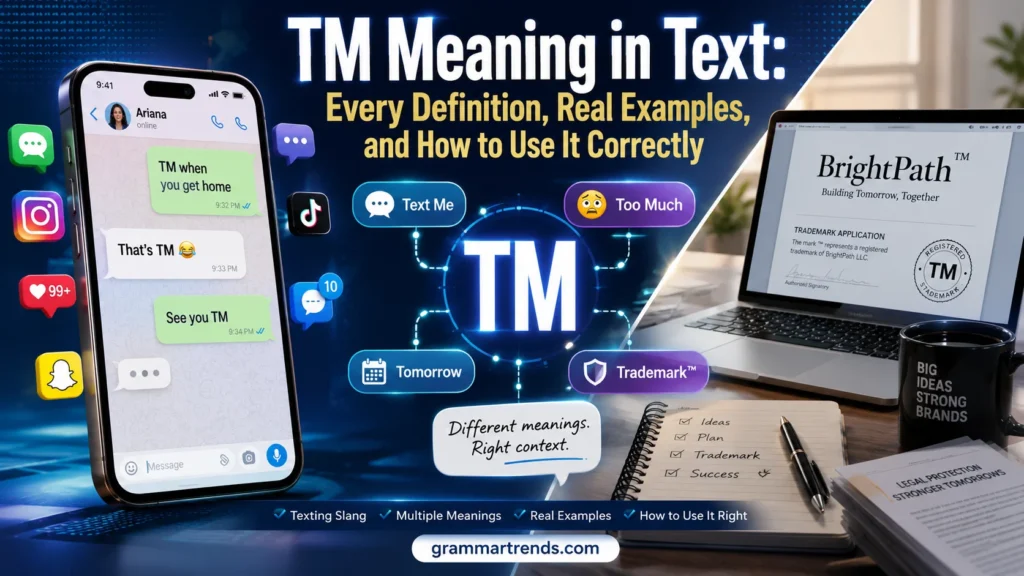
The abbreviation TM in text messaging commonly means:
- Text Me
- Too Much
- Tomorrow
- Trademark (™ symbol usage)
- Rare slang meanings depending on group context
However, the real meaning changes based on where and how someone uses it.
Think of TM like a chameleon. It changes color depending on its surroundings.
All TM Meanings Explained in Text Conversations
Let’s break down every real interpretation of TM meaning in text with practical use cases.
TM Meaning in Text: “Text Me” (Most Common in Chats)
This is the most frequent meaning in casual texting.
People use “TM” as a fast shortcut for “text me,” especially when they want quick communication.
Example:
- “I’m leaving now TM when you get home”
- “Busy rn TM later”
Where you’ll see it:
- WhatsApp chats
- Instagram DMs
- Snapchat conversations
Tone:
- Casual
- Direct
- Action-based
Key idea: If someone uses TM while talking about contact or communication, it almost always means text me.
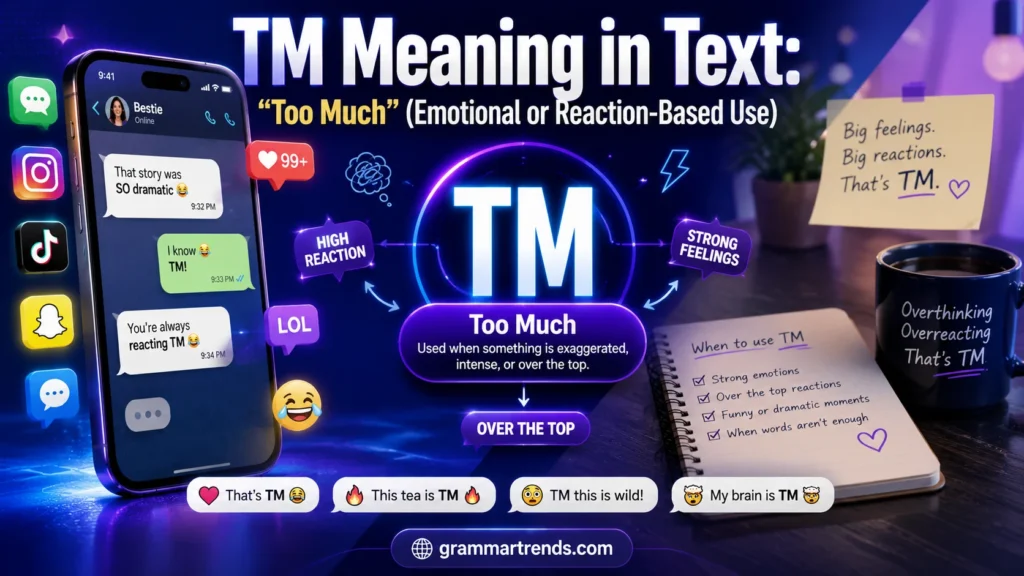
TM Meaning in Text: “Too Much” (Emotional or Reaction-Based Use)
In social media and modern texting, TM often means “too much.”
People use it when something feels:
- overwhelming
- exaggerated
- funny or dramatic
Example:
- “That outfit is TM 😂”
- “This drama is TM fr”
Tone:
- Expressive
- Emotional
- Often humorous
This version shows up heavily in TikTok comments and meme culture.
“TM as ‘too much’ usually carries emotional exaggeration, not literal meaning.”
TM Meaning in Text: “Tomorrow” (Time-Saving Shortcut)
In fast-paced texting, TM can also mean “tomorrow.”
This version is less common but still used in scheduling conversations.
Example:
- “Let’s meet TM at 5”
- “I’ll call you TM morning”
Tone:
- Functional
- Time-focused
- Straight to the point
If the conversation involves plans or scheduling, TM likely refers to time.
TM Meaning in Text: Trademark (™) in Business Contexts
Outside casual texting, TM often refers to the trademark symbol (™).
This appears in:
- branding
- product names
- marketing content
- legal disclaimers
Example:
- “BrandName™ launches new product”
- “All logos are protected by TM laws”
Important fact:
The ™ symbol signals a claimed but unregistered trademark, while ® indicates a registered trademark.
| Symbol | Meaning | Legal Status |
| ™ | Trademark claim | Not officially registered |
| ® | Registered trademark | Legally registered |
TM Meaning in Text: Rare and Contextual Slang
Sometimes TM shows up in niche communities with meanings like:
- “Team”
- “To Me”
- group-specific shorthand
These uses are not standard and depend entirely on inside group language.
TM Meaning in Text by Platform: Why Context Changes Everything
Where you see TM matters just as much as the words around it.
| Platform | Most Likely TM Meaning | Reason |
| Text Me / Tomorrow | Personal communication | |
| Snapchat | Too Much / Text Me | Fast casual slang |
| Too Much | Reaction-based culture | |
| TikTok | Too Much | Meme-driven usage |
| Trademark | Formal/business tone | |
| Work chat (Slack/Teams) | Text Me / Tomorrow | Short professional shorthand |
Key takeaway: Platform sets expectations before you even read the sentence.
Real TM Meaning in Text Conversations (Actual Examples)
Let’s break it down the way people actually talk.
Example 1: Text Me Meaning
- A: “Heading out now”
- B: “Ok TM when you reach”
👉 Meaning: Text me when you reach
Example 2: Too Much Meaning
- A: “He brought flowers, chocolates, and a gift card”
- B: “That’s TM 😂”
👉 Meaning: That’s too much
Example 3: Tomorrow Meaning
- A: “We meeting today?”
- B: “No TM instead”
👉 Meaning: Tomorrow instead
Example 4: Trademark Context
- “NewApp™ now available worldwide”
👉 Meaning: Brand identity/legal trademark
How to Decode TM Meaning in Text Messages (Simple System That Works)
You don’t need guesswork. Use this 4-step method.
How to Understand TM Meaning in Text Easily
Seeing TM in a text message can feel confusing because the same two letters may represent different ideas in different situations. Instead of guessing, focus on the conversation, the platform, and the overall tone. These small clues usually make the meaning clear.
Look at the Conversation Topic First
The topic being discussed often helps you discover the intended meaning of TM.
- When the conversation is about messaging or communication, TM may suggest something related to contacting someone, such as “text me.”
- During emotional or dramatic conversations, it can sometimes describe a situation as “too much.”
- If people are making plans, TM may be used casually to refer to “tomorrow.”
- In business, marketing, or legal discussions, TM usually stands for “trademark.”
Pay Attention to the Feeling Behind the Message
The tone of a message can completely change how an abbreviation should be understood. A humorous post or exaggerated reaction may point toward a meaning connected to “too much.” Meanwhile, a quick request from a friend could suggest that the person wants you to send a text.
Consider the App or Platform
Where you find TM can provide another important clue.
Social platforms like TikTok, Instagram, and Snapchat often encourage creative slang, emotional expressions, and inside jokes. Because of this, abbreviations may have informal meanings that are popular only within certain communities.
Professional platforms and workplace conversations usually follow a different style. In emails, documents, or business discussions, TM is more commonly connected to trademark terminology rather than casual internet slang.
Use the Surrounding Words as Your Guide
An abbreviation rarely explains itself without context. The sentence around TM usually tells you what the person actually means. Reading the entire message before responding helps you avoid misunderstandings and keeps online conversations smooth.
Digital language changes quickly, but understanding the basics of context makes it much easier to decode new texting abbreviations. The next time you see TM in a message, don’t focus only on the letters—look at the story behind them.
Read more: Payment vs Payments: Which Word Should You Use?
Case Studies: Real-Life TM Meaning in Text Confusion
Let’s look at how misunderstanding TM actually causes confusion.
Case Study 1: Misread “Text Me”
A user sees:
“Call me TM”
They think it means “too much.”
They ignore the message.
Result:
They miss an important job callback.
👉 Lesson: Always check if communication is involved.
Case Study 2: Social Media Misinterpretation
On TikTok:
“This plot twist is TM”
A viewer interprets it as “tomorrow.”
They look for a date that doesn’t exist.
👉 Lesson: Social media TM usually means emotional reaction.
Case Study 3: Work Context Error
Email:
“Brand name TM policy updated”
Employee thinks it means “text me.”
They delay reading it.
👉 Lesson: Business context almost always means trademark.
TM Meaning in Text by Generation
Different age groups interpret TM differently.
Younger users (Gen Z)
- Prefer slang meanings
- Commonly use “too much”
- Very comfortable with abbreviation culture
Millennials
- Mix of slang and functional meaning
- More likely to use “text me” or “tomorrow”
Older generations
- Prefer full words
- Often misunderstand slang meanings
- Default to literal interpretations
Common Mistakes When Reading TM Meaning in Text
People often mess this up in predictable ways:
- Assuming TM has only one meaning
- Ignoring tone of conversation
- Missing platform clues
- Overthinking simple slang
Simple truth: TM is not fixed language. It’s flexible shorthand.
When You Should Avoid Using TM in Text
Even though TM saves time, it can create confusion.
Avoid using TM in:
- Professional emails
- Job applications
- Formal writing
- Cross-cultural conversations
- Sensitive discussions
Why?
Because clarity always beats speed when stakes are high.
Better Alternatives to TM (Clearer Communication Options)
Clear Alternatives for Common MYF Meanings
When “Text Me” feels unclear or too short, you can use alternatives like:
- “Message me”
- “Send me a text”
- “Reach out to me”
If you mean “Too Much,” try using clearer expressions such as:
- “That’s overwhelming”
- “That’s a lot”
- “That feels excessive”
For “Tomorrow,” writing the full word is usually the best choice because it keeps your message simple and easy to understand.
In professional or legal situations, avoid shortening “Trademark” and use the complete legal wording to maintain clarity.
TM vs Similar Abbreviations (Quick Comparison Table)
| Abbreviation | Meaning | Common Use |
| TM | Text Me / Too Much / Tomorrow | Context-based |
| TBH | To Be Honest | Opinion expression |
| TY | Thank You | Gratitude |
| TTYL | Talk To You Later | Closing chats |
| IMO | In My Opinion | Personal view |
Frequently Asked Questions
1. What does TM mean in text messages?
TM meaning in text depends on the conversation and platform. In most online chats, TM can mean “Trust Me,” “Tomorrow,” or “Too Much.” It can also refer to “Trademark” in certain situations. Always check the surrounding words to understand the intended meaning.
2. Does TM mean the same thing on every social media platform?
No, TM does not have one fixed meaning across all platforms. On messaging apps, people often use it as a casual abbreviation, while in business or online branding discussions, TM may represent trademark. The context of the message usually reveals the correct meaning.
3. How can I know what someone means by TM in a chat?
Look at the full sentence, the person’s writing style, and the topic of the conversation. For example, if someone says “I’ll tell you TM,” they likely mean “tomorrow.” If they write “TM, you need to believe me,” it may mean “trust me.”
4. Is TM a popular slang word in texting?
Yes, TM is commonly used in digital communication, especially when people want to shorten phrases and type faster. However, it is not as universal as abbreviations like LOL or BRB, so some users may interpret it differently.
5. Can TM have a professional meaning?
Yes. In professional contexts, TM often means “trademark.” Businesses and brands use the ™ symbol to show that a name, logo, or phrase is claimed as a trademark, even if it is not officially registered.
6. Should I use TM in my own text messages?
You can use TM in casual conversations if your audience understands what you mean. However, because it has multiple meanings, it is better to write the full phrase when clarity matters, especially in professional or important messages.
Conclusion
Understanding TM meaning in text helps you communicate more clearly in today’s fast-moving digital world. Since abbreviations often change their meaning depending on the conversation, platform, and relationship between people, it’s important to look at the complete message before making assumptions. Whether TM means “Trust Me,” “Tomorrow,” “Too Much,” or “Trademark,” the surrounding context usually provides the answer.
Online conversations are filled with short forms that save time but can sometimes create confusion. Learning these common texting terms makes it easier to follow social media chats, reply confidently, and avoid unnecessary misunderstandings. The next time you see TM in a message, take a moment to consider the situation, tone, and purpose behind the words. A little context can turn a confusing abbreviation into a simple and clear conversation.

Mia Rose brings fifteen years of experience at The University of Edinburgh’s English Literature department, leading students through explorations of classic and contemporary texts, literary theory, and narrative design. Her academic interests center on Victorian and modernist fiction, poetic rhythms, postcolonial storytelling, and digital approaches to literary study—with a keen eye on how voice and perspective frame cultural dialogue. Mia has delivered talks at prestigious global conferences and authored articles in scholarly journals, showcasing her commitment to meaningful research and lively classroom engagement.