Stuck vs Stock confusion shows how sound and meaning mix in daily language, creating errors in writing, speech, and understanding.
I still notice in everyday use that stuck and stock often create confusion because their sound and meaning are similar, yet they have completely different definitions. Sometimes the brain hears a familiar sound and instinctively chooses the wrong word, creating mistakes in speech and writing. This is why context, spelling, sentence structure, and word choice matter. Missing the right context can change the intended meaning and lead to misunderstandings.
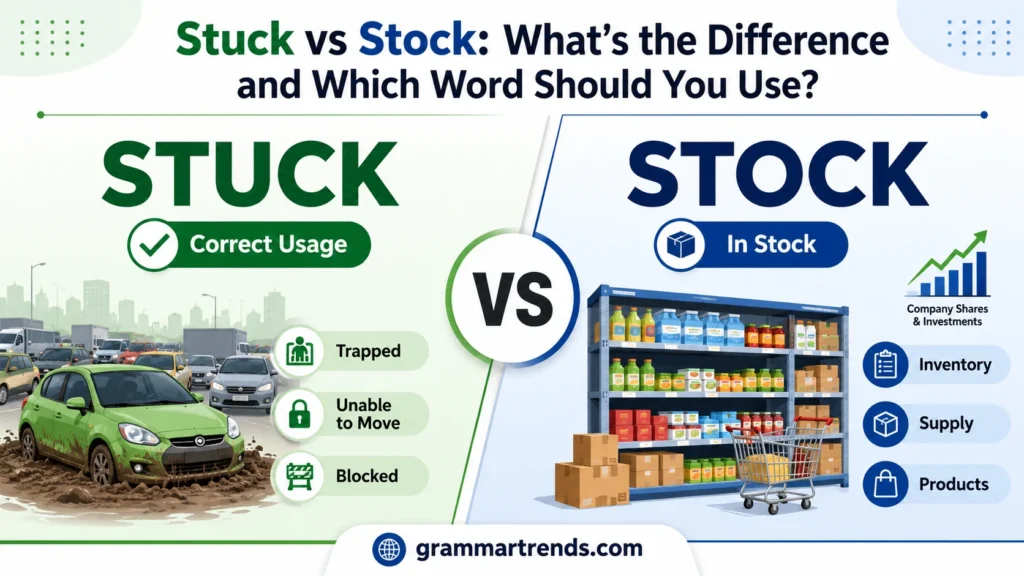
Both stuck and stock are correct English words, but they have different meanings. Stuck refers to being unable to move, escape, or make progress, such as being stuck in traffic, stuck in an elevator, or feeling mentally or emotionally trapped. In contrast, stock refers to a supply of goods, materials, canned items, or products that businesses keep available, and it can also mean shares of a company traded in the financial market. Understanding the context and correct usage of stuck and stock helps avoid common spelling mistakes and improves clear, effective communication.
Stuck vs Stock at a Glance
Before diving into details, here is a quick comparison.
| Word | Part of Speech | Main Meaning | Common Use | Example |
| Stuck | Verb / adjective | Unable to move or trapped | Movement, situations, emotions | “We got stuck in traffic.” |
| Stock | Noun / verb / adjective | Supply, inventory, shares, standard item | Business, retail, finance | “The store has the product in stock.” |
A simple way to think about it:
Stuck = trapped
Stock = supply
That shortcut alone solves most confusion.
What Does “Stuck” Mean?
The word stuck usually describes something that cannot move, cannot progress, or remains fixed in place.
The word comes from the verb stick, which means to attach, become fixed, or remain in one position.
Examples:
- The key got stuck in the lock.
- We became stuck in heavy traffic.
- She felt stuck in a difficult situation.
Notice something interesting. Stuck does not always describe physical movement. It often describes emotional and mental states too.
Stuck as the Past Tense and Past Participle of “Stick”
Here are examples:
- I accidentally stuck the note on the refrigerator.
- The chewing gum stuck to my shoe.
- The poster stuck well to the wall.
In these cases, stuck relates directly to attaching something.
Stuck as an Adjective
Sometimes stuck works more like a descriptive word.
Examples:
- I feel stuck at work.
- He’s stuck between two choices.
- They are stuck in the middle of nowhere.
In these situations, the word describes a condition rather than an action.
Literal Meanings of Stuck
Literal meanings involve physical situations.
Common examples include:
- Stuck in mud
- Stuck in traffic
- Stuck in an elevator
- Stuck inside a building
- Stuck in a door
Imagine driving after heavy rain. Your tires sink into soft ground and spin without moving forward. You are literally stuck.
Figurative Meanings of Stuck
English loves metaphors. Because of that, stuck expanded beyond physical situations.
Examples include:
Emotionally stuck
- He feels stuck after ending a long relationship.
Mentally stuck
- I’m stuck on this math problem.
Professionally stuck
- She feels stuck in her career.
Financially stuck
- They became stuck with debt.
Physical movement isn’t involved here. Instead, progress itself becomes trapped.
Common Expressions Using “Stuck”
English speakers use stuck in many everyday expressions.
| Expression | Meaning |
| Stuck in traffic | Unable to move because of congestion |
| Stuck with a problem | Forced to deal with something |
| Stuck in a routine | Repeating the same pattern |
| Stuck between two choices | Unable to decide |
| Stuck on someone | Strong attraction or affection |
What Does “Stock” Mean?
Unlike stuck, stock has several meanings.
This flexibility often creates confusion because people encounter the word in business, finance, retail, cooking, and general conversation.
Stock as a Noun
The noun form appears most often.
Inventory or Supply
Businesses use stock to describe products available for sale.
Examples:
- The store restocked its shelves.
- We have enough stock for the holiday season.
Retail businesses monitor inventory carefully because poor stock management creates losses.
Company Shares and Investments
The financial world uses stock to describe ownership in a company.
Examples:
- He purchased technology stocks.
- Investors sold their stocks yesterday.
Owning stock means owning a small piece of a company.
For example:
If a business has one million shares and you own ten thousand shares, you own one percent of the company.
Livestock Meaning
Farmers sometimes use stock to describe animals.
Examples:
- The ranch increased its livestock numbers.
- Farmers moved their stock to new grazing areas.
Cooking Stock
Cooking stock is a liquid made by simmering bones, vegetables, herbs, or meat.
Examples:
- Chicken stock
- Beef stock
- Vegetable stock
Stock serves as a flavor base for:
- Soups
- Sauces
- Stews
- Gravies
Stock as a Verb
As a verb, stock means supplying or replenishing.
Examples:
- We stock fresh produce every morning.
- The warehouse stocks thousands of items.
Stock as an Adjective
The adjective form describes something standard or commonly used.
Examples:
- Stock image
- Stock response
- Stock character
A stock response often sounds rehearsed.
For example:
“Thank you for your feedback. We value your opinion.”
Many companies use variations of that line.
Common Expressions Using “Stock”
| Expression | Meaning |
| In stock | Available |
| Out of stock | Unavailable |
| Stock up on | Buy large amounts |
| Take stock of | Assess a situation |
| Stock market | Market for buying and selling shares |
Why People Confuse Stuck and Stock
The confusion isn’t random.
Several reasons explain why people mix these words.
Similar Spelling
Look closely:
Stuck
Stock
Only one vowel changes.
Our brains often scan words quickly instead of reading each letter.
Similar Pronunciation
In some accents, vowel sounds blend together.
Fast speech can make stuck and stock sound closer than they actually are.
Typing Errors
Typing quickly creates mistakes.
For example:
You intend to write:
“I’m stuck in traffic.”
Instead you type:
“I’m stock in traffic.”
Spell check may miss it because stock is still a real word.
Reading Habits
People often predict words before finishing them.
Researchers sometimes call this word shape recognition.
Your brain sees:
st—ck
Then fills in the rest automatically.
Read more: Useful vs Usefull: Meaning, Usage and Examples
Stuck vs Stock: Key Differences Explained
The easiest way to remember the distinction is through context.
| Feature | Stuck | Stock |
| Main meaning | Trapped | Supply or inventory |
| Common situations | Movement and emotions | Business and products |
| Word category | Verb/adjective | Noun/verb/adjective |
| Associated idea | Can’t move | Available items |
Think of it this way:
Stuck stops movement.
Stock fills shelves.
Short. Simple. Memorable.
How to Use “Stuck” Correctly in Sentences
The best way to learn vocabulary involves exposure and repetition.
Here are practical examples.
Physical Situation Examples
- The car became stuck in mud after the storm.
- My zipper got stuck halfway up.
- The elevator was stuck between floors.
- Her ring became stuck on her finger.
Emotional Situation Examples
- He felt stuck after losing his job.
- She remained stuck in the past.
- They felt stuck in an unhealthy relationship.
Problem-Solving Examples
- I’m stuck on question number six.
- The team got stuck during planning.
- We became stuck trying to solve the issue.
Everyday Conversation Examples
- I’m stuck at work tonight.
- We got stuck in traffic.
- I feel stuck right now.
How to Use “Stock” Correctly in Sentences
Retail and Shopping Examples
- The product is back in stock.
- The company ran out of stock.
- Stores increased stock before the holidays.
Financial Examples
- She invested in technology stocks.
- Stock prices rose this morning.
- Investors watched the market closely.
Food Examples
- Add chicken stock to the soup.
- Beef stock creates a richer flavor.
- Homemade stock usually tastes better.
General Conversation Examples
- We stocked the shelves.
- They stocked emergency supplies.
- The warehouse stocks thousands of products.
Real-Life Contexts Where These Words Appear
Words become easier when you see them in everyday situations.
Business and Retail
Retail businesses constantly track inventory.
Imagine a store selling phones.
If demand increases unexpectedly and inventory disappears, employees may say:
“We’re out of stock.”
Saying:
“We’re out of stuck”
would make customers wonder whether the products became trapped somewhere.
Finance and Investing
Financial news frequently uses stock.
Examples:
- Stock market growth
- Stock exchanges
- Stock portfolios
You will almost never see stuck used in this context.
Transportation Situations
Transportation commonly uses stuck.
Examples:
- Stuck in traffic
- Stuck at the airport
- Stuck on a train
Personal Conversations
People often discuss emotions using stuck.
Examples:
- Feeling stuck in life
- Feeling stuck emotionally
- Feeling stuck professionally
Cooking Situations
Cooking relies heavily on stock.
Examples:
- Vegetable stock
- Fish stock
- Beef stock
Chefs often call stock the hidden backbone of flavor.
Without it, many dishes lose depth.
Common Mistakes People Make
Small word errors can create strange sentences.
Using “Stock” Instead of “Stuck”
Incorrect:
❌ I was stock in traffic.
Correct:
✅ I was stuck in traffic.
Using “Stuck” Instead of “Stock”
Incorrect:
❌ The product is stuck.
Correct:
✅ The product is in stock.
Mixing Contexts
Incorrect:
❌ The company sells stuck options.
Correct:
✅ The company sells stock options.
Relying Entirely on Spell Check
Spell-checking software catches spelling errors.
It often misses vocabulary mistakes.
Why?
Because both words already exist.
The software sees no issue.
Simple Memory Tricks to Never Mix Them Up Again
Memory tricks work because they create associations.
Remember the Letter U
StUck
The U can remind you of:
Unable to move
Remember the Letter O
StOck
The O can remind you of:
Objects on shelves
Visual Picture Method
Imagine:
Stuck
A car buried in mud.
Imagine:
Stock
Store shelves packed with products.
Visual memory usually sticks longer.
Sentence Replacement Trick
Ask yourself:
Can I replace the word with trapped?
If yes:
Use stuck.
Can I replace the word with inventory?
If yes:
Use stock.
Practice Quiz: Test Yourself
Try answering before checking the answers.
Fill in the Blank
Question 1
We got ______ in heavy traffic.
Question 2
The store ran out of ______.
Question 3
She felt ______ in her career.
Question 4
Add chicken ______ to the soup.
Choose the Correct Word
Question 1
The warehouse needs to (stuck/stock) more products.
Question 2
The elevator became (stuck/stock).
Question 3
Investors bought company (stuck/stock).
Answers
- Stuck
- Stock
- Stuck
- Stock
- Stock
- Stuck
- Stock
A Quick Real-World Case Study
A customer once emailed an online retailer:
“Your website says the item is stuck.”
The company had accidentally written:
“Item stuck available.”
The intended phrase was:
“Item in stock available.”
Customers became confused and contacted support repeatedly.
One missing letter created a chain reaction.
Tiny details matter.
FAQs
1. What is the main difference between “stuck” and “stock”?
Stuck means unable to move or escape a situation, while stock means a supply of goods, materials, or financial assets.
2. Why do people confuse “stuck” and “stock”?
They sound similar, so the brain often mixes them when speaking or writing without paying attention to context.
3. Can “stuck” be used in emotional situations?
Yes. You can feel stuck mentally or emotionally when you cannot make decisions or move forward in life.
4. What does “stock” mean in business?
In business, stock refers to products kept in storage or available for sale, including inventory and goods.
5. Is “stuck” only physical?
No. It can be physical (like traffic) or emotional/mental (like feeling blocked in thinking or life choices).
6. How can I avoid mixing these words?
Focus on context: movement or blockage suggests stuck, while goods or inventory suggest stock.
7. Are both words grammatically correct?
Yes, both stuck and stock are correct English words, but they are used in completely different meanings.
Conclusion
Understanding the difference between stuck and stock is essential for clear and accurate communication. Although the two words sound similar, they have completely different meanings and are used in different contexts. Stuck describes a person or object that cannot move or make progress, while stock refers to a supply of goods or ownership shares in a company. Paying attention to context and sentence meaning will help you choose the correct word every time and avoid common writing mistakes.

Emma Rose has spent 15 years in the English Department at the University of California, Los Angeles (UCLA), guiding students through British and American literary classics, critical theory, and narrative techniques. Her scholarly focus includes 19th- and 20th-century fiction, the art of poetry, postcolonial writing, and digital humanities particularly how storytelling voice influences cultural perspectives. Emma has presented her research at major international conferences and published in respected academic journals, underscoring her dedication to both high-level scholarship and engaging teaching.