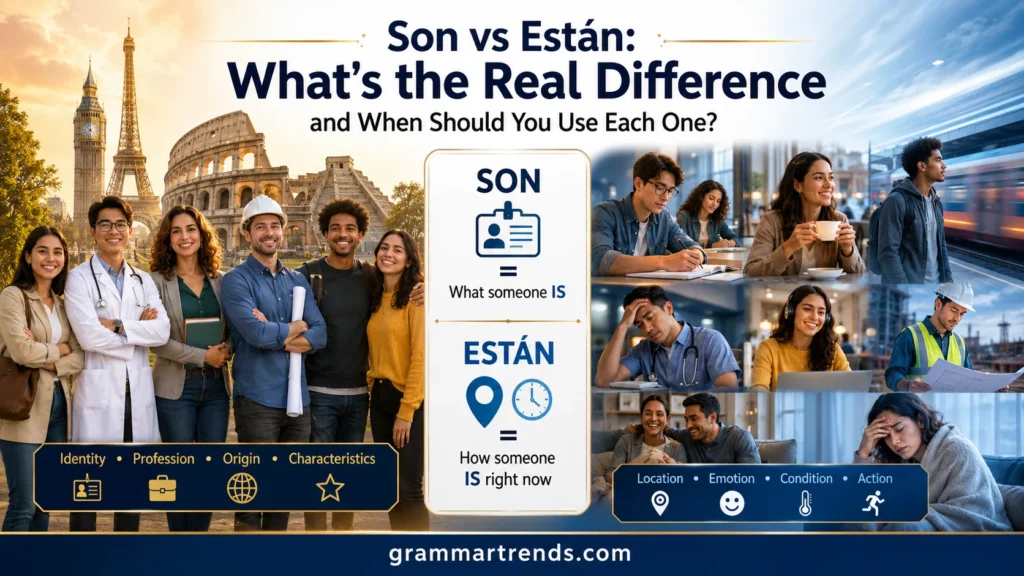
Son vs Están: Spanish verb forms ser/estar show permanent vs temporary states in daily communication and often confuse learners easily here
In Spanish, verb forms Son and Están come from ser and estar, and they are used in different contexts, meanings, and usage in daily communication. From my experience in learning, I often notice learners get confused because these tricky words are hard to differentiate in early grammar.
The article helps explore understanding of their differences, showing how they describe a person, place, or thing, and why they are not interchangeable and cannot be used in the wrong context. In grammar, Son is third person plural from ser, while Están comes from estar, both copular verb forms used in Spanish descriptions.
In real usage, Son shows permanent, inherent, and long-lasting qualities like nationality, profession, and physical traits, while Están shows temporary, changing conditions, emotions, locations, and states. For examples, Ellos son altos, manzanas rojas, or apples in beach/playa scenes with ripe maduras fruit, while niños cansados shows a temporary state.
From my experience, mixing both verb forms creates unnatural sentences, leading to confusion and miscommunication in writing, speaking, and overall communication. Improving sentence structure, meaning, and clarity helps readers better understand descriptions in writing.
Son vs Están: The Quick Answer
The simplest explanation looks like this:
| Word | Verb | Main Use | English Meaning |
| Son | Ser | Identity, characteristics, origin | They are |
| Están | Estar | Location, condition, temporary state | They are |
Here’s the core idea:
- Use son for things that define what something is
- Use están for things that describe how something is right now
For example:
| Spanish Sentence | English Meaning |
| Ellos son estudiantes | They are students |
| Ellos están cansados | They are tired |
Being a student is identity.
Being tired is temporary.
That single distinction solves most confusion.
What Does “Son” Mean in Spanish?
The word son comes from the verb ser.
It is the third-person plural form of the verb. In plain English, it means:
- they are
- you all are
Spanish uses son when talking about identity, characteristics, origin, or permanent traits.
Think of son as the verb for things that define someone or something at its core.
When To Use “Son” Correctly
Use “Son” for Identity
Identity answers the question:
“What is this person or thing?”
Examples:
- Ellos son profesores.
- Ustedes son hermanos.
- Esos animales son perros.
These examples describe what someone is, not how they feel temporarily.
Use “Son” for Professions
Jobs and occupations almost always use ser.
| Correct Usage | Translation |
| Son médicos | They are doctors |
| Son ingenieros | They are engineers |
| Son artistas | They are artists |
A profession forms part of identity in Spanish grammar.
That’s why saying:
- Están médicos
sounds incorrect to native speakers.
Use “Son” for Nationality and Origin
Origin also uses ser because birthplace and nationality usually stay constant.
Examples:
- Ellos son de España.
- Mis amigos son mexicanos.
- Estas uvas son de Chile.
You can think of origin as part of a thing’s “core information.”
Use “Son” for Physical and Personality Traits
Descriptions that define a person normally use son.
Examples:
- Son inteligentes.
- Son altos.
- Son simpáticos.
- Son generosos.
These traits describe general characteristics rather than temporary moods.
Use “Son” for Time and Dates
Spanish uses ser for clock time and calendar dates.
Examples:
- Son las tres.
- Hoy es lunes.
- Son las ocho y media.
This rule surprises many English speakers because time feels temporary. Spanish simply treats time differently grammatically.
Use “Son” for Ownership and Material
Examples:
- Las llaves son de Ana.
- La mesa es de madera.
- Estos libros son míos.
The sentence identifies possession or composition.
What Does “Están” Mean in Spanish?
The word están comes from the verb estar.
Like son, it also means:
- they are
- you all are
However, estar focuses on:
- location
- emotional states
- temporary conditions
- ongoing actions
Think of están as the “current situation” verb.
It describes what’s happening now rather than permanent identity.
When To Use “Están” Correctly
Use “Están” for Location
Location almost always requires estar.
Examples:
- Los niños están en casa.
- Mis zapatos están debajo de la cama.
- Ellos están en México.
A quick shortcut:
If you can point to where something is, you probably need estar.
Use “Están” for Temporary Conditions
Conditions change. Because of that, Spanish uses estar.
Examples:
- Están cansados.
- Están enfermos.
- Están nerviosos.
These situations can improve or change later.
Use “Están” for Emotions
Feelings also use estar.
Examples:
- Están felices.
- Están tristes.
- Están preocupados.
Emotions fluctuate constantly. Spanish treats them as temporary states.
Use “Están” for Ongoing Actions
Spanish forms the present progressive tense using estar.
Structure:
Están + verb ending in -ando or -iendo
Examples:
- Están estudiando.
- Están trabajando.
- Están comiendo.
This works similarly to English “are studying” or “are working.”
Use “Están” for Temporary Situations
Examples:
- Las calles están vacías.
- Los estudiantes están ocupados.
- Las computadoras están apagadas.
These conditions may change soon.
Read more: “Shaky” vs “Shakey”: Usage with Real Examples
The Real Difference Between Son and Están
Many grammar guides oversimplify the rule as:
- ser = permanent
- estar = temporary
That helps beginners. Still, real Spanish goes deeper than that.
The true distinction often comes down to:
| Son (Ser) | Están (Estar) |
| Identity | Condition |
| Essence | State |
| Classification | Situation |
| Permanent quality | Temporary quality |
| What something is | How something is |
This subtle distinction explains tricky examples.
Why Meaning Changes So Much
Consider these two sentences:
| Sentence | Meaning |
| Ellos son aburridos | They are boring |
| Ellos están aburridos | They are bored |
The adjective stays the same.
The verb changes everything.
In the first sentence, boredom defines their personality.
In the second, boredom describes a temporary feeling.
That’s why mastering ser and estar matters so much in real communication.
How To Use “Son” in Sentences
Common Sentence Structures With “Son”
Spanish often follows these patterns:
Subject + Son + Noun
Examples:
- Ellos son médicos.
- Ustedes son estudiantes.
Subject + Son + Adjective
Examples:
- Son inteligentes.
- Son amables.
Subject + Son + Origin
Examples:
- Son de Colombia.
- Son de Perú.
Examples of “Son” Used Naturally
| Spanish | English |
| Mis padres son muy trabajadores | My parents are very hardworking |
| Ellos son buenos amigos | They are good friends |
| Son las nueve de la noche | It is 9 PM |
| Las flores son hermosas | The flowers are beautiful |
| Estos teléfonos son caros | These phones are expensive |
Notice how each sentence describes identity, classification, or defining qualities.
How To Use “Están” in Sentences
Common Sentence Structures With “Están”
Subject + Están + Location
Examples:
- Los libros están aquí.
- Mis amigos están afuera.
Subject + Están + Adjective
Examples:
- Están cansados.
- Están emocionados.
Subject + Están + Progressive Verb
Examples:
- Están hablando.
- Están corriendo.
Examples of “Están” Used Naturally
| Spanish | English |
| Los niños están dormidos | The children are asleep |
| Las llaves están en la cocina | The keys are in the kitchen |
| Ellos están estudiando español | They are studying Spanish |
| Los estudiantes están nerviosos | The students are nervous |
| Ustedes están muy callados hoy | You all are very quiet today |
Each example describes condition, position, or current activity.
Side-by-Side Examples of Son vs Están
This is where things become interesting.
The same adjective can completely change meaning depending on the verb.
Adjectives That Change Meaning With Ser and Estar
| Adjective | With Ser | With Estar |
| Aburrido | Boring | Bored |
| Listo | Clever | Ready |
| Rico | Wealthy | Delicious |
| Verde | Green | Unripe |
| Malo | Bad | Sick |
| Vivo | Lively | Alive |
| Orgulloso | Arrogant | Proud |
These shifts happen because ser defines identity while estar describes state.
Real Contextual Examples
Ser + Aburrido
- Juan es aburrido.
Juan has a boring personality.
Estar + Aburrido
- Juan está aburrido.
Juan feels bored right now.
Huge difference.
Another Important Example
| Sentence | Meaning |
| La sopa es buena | The soup is generally good |
| La sopa está buena | The soup tastes good right now |
The first sentence evaluates the soup overall.
The second focuses on the current experience.
Native speakers use these nuances constantly.
Common Mistakes To Avoid
Spanish learners often make the same mistakes repeatedly.
Avoid these and your Spanish immediately sounds more natural.
Using “Son” for Location
Incorrect:
- Ellos son en casa.
Correct:
- Ellos están en casa.
Remember:
Physical location almost always uses estar.
Using “Están” for Profession
Incorrect:
- Ellos están médicos.
Correct:
- Ellos son médicos.
Jobs describe identity, not temporary condition.
Translating Directly From English
English uses one verb: “to be.”
Spanish splits the concept into two verbs.
That means direct translation often fails.
For example:
English:
- “They are quiet.”
Spanish could be:
- Son callados → quiet by nature
- Están callados → quiet right now
The context changes everything.
Forgetting Accent Marks
The correct form is:
- están
Not:
- estan
Accent marks matter in Spanish because they affect pronunciation and meaning.
Easy Memory Tricks for Son vs Están
Grammar rules become easier when tied to mental shortcuts.
The DOCTOR Acronym for Ser
| Letter | Meaning |
| D | Description |
| O | Occupation |
| C | Characteristic |
| T | Time |
| O | Origin |
| R | Relationship |
If the sentence fits DOCTOR, use ser.
Examples:
- Son profesores.
- Son altos.
- Son hermanos.
The PLACE Acronym for Estar
| Letter | Meaning |
| P | Position |
| L | Location |
| A | Action |
| C | Condition |
| E | Emotion |
If the sentence fits PLACE, use estar.
Examples:
- Están aquí.
- Están durmiendo.
- Están felices.
Visual Analogy That Actually Helps
Imagine:
- Ser = permanent marker
- Estar = sticky note
A permanent marker represents defining identity.
A sticky note represents temporary information that can change tomorrow.
Simple. Memorable. Effective.
Special Cases and Exceptions Most Learners Miss
Spanish grammar always contains exceptions.
These cases confuse even intermediate learners.
Event Locations Use Ser
Normally location uses estar.
However, events use ser.
Example:
- La conferencia es en Madrid.
- La fiesta es en mi casa.
Why?
Because Spanish treats the sentence as identifying where the event takes place rather than describing physical position.
Temporary Appearance Changes Use Estar
Examples:
- Estás muy guapo hoy.
- Están elegantes esta noche.
The appearance may not define permanent identity. It describes a current state.
Some Conditions Become Permanent Over Time
This creates gray areas.
For example:
- Está muerto.
Death is permanent in reality. Yet Spanish still uses estar because it describes condition rather than identity.
That surprises many learners.
Idiomatic Expressions With Ser and Estar
Some phrases simply need memorization.
Common Expressions With Ser
| Expression | Meaning |
| Es importante | It is important |
| Es verdad | It is true |
| Es posible | It is possible |
Common Expressions With Estar
| Expression | Meaning |
| Está bien | It is okay |
| Está claro | It is clear |
| Está mal | It is wrong |
Native speakers use these constantly in conversation.
Son vs Están in Questions
Questions reveal whether you truly understand the distinction.
Questions Using “Son”
Examples:
- ¿Son ustedes hermanos?
- ¿Son de Argentina?
- ¿Son profesores?
These ask about identity or origin.
Questions Using “Están”
Examples:
- ¿Dónde están mis llaves?
- ¿Están cansados?
- ¿Están trabajando ahora?
These ask about condition, location, or activity.
How Native Speakers Respond Naturally
Identity Response
Question:
- ¿Son médicos?
Answer:
- Sí, somos médicos.
Condition Response
Question:
- ¿Están cansados?
Answer:
- Sí, estamos agotados.
Notice how the response mirrors the original verb.
Mini Practice Exercise
Try these before checking the answers.
Choose Between Son or Están
- Ellos ___ felices hoy.
- Mis amigos ___ estudiantes.
- Las llaves ___ sobre la mesa.
- Ustedes ___ inteligentes.
- Los niños ___ jugando.
Answers
- están
- son
- están
- son
- están
Correct the Mistakes
Incorrect:
- Ellos son cansados.
Correct:
- Ellos están cansados.
Incorrect:
- Los libros son en la mochila.
Correct:
- Los libros están en la mochila.
Translate Into Spanish
| English | Spanish |
| They are doctors | Son médicos |
| They are tired | Están cansados |
| The children are at school | Los niños están en la escuela |
| They are funny | Son graciosos |
Quick Reference Chart for Son vs Están
| Use Son For | Use Están For |
| Identity | Location |
| Profession | Emotion |
| Origin | Temporary condition |
| Personality | Ongoing action |
| Material | Physical state |
| Time and date | Temporary appearance |
Bookmark this chart mentally. It covers most everyday situations.
Why Native Speakers Rarely Think About the Rules
Fluent speakers don’t mentally run grammar formulas during conversation.
Instead, they absorb patterns through exposure.
That’s why reading, listening, and speaking matter more than memorizing endless charts.
Children learning Spanish never study “ser vs estar” formally at first. They hear thousands of examples naturally.
You can train your brain similarly through repetition and context.
A Simple Study Strategy That Actually Works
Many learners waste months memorizing isolated rules.
A smarter method works better.
Focus on Chunks, Not Single Words
Learn:
- está cansado
- son amigos
- están aquí
as complete phrases.
Your brain remembers patterns faster this way.
Read Real Spanish Daily
Good sources include:
- Spanish news articles
- YouTube subtitles
- Netflix shows
- Beginner Spanish readers
- Language exchange chats
Repeated exposure builds intuition naturally.
Speak Before You Feel Ready
Perfectionism slows fluency.
Most learners improve faster once they stop fearing mistakes.
Even native speakers occasionally mix grammar in fast speech. Communication matters more than flawless precision early on.
FAQ
What is the difference between Son and Están?
Son is used for permanent traits, while Están is used for temporary conditions or states in Spanish.
When should I use Son?
Use Son when describing lasting characteristics like profession, nationality, or physical traits.
When is Están used in Spanish?
Están is used for changing situations such as emotions, locations, or temporary states.
Are Son and Están interchangeable?
No, Son and Están are not interchangeable because they express different meanings.
Why do learners get confused between Son and Están?
Many learners mix them because both mean “to be” but are used in different contexts.
Can using the wrong form change meaning?
Yes, using the wrong form can create confusion and make sentences sound unnatural.
How can I improve my usage of Son and Están?
Practice examples in real situations and focus on whether the condition is permanent or temporary.
Conclusion
Here’s a concise, SEO-friendly conclusion for your article:
Conclusion
Understanding the difference between Son vs Están is an important step toward speaking and writing Spanish accurately. While Son is used for permanent characteristics such as identity, nationality, profession, and physical traits, Están describes temporary conditions, emotions, locations, and changing states. Remembering this simple distinction will help you choose the correct verb naturally in everyday conversations.
The more you practice with real-life examples, the easier it becomes to recognize when each verb should be used. By mastering Son vs Están, you’ll improve your Spanish grammar, avoid common mistakes, and communicate with greater confidence and clarity.

Mia Rose brings fifteen years of experience at The University of Edinburgh’s English Literature department, leading students through explorations of classic and contemporary texts, literary theory, and narrative design. Her academic interests center on Victorian and modernist fiction, poetic rhythms, postcolonial storytelling, and digital approaches to literary study—with a keen eye on how voice and perspective frame cultural dialogue. Mia has delivered talks at prestigious global conferences and authored articles in scholarly journals, showcasing her commitment to meaningful research and lively classroom engagement.