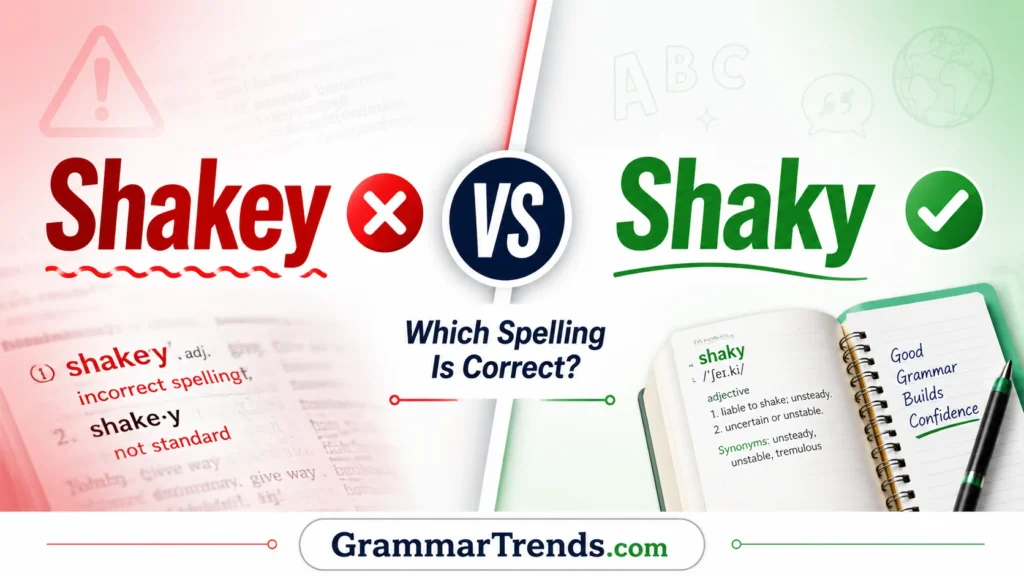
Shaky vs Shakey creates spelling confusion because both words sound the same, making many writers stop and question which version is correct.
I remember typing a message and staring at the word, wondering if shakey somehow looked better than shaky. It is a small doubt, but it catches students, bloggers, and professionals every day. The extra e seems harmless, yet it often turns a simple sentence into a spelling puzzle. Because English pronunciation does not always match spelling, this common error, typo, and misspelling appears frequently in texts, emails, captions, and online posts.
Many people struggle with these commonly confused words while writing articles, assignments, or social media content. The correct and widely accepted spelling is shaky, while shakey is generally considered a nonstandard variant or a simple spelling mistake. Understanding the correct spelling, proper meaning, and accurate usage improves writing confidence, readability, communication skills, and overall language accuracy.
The easiest way to remember the difference is to focus on standard English usage. Shaky is an adjective that describes something unsteady, weak, wobbly, nervous, or uncertain. You can talk about shaky hands, shaky legs, a shaky bridge, or a shaky relationship. In medical situations, it may describe trembling, tremors, or involuntary shaking. Common synonyms include unsteady, wobbly, and unstable, while antonyms include steady, firm, and stable.
In everyday English, shaky is the form recognized in formal writing, professional communication, academic work, and trusted publications. Good grammar, proper sentence structure, accurate spelling, and careful word choice help writers avoid confusion and produce clear, polished content. Modern spellcheck tools, language-learning resources, NLP systems, and semantic analysis also identify shaky as the standard spelling, making it the best choice for confident and effective writing.
Quick Answer:
In short:
- “Shaky” is the correct and standard spelling
- “Shakey” is non-standard and usually informal
You’ll see “shakey” in:
- Brand names
- Nicknames
- Stylized writing
- Informal internet usage
But in:
- Essays
- Exams
- Professional writing
- Journalism
You should always use “shaky.”
Here’s a simple way to remember it:
If it’s English grammar, go with “shaky.”
If it’s a name or style choice, “shakey” might appear—but that’s the exception, not the rule.
What “Shaky” Means: Definition and Real Usage
The word “shaky” is an adjective. It comes from the verb shake, and it describes something unstable, unsteady, or uncertain.
But its meaning shifts depending on context. Let’s break it down clearly.
Physical meaning
When something literally moves or trembles.
- shaky hands
- shaky legs
- shaky camera footage
Example:
After running the marathon, his legs felt shaky, and he had to sit down immediately.
Emotional meaning
When a person feels nervous, scared, or unsure.
- shaky confidence
- shaky voice
- shaky nerves
Example:
She gave a shaky smile before walking onto the stage.
Abstract or figurative meaning
Used for situations, systems, or ideas that are unreliable.
- shaky plan
- shaky argument
- shaky economy
Example:
His argument sounded shaky because he didn’t include any evidence.
Key takeaway
“Shaky” doesn’t only describe physical trembling. It also describes anything that feels unstable, uncertain, or weak.
Think of it as a word that always signals:
👉 “Something isn’t solid here.”
Is “Shakey” a Real Word or Just a Mistake?
Here’s where things get interesting.
“Shakey” is not considered standard English.
But that doesn’t mean it never appears.
You’ll find it in:
- Business names (like cafés or restaurants)
- Nicknames (someone trying to sound playful)
- Branding choices
- Online usernames
So why does it exist at all?
Simple explanation
People often add “-ey” endings to make words feel casual or friendly.
For example:
- dog → doggy
- sweet → sweety (informal/incorrect standard English)
- shaky → shakey (stylized form)
But in grammar rules, “shaky” already follows correct English word formation patterns, so “shakey” is unnecessary.
Important rule
If you remove branding and informal style, “shakey” does not belong in standard writing.
Word Origin of “Shaky”
To really understand the word, it helps to see where it came from.
Root word: “shake”
The verb “shake” has been part of English for centuries. It means to move rapidly back and forth.
From that verb, English naturally builds adjectives.
Formation of “shaky”
English often uses the suffix “-y” to turn verbs or nouns into adjectives.
Examples:
- mess → messy
- noise → noisy
- cloud → cloudy
- shake → shaky
So “shaky” literally means:
“having the quality of shaking”
Why spelling became standardized
Over time, English writing settled on consistent forms. “Shaky” became the accepted spelling in dictionaries, education, and publishing.
“Shakey,” however, never became part of that standardization process.
Real Differences:
Let’s make this crystal clear.
| Feature | Shaky | Shakey |
| Standard English | Yes | No |
| Dictionary usage | Yes | Rare/Not standard |
| Formal writing | Correct | Incorrect |
| Common usage | Very common | Limited (names/branding) |
| Meaning clarity | Clear | Depends on context |
The key difference
It’s not about meaning. Both look like they mean the same thing.
The real difference is:
“Shaky” is grammar. “Shakey” is style or mistake.”
How to Use “Shaky” in Real Sentences
Let’s see how the word actually works in everyday English.
Physical examples
- My hands felt shaky after too much coffee.
- The bridge looked shaky in the strong wind.
- His voice turned shaky during the interview.
Emotional examples
- She felt shaky before her exam results.
- I gave a shaky laugh to hide my nerves.
- His confidence was shaky after the mistake.
Situational examples
- The company has a shaky financial history.
- Their friendship is on shaky ground.
- The deal rests on a shaky agreement.
Quick pattern insight
You’ll often see “shaky” followed by:
- nouns (shaky hands)
- abstract ideas (shaky plan)
- emotional states (shaky confidence)
It acts like a warning sign in language.
Read more: Comment vs Coment: When Should You Use It?
Common Word Combinations With “Shaky”
English loves pairing words together. “Shaky” is no different.
Here are the most natural collocations:
- shaky start
- shaky ground
- shaky voice
- shaky relationship
- shaky evidence
- shaky foundation
- shaky performance
Why these matter
These combinations feel natural to native speakers. Using them helps your writing sound smooth instead of robotic.
Antonyms of “Shaky” (With Real Examples)
To understand a word fully, you also need its opposites.
Stable
The table is stable even on uneven ground.
Steady
Her steady hands helped her perform the surgery.
Firm
He gave a firm answer without hesitation.
Secure
The building feels secure during storms.
Confident
She walked in with a confident smile.
Comparison in context
- Shaky confidence → nervous and uncertain
- Confident mindset → calm and sure
The contrast is sharp and easy to spot.
“Shaky” in Different Contexts
Let’s look at how the word changes depending on where it’s used.
Everyday life
People use it casually to describe nerves or instability.
“I feel shaky after that rollercoaster ride.”
Business and finance
It describes uncertainty or risk.
“The startup has a shaky business model.”
Health and physical state
It often refers to trembling or weakness.
“Low blood sugar can make you feel shaky.”
Technical and structural use
Engineers or analysts may use it metaphorically.
“The data rests on shaky assumptions.”
Why People Confuse “Shaky” and “Shakey”
This confusion makes sense when you think about how language works in real life.
Here’s why it happens:
Pronunciation confusion
Both words sound identical when spoken. So spelling becomes guesswork.
Influence of informal writing
Text messages, social media, and usernames often bend spelling rules.
Branding effect
Some businesses intentionally use “shakey” to stand out visually.
Search engine reinforcement
People type both versions into search engines, which keeps the confusion alive.
Memory Trick to Remember the Correct Form
Here’s a simple trick you can use instantly:
“Shaky ends like funny, messy, and noisy — all correct adjectives.”
So when you’re unsure, think:
- funny ✔
- messy ✔
- shaky ✔
“Shakey” doesn’t fit that pattern.
Case Study: How One Extra Letter Changes Meaning
Let’s look at a real-world writing scenario.
Scenario
A student writes:
“The argument was shakey and lacked evidence.”
A teacher marks it incorrect.
Correction
“The argument was shaky and lacked evidence.”
Why it matters
- Academic writing demands standard spelling
- “Shakey” signals carelessness
- “Shaky” signals correctness and clarity
Even one letter can affect credibility.
Another Example: Professional Communication
Imagine an email in a workplace:
❌ “The project plan looks shakey.”
✔ “The project plan looks shaky.”
The second version sounds:
- professional
- polished
- trustworthy
The first one feels informal and sloppy.
Final Summary: The Simple Truth
Let’s bring everything together.
- Shaky is the correct, standard spelling
- It describes physical, emotional, and abstract instability
- Shakey is informal, stylistic, or incorrect in grammar
- The confusion comes from pronunciation and informal usage
If you remember one thing, make it this:
When writing English properly, “shaky” always wins.
It keeps your writing clean, professional, and easy to trust.
My Personal Experience:
Over the past 10 years of teaching English, I have noticed that “shaky” and “shakey” are among the spelling pairs that often confuse students and even experienced writers. In my grammar classes, learners frequently write “shakey” because it looks similar to other English words ending in -ey. However, whenever we check trusted dictionaries and style guides together, they quickly discover that “shaky” is the standard and correct spelling used in modern English.
I also encourage my students to read newspapers, books, and reputable online publications to see how words are used in real-life contexts. This practical approach helps them remember that shaky is the preferred spelling in academic, professional, and everyday writing, while shakey is generally limited to informal usage, brand names, or personal names. From my classroom experience, understanding the reason behind the spelling not just memorizing it helps learners avoid repeating the same mistake and write with greater confidence.
FAQs
Is shaky the correct spelling in English?
Yes, shaky is the correct spelling in modern English language usage. The form shakey is usually treated as an alternative spelling, common typo, or misspelling.
Why do people confuse shaky and shakey?
Many people get confused because both spellings have the same pronunciation in spoken English. This creates language confusion, especially during fast writing or casual texting.
Is shakey officially recognized in dictionaries?
Most major dictionaries list shaky as the standard form. Shakey may appear as a personal name, slang reference, or informal variation, but it is not widely accepted in formal writing.
Can shaky describe emotions and physical movement?
Yes, shaky can describe both emotional and physical conditions. People often use it for shaky hands, shaky feelings, trembling motion, nervous behavior, or unsteady movement.
What are some synonyms of shaky?
Common synonyms include wobbly, unsettled, weak, jittery, and unsteady. These words carry similar meanings depending on the context and sentence structure.
How can I avoid this spelling mistake?
Using spellcheck, improving vocabulary building, practicing language learning, and reading more written English can help prevent this spelling mistake and improve writing clarity.
Does using the correct spelling improve writing quality?
Absolutely. Using the correct usage, proper spelling, and accurate word choice makes your work look more professional, trustworthy, and polished in both casual and professional communication.
Conclusion
The difference between shaky and shakey may seem small, but knowing the right spelling can greatly improve your writing confidence and overall communication skills. Since both words sound alike, it is easy to fall into this common spelling dilemma, especially in fast typing or casual conversation. Still, shaky remains the accepted and standard spelling in modern English, while shakey is mostly viewed as an informal variation or typo. Once you understand the proper meaning, correct spelling, and natural usage of the word, you can write more clearly, avoid unnecessary grammar confusion, and communicate with greater confidence in everyday and professional writing.
References
- Cambridge Dictionary. Shaky. Cambridge University Press.
- Collins English Dictionary. Shaky. HarperCollins Publishers.
- Dictionary.com. Shaky. Dictionary.com, LLC.
- Merriam-Webster Dictionary. Shaky. Merriam-Webster, Incorporated.
- Oxford Learner’s Dictionaries. Shaky. Oxford University Press.

Emma Brooke brings 15 years of experience in the Department of English Language and Literature at the University of California, Berkeley, where she has taught and mentored students across courses in British and American literary traditions, critical theory, and narrative form. Her expertise spans 19th- and 20th-century fiction, poetic prosody, postcolonial literatures, and digital humanities, with a focus on how narrative voice shapes cultural meaning. Emma’s work has been presented at international conferences and published in peer-reviewed venues, reflecting her deep commitment to rigorous literary scholarship and accessible teaching.