
Have you ever typed “safetyness” only to wonder if your spellchecker was right to flag it? It’s a surprisingly common question. Since many English adjectives become nouns by adding -ness, it’s easy to assume that safe should follow the same pattern. However, English has a few exceptions that catch even experienced writers off guard.
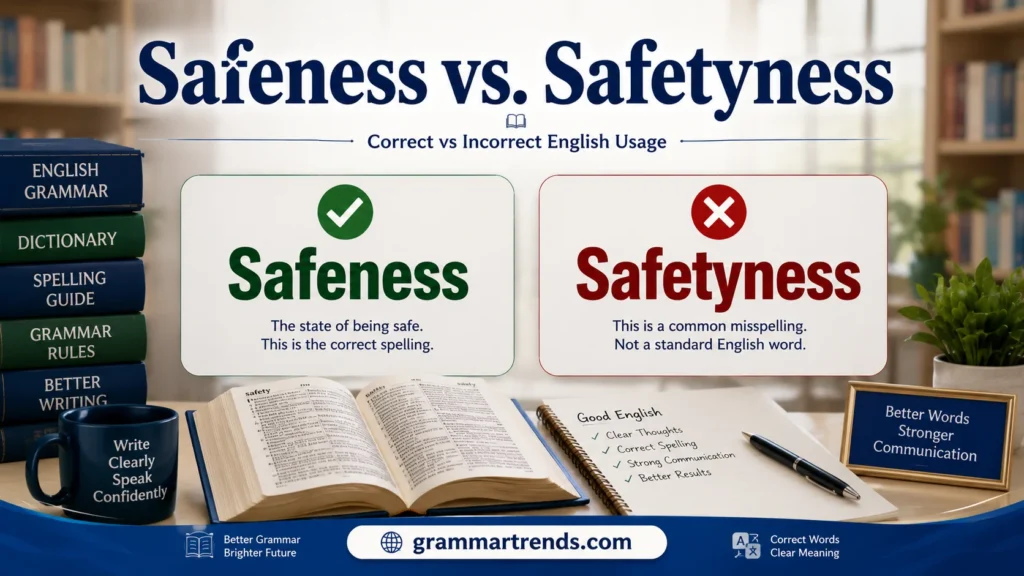
When comparing safeness vs. safetyness, only one is recognized as standard English. While safeness is a legitimate word, safetyness isn’t accepted by major dictionaries or style guides. To make things even more interesting, most native speakers rarely use safeness because safety has become the preferred noun in modern English.
Understanding this small difference can improve your writing, whether you’re drafting a school assignment, preparing a professional report, or creating online content. In this guide, you’ll learn what safeness really means, why safetyness is incorrect, how safety differs from safeness, and which word fits best in different situations. By the end, you’ll know exactly which spelling to choose and why it matters.
Quick Answer
Here’s the simple answer.
- Safeness is a correct English word.
- Safetyness is an incorrect and nonstandard word.
- In most situations, safety is the preferred noun in modern English.
Although safeness exists in reputable dictionaries, it appears much less often than safety. Native English speakers usually choose safety because it sounds more natural in everyday conversation, academic writing, business communication, and technical documents.
If you’re writing an essay, email, report, article, or professional document, avoid safetyness entirely. Using it may distract readers because standard dictionaries and style guides do not recognize it.
| Word | Correct? | Common Usage |
| Safeness | ✅ Yes | Less common |
| Safety | ✅ Yes | Very common |
| Safetyness | ❌ No | Incorrect spelling |
A helpful way to remember this is to think about how people naturally speak. Most people say:
- “Workplace safety is important.”
- “The safety of passengers comes first.”
- “Child safety should always be a priority.”
Very few people would naturally replace safety with safeness, even though it is grammatically acceptable.
What Does “Safeness” Mean?
The word safeness refers to the state, quality, or condition of being safe. It emphasizes freedom from danger, harm, injury, or unnecessary risk.
Unlike many invented internet words, safeness has existed in English for centuries. It appears in respected dictionaries and literary works, although modern speakers generally prefer safety.
Definition of Safeness
In simple terms, safeness means:
The condition or quality of being safe from danger, harm, or risk.
Think of it as describing how secure or protected someone or something is.
For example:
- The hikers appreciated the safeness of the marked trail.
- Engineers tested the safeness of the bridge before opening it.
- Parents often consider the safeness of a neighborhood before moving.
Each sentence focuses on the quality of being safe rather than on safety rules or procedures.
Pronunciation
The pronunciation of safeness is simple.
IPA: /ˈseɪf.nəs/
Phonetic pronunciation:
SAFE-ness
The stress falls on the first syllable.
Origin of the Word
Understanding where the word comes from makes its meaning easier to remember.
The adjective safe comes from the Latin word salvus, meaning healthy, unharmed, or secure. Over time, English developed two accepted noun forms:
- Safeness
- Safety
Although both words describe protection from harm, language gradually favored safety in everyday use.
This kind of change happens often in English. Some words survive in common speech while others become less frequent without disappearing entirely.
For example:
- Happy → Happiness
- Kind → Kindness
- Dark → Darkness
- Safe → Safeness
However, English also developed another noun:
- Safe → Safety
Today, safety dominates modern English.
What Is “Safetyness”?
Many people assume safetyness must be correct because it looks similar to words like kindness, brightness, or carefulness.
That assumption is understandable. Unfortunately, English grammar doesn’t support it.
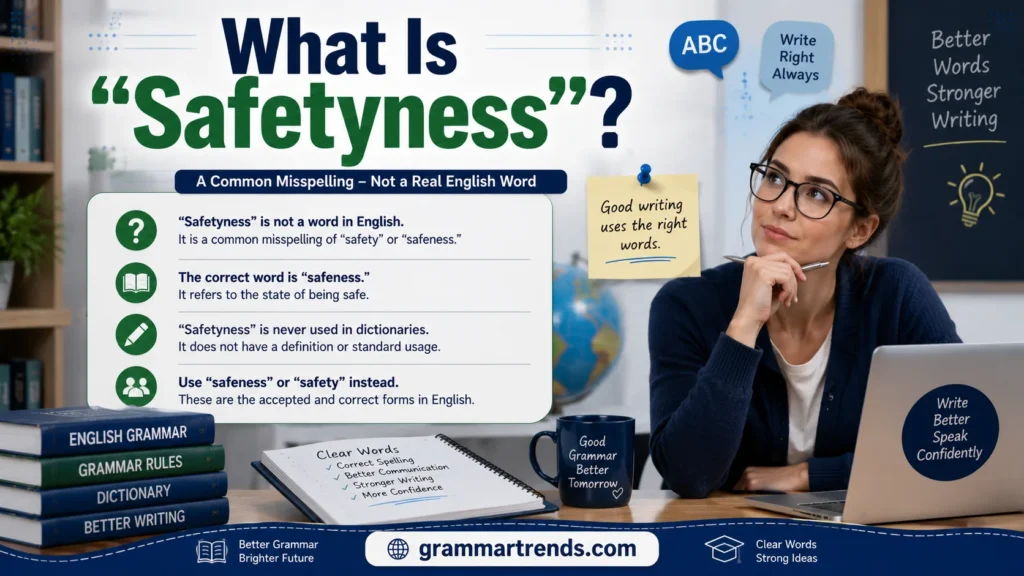
Is Safetyness a Real Word?
No.
Safetyness is not recognized by standard English dictionaries.
It does not appear as an accepted spelling in respected language references, educational style guides, or academic writing standards.
If you use safetyness in formal writing, spellcheckers and grammar checkers will usually flag it as an error.
That alone is a strong sign that it isn’t part of standard English.
Why Does Safetyness Look Correct?
English contains thousands of nouns ending in -ness.
Consider these examples:
- Kind → Kindness
- Weak → Weakness
- Calm → Calmness
- Dark → Darkness
- Happy → Happiness
After seeing these patterns repeatedly, writers often assume every adjective follows the same rule.
Since safe becomes safeness, some people mistakenly combine safety and -ness to produce safetyness.
The problem is that safety is already a noun.
Adding another noun-forming suffix creates a word English never adopted.
Think of it like saying:
- Happinessness ❌
- Kindnessness ❌
- Softnessness ❌
Those forms sound awkward because the noun already exists.
The same principle applies to safetyness.
Why Do People Write Safetyness?
Several factors contribute to this mistake.
Common reasons include:
- Confusing safe with safety
- Assuming every adjective forms a noun with -ness
- Typing too quickly
- Autocorrect errors
- Learning English as a second language
- Seeing incorrect spellings online
- Copying unverified content
The internet contains countless spelling mistakes. Once incorrect words appear on blogs or forums, they often spread rapidly.
That’s why checking reliable dictionaries remains important.
Safeness vs. Safetyness: Side-by-Side Comparison
The easiest way to understand the difference is to compare the two words directly.
| Feature | Safeness | Safetyness |
| Standard English word | ✅ Yes | ❌ No |
| Recognized by dictionaries | ✅ Yes | ❌ No |
| Correct spelling | ✅ Yes | ❌ No |
| Accepted in formal writing | ✅ Yes | ❌ No |
| Used in academic writing | Occasionally | Never |
| Common in everyday speech | Rarely | Never |
| Recommended for professional writing | Sometimes | Never |
The comparison reveals an important point.
Although safeness is technically correct, it isn’t always the best choice.
Most professional writers still prefer safety because readers recognize it immediately.
Safeness vs. Safety: What’s the Difference?
This is where many people become confused.
Both words describe protection from danger, yet they aren’t always interchangeable.
Understanding the subtle difference helps you choose the right word naturally.
Meaning Comparison
Safeness highlights the quality or condition of being safe.
Safety often refers to the overall concept, condition, practices, systems, or measures that protect people from harm.
Compare these examples.
Safeness
- Scientists measured the safeness of the drinking water.
- The inspector evaluated the safeness of the equipment.
Safety
- Workplace safety requires regular inspections.
- Road safety saves lives.
- Food safety protects public health.
Notice the difference.
When discussing policies, regulations, procedures, or broad concepts, safety sounds much more natural.
When Should You Use Safety?
In modern English, safety is the preferred choice in most situations.
You’ll frequently encounter it in:
- Schools
- Hospitals
- Construction
- Aviation
- Manufacturing
- Government regulations
- Engineering
- Transportation
- Public health
- Emergency management
Examples include:
- Fire safety
- Water safety
- Workplace safety
- Road safety
- Electrical safety
- Patient safety
- Internet safety
- Aviation safety
- Construction safety
- Laboratory safety
These expressions have become fixed phrases in English.
Replacing safety with safeness would sound unusual to native speakers.
When Can You Use Safeness?
Although less common, safeness still has valid uses.
It often appears when emphasizing the inherent quality of something being safe rather than discussing safety programs or regulations.
Examples include:
- The mountain guide explained the safeness of the new climbing route.
- Researchers evaluated the safeness of the experimental material.
- Buyers questioned the safeness of the children’s toy.
These sentences focus on the condition or quality itself.
Even here, many writers would still choose safety, which explains why safeness appears relatively infrequently.
Why “Safety” Is More Common Than “Safeness”
Language changes naturally over time.
Some words become everyday vocabulary while others gradually fade into the background. That doesn’t mean the older word becomes incorrect. It simply becomes less common because speakers prefer a shorter, smoother, or more familiar alternative.
Safety is a perfect example of this evolution.
Native English speakers overwhelmingly use safety because it sounds natural in almost every context. News articles, government publications, workplace manuals, legal documents, educational resources, and everyday conversations all favor safety over safeness.
Several factors explain this preference.
- Safety is shorter and easier to recognize.
- It appears in countless fixed expressions.
- Professional industries use it consistently.
- Readers expect it in formal writing.
- Major style guides and organizations rely on it.
For example, consider these familiar phrases:
- Public safety
- Fire safety
- Product safety
- Workplace safety
- Child safety
- Consumer safety
- Electrical safety
- Food safety
- Online safety
- Travel safety
These expressions have become standard English. Changing them to safeness would sound awkward because readers rarely encounter those versions.
A simple way to think about it is this:
Safeness describes a quality.
Safety describes both the quality and the broader concept, which makes it much more versatile in modern English.
Because of that flexibility, safety has become the preferred choice in nearly every professional and everyday setting.
Correct Examples Using “Safeness”
Although safeness isn’t as common as safety, it remains a valid English word. The key is using it in situations where you’re describing the quality or condition of being safe rather than discussing safety policies, regulations, or systems.
Here are several examples that show how safeness works in different contexts.
Workplace Examples
Employees appreciated the safeness of the newly renovated office because every emergency exit remained clearly marked.
The engineer documented the safeness of the new machinery before production began.
Management evaluated the safeness of the storage area after installing additional security features.
School Examples
Teachers discussed the safeness of the playground before allowing students to return after renovations.
Parents often ask about the safeness of school transportation before enrolling their children.
The principal assured families that the safeness of every classroom remained the school’s highest priority.
Home Examples
Before purchasing the property, the family carefully considered the safeness of the neighborhood.
The electrician confirmed the safeness of the home’s wiring after completing the inspection.
Everyone appreciated the safeness of the newly installed stair railing.
Travel Examples
Travelers researched the safeness of hiking trails before planning their trip.
Visitors frequently ask about the safeness of drinking tap water in unfamiliar destinations.
The guide explained the safeness of the route despite recent weather changes.
Technical Examples
Researchers evaluated the safeness of the experimental material before approving additional testing.
Engineers spent months verifying the safeness of the bridge under different weather conditions.
Scientists continued monitoring the safeness of the chemical process throughout the project.
Academic Examples
The report examined the safeness of several manufacturing methods.
The study compared the safeness of different transportation systems.
Researchers measured the safeness of various construction materials using standardized testing procedures.
While every sentence above is grammatically correct, many professional writers would naturally replace safeness with safety. That’s one reason safety appears far more often in books, newspapers, research papers, and business documents.
Incorrect Examples Using “Safetyness”
Since safetyness isn’t a standard English word, it should never appear in formal writing. The following examples illustrate common mistakes and show how to correct them.
| Incorrect Sentence | Correct Sentence | Why It Is Wrong |
| The safetyness of the building was impressive. | The safety of the building was impressive. | Safetyness isn’t a recognized English word. |
| We tested the safetyness of the equipment. | We tested the safety of the equipment. | Safety is the accepted noun. |
| Parents worry about the safetyness of schools. | Parents worry about the safety of schools. | Professional English uses safety. |
| The safetyness of the bridge was confirmed. | The safety of the bridge was confirmed. | Standard dictionaries don’t recognize safetyness. |
| Scientists studied the safetyness of the medicine. | Scientists studied the safety of the medicine. | Scientific writing consistently uses safety. |
A good editing habit is to pause whenever you type safetyness. Replace it with safety in almost every case. If your sentence specifically discusses the quality of being safe, safeness may also work.
Common Mistakes Writers Make
Many spelling errors happen because English doesn’t always follow perfectly predictable patterns. Understanding these common mistakes will help you avoid them.
Adding “-ness” to an Existing Noun
One of the biggest mistakes is attaching -ness to words that are already nouns.
For example:
- Happinessness ❌
- Kindnessness ❌
- Brightnessness ❌
- Safetyness ❌
Each example adds an unnecessary ending to a complete noun.
Confusing “Safe,” “Safety,” and “Safeness”
Many writers accidentally mix these related words.
Here’s a simple comparison.
| Word | Part of Speech | Meaning |
| Safe | Adjective | Free from danger |
| Safety | Noun | Protection from danger |
| Safeness | Noun | The quality of being safe |
Once you understand their roles, choosing the right word becomes much easier.
Assuming Every Adjective Creates a “-ness” Word
Many adjectives do become nouns with -ness.
Examples include:
- Kind → Kindness
- Happy → Happiness
- Calm → Calmness
- Dark → Darkness
- Soft → Softness
However, English also contains exceptions.
For instance:
- True → Truth
- Strong → Strength
- Long → Length
- Wide → Width
- Safe → Safety
Although safeness also exists, safety became the dominant noun through centuries of language development.
Trusting Spellcheck Without Verification
Spellcheck software continues improving every year. Even so, it isn’t perfect.
Some writing tools may miss unusual errors. Others may suggest corrections without explaining why one word is better than another.
Whenever you’re unsure about a word, verify it using a trusted dictionary rather than relying solely on automated software.
Grammar Rule Behind These Words
Learning a little word formation makes English much easier to understand.
How English Forms Nouns
English creates nouns in several different ways.
One common method adds a suffix to an adjective.
| Adjective | Noun |
| Happy | Happiness |
| Kind | Kindness |
| Dark | Darkness |
| Weak | Weakness |
| Calm | Calmness |
The adjective safe follows two accepted paths.
| Base Word | Accepted Noun |
| Safe | Safeness |
| Safe | Safety |
Both nouns developed naturally in English. However, usage changed over time.
Today:
- Safety appears in everyday English.
- Safeness appears much less frequently.
- Safetyness never became part of standard English.
That explains why dictionaries include the first two but reject the third.
Why English Doesn’t Accept “Safetyness”
Languages evolve through usage rather than strict mathematical rules.
Even though safetyness may seem logical, English speakers never adopted it widely enough for it to become a standard word.
Instead, the language settled on two accepted nouns:
- Safety
- Safeness
As a result, adding -ness to safety creates an unnecessary and incorrect form.
Think about it this way.
You wouldn’t say:
- Beautifulnessful
- Happinessness
- Strongthness
The same principle applies here.
English already has the noun it needs.
Real-World Usage Examples
Looking at real situations makes the difference much easier to understand.
Business Writing
Businesses almost always use safety because it sounds professional and aligns with industry standards.
Examples include:
- Workplace safety policy
- Employee safety handbook
- Product safety testing
- Customer safety guidelines
Using safetyness in any of these situations would appear unprofessional.
Academic Writing
Research papers favor precise, widely recognized terminology.
You’ll frequently see phrases such as:
- Patient safety
- Laboratory safety
- Environmental safety
- Drug safety
- Consumer safety
Academic journals rarely use safeness, and they do not use safetyness.
Technical Documentation
Engineers, architects, manufacturers, and software developers rely on consistent terminology.
Typical examples include:
- System safety analysis
- Equipment safety requirements
- Machine safety inspection
- Structural safety assessment
Standardized language helps eliminate confusion in industries where precision matters.
Everyday Conversation
Most native speakers naturally choose safety.
For example:
- “Your safety comes first.”
- “Road safety is everyone’s responsibility.”
- “Child safety should never be ignored.”
- “Wear a helmet for your safety.”
While safeness isn’t wrong, it sounds noticeably less natural in casual conversation.
Legal and Compliance Documents
Legal writing values consistency above all else.
Government agencies, insurance companies, and regulatory organizations almost always use safety in phrases such as:
- Public safety regulations
- Product safety standards
- Consumer safety laws
- Workplace safety compliance
Using standard terminology reduces ambiguity and improves legal clarity.
Read more: Pedantic vs Semantic: Complete Guide for Clear Communication
Case Study: Why One Incorrect Word Can Hurt Professional Credibility
Imagine two companies publishing product manuals for the same piece of equipment.
Company A writes:
“Customer safety is our highest priority. Every machine undergoes extensive safety testing before shipment.”
Company B writes:
“Customer safetyness is our highest priority. Every machine undergoes extensive safetyness testing.”
Although both companies intend to communicate the same message, readers immediately notice the spelling error in Company B’s manual.
That single mistake can create several problems:
- It reduces credibility.
- It makes the document appear poorly edited.
- It distracts readers from important information.
- It may cause customers to question the company’s professionalism.
This example highlights why using accepted English vocabulary matters, especially in business, education, healthcare, engineering, and public communication.
“Clear writing builds trust. Accurate word choice strengthens credibility.”
Synonyms of Safeness
Sometimes repeating the same word makes your writing feel monotonous. Choosing the right synonym can improve readability while keeping your message clear. The best alternative depends on the context because each word carries a slightly different meaning.
The table below compares common synonyms for safeness.
| Synonym | Meaning | Best Used For |
| Safety | Freedom from danger or risk | Everyday writing, business, education |
| Security | Protection from threats or unauthorized access | Technology, finance, law enforcement |
| Protection | The act of keeping someone or something safe | General writing |
| Well-being | Good health, comfort, and happiness | Healthcare, personal development |
| Reliability | Dependability and consistent performance | Products, machinery, services |
| Stability | A secure and steady condition | Engineering, economics, science |
| Shelter | Protection from harm or weather | Emergency planning, housing |
| Defense | Protection against attack or danger | Military, cybersecurity, sports |
| Safeguarding | The process of protecting people or assets | Education, healthcare, legal writing |
| Risk Reduction | Lowering the chance of harm | Safety management and engineering |
Although these words are related, they aren’t always interchangeable.
For example:
- Safety refers to freedom from danger.
- Security often involves protection against crime or unauthorized access.
- Protection emphasizes the action taken to prevent harm.
- Reliability focuses on consistent performance rather than physical safety.
Choosing the right word helps your writing sound more natural and precise.
Related Words
Understanding related words expands your vocabulary and makes writing more flexible.
Here are some of the most closely connected words to safe, safety, and safeness.
| Word | Part of Speech | Meaning |
| Safe | Adjective | Free from danger |
| Safety | Noun | Protection from harm |
| Safeness | Noun | The quality of being safe |
| Safely | Adverb | In a secure manner |
| Safeguard | Verb/Noun | To protect from harm |
| Secure | Adjective | Protected against threats |
| Security | Noun | State of being protected |
| Protect | Verb | Keep from harm |
| Protection | Noun | The act of protecting |
| Risk | Noun | Possibility of danger |
| Hazard | Noun | A potential source of harm |
| Danger | Noun | Likelihood of injury or damage |
| Prevention | Noun | Action taken to stop harm before it happens |
| Precaution | Noun | A measure taken in advance to reduce risk |
| Reliability | Noun | Consistent and dependable performance |
These related words often appear together in discussions about workplace safety, engineering, healthcare, public policy, travel, cybersecurity, and environmental protection.
For example:
- Product safety testing
- Building security systems
- Risk assessment reports
- Hazard identification
- Safety precautions
- Protective equipment
- Secure environments
Learning these connections makes it easier to choose the most accurate word for every situation.
Memory Trick to Remember the Correct Word
A simple memory trick can help you avoid this mistake forever.
Think about this sentence:
Safe becomes safety—not safetyness.
Remember these three words together:
- Safe → adjective
- Safety → common noun
- Safeness → less common noun
That’s all English needs.
If you’re tempted to type safetyness, pause for a moment and ask yourself:
Does the word already exist without adding “-ness”?
In this case, the answer is yes.
English already has safety, so there’s no need to create safetyness.
Another easy trick is to remember familiar phrases you hear every day.
- Road safety
- Fire safety
- Water safety
- Internet safety
- Food safety
- Workplace safety
Notice that none of these expressions use safetyness.
The more often you read and hear these standard phrases, the easier the correct spelling becomes.
FAQs
Can I use safetyness in formal writing?
No. Safetyness is not a recognized English word, so you should avoid using it in essays, business documents, research papers, and professional communication. Instead, use safety in most contexts or safeness when referring to the quality of being safe.
Why is safety more common than safeness?
Although both are valid nouns, safety has become the standard choice in modern English. It’s widely used in education, healthcare, engineering, government, and everyday conversations, making it the more natural and familiar option for most readers.
Is safeness an old-fashioned word?
Not exactly. Safeness is still a correct English word, but it appears far less frequently than safety. Today, it mainly shows up in literary works, technical discussions, or contexts where someone wants to emphasize the quality of being safe.
How can I remember the correct spelling?
A simple trick is to remember common phrases like road safety, fire safety, and workplace safety. Since you’ve probably never heard someone say road safetyness, it’s easier to recognize that safetyness isn’t a standard English word.
Do dictionaries recognize both safeness and safety?
Yes. Major English dictionaries recognize both safeness and safety as legitimate words. However, they do not recognize safetyness as a standard spelling because English already has accepted noun forms for safe.
Which word should I use in everyday writing?
For almost every situation, safety is the best choice. It’s clear, widely accepted, and familiar to readers. Use safeness only when you specifically want to describe the quality or condition of being safe, and avoid safetyness altogether.d workplace safety, you’ll naturally avoid the incorrect spelling.
Key Takeaways
Choosing between safeness vs. safetyness becomes simple once you understand how English forms these words.
Here are the most important points to remember:
- Safeness is a genuine English word that describes the quality or condition of being safe.
- Safetyness is not a standard English word and should be avoided in all forms of writing.
- Safety is the preferred noun in modern English because it’s more natural, more common, and more versatile.
- Professional writers, educators, researchers, and organizations overwhelmingly use safety in formal communication.
- When in doubt, choose safety unless you have a specific reason to emphasize the quality of being safe.
Using the correct word improves clarity, strengthens credibility, and ensures your writing aligns with standard English usage. Whether you’re writing an essay, business report, academic paper, or everyday email, understanding this small distinction helps you communicate with greater confidence and precision.
Conclusion
The debate over safeness vs. safetyness has a clear answer. Safeness is a valid English word, while safetyness is not. Although safeness accurately describes the quality of being safe, modern English overwhelmingly prefers safety because it’s concise, familiar, and widely accepted across nearly every field.
The next time you encounter this spelling question, remember that English already provides the words you need. Use safety for most situations, choose safeness only when the context specifically calls for it, and avoid safetyness altogether. Doing so will make your writing more accurate, more professional, and easier for every reader to understand.

Emma Brooke brings 15 years of experience in the Department of English Language and Literature at the University of California, Berkeley, where she has taught and mentored students across courses in British and American literary traditions, critical theory, and narrative form. Her expertise spans 19th- and 20th-century fiction, poetic prosody, postcolonial literatures, and digital humanities, with a focus on how narrative voice shapes cultural meaning. Emma’s work has been presented at international conferences and published in peer-reviewed venues, reflecting her deep commitment to rigorous literary scholarship and accessible teaching.