

25+ Professional Ways to Say “I’m on It” at Work helps you choose confident words for communication, progress, and reassurance.
In communication, the right words help you express a response clearly and respond thoughtfully. Your message conveys responsibility, shows care, and gives your audience reassurance that real progress is happening. I’m working on it is a common phrase, but using it repeatedly may sound repetitive, generic, informal, or insincere. In professional communication and workplace communication, a thoughtful alternative can make your message more personal, meaningful, engaging, and confident.
Whether you’re responding to a client, updating your manager, reassuring a friend, or conversing with a teacher, parent, or teammate, the right expression can let someone know you’re dealing with something in a positive, clear, and effective way. This significant role of language helps you make someone understand your progress without repeating yourself.
So, if you’re worried about how to say “I’m on it” in a professional way, there are many other ways to respond. Each different expression can emphasize urgency, dedication, collaboration, or reassurance, depending on the situation. For a formal option, you can use I’ve taken ownership of that task, Consider it in my queue, I’m actively working on it, I will address that, I’ve assumed responsibility, I’m tackling this issue, I’m handling the matter, I’ve got it under control, I’m on top of this, or I’ll address this promptly. These phrases have different meanings and tones, so using them naturally in conversations and emails can make your message more professional.
Quick Answer
“I’m on it” means you’re taking responsibility for a task and will deal with it. In professional settings, you can say “I’m handling this,” “I’m actively working on it,” “I’ll take care of this,” or “I’ve taken ownership of this.” Choose the phrase that best matches what you’re actually doing.
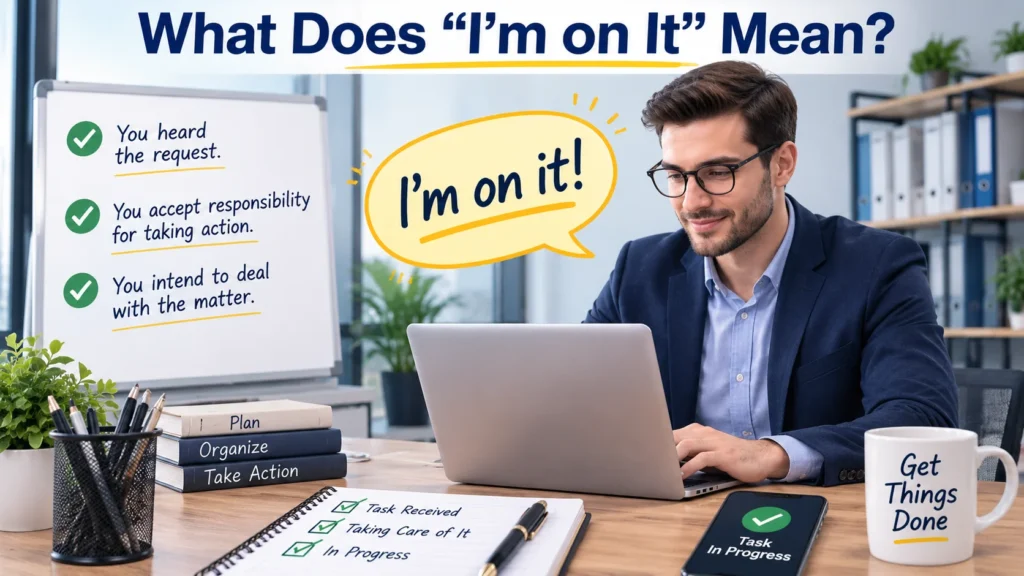
What Does “I’m on It” Mean?
The phrase “I’m on it” generally means “I’m taking care of this” or “I’m going to deal with this now.”
It usually communicates three things:
- You heard the request.
- You accept responsibility for taking action.
- You intend to deal with the matter.
The phrase is short and natural. It works especially well in quick conversations and informal workplace messages.
For example:
Manager: Can you check the updated sales figures before the meeting?
Employee: I’m on it.
That response works because the context is clear.
Still, “I’m on it” doesn’t tell the listener exactly what stage the task has reached. You might have just received the request, started working, contacted someone, or nearly finished.
Professional communication becomes stronger when your wording reflects the actual situation.
When Is “I’m on It” Appropriate at Work?
“I’m on it” isn’t unprofessional by itself. In many workplaces, it’s perfectly acceptable.
The issue usually comes down to context, audience, and precision.
You can comfortably use it when:
- Messaging a familiar coworker
- Responding quickly in Slack or Microsoft Teams
- Acknowledging a simple request
- Speaking with a manager who prefers concise communication
- Confirming that you received an assignment
- Handling a routine internal task
However, a more specific phrase may work better when communicating with:
- Clients
- Customers
- Senior executives
- External partners
- Vendors
- People waiting for an important resolution
- Anyone who needs a clear deadline or progress update
For instance, compare these two responses:
“I’m on it.”
and:
“I’ve started reviewing the issue and will send you an update this afternoon.”
The second response gives the recipient much more useful information.
25+ Professional Ways to Say “I’m on It”
The best alternative depends on what you actually mean. Don’t choose a polished phrase simply because it sounds impressive. Choose one that accurately describes your action.
I’m Actively Working on It
“I’m actively working on it” is one of the clearest professional alternatives.
It tells the recipient that you haven’t merely acknowledged the request. You have already started working.
Best for: Progress updates and ongoing tasks.
Example:
“I’m actively working on the report and expect to have the revised version ready this afternoon.”
This phrase works particularly well when someone asks for a status update.
I’ve Taken Ownership of This
When accountability matters, “I’ve taken ownership of this” sounds stronger than a simple acknowledgment.
It communicates that you accept responsibility for moving the task forward.
Best for: Projects, problems, client concerns, and managerial communication.
Example:
“I’ve taken ownership of this issue and will coordinate with the support team to resolve it.”
This wording can reassure someone who wants to know who is responsible.
I’m Handling It
“I’m handling it” is short, confident, and professional.
It works well when the details don’t need explanation.
Example:
“Thanks for flagging the issue. I’m handling it now.”
The phrase sounds natural in internal communication. For a formal client email, you may want to add a next step or expected update.
I’m Taking Care of It
“I’m taking care of it” is a friendly alternative that still fits many professional situations.
It works especially well when the task is straightforward.
Example:
“No problem. I’m taking care of the invoice correction now.”
Compared with “I’ve taken ownership of this,” this phrase feels less formal and more conversational.
I’m Working on This Now
If you want to emphasize immediate action, try “I’m working on this now.”
It provides more information than “I’m on it” while remaining concise.
Example:
“I’m working on this now and will send you the updated figures shortly.”
This is an excellent choice for quick workplace messages.
I’ll Take Care of This
Use “I’ll take care of this” when you’re accepting a new responsibility.
The future-oriented wording matters. It tells the recipient that you’re committing to action rather than claiming that work has already begun.
Example:
“I’ll take care of this and make sure the documents are sent before the deadline.”
I’ve Started Working on It
If you’ve genuinely begun the task, “I’ve started working on it” provides an accurate progress update.
Example:
“I’ve started working on the presentation and have completed the first three sections.”
This phrase becomes even more useful when paired with a concrete progress detail.
I’m Addressing the Issue
For complaints, problems, errors, and concerns, “I’m addressing the issue” sounds professional and focused.
Example:
“I’m addressing the issue with the billing team and will provide an update once I have more information.”
The word “addressing” suggests that you’re taking steps to deal with the matter. It doesn’t necessarily claim that you’ve already solved it.
I’m Looking Into It
Sometimes you aren’t ready to fix something because you first need to understand what happened.
In that situation, “I’m looking into it” is more accurate than saying “I’m handling it.”
Example:
“I’m looking into the discrepancy now and will let you know what I find.”
This phrase works well for investigations, technical problems, billing discrepancies, customer complaints, and unclear situations.
I’m Following Up on It
Use “I’m following up on it” when another person or department needs to provide information or take action.
Example:
“I’m following up with the shipping team and will update you as soon as I receive a response.”
This wording makes the dependency clear.
I’m Taking the Necessary Steps
“I’m taking the necessary steps” works when several actions are involved.
It can sound formal, so use it when the situation genuinely requires a process rather than a simple task.
Example:
“I’m taking the necessary steps to resolve the account issue and will keep you updated.”
Avoid using this phrase when you can explain the actual action more clearly.
Specific language usually beats corporate-sounding language.
I’m Working to Resolve This
When the goal is a solution, “I’m working to resolve this” is a strong choice.
Example:
“I understand the concern. I’m working to resolve this and will follow up with you tomorrow.”
It works particularly well in customer service because it acknowledges the problem without falsely claiming that it’s already fixed.
I’ll Handle This Promptly
If the task needs quick attention, “I’ll handle this promptly” communicates urgency.
Example:
“Thank you for bringing this to my attention. I’ll handle this promptly and keep you informed of the progress.”
Use “promptly” only when you can genuinely act quickly. Promising speed without delivering can weaken trust.
I’m Prioritizing This
Sometimes the important message isn’t simply that you’re working on something. It’s that you’ve moved it higher on your list.
“I’m prioritizing this” communicates exactly that.
Example:
“I’m prioritizing this request and will send you an update by 3 p.m.”
This phrase is particularly useful when multiple competing tasks exist.
I’ve Added This to My Priorities
If you can’t start immediately, don’t pretend that you have.
Instead, say:
“I’ve added this to my priorities and will begin reviewing it tomorrow morning.”
This wording helps set realistic expectations.
It’s much better than promising immediate action that you can’t deliver.
I’ll Get Started on This Right Away
For a newly assigned task, “I’ll get started on this right away” communicates enthusiasm and urgency.
Example:
“Thanks for sending the specifications. I’ll get started on this right away.”
It works especially well when your manager or teammate has just assigned you something.
I’m Taking Care of This Now
This phrase combines immediate action with ownership.
Example:
“I’m taking care of this now. I’ll let you know once the update has been completed.”
It’s friendly enough for internal communication while still sounding professional.
I’m Currently Addressing This
For more formal workplace writing, “I’m currently addressing this” can replace “I’m on it.”
Example:
“I’m currently addressing the reported issue and reviewing the relevant account records.”
The word “currently” indicates that the work is underway.
I’ve Got This Covered
“I’ve got this covered” is confident and reassuring.
It isn’t as formal as “I’ve taken ownership of this,” but it works well with coworkers and familiar professional contacts.
Example:
“No worries. I’ve got this covered.”
Use it carefully in formal client correspondence. A more specific statement may sound more polished.
I’m On Top of This
“I’m on top of this” communicates awareness, control, and active attention.
Example:
“Thanks for the reminder. I’m on top of this and will have an update for you shortly.”
It’s useful in conversational workplace communication.
I’ll Take the Lead on This
When you’re coordinating several people or managing a larger task, “I’ll take the lead on this” is more precise than “I’m on it.”
Example:
“I’ll take the lead on this project and coordinate with the design and marketing teams.”
This phrase communicates leadership rather than merely task completion.
I’m Managing This
“I’m managing this” suggests ongoing responsibility.
It works well for matters that require continued oversight.
Example:
“I’m managing the client request and will coordinate the next steps with the account team.”
It’s especially appropriate when the situation involves multiple stages.
I’m Moving This Forward
For projects, approvals, negotiations, and processes, “I’m moving this forward” focuses on progress.
Example:
“I’m moving this forward with the legal team and will share the next update once we receive approval.”
This phrase works well when you can’t complete the entire task yourself but can keep the process progressing.
I’m Working Through the Details
Some tasks require careful review before you can provide an answer.
In those situations, “I’m working through the details” is useful.
Example:
“I’m working through the details now and want to make sure the final numbers are accurate.”
It communicates care without suggesting that the task is finished.
I’ll Follow Up and Keep You Updated
When a task requires ongoing communication, “I’ll follow up and keep you updated” is more useful than simply saying “I’m on it.”
Example:
“I’ll follow up with the vendor and keep you updated on the delivery schedule.”
The phrase reassures the recipient that they won’t need to chase you for information.
I’ll Address This and Report Back
This option combines action with a clear follow-up.
Example:
“I’ll address this with the team and report back once I have a confirmed answer.”
It’s particularly useful when someone expects a later status update.
Professional Alternatives to “I’m on It” by Situation
Choosing the right phrase becomes easier when you focus on the situation.
| Situation | Recommended phrase | What it communicates |
| New task | “I’ll get started on this right away.” | Immediate action |
| Work already started | “I’m actively working on it.” | Current progress |
| Problem | “I’m working to resolve this.” | Problem-solving |
| Investigation | “I’m looking into it.” | Research or review |
| Follow-up | “I’m following up on it.” | Coordination |
| Urgent task | “I’m prioritizing this.” | Higher priority |
| Ownership | “I’ve taken ownership of this.” | Accountability |
| Leadership | “I’ll take the lead on this.” | Responsibility and coordination |
| Ongoing matter | “I’m managing this.” | Continued oversight |
| Project progress | “I’m moving this forward.” | Forward momentum |
| Delayed start | “I’ve added this to my priorities.” | Realistic commitment |
| Client issue | “I’m addressing the issue.” | Professional action |
| Future update | “I’ll address this and report back.” | Action plus communication |
“I’m on It” vs. “I’ll Handle It” vs. “I’m Working on It”
These phrases look similar, but they don’t communicate exactly the same thing.
| Phrase | Main meaning | Does work need to have started? | Formality |
| I’m on it. | I acknowledge the task and will act. | No | Casual-professional |
| I’ll handle it. | I accept responsibility. | No | Professional |
| I’m working on it. | The task is underway. | Yes | Professional |
| I’m looking into it. | I’m investigating. | Usually | Professional |
| I’ll address it. | I’ll deal with the matter. | No | Formal-professional |
| I’m prioritizing it. | I’ve given it increased attention. | Not necessarily | Professional |
| I’ve taken ownership. | I’m responsible for moving it forward. | Not necessarily | Formal-professional |
| I’m following up. | I’m contacting someone for more information or action. | Yes | Professional |
The key difference is accuracy.
If you haven’t started, don’t say:
“I’m actively working on it.”
If you’ve already begun, don’t undersell your progress with a vague:
“I’m on it.”
Good workplace communication tells the truth about the current stage of the work.
How to Choose the Right Professional Way to Say “I’m on It”
A simple decision process can help.
When You Want to Show Ownership
Use:
- I’ve taken ownership of this.
- I’ll handle this.
- I’ll take the lead on this.
- I’m managing this.
These expressions work when the main concern is responsibility.
When You Want to Show Immediate Action
Use:
- I’m working on this now.
- I’ll get started right away.
- I’m actively working on it.
- I’m taking care of this now.
These phrases work when speed matters.
When You Need More Time
Use:
- I’ve added this to my priorities.
- I’m working through the details.
- I’ll follow up once I have an update.
These phrases help you manage expectations without making an unrealistic promise.
When You’re Investigating a Problem
Use:
- I’m looking into it.
- I’m reviewing the issue.
- I’m checking the details.
- I’m working to determine the cause.
Investigation requires different wording from resolution.
When You Need to Reassure Someone
Use:
- I’m handling it.
- I’ve got this covered.
- I’m on top of this.
- I’ve taken ownership of this.
These options emphasize confidence and responsibility.
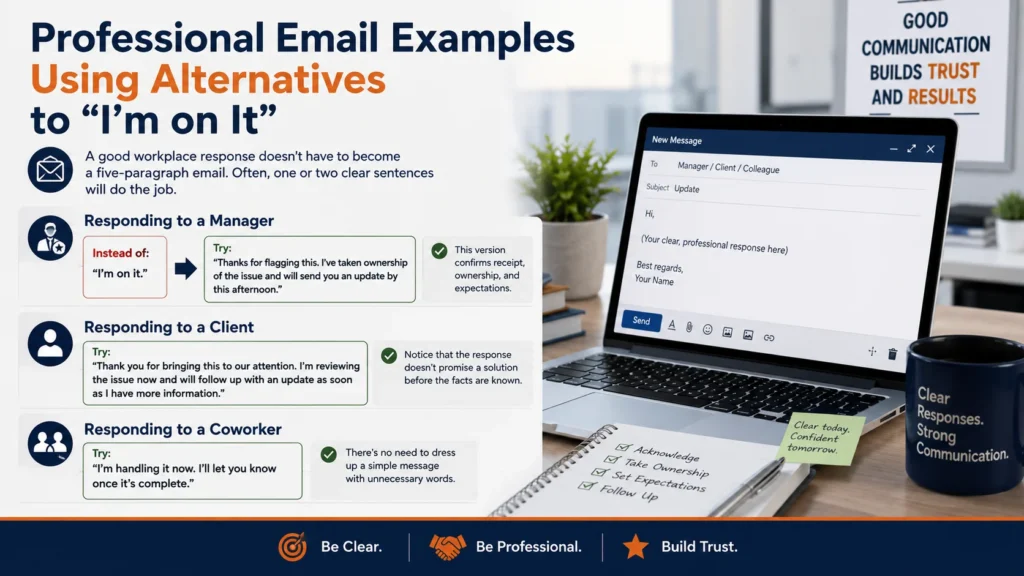
Professional Email Examples Using Alternatives to “I’m on It”
A good workplace response doesn’t have to become a five-paragraph email. Often, one or two clear sentences will do the job.
Responding to a Manager
Instead of:
“I’m on it.”
Try:
“Thanks for flagging this. I’ve taken ownership of the issue and will send you an update by this afternoon.”
This version confirms receipt, ownership, and expectations.
Responding to a Client
A client usually benefits from clarity rather than casual language.
Try:
“Thank you for bringing this to our attention. I’m reviewing the issue now and will follow up with an update as soon as I have more information.”
Notice that the response doesn’t promise a solution before the facts are known.
Responding to a Coworker
Internal communication can remain concise:
“I’m handling it now. I’ll let you know once it’s complete.”
There’s no need to dress up a simple message with unnecessary corporate language.
Reporting Progress
When work has already started, be specific:
“I’ve started reviewing the report and have identified the main discrepancies. I’m working through the remaining figures now.”
This response is more informative than:
“I’m on it.”
Handling an Urgent Request
For urgent work, connect the action with a clear expectation:
“I’m prioritizing this now and will send you an update within the next hour.”
Only use a specific timeframe when you can realistically meet it.
Professional Ways to Say “I’m on It” in an Email
Here are ready-to-use sentence patterns for common workplace situations.
Acknowledgment:
“Thanks for flagging this. I’m looking into it now.”
Ownership:
“I’ve taken ownership of this and will keep you updated.”
Immediate action:
“I’ll get started on this right away.”
Investigation:
“I’m reviewing the issue and will follow up once I have more information.”
Resolution:
“I’m working to resolve this and will report back once I have an update.”
Follow-up:
“I’m following up with the relevant team and will keep you posted.”
Urgency:
“I’m prioritizing this and will provide an update shortly.”
Leadership:
“I’ll take the lead on this and coordinate the next steps.”
How to Make “I’m on It” Sound More Professional
One of the easiest ways to improve workplace communication is to add specific information.
Use this simple formula:
Acknowledge → Take ownership → State the action → Set expectations
For example:
“Thanks for flagging this. I’ve taken ownership of the issue and am reviewing the details now. I’ll send you an update by tomorrow afternoon.”
That message works because it answers the questions the recipient is likely to have:
- Did you see my message?
- Who is handling this?
- What are you doing?
- When will I hear from you?
The phrase “I’m on it” answers only the first two.
Specificity makes professional communication more useful.
Read more: 15 Polite Ways to Say “It’s Okay” in Any Situation
Common Mistakes to Avoid When Saying “I’m on It”
Making a Promise You Can’t Keep
Don’t say:
“I’ll have this done in an hour.”
unless you genuinely expect to finish within an hour.
A more responsible alternative might be:
“I’ve started working on this and will confirm the expected completion time shortly.”
Professionalism isn’t about sounding confident at all costs. It’s about being reliable.
Being Too Vague
A vague response can force the recipient to ask another question.
Instead of:
“I’m on it.”
try:
“I’m reviewing the figures now and will send the corrected version this afternoon.”
The second sentence gives the recipient something concrete.
Using Overly Formal Language
Professional doesn’t mean robotic.
For example, this sentence sounds unnecessarily stiff:
“I hereby acknowledge receipt of your request and shall proceed accordingly.”
A natural alternative is:
“Thanks for sending this. I’ll take care of it.”
Clear language usually sounds more confident than inflated language.
Confusing Acknowledgment With Completion
This distinction matters.
“I’m on it” means you’re taking action.
It does not mean the task is finished.
If you have completed the work, say:
“This is complete.”
If you’re still working, say:
“I’m actively working on it.”
Accurate wording prevents misunderstandings.
Ignoring Deadlines
If timing matters, don’t leave the recipient guessing.
Instead of:
“I’m working on it.”
consider:
“I’m working on it now and expect to have it ready by 4 p.m.”
A clear expectation can save several follow-up messages.
Case Study: Turning a Vague Workplace Reply Into a Strong Update
Imagine a manager sends this message:
“Can you review the customer report and correct any discrepancies?”
An employee replies:
“I’m on it.”
That’s acceptable, but it doesn’t provide much information.
Now consider:
“Absolutely. I’ve started reviewing the report and am checking the discrepancies against the original records. I’ll send you the corrected version by 3 p.m.”
The second response is stronger because it communicates:
- Acknowledgment — the request was understood.
- Ownership — someone is responsible.
- Action — the review has started.
- Method — the records are being checked.
- Expectation — a completion time is provided.
That’s the real advantage of professional alternatives to “I’m on it.”
The goal isn’t to sound more sophisticated. The goal is to communicate more information with fewer misunderstandings.
Quick Reference: Best Alternatives to “I’m on It”
Ownership
- I’ve taken ownership of this.
- I’ll handle this.
- I’ll take the lead on this.
- I’m managing this.
Immediate Action
- I’m working on this now.
- I’ll get started right away.
- I’m actively working on it.
- I’m taking care of this now.
Investigation
- I’m looking into it.
- I’m reviewing the issue.
- I’m checking the details.
- I’m working through the details.
Resolution
- I’m working to resolve this.
- I’m addressing the issue.
- I’ll address this promptly.
- I’m taking the necessary steps.
Follow-Up
- I’m following up on this.
- I’ll report back.
- I’ll keep you updated.
- I’ll follow up once I have more information.
The Most Professional Alternatives to “I’m on It” at a Glance
If you need a quick answer, start here:
| What you mean | Best choice |
| You just accepted the task | I’ll take care of this. |
| You already started | I’m actively working on it. |
| You own the problem | I’ve taken ownership of this. |
| You’re investigating | I’m looking into it. |
| You’re solving a problem | I’m working to resolve this. |
| The matter is urgent | I’m prioritizing this. |
| Someone else needs to respond | I’m following up on this. |
| You’re coordinating a project | I’ll take the lead on this. |
| You need to give an update later | I’ll address this and report back. |
| You want a casual internal reply | I’m handling it. |
My Personal Experience as an English Specialist
As an English specialist, I’ve learned that teaching English is about more than grammar and vocabulary. I’ve worked with students who knew the rules but lacked confidence when speaking. One student, for example, often gave correct written answers but hesitated during conversations. By giving them time to speak without interrupting every mistake, I watched their confidence grow.
I’ve also noticed learners struggle with workplace expressions like “I’m on it.” I help them understand when phrases such as “I’m looking into it” or “I’m actively working on it” are more appropriate.
My biggest lesson is simple: clear, natural English matters more than complicated English.
FAQs
1. What is a professional way to say “I’m on it”?
You can say “I’m actively working on it,” “I’ll address this promptly,” or “I’ve taken ownership of that task.” These phrases sound clear, responsible, and professional.
2. Is “I’m on it” appropriate at work?
Yes, “I’m on it” is common in workplace communication. However, a more specific phrase can sound more polished when speaking with a manager, client, or senior colleague.
3. How can I sound confident instead of informal?
Choose words that show responsibility and action. For example, “I’ve assumed responsibility” or “I’m handling the matter” clearly shows that you’re taking action.
4. What can I say instead of “I’m working on it” in an email?
Try “I’m actively working on this,” “I will address that,” or “I’ll address this promptly.” These options work well in professional emails because they communicate progress without sounding repetitive.
5. How do I reassure a client that I’m handling an issue?
Use a direct phrase such as “I’ve got it under control” or “I’m handling the matter.” You can also mention the next step or expected update to provide stronger reassurance.
6. Which alternative to “I’m on it” sounds the most formal?
“I’ve taken ownership of that task” is one of the more formal choices. It clearly communicates accountability and shows that you’re responsible for moving the task forward.
Conclusion
Finding the right way to say “I’m on it” can make everyday workplace communication sound more confident and intentional. A simple phrase can show that you’re paying attention, taking responsibility, and moving a task forward. Whether you choose “I’m actively working on it,” “I’ve taken ownership of that task,” or “I’ll address this promptly,” the best option depends on who you’re speaking with and how urgent the situation is.
You don’t need to replace “I’m on it” every time. Instead, keep a few professional alternatives ready so your responses don’t feel repetitive or vague. With the right wording, you can reassure clients, update managers, and communicate with teammates in a way that feels clear, natural, and dependable.

Mia Rose brings fifteen years of experience at The University of Edinburgh’s English Literature department, leading students through explorations of classic and contemporary texts, literary theory, and narrative design. Her academic interests center on Victorian and modernist fiction, poetic rhythms, postcolonial storytelling, and digital approaches to literary study—with a keen eye on how voice and perspective frame cultural dialogue. Mia has delivered talks at prestigious global conferences and authored articles in scholarly journals, showcasing her commitment to meaningful research and lively classroom engagement.