Plushie vs Plushy life moves fast, train language changes at lightning speed. This guide slows down the confusion and finally clarifies the distinctions between these terms often used interchangeably. You hear them in stores, online shops, and everyday conversations. We’ll compare plush vs plushie, plushie vs stuffed animals, and explain how each term is used.
Everything becomes clearer when we explore the similarities, differences, and everyday usage of plushies, plush material, plushy chair, cartoonish design, stuffed animals, cute, soft, comfortable blanket, plushy, plushie, informal term, proper word, and their appearance in popular culture.
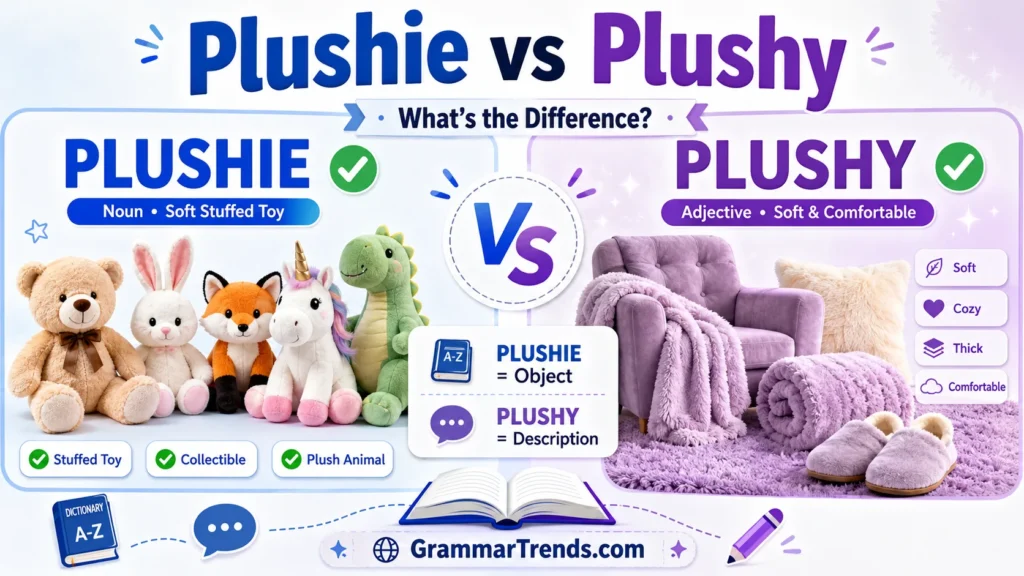
People often mix these words, but they have slightly different uses in everyday English. A plushie is a plush fabric toy filled with stuffing. Children and collectors love cuddly teddy bear, bunny, and unicorn plushies. On the other hand, plushy is an adjective used to describe something thick, soft, and comfortable, such as a carpet, pillows, or a comfortable blanket. Understanding this distinction helps you choose the right word in the right context. Using plushie and plushy correctly improves clarity.
Quick Answer: Plushie or Plushy?
If you only want the short answer, here it is:
| Word | Main Use | Example |
| Plushie | A stuffed toy or soft collectible | “I bought a cat plushie.” |
| Plushy | Describing a soft texture | “This pillow feels plushy.” |
The easiest rule:
Plushie = object
Plushy = description
Think of it this way:
You can hold a plushie.
You can feel something plushy.
Simple.
What Does “Plushie” Mean?
A plushie is a soft stuffed toy made from plush fabric or similar materials.
People commonly use this word when referring to:
- Stuffed animals
- Character merchandise
- Cartoon collectibles
- Anime merchandise
- Gaming collectibles
- Handmade stuffed toys
You probably hear the term often because internet culture pushed it into everyday language.
Years ago, people mostly said:
- Stuffed animal
- Stuffed toy
- Plush toy
Then communities online began using plushie because it sounded shorter and friendlier.
The word developed a warmer feeling.
Compare these:
Stuffed animal:
“She bought a stuffed animal.”
Plushie:
“She bought an adorable fox plushie.”
The second sentence feels more casual and expressive.
Why “plushie” became so popular
Several online spaces helped the word grow:
- Gaming communities
- Anime fandoms
- Collector communities
- Social media platforms
- Handmade craft marketplaces
Collectors especially prefer it because “plushie” sounds more personal.
A collector rarely says:
“I own 300 stuffed animals.”
They often say:
“I own 300 plushies.”
That tiny difference changes the tone.
Common examples of plushie usage
Examples:
- “My desk has three Pokémon plushies.”
- “She sleeps with a teddy bear plushie.”
- “That dinosaur plushie sold out immediately.”
- “My kid carries a rabbit plushie everywhere.”
What Does “Plushy” Mean?
Now things get interesting.
Plushy usually works as an adjective, not a noun.
It describes something soft, luxurious, cushioned, or comfortable.
Examples:
- Plushy carpet
- Plushy blanket
- Plushy chair
- Plushy slippers
Plushy focuses on feel
You aren’t naming the object itself.
You are describing its qualities.
For example:
“This hotel bed feels plushy.”
The focus isn’t the bed.
The focus is the softness.
Natural examples of plushy
Examples:
- “The rug felt plushy under my feet.”
- “The sofa has plushy cushions.”
- “The winter robe feels plushy.”
- “Those seats looked incredibly plushy.”
The Core Difference Between Plushie and Plushy
Here is the difference in one table.
| Feature | Plushie | Plushy |
| Part of speech | Noun | Usually adjective |
| Meaning | Stuffed toy | Soft texture |
| Used for toys | Yes | Rarely |
| Casual speech | Very common | Less common |
| Product descriptions | Moderate use | Common |
A quick comparison
Correct:
“I bought a dragon plushie.”
Correct:
“The blanket feels plushy.”
Incorrect:
“I bought a dragon plushy.”
Although people occasionally say this informally, it sounds less natural to many English speakers.
Is Plushy Ever Used as a Noun?
Technically, yes.
Language changes constantly. People sometimes use plushy as a noun.
You might hear:
“Look at my new plushy.”
However, it remains less common than plushie.
Many people see it as informal or unusual.
Imagine walking into a toy store and seeing these labels:
Option A
Rabbit Plushie
Option B
Rabbit Plushy
Most native speakers naturally lean toward Option A.
Why does this happen?
People tend to add -ie endings to create friendly or affectionate nouns.
Examples include:
| Word | Friendlier Form |
| Dog | Doggie |
| Bird | Birdie |
| Sweet | Sweetie |
| Plush | Plushie |
The -ie ending creates familiarity.
That explains why plushie feels natural.
Why So Many People Search “Is It Plushy or Plushie?”
Several reasons create confusion.
Similar spelling
The words differ by only two letters.
Your brain naturally groups them together.
Online shopping labels vary
Some product pages say:
- Plush toy
- Plush doll
- Plushie
- Plush animal
- Plushy toy
People encounter all of them.
Internet culture changed language
Social media spreads words quickly.
A term used by one community suddenly appears everywhere.
Gaming communities helped popularize plushie in particular.
Personal habits matter
Some families simply grow up using one term over another.
Language often works like that.
A word can feel normal simply because you heard it throughout childhood.
Plushie vs Plush Toy vs Stuffed Anim
Many people assume these terms are identical.
They overlap. Still, each carries a different feeling.
| Term | Typical Use | Tone |
| Plushie | Casual | Friendly |
| Plush toy | Retail | Neutral |
| Stuffed animal | Traditional | General |
| Stuffed toy | Formal | Broad |
Plushie
Usually used among:
- Collectors
- Gamers
- Anime fans
- Younger audiences
Example:
“I finally found the plushie I wanted.”
Plush toy
Stores frequently use this wording.
Example:
“Soft elephant plush toy for ages 3 and up.”
Stuffed animal
Parents often use this phrase.
Example:
“My daughter sleeps with a stuffed animal.”
Read more: Seak vs Seek: Which Is Correct Meaning, Examples and Usage?
Real Examples of Plushie and Plushy Used Naturally
Examples help more than rules.
Correct examples using plushie
- “The convention sold exclusive plushies.”
- “My bookshelf has ten anime plushies.”
- “I bought a shark plushie yesterday.”
- “That panda plushie looks adorable.”
Correct examples using plushy
- “The hotel carpet felt plushy.”
- “The jacket has a plushy lining.”
- “The cushions are thick and plushy.”
- “These slippers feel wonderfully plushy.”
Incorrect examples and corrections
| Incorrect | Better Version |
| I bought a tiger plushy | I bought a tiger plushie |
| My plushie couch feels soft | My plushy couch feels soft |
| She owns plushy collectibles | She owns plushie collectibles |
Common Mistakes People Make
Even experienced writers occasionally mix these up.
Here are the biggest mistakes.
Using them interchangeably
This creates awkward phrasing.
Wrong:
“I sat on a plushie chair.”
Correct:
“I sat on a plushy chair.”
Ignoring parts of speech
Remember:
Plushie = noun
Plushy = adjective
Mixing them changes sentence meaning.
Copying product wording without context
Some websites use inconsistent labels.
Never assume every product title follows standard usage.
How Writers, Stores, and Collectors Use These Terms
Different groups often prefer different wording.
E-commerce sites
Stores commonly use:
- Plush toy
- Stuffed animal
- Plush collectible
Why?
Because search engines and shoppers understand those terms easily.
Collectors
Collectors often prefer:
- Plushie
- Character plushie
- Limited plushie
The word feels personal.
Social media users
Social media leans heavily toward plushie.
Examples:
- “My new plushie collection”
- “Cute plushie haul”
- “Rare plushie drop”
Mini Case Study: Why Product Wording Matters
Imagine two listings selling the same toy.
Listing A
Cute Fox Plushy
Listing B
Cute Fox Plushie
Which one sounds more natural?
Most buyers would probably choose Listing B.
Why?
Because it aligns with how people naturally speak.
Language affects perception.
A tiny wording shift can change how polished a product feels.
Regional and Cultural Usage Differences
Language behaves differently depending on location.
United States usage
American speakers commonly use:
- Plushie
- Stuffed animal
- Plush toy
United Kingdom usage
British speakers sometimes lean toward:
- Soft toy
- Plush toy
Still, plushie remains common online.
Gaming culture influence
Gaming communities strongly shaped plushie vocabulary.
Popular franchises frequently release:
- Character plushies
- Mascot plushies
- Limited-edition plushies
Fans adopted the term quickly.
Anime community influence
Anime communities also helped spread the term.
Fans often discuss:
- Chibi plushies
- Character plushies
- Collector plushies
Over time, usage expanded beyond fandom spaces.
Quick Memory Trick to Never Mix Them Up Again
Here is an easy shortcut.
PlushIE = Item
PlushY = QualitY
Look at the ending.
IE → Item
Y → Quality
Examples:
“I bought a unicorn plushie.”
“The unicorn blanket feels plushy.”
Easy.
Fun Sentence Challenge
See if you can identify the correct answer.
Sentence One
“I bought a new bear ______.”
Answer:
Plushie
Sentence Two
“These pillows feel incredibly ______.”
Answer:
Plushy
Sentence Three
“The chair has thick and ______ cushions.”
Answer:
Plushy
Sentence Four
“My shelf holds thirty collectible ______.”
Answer:
Plushies
FAQs
1. What is the difference between a plushie and a plushy?
A plushie is a soft stuffed toy made from plush fabric, while plushy is an adjective that describes something soft, thick, and luxurious, such as a plushy chair, blanket, or carpet.
2. Is plushie a real word?
Yes. Plushie is an informal but widely accepted word used to describe stuffed animals and other soft plush toys. It is especially popular among collectors, gamers, and anime fans.
3. Can I use plushy instead of plushie?
Not usually. If you’re talking about a stuffed toy, plushie is the better choice. Plushy should be used to describe the texture or appearance of something soft and comfortable.
4. Are plushies the same as stuffed animals?
Most plushies are stuffed animals, but the term plushie can also include fictional characters, cartoon figures, and fantasy creatures made from plush fabric.
5. What material are plushies made from?
Most plushies are made from plush fabric and filled with soft stuffing such as polyester fiber, making them cuddly and comfortable.
6. Why is the word plushie so popular?
The word plushie has become popular through gaming, anime, social media, and collector communities, where it is commonly used instead of “stuffed animal.”
7. When should I use plushy?
Use plushy when describing something that feels soft, thick, or luxurious, such as a plushy carpet, plushy chair, pillows, or a cozy blanket.
Conclusion
Understanding Plushie vs Plushy is simple once you know how each word is used. A plushie refers to a soft stuffed toy made from plush fabric, while plushy describes something that feels soft, thick, and luxurious. Although the terms are sometimes used interchangeably in casual conversation, choosing the correct word makes your writing and speech clearer. Whether you’re talking about stuffed animals, collecting plushies, or describing a plushy blanket or chair, using the right term helps communicate your meaning accurately.

Emma Brooke brings 15 years of experience in the Department of English Language and Literature at the University of California, Berkeley, where she has taught and mentored students across courses in British and American literary traditions, critical theory, and narrative form. Her expertise spans 19th- and 20th-century fiction, poetic prosody, postcolonial literatures, and digital humanities, with a focus on how narrative voice shapes cultural meaning. Emma’s work has been presented at international conferences and published in peer-reviewed venues, reflecting her deep commitment to rigorous literary scholarship and accessible teaching.