
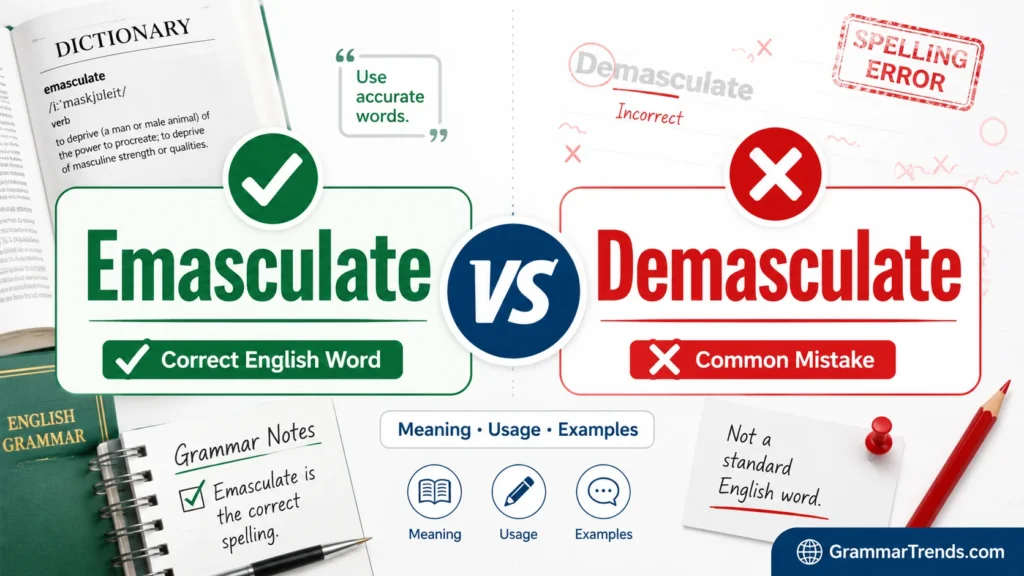
Emasculate vs Demasculate shows language confusion in modern writing and usage across online forums and professional communication today now.
The way language constantly evolves shows how people think, and sometimes we encounter confusing new words that feel real but are actually aren’t. I’ve seen this firsthand while browsing online forums, where many users treat emasculate and demasculate as interchangeable, creating misuse, debate, and ongoing grammar confusion across modern speech, podcasts, videos, and online writing.
In real experience as a coach, I’ve seen terminology and vocabulary confusion appear in professional writing, casual conversation, and everyday communication. Even though emasculation has historical roots, scientific context, and metaphorical meaning, many still wrongly use demasculated, even though most dictionaries mark it as incorrect or a mistaken formation. The correct Latin origin (e-, masculus) supports emasculate across medical, societal, and agriculture contexts like surgical genitalia, pollen, and pollination, ensuring clear communication.
Quick Answer
Emasculate is the correct and widely accepted English word. It means to weaken someone’s strength, confidence, authority, or masculinity, either literally or figuratively. Demasculate is a nonstandard form that most dictionaries and style guides do not recognize. For clear, accurate, and professional writing, always use emasculate.
Why People Confuse “Emasculate” and “Demasculate”
The confusion between emasculate and demasculate mostly comes from English word patterns.
People naturally assume “de-” means removal or reversal. That assumption makes “demasculate” sound reasonable. Your brain hears it and thinks:
“If something can motivate you, it can demotivate you. So if something can masculinize, maybe it can demasculate.”
That logic feels natural. English, however, doesn’t always follow tidy rules.
The word emasculate already contains the idea of removing strength, power, or masculinity. Adding “de-” becomes unnecessary. In other words, “demasculate” tries to duplicate a meaning already built into the original word.
Another reason for the confusion comes from sound. “Demasculate” rolls off the tongue easily. Many people hear it in casual speech and assume it’s standard English.
Search trends also contribute to the problem. Thousands of users type phrases like:
- “demasculate meaning”
- “demasculate definition”
- “demasculate vs emasculate”
That repeated exposure makes the word seem more legitimate than it actually is.
Still, in professional writing, academic work, journalism, and dictionaries, emasculate remains the accepted term.
What Does “Emasculate” Mean?
Clear Definition of Emasculate
The verb emasculate means:
- To weaken someone emotionally or psychologically
- To reduce strength, effectiveness, or authority
- Historically, to castrate a male physically
Modern English mostly uses the word figuratively rather than literally.
For example:
- “The harsh criticism emasculated his confidence.”
- “The new law emasculated the committee’s authority.”
In both cases, the word means to weaken or diminish power.
The emotional meaning often appears in discussions about masculinity, social expectations, relationships, or authority dynamics.
Origin and Etymology of “Emasculate”
The word comes from the Latin term emasculare.
Here’s the breakdown:
| Word Part | Meaning |
| e- | out of / remove |
| masculus | male |
So the original meaning literally referred to removing male characteristics.
The word entered English in the 17th century and gradually evolved beyond its physical meaning.
Over time, writers began using it metaphorically.
For instance:
- weakening an argument
- reducing military power
- stripping authority from leaders
- undermining confidence
That broader figurative usage dominates modern English today.
How “Emasculate” Is Used Today
Modern usage stretches across many contexts.
Relationships
People sometimes use the word to describe emotional dynamics where a man feels diminished, mocked, or stripped of confidence.
Example:
“He felt emasculated after being constantly belittled in front of friends.”
This usage can become emotionally charged because masculinity itself means different things to different people.
Workplace Discussions
In professional settings, the word often refers to authority or influence rather than gender.
Example:
“The restructuring emasculated the manager’s decision-making power.”
Here, the word simply means weakening authority.
Politics and Government
Political analysts frequently use “emasculate” when discussing reduced power.
Example:
“The amendment emasculated the court’s ability to enforce the law.”
This meaning has nothing to do with masculinity. It focuses purely on reduced effectiveness.
Literature and Media
Writers often use “emasculate” for dramatic emotional impact.
You’ll see it in:
- novels
- TV dramas
- opinion essays
- social commentary
- cultural criticism
Because the word carries emotional weight, authors use it carefully.
What Does “Demasculate” Mean?
Is “Demasculate” a Real Word?
This question sparks endless debate online.
Technically, demasculate exists in limited usage because people use it. Language evolves through usage patterns. However, major dictionaries either:
- omit the word entirely
- label it nonstandard
- mark it as erroneous or rare
That distinction matters.
A word can exist informally without becoming accepted standard English.
Most professional editors still treat “demasculate” as incorrect or unnecessary because emasculate already expresses the same meaning.
Why “Demasculate” Sounds Logical
English trains people to expect “de-” prefixes.
Consider these examples:
| Standard Word | Meaning |
| Deactivate | Remove activation |
| Demoralize | Remove morale |
| Devalue | Reduce value |
| Deconstruct | Take apart |
So when people hear “emasculate,” they instinctively assume “demasculate” should also exist.
The brain loves patterns. Language loves exceptions.
That clash creates the confusion.
Should You Ever Use “Demasculate”?
In most situations, no.
Avoid It In:
- Academic writing
- Journalism
- Business communication
- Essays
- Professional blogs
- Formal speeches
You May Hear It In:
- Casual conversation
- Social media posts
- Internet debates
- Informal slang
Even then, many readers will view it as incorrect.
If clarity and credibility matter, stick with emasculate.
Emasculate vs Demasculate: The Core Difference
Here’s the simplest explanation possible:
Emasculate is the standard English word. Demasculate usually isn’t.
That’s the real difference.
Side-by-Side Comparison Table
| Feature | Emasculate | Demasculate |
| Standard English | Yes | Usually no |
| Found in major dictionaries | Yes | Rarely |
| Common in formal writing | Yes | No |
| Grammatically accepted | Yes | Generally avoided |
| Means weakening or reducing masculinity/power | Yes | Intended to mean the same |
| Recommended for professional use | Yes | No |
The Fastest Way to Remember the Difference
Use this memory trick:
If you mean “weaken” or “strip power from,” use emasculate.
You almost never need “demasculate.”
Simple beats complicated.
Correct Pronunciation of “Emasculate”
Many people know the word but pronounce it incorrectly.
Phonetic Breakdown
Emasculate is pronounced:
ih-MASS-kyuh-layt
Broken into syllables:
- ih
- MASS
- kyuh
- layt
The stress falls on MASS.
Common Mispronunciations
People often say:
- ee-mass-cue-late
- eh-mask-you-late
- dee-masculate
Those versions sound awkward because English naturally stresses the middle syllable.
Listening to native speakers in interviews, documentaries, or academic lectures can help reinforce the correct pronunciation.
How To Use “Emasculate” Correctly in a Sentence
Formal Sentence Examples
- “The policy changes emasculated local government authority.”
- “The ruling effectively emasculated the agency’s enforcement powers.”
- “The editor argued that excessive revisions emasculated the author’s original voice.”
Casual Conversation Examples
- “He felt emasculated after being mocked publicly.”
- “That joke was meant to emasculate him.”
- “Constant criticism can emasculate someone emotionally.”
Literary and Media Examples
Writers often use emotionally charged wording to intensify conflict.
Example:
“Years of manipulation slowly emasculated the once-confident leader.”
The word adds dramatic weight because it implies deeper psychological damage than simple embarrassment.
Examples That Show Emotional Context
The emotional context matters enormously.
Compare these:
| Sentence | Tone |
| “The layoffs emasculated the department.” | Professional |
| “He felt emasculated by the insult.” | Emotional |
| “The reforms emasculated the institution.” | Political |
| “The joke emasculated him.” | Personal/social |
Same word. Different emotional impact.
That flexibility explains why the term remains powerful in English.
Common Mistakes People Make With “Emasculate”
Using “Demasculate” in Professional Writing
This mistake appears constantly online.
Writers assume the word sounds more logical because of the “de-” prefix. Editors usually remove it immediately.
If credibility matters, avoid it.
Confusing Literal and Figurative Meanings
Historically, “emasculate” referred to physical castration.
Today, most people use it figuratively.
That distinction matters because the literal meaning can make the word feel harsher than intended.
Overusing the Word in Sensitive Discussions
Because the word touches masculinity and identity, careless use can sound insulting or exaggerated.
For example:
- constructive criticism ≠ emasculation
- disagreement ≠ emasculation
- accountability ≠ emasculation
Precision matters.
Assuming the Word Only Applies to Men
Interestingly, “emasculate” often describes systems, institutions, organizations, or ideas.
Examples:
- “The new rules emasculated the board.”
- “Budget cuts emasculated the program.”
In these cases, the word simply means weakened or stripped of effectiveness.
Synonyms and Related Words
Sometimes another word fits better than “emasculate.”
Direct Synonyms
| Synonym | Best Context |
| Weaken | General |
| Undermine | Authority/confidence |
| Belittle | Social situations |
| Humiliate | Emotional damage |
| Disempower | Politics/social systems |
| Diminish | Formal writing |
Context-Based Alternatives
Different situations require different tones.
Softer Alternatives
- reduce confidence
- discourage
- weaken morale
- undercut authority
Stronger Alternatives
- humiliate
- degrade
- crush confidence
- strip power from
Antonyms of Emasculate
These words express the opposite meaning:
- empower
- strengthen
- encourage
- reinforce
- validate
- uplift
Example:
“Good leadership empowers employees instead of emasculating them.”
Read more: Son vs Están: What’s the Real Difference?
Is “Emasculate” Offensive? Understanding Context and Tone
This question matters more today than ever.
Why the Word Can Sound Harsh
The term carries historical baggage tied to masculinity, identity, and power.
As a result, some people hear the word as emotionally loaded or even sexist.
The tone depends heavily on context.
Cultural and Gender Sensitivities
Modern conversations around gender have changed how people interpret language.
For example:
- Older usage often framed masculinity narrowly.
- Modern audiences may view the term critically.
- Some readers associate it with outdated stereotypes.
That doesn’t make the word unusable. It simply means writers should use it thoughtfully.
When To Avoid the Word
You may want to choose alternatives when discussing:
- mental health
- workplace inclusion
- gender-sensitive topics
- interpersonal conflict
- educational settings
Words like “undermine,” “belittle,” or “disempower” may communicate the idea more clearly without emotional baggage.
Better Alternatives in Sensitive Conversations
Instead of saying:
“The comment emasculated him.”
You could say:
- “The comment undermined his confidence.”
- “The criticism embarrassed him.”
- “The remark diminished his self-esteem.”
Those phrases often sound more precise and less emotionally explosive.
“Emasculate” in Popular Culture and Media
The word appears constantly in entertainment and commentary.
Use in Movies and TV
Screenwriters use “emasculate” because it creates emotional intensity quickly.
Characters may use it during:
- arguments
- relationship conflicts
- power struggles
- identity crises
It signals vulnerability and wounded pride almost instantly.
Political and Social Commentary
Journalists often use the word metaphorically.
Examples include:
- emasculated institutions
- emasculated legislation
- emasculated leadership
- emasculated authority
In politics, the term usually means weakened power structures.
Internet Discussions and Modern Slang
Online conversations have expanded the word’s usage dramatically.
Social media users sometimes exaggerate the term humorously.
For example:
“That karaoke performance completely emasculated me.”
In casual internet speech, the word may sound hyperbolic or sarcastic rather than literal.
Grammar Notes: Part of Speech and Word Forms
Understanding the grammar helps you use the word naturally.
Verb Form
Emasculate functions primarily as a verb.
Example:
“The scandal emasculated his influence.”
Adjective Form: “Emasculated”
Example:
“He appeared emotionally emasculated after the confrontation.”
Noun Form: “Emasculation”
Example:
“The policy caused the emasculation of local authority.”
Sentence Structure Examples
| Form | Example |
| Verb | “The reforms emasculated the agency.” |
| Adjective | “He felt emasculated afterward.” |
| Noun | “The emasculation of leadership hurt morale.” |
Practice Exercises
Fill in the Blank
Choose the correct word.
- The reforms completely ______ the committee’s authority.
- Many editors avoid the word ______ because it is considered nonstandard.
- Public humiliation can emotionally ______ someone.
Answers
- emasculated
- demasculate
- emasculate
Choose the Correct Word
| Sentence | Correct Choice |
| “The criticism emasculated/demasculated him.” | emasculated |
| “The law emasculated/demasculated local authority.” | emasculated |
| “Editors rarely accept emasculate/demasculate.” | demasculate |
Rewrite the Incorrect Sentence
Incorrect:
“The speech demasculated his confidence.”
Correct:
“The speech emasculated his confidence.”
Match the Word to Its Meaning
| Word | Meaning |
| Emasculate | To weaken or undermine |
| Empower | To strengthen |
| Humiliate | To shame publicly |
| Undermine | To weaken gradually |
Quick Recap: Emasculate vs Demasculate
Let’s simplify everything into a few fast points.
| Question | Answer |
| Which word is standard English? | Emasculate |
| Is demasculate widely accepted? | No |
| What does emasculate mean? | To weaken, undermine, or strip power/confidence |
| Can the word apply beyond gender? | Yes |
| Should you use demasculate professionally? | No |
The easiest rule is simple:
Use emasculate. Avoid demasculate in formal writing.
That one decision instantly improves clarity and credibility.
Related Grammar and Word Usage Guides
- Affect vs Effect
- Compliment vs Complement
- Then vs Than
- Peak vs Peek vs Pique
- Irregardless vs Regardless
- Imply vs Infer
- Farther vs Further
- Ensure vs Insure vs Assure
- Stationary vs Stationery
- Who’s vs Whose
7 FAQs on Emasculate vs Demasculate
1. What does emasculate mean?
It means to reduce a man’s strength, masculinity, or confidence, either physically, emotionally, or symbolically.
2. Is demasculate a real English word?
No, most standard English dictionaries do not recognize demasculate as a correct word.
3. Why do people use demasculate?
People often assume it is correct because it sounds similar to words like “deactivate” or “defrost.”
4. Which word is correct: emasculate or demasculate?
Only emasculate is correct and accepted in standard English usage.
5. Where is emasculate used in real life?
It is used in medical, social, and even agricultural contexts, depending on meaning.
6. Does emasculate always mean something negative?
Mostly yes, especially when referring to loss of strength, confidence, or masculinity.
7. How can I avoid this mistake?
By remembering that only emasculate appears in formal writing and dictionaries.
Conclusion
The confusion between emasculate vs demasculate comes from the fact that both words sound believable, but only emasculate is recognized as the correct English word. It means to deprive someone of strength, confidence, or traditional masculine qualities, and it also has established medical, biological, and metaphorical uses. In contrast, demasculate is considered a mistaken formation or misspelling and is not accepted in standard English dictionaries.
To write clearly and professionally, always choose emasculate in academic papers, business communication, journalism, and everyday writing. Understanding the difference helps you avoid a common vocabulary mistake and ensures your message is accurate, credible, and grammatically correct. Whenever you encounter demasculate, treat it as an error and replace it with emasculate unless you are specifically discussing the misconception itself.

Mia Rose brings fifteen years of experience at The University of Edinburgh’s English Literature department, leading students through explorations of classic and contemporary texts, literary theory, and narrative design. Her academic interests center on Victorian and modernist fiction, poetic rhythms, postcolonial storytelling, and digital approaches to literary study—with a keen eye on how voice and perspective frame cultural dialogue. Mia has delivered talks at prestigious global conferences and authored articles in scholarly journals, showcasing her commitment to meaningful research and lively classroom engagement.