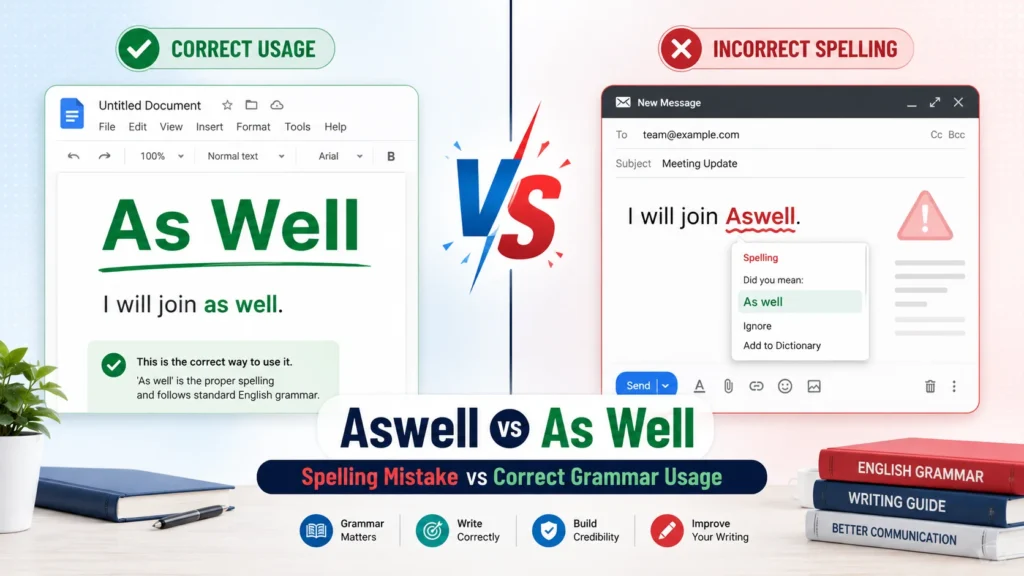
Aswell vs As Well often creates confusion because Many people, English learners, language learners, native speakers, and native English speakers encounter both versions online, in text messages, on social media, across social platforms, and through everyday email writing. From reviewing professional documents and school assignments, I have noticed that a minor spelling issue can quickly attract teacher notice or employer notice, even when the writer intended the correct form.
People naturally assume that aswell follows the same pattern as compound words like already or someone, yet grammar rules reveal a different story about what is correct and what supports proper usage.
Using simple language, the standard form in standard English is as well, while aswell is considered incorrect. Understanding this small difference in spacing can instantly improve writing clarity, writing confidence, grammar accuracy, language accuracy, and overall professionalism in formal writing, casual writing, informal writing, and professional writing.
This complete guide explains the origin, phrase usage, usage rules, real-world examples, practical examples, English grammar, grammar guidance, and grammar tips behind these two words, helping readers match search intent, answer FAQs, avoid common mistakes and grammar mistakes, strengthen communication, and confidently use the right form in everyday English, English conversation, meeting invitations, assignments, and learning English situations.
Quick Answer: Is It “Aswell” or “As Well”?
If you’re in a hurry, here is the answer:
| Term | Correct? | Meaning | Standard Usage |
| Aswell | ❌ No | Misspelling | Not accepted |
| As Well | ✅ Yes | Also; in addition | Correct |
You should always write as well as two separate words.
Examples:
✅ I bought dessert as well.
✅ Sarah wants to come as well.
❌ I bought dessert aswell.
❌ Sarah wants to come aswell.
No major style guide recognizes aswell as correct standard English.
That includes:
- AP Style
- Chicago Manual of Style
- Oxford English conventions
- Merriam-Webster usage standards
The rule stays the same in formal and informal writing.
What Does “As Well” Mean?
The phrase as well usually means:
- also
- too
- in addition
- along with that
It adds extra information.
Think of it as adding another item into a shopping cart.
You already have one thing. Then you throw in another thing too.
For example:
“I ordered coffee.”
Now add more information:
“I ordered coffee as well.”
The phrase tells readers that coffee joined something else.
More examples:
- Mark plays soccer as well.
- We visited the museum as well.
- She speaks Spanish as well.
In every case, as well adds something extra.
Why “Aswell” Is Incorrect
Many people assume aswell follows the same pattern as words like:
- Already
- Somehow
- Somewhere
- Anyone
- Anywhere
Those are single words. Naturally, some writers assume aswell should work the same way.
The problem is that English never officially merged as well into one word.
Language evolves over time. Some words join together naturally.
For example:
| Older Form | Modern Form |
| To day | Today |
| Any one | Anyone |
| Some body | Somebody |
However, as well never made that transition.
Why?
Because the phrase still functions as two separate units rather than a fully merged word.
Why People Keep Writing “Aswell”
The mistake isn’t random.
Several factors create it.
Fast typing habits
Most people type quickly on phones. They hit spacebars less carefully than they used to.
Small mistakes sneak in.
Social media culture
Social platforms reward speed over accuracy.
Someone writes:
“I want pizza aswell.”
Then thousands of people see it.
After enough repetition, incorrect forms begin to look normal.
Autocorrect problems
Autocorrect tools aren’t perfect.
Sometimes they miss unusual spacing errors.
Sometimes they even learn repeated user mistakes.
Pattern matching in the brain
Humans love patterns.
You unconsciously think:
- Already
- Somehow
- Anyway
- Therefore
So your brain says:
“Maybe aswell belongs here too.”
It doesn’t.
Read more: Oversite vs Oversight: What’s the Difference?
As Well vs Also vs Too: Understanding The Difference
Many people use these interchangeably.
They overlap in meaning. However, they don’t always sound identical.
| Phrase | Position | Tone | Example |
| As well | Usually sentence end | Natural | I bought coffee as well. |
| Also | Beginning or middle | Slightly formal | I also bought coffee. |
| Too | Usually sentence end | Casual | I bought coffee too. |
Let’s break this down.
Using “as well”
“As well” often feels balanced and smooth.
Example:
“We watched a movie as well.”
Using “also”
“Also” often appears in business writing.
Example:
“We also reviewed quarterly results.”
Using “too”
“Too” sounds relaxed.
Example:
“I’m coming too.”
Imagine three people entering a room.
One says:
“I’m joining as well.”
Another says:
“I’m also joining.”
The third says:
“I’m joining too.”
All three communicate nearly the same idea.
The tone changes slightly.
Where Should You Place “As Well” In A Sentence?
Sentence placement matters.
Most writers place as well near the end.
Examples:
- I want dessert as well.
- They attended the meeting as well.
- She enjoys reading as well.
This placement sounds natural.
However, English gives some flexibility.
Inside a sentence
You can sometimes place it in the middle.
Examples:
- She as well accepted the invitation.
- John as well contributed ideas.
These structures appear less often.
They may sound formal or old-fashioned.
Formal writing
Formal writing sometimes shifts placement for rhythm.
Example:
“The committee, as well, approved the proposal.”
You won’t see this frequently in everyday speech.
Common Sentence Patterns With “As Well”
Certain structures appear repeatedly.
Understanding them makes writing easier.
Subject + verb + object + as well
Examples:
- I bought snacks as well.
- They invited Emma as well.
- She completed the project as well.
Adding extra information
Examples:
- The package includes headphones as well.
- Breakfast comes with coffee as well.
Lists
Examples:
- We packed jackets, boots, and gloves as well.
- The course covers writing, editing, and research as well.
“As Well” vs “As Well As”: They Are Different
This creates huge confusion.
People often think they’re interchangeable.
They aren’t.
Look at this comparison:
| Expression | Meaning | Example |
| As well | Also | I want pizza as well. |
| As well as | In addition to | Sarah as well as Jake is coming. |
Notice something important.
The subject changes.
Consider:
“Sarah as well as Jake is coming.”
Not:
“Sarah as well as Jake are coming.”
The main subject remains Sarah.
Jake adds extra information.
This grammar point trips up many writers.
Real-World Examples Of “As Well” Used Correctly
Learning grammar through real situations works better than memorizing rules.
Everyday conversations
“Can I order fries as well?”
“We’re bringing drinks as well.”
“I’ll join you as well.”
Workplace communication
“Please attach the spreadsheet as well.”
“Marketing reviewed the proposal as well.”
“Could you copy the finance team as well?”
Academic writing
“The study examined environmental effects as well.”
“Researchers evaluated secondary factors as well.”
Social media examples
“Just finished the movie and loved the soundtrack as well.”
“That recipe looks amazing. I’ll try it as well.”
Case Study: How One Tiny Space Changed Professional Writing
A hiring manager reviewed hundreds of job applications.
Many looked strong.
Then a pattern appeared.
Several candidates repeatedly wrote:
“I have experience in sales aswell.”
Small issue?
Maybe.
However, employers often view grammar mistakes as signals about attention to detail.
Research from multiple hiring surveys consistently shows that spelling and grammar errors can negatively influence first impressions.
One missing space seems tiny.
Still, tiny details can leave lasting impressions.
That’s why grammar matters.
Common Mistakes People Make With “As Well”
Let’s look at mistakes that appear constantly.
Writing “aswell”
Wrong:
❌ I want ice cream aswell.
Correct:
✅ I want ice cream as well.
Confusing “as well” with “as well as”
Wrong:
❌ James as well Mike are here.
Correct:
✅ James as well as Mike is here.
Using multiple addition words
Wrong:
❌ I also came too as well.
Correct:
✅ I also came.
OR
✅ I came as well.
OR
✅ I came too.
Too many addition words make writing sound awkward.
Think of it like putting four toppings on a pizza when one already tastes perfect.
Examples Of Incorrect vs Correct Usage
| Incorrect | Correct |
| I want dessert aswell. | I want dessert as well. |
| She aswell joined us. | She joined us as well. |
| I also came too as well. | I came as well. |
| Mark as well Sarah arrived. | Mark as well as Sarah arrived. |
Fast Memory Trick To Never Confuse “Aswell” And “As Well”
Here’s an easy trick.
Ask yourself:
Can I replace it with “also”?
Example:
“I want coffee as well.”
Replace:
“I want coffee also.”
The sentence still works.
That tells you as well functions as two words.
Remember this phrase:
If you mean “also,” leave a space.
Short rule.
Easy to remember.
Mini Grammar Test: Can You Spot The Correct Usage?
Fill in the blanks.
Choose aswell or as well.
Questions
- I ordered fries ______.
- She plays tennis ______.
- We invited Daniel ______.
- Sarah wanted dessert ______.
Answers
- I ordered fries as well.
- She plays tennis as well.
- We invited Daniel as well.
- Sarah wanted dessert as well.
No tricks here.
Every answer uses as well.
7 FAQs on “Aswell vs As Well”
1. Is “aswell” a correct English word?
No, “aswell” is incorrect. The correct form is “as well.”
2. What does “as well” mean?
It means “also” or “in addition” in a sentence.
3. Why do people write “aswell”?
Because in spoken English, “aswell” and “as well” sound the same.
4. Can I use “aswell” in formal writing?
No, it should be avoided in all formal writing.
5. Where is “as well” commonly used?
It is used in emails, essays, social media posts, and professional writing.
6. Is there any difference between British and American English here?
No, both British and American English use “as well.”
7. Can “as well” be replaced with another word?
Yes, it can often be replaced with “also” or “in addition.”
Conclusion
The difference between “aswell” and “as well” may seem small, but it can significantly improve the quality of your writing. While many people make this mistake, standard English recognizes only “as well” as the correct form. Understanding this simple rule helps you communicate more clearly, avoid common grammar errors, and write with greater confidence in both formal and casual situations.
Whether you are drafting an email, completing an assignment, or publishing an article, choosing the correct form reflects accuracy, professionalism, and strong writing habits.

Mia Rose brings fifteen years of experience at The University of Edinburgh’s English Literature department, leading students through explorations of classic and contemporary texts, literary theory, and narrative design. Her academic interests center on Victorian and modernist fiction, poetic rhythms, postcolonial storytelling, and digital approaches to literary study—with a keen eye on how voice and perspective frame cultural dialogue. Mia has delivered talks at prestigious global conferences and authored articles in scholarly journals, showcasing her commitment to meaningful research and lively classroom engagement.