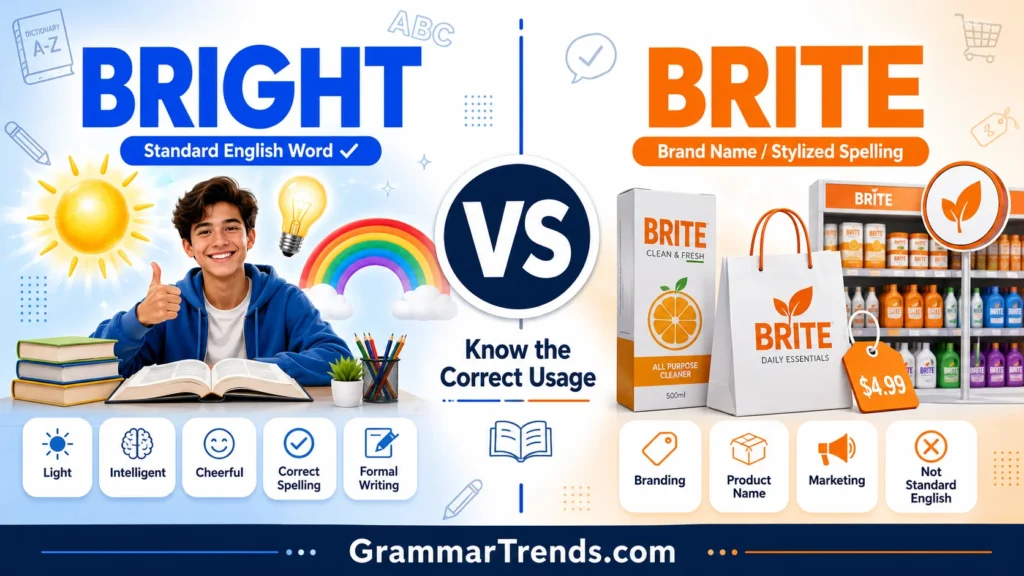
Bright vs Brite shows common spelling confusion where bright means light or smart while Brite is often brand usage or a variation in language use.
People often get confused between “bright” and “brite” because they sound almost identical, but their meanings and contexts are very different in everyday writing and speech. “Bright” is a standard English word used to describe something full of light, vivid color, or a person who is intelligent and quick to understand. It is widely accepted in dictionaries and used in academic, professional, and casual communication without any issues.
On the other hand, “Brite” is not a standard spelling in most cases and is mainly seen in branding or product names like Scotch-Brite. It is used for stylistic or marketing purposes rather than formal language rules. This is why using “brite” in school assignments, emails, or professional writing can look incorrect unless you are referring to a specific brand.
Understanding the difference between Bright and Brite helps improve writing accuracy, avoids spelling mistakes, and makes communication more professional. With practice and awareness, choosing the correct spelling becomes easier, especially when writing essays, social media posts, or professional documents.
Bright vs Brite at a Glance
Before diving deeper, here’s the fast answer.
| Feature | Bright | Brite |
| Standard English word | Yes | Limited |
| Found in everyday writing | Yes | Rare |
| Used in school essays | Yes | Usually no |
| Describes intelligence | Yes | No |
| Describes light | Yes | No |
| Used for branding | Sometimes | Frequently |
| Accepted in formal writing | Yes | Context dependent |
Quick takeaway:
If you’re writing regular English, choose bright almost every time.
What Does Bright Mean?
The word bright carries several meanings. That’s one reason it appears so often in English.
It can describe:
- Light
- Intelligence
- Mood
- Personality
- Hope
- Future success
- Color intensity
Instead of having one fixed role, bright behaves like a multi-tool.
Let’s unpack each meaning.
Bright as a Description of Light
This is probably the first meaning most people learn.
Bright refers to something producing a lot of light or appearing vivid and shining.
Examples:
- The moon looked unusually bright tonight.
- A bright lamp illuminated the room.
- The stars seemed bright in the desert sky.
Imagine walking into a dark room and flipping a switch. Suddenly the space fills with light. That light feels bright.
Common objects described as bright:
- Sunlight
- Stars
- Flashlights
- Screens
- Colors
- Lamps
- Neon signs
Bright as Intelligence or Mental Ability
English often uses bright to describe someone’s thinking skills.
When people call someone bright, they usually mean:
- Smart
- Quick to learn
- Mentally sharp
- Intelligent
Examples:
- Emma is a bright student.
- He’s incredibly bright for his age.
- The company hired several bright young engineers.
Notice something interesting here.
Nobody says:
“She’s a brite student.”
That instantly sounds wrong because bright owns this meaning.
Bright as Mood or Personality
Words often stretch beyond literal meanings. Bright does this very well.
A person can have:
- A bright smile
- A bright personality
- A bright attitude
Examples:
- She greeted everyone with a bright smile.
- His bright personality changed the mood in the room.
Think of happiness as sunlight entering a room. That’s essentially the metaphor hiding behind this meaning.
Bright as Hope or Future Potential
People often connect brightness with opportunity.
Examples:
- She has a bright future.
- The startup has bright prospects.
- Young athletes dream of bright careers.
A bright future doesn’t mean the future literally glows.
It means:
- promising
- successful
- hopeful
- positive
Bright as Color Intensity
Colors can also be bright.
Examples:
- bright blue
- bright red
- bright yellow
Bright colors tend to:
- attract attention
- appear vivid
- stand out visually
Marketing teams often use bright colors because the human eye notices them quickly.
What Does Brite Mean?
Now let’s talk about the word causing all the confusion.
Unlike bright, brite usually isn’t a standard replacement word.
Instead, it commonly appears as:
- a brand name
- a surname
- an intentionally modified spelling
Examples:
- Product names
- Business names
- Company branding
Brite as a Brand Name
Businesses love modifying spellings.
Why?
Because unique spellings stand out.
For example:
A company might choose:
UltraBrite
instead of:
UltraBright
The altered version looks distinctive and becomes easier to trademark.
Marketing teams have used this strategy for decades.
Examples of modified brand spelling patterns:
| Standard Word | Alternate Branding |
| Light | Lite |
| Through | Thru |
| Bright | Brite |
| Express | Xpress |
Brite as a Proper Name
Some people carry Brite as a surname.
Examples:
- family names
- business owners
- organization names
In these cases, the spelling isn’t wrong.
It’s simply a proper noun.
Brite as an Intentional Alternate Spelling
Modern brands often create alternate spellings because they want:
- uniqueness
- memorability
- trademark availability
This happens all over advertising.
Think about how language changes online.
Companies sometimes bend spelling rules because attention matters.
Is Brite a Real Word?
Yes.
But context matters.
That’s where many people get confused.
The better question isn’t:
“Is brite real?”
The better question is:
“When should I use brite?”
The answer:
Use brite only when referring to:
- brand names
- proper names
- intentional spellings
Avoid replacing bright with brite in standard writing.
Correct:
- The room became bright.
Incorrect:
- The room became brite.
Correct:
- I bought a product called UltraBrite.
“The right word may be effective, but no word was ever as effective as a rightly timed word.” — Mark Twain
That quote captures the point perfectly.
Small word choices create big differences.
Reaad more: Remanent vs Remnant: Which Word Should You Use?
Why People Confuse Bright and Brite
Several factors create this mix-up.
They Sound Exactly the Same
Bright and brite are homophones.
Homophones are words that:
- sound identical
- have different spellings
- have different meanings
Examples include:
| Word Pair | Meaning Difference |
| Their / There | Ownership vs place |
| Right / Write | Correct vs create text |
| Brake / Break | Stop vs damage |
| Bright / Brite | Standard word vs limited use |
Because pronunciation offers no clues, people rely entirely on spelling memory.
Branding Influences Everyday Writing
Advertising surrounds people constantly.
You see alternate spellings in:
- websites
- apps
- packaging
- social media
- product labels
Eventually the brain starts accepting those patterns.
It’s like hearing a song repeatedly until the lyrics feel automatic.
Texting and Informal Habits
Fast typing changes behavior.
People shorten words because speed matters.
Examples:
- thru
- u
- lite
- brite
The problem appears when casual habits move into formal writing.
Bright vs Brite: Side-by-Side Examples
Let’s compare them directly.
| Correct Usage | Incorrect Usage |
| The sun looked bright today. | The sun looked brite today. |
| Sarah has a bright future. | Sarah has a brite future. |
| The classroom felt bright and cheerful. | The classroom felt brite and cheerful. |
| Brite is the company’s product name. | Bright is the product trademark. |
Patterns become easier when you see them repeatedly.
Common Phrases That Use Bright
English loves expressions built around bright.
Here are several popular ones.
Bright Future
Meaning:
A successful or promising future.
Example:
- Olivia has a bright future in medicine.
Bright Idea
Meaning:
A clever solution.
Example:
- Jake had a bright idea during the meeting.
Sometimes people also use it sarcastically:
“Well, that was a bright idea.”
Context changes everything.
Bright Side
Meaning:
The positive aspect of a situation.
Example:
- Look on the bright side.
Bright Lights
Meaning:
Strong lights or city excitement.
Example:
- She moved to New York for the bright lights and opportunities.
Bright Smile
Meaning:
A cheerful smile.
Example:
- Her bright smile immediately relaxed the audience.
Bright Spark
Meaning:
A clever person.
Example:
- Ethan is a real bright spark.
Synonyms of Bright by Meaning
Different situations need different alternatives.
| Word | Meaning |
| Radiant | Glowing strongly |
| Brilliant | Extremely bright |
| Luminous | Producing light |
| Shining | Reflecting light |
Bright Synonyms for Intelligence
| Word | Meaning |
| Clever | Quick thinker |
| Sharp | Mentally alert |
| Intelligent | High reasoning ability |
| Smart | Knowledgeable |
Bright Synonyms for Mood
| Word | Meaning |
| Cheerful | Happy |
| Sunny | Positive |
| Upbeat | Optimistic |
| Joyful | Full of happiness |
Common Mistakes Writers Make With Bright vs Brite
Even experienced writers occasionally make these mistakes.
Using Brite in Academic Writing
Wrong:
“The scientist had a brite mind.”
Correct:
“The scientist had a bright mind.
Copying Brand Spellings
Brands sometimes influence writing unconsciously.
Someone sees:
UltraBrite
Then writes:
“The room became brite.”
The brain likes shortcuts.
Sometimes those shortcuts take a wrong turn.
Assuming Similar Sound Means Similar Usage
English doesn’t always play fair.
Words that sound alike can behave completely differently.
A Quick Memory Trick You’ll Actually Remember
Here’s a simple trick:
Bright = Right
Notice something?
Both words end with:
-ght
Both look complete.
Both fit standard English.
Now remember:
Brite = Brand
The moment you see brite, ask yourself:
“Am I talking about a product or name?”
If not, use bright.
Small Case Study: How One Letter Changes Meaning
A marketing intern once sent two email versions.
Version A:
“Our company has a bright future.”
Version B:
“Our company has a brite future.”
Customers immediately noticed Version B.
Not because it sounded creative.
Because it looked like a typo.
One small letter shifted the entire impression.
Language works that way.
Tiny details often carry surprising weight.
FAQs
1. What is the difference between bright and brite?
“Bright” is the correct English word meaning full of light or intelligent, while “brite” is usually a brand-style spelling or informal variation.
2. Is brite a correct English spelling?
In standard English, no. “Brite” is generally not accepted in dictionaries except when used in product or brand names.
3. When should I use bright instead of brite?
Use “bright” in all formal writing like essays, emails, and exams unless you are referring to a brand that uses “brite.”
4. Why do people get confused between bright and brite?
They sound identical when spoken, so people often assume both spellings are correct, even though only “bright” is standard English.
5. Is brite used in company or product names?
Yes, many brands use it creatively, such as Scotch-Brite, where spelling is intentionally stylized for branding.
6. Does bright only mean light?
No, it can also describe intelligence, mood, or clarity, such as a “bright student” or “bright idea.”
7. How can I avoid mistakes between bright and brite?
Practice writing, check dictionaries, and focus on context—use “bright” for meaning and “brite” only when it’s part of a proper name.
Conclusion
Understanding the difference between Bright vs Brite is simple once you know their correct usage. Bright is the standard English word used to describe light, vivid colors, intelligence, or cheerful qualities. It is the correct spelling for academic, professional, and everyday writing. Brite, on the other hand, is generally used as part of brand names or for marketing purposes and is not considered standard English in most contexts. Choosing the right word improves your writing, avoids spelling mistakes, and helps you communicate more clearly and professionally.

Emma Rose has spent 15 years in the English Department at the University of California, Los Angeles (UCLA), guiding students through British and American literary classics, critical theory, and narrative techniques. Her scholarly focus includes 19th- and 20th-century fiction, the art of poetry, postcolonial writing, and digital humanities particularly how storytelling voice influences cultural perspectives. Emma has presented her research at major international conferences and published in respected academic journals, underscoring her dedication to both high-level scholarship and engaging teaching.