
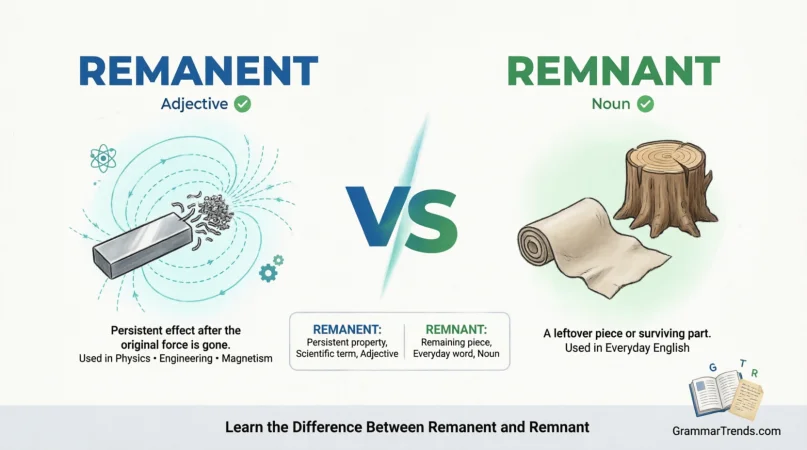
Remanent vs Remnant shows difference in context, confusing users in science and everyday usage of remaining matter in technical language use
In main, the idea is actually simple: I often see people confused in an article when they explore the difference, but both carry distinct meanings with clear definitions and examples when you use them correctly. To clarify the proper word, everything depends on context, where one acts as an adjective and the other as a noun, linked to something remaining, left over, after a process or event, usually a small quantity of matter.
When I dive deeper, I rely on short definitions provided as explanation, because many words are interchangeably used, and the correct word depends on what it describes or refers, especially in grammar and usage, where Remanent is adjective and Remnant is noun.
In science, remanent often relates to magnetized materials and residual magnetization in a rock, measured with a magnetometer, while in everyday life, remnants appear as leftovers like a piece of cloth, food, or people who remain after a castle on a hill. These effects extend into energy and technical discussions, where traces of something matter, and understanding this improves english, avoids confusion, and makes ideas more precise and natural.
Quick Answer: Remanent vs Remnant at a Glance
If you’re in a hurry, here is the short version:
- Remanent describes something that continues to exist after a cause disappears. It appears mostly in scientific and technical contexts.
- Remnant refers to a leftover piece, surviving portion, or remaining part of something.
| Word | Meaning | Common Usage | Example |
| Remanent | Continuing effect after removal of a force | Physics, engineering, magnetism | “The material retained remanent magnetization.” |
| Remnant | Leftover piece or surviving part | Everyday language | “A remnant of the castle still stands.” |
The important thing to remember is simple:
Most people will use “remnant” far more often than “remanent.
Why People Confuse Remanent and Remnant
The confusion doesn’t happen by accident.
Several things make these words look like twins.
They share similar spelling
Look at them side by side:
- Remanent
- Remnant
Only one extra letter separates them.
When people read quickly, the brain often recognizes word patterns instead of examining every letter. That tiny difference slips through unnoticed.
They come from related linguistic roots
Both words trace back to ideas involving remaining or staying behind.
That shared history creates overlap in meaning.
Yet language evolved over time. Each word developed its own lane.
Spell-check doesn’t always save you
Modern writing tools catch many mistakes. Still, they sometimes miss contextual problems.
For example:
❌ “The remanent of the building remained.”
Because remanent exists as a legitimate word, software may not flag it.
Context matters more than spelling
Words often depend on their surroundings.
Consider these examples:
- “Scientists studied remanent magnetization.”
- “Only a remnant of the ancient wall survived.”
The surrounding topic immediately reveals which word belongs.
What Does “Remanent” Mean?
Remanent is an adjective used mainly in technical and scientific settings.
It describes something that remains after the original cause disappears.
Most commonly, the term appears in discussions involving magnetic properties.
Simple definition
Remanent: Continuing or persisting after an external influence ends.
Origin and word history
The term comes from Latin roots connected to remaining behind.
Scientists later adopted the word for specialized uses.
Over time, remanent became closely associated with physics and engineering.
Where “remanent” commonly appears
You’ll usually see it in fields such as:
- Materials science
- Electrical engineering
- Physics
- Magnetism research
- Geology
Understanding remanent magnetization
One of the most common technical phrases is:
Remanent magnetization
This refers to magnetization that remains after an external magnetic field disappears.
Here is a simple analogy:
Imagine rubbing a balloon against your hair.
The balloon becomes charged and can attract paper pieces even after you stop rubbing it.
Something similar happens with magnetic materials. They can keep some magnetic behavior after the original force disappears.
Example sentences using remanent
Scientific examples:
- The experiment measured remanent magnetic properties.
- Engineers tested the remanent behavior of the alloy.
- Researchers examined remanent polarization in ceramic materials.
- The sample showed strong remanent magnetization.
Academic examples:
- The study evaluated remanent effects after thermal exposure.
- Scientists compared remanent characteristics across materials.
What Does “Remnant” Mean?
Unlike remanent, remnant appears almost everywhere.
You hear it in daily conversation, novels, journalism, business writing, and history books.
Simple definition
Remnant: A remaining piece, leftover portion, or surviving fragment.
Origin and historical meaning
The word comes from older French and Latin roots connected with remaining parts.
For centuries people have used it to describe whatever survives after the larger whole disappears.
Common contexts where remnant appears
You’ll encounter remnant in many places:
Daily conversation
- “There’s a remnant of cake left.”
History
- “Only remnants of the ancient civilization remain.”
Religion
- “The faithful remnant survived difficult times.”
Business
- “The store sold fabric remnants at discounted prices.”
Literature
- “A remnant of hope stayed alive.”
Example sentences using remnant
General examples:
- A remnant of smoke lingered in the room.
- The storm left only a remnant of the old fence.
- Archaeologists discovered remnants of an ancient settlement.
- Small remnants of snow covered the mountain.
Business examples:
- Quilters often buy fabric remnants.
- The company sold remnant inventory at reduced prices.
Descriptive examples:
- A remnant of sunlight painted the sky orange.
Remanent vs Remnant Side-by-Side Comparison
Here is the complete comparison.
| Feature | Remanent | Remnant |
| Part of speech | Adjective | Noun |
| Main meaning | Persistent property | Remaining piece |
| Usage frequency | Rare | Common |
| Typical field | Science and engineering | Everyday language |
| Can replace the other? | No | No |
Remanent vs Remnant in Real Writing Situations
Understanding definitions helps. Seeing them in action helps even more.
In scientific writing
Scientists need precision.
Even tiny wording mistakes can alter meaning.
Correct:
“Researchers measured remanent magnetic behavior.”
Incorrect:
“Researchers measured remnant magnetic behavior.”
The second version changes the intended meaning.
In academic writing
Students sometimes assume remanent sounds more scholarly.
That creates problems.
Example:
❌ “The remanent of ancient culture survived.”
Corrected:
✅ “The remnant of ancient culture survived.”
In everyday communication
Daily speech almost always favors remnant.
Examples:
- A remnant of pizza remained.
- Small remnants of paint covered the wall.
- The village became a remnant of another era.
In business and product descriptions
Retailers often use remnant.
Examples include:
- Carpet remnants
- Fabric remnants
- Inventory remnants
- Stock remnants
Walk into a fabric store and you’ll often find a section labeled:
Remnant Sale
Those are leftover cuts sold at lower prices.
Read more: Traunch vs Tranche: What’s the Difference?
Case Study: How One Word Changed an Entire Meaning
Imagine a student writing a geology paper.
Original sentence:
“Scientists studied the remnant magnetic field.”
Professor feedback:
“Did you mean remanent magnetic field?”
The issue seems tiny.
Yet remnant magnetic field suggests leftover fragments of a magnetic field.
Remanent magnetic field describes persistent magnetization after the original source disappears.
One letter changed the scientific meaning entirely.
That small detail could affect accuracy, grades, or research interpretation.
Common Mistakes Writers Make
Writers repeat a few mistakes frequently.
Knowing them helps you avoid the same traps.
Using “remanent” because it sounds formal
Long words sometimes feel more academic.
Still, sounding sophisticated doesn’t make a word correct.
Incorrect:
❌ A remanent of history survives today.
Correct:
✅ A remnant of history survives today.
Assuming both words mean “leftover”
They share related ideas yet mean different things.
Remnant
- Remaining piece
Remanent
- Persistent effect
Confusing nouns and adjectives
Another mistake involves grammar.
Remnant commonly acts as a noun:
- The remnant survived.
Remanent acts as an adjective:
- The material showed remanent properties.
Easy Memory Tricks to Never Mix Them Up Again
Memory devices work because they create associations.
Try these.
Remember the magnet connection
Remanent → Magnet
Both contain similar sounds.
Think:
Remanent = magnetic persistence
Remember the remains connection
Remnant → Remains
Both involve leftovers.
Think:
Remnant = what remains
Visual memory diagram
Remanent
↓
Persistent effect
↓
Magnetism
Remnant
↓
Remaining piece
↓
Leftovers
Correct vs Incorrect Sentence Examples
Examples make the distinction clearer.
| Sentence | Correct? | Explanation |
| The scientist measured remanent magnetization. | ✔ | Technical use |
| A remanent of the old city survived. | ✘ | Should be remnant |
| Small remnants of snow covered the field. | ✔ | Leftover pieces |
| Engineers studied remnant magnetization. | ✘ | Should be remanent |
Related Words Often Confused With Remnant and Remanent
English contains several similar terms.
Here’s how they compare.
| Word | Meaning | Difference |
| Remains | What stays behind | Broad meaning |
| Residue | Material left after a process | Often physical material |
| Residual | Remaining effect | Usually statistical or technical |
| Remainder | Portion left | Often quantity-related |
| Remnant | Surviving fragment | Physical or symbolic piece |
Remains
Examples:
- Human remains
- Ancient remains
This term often refers to surviving traces.
Residue
Examples:
- Soap residue
- Chemical residue
Residue usually appears after reactions or processes.
Residual
Examples:
- Residual income
- Residual heat
Residual often describes lingering effects.
Remainder
Examples:
- The remainder of the class arrived later.
- Five divided by two leaves a remainder.
Interesting Facts About the Word “Remnant”
Language carries fascinating stories.
Here are a few:
- Remnant has existed in English for hundreds of years.
- Fabric stores frequently use the term commercially.
- Historians often describe surviving civilizations as remnants.
- Religious texts sometimes refer to a surviving faithful group as a remnant.
- Remanent appears heavily in physics literature.
Mini Practice Quiz
Try these before checking answers.
Fill in the blanks
Choose remanent or remnant.
- The engineer measured ______ magnetization.
- Only a small ______ of the castle remains.
- The researchers studied ______ properties.
- Small ______ of snow covered the road.
- Scientists analyzed ______ effects.
Choose the correct word
A.
“The storm left a remanent/remnant of the old bridge.”
B.
“The material showed remanent/remnant magnetic behavior.”
C.
“The museum displayed remnants/remanents of ancient pottery.”
D.
“The study examined remanent/remnant effects.”
E.
“Only a remanent/remnant survived.”
Answer key
- Remanent
- Remnant
- Remanent
- Remnants
- Remanent
A: Remnant
B: Remanent
C: Remnants
D: Remanent
E: Remnant
FAQs
What is the main difference between Remanent and Remnant?
Remanent refers to something that remains after a process, while Remnant is a small leftover quantity of something.
Is Remanent a noun or adjective?
Remanent is an adjective used to describe something that remains after a process or event.
Is Remnant used in science?
Not usually. Remnant is mostly used for everyday leftover objects or quantities, not technical science terms.
Can Remanent and Remnant be used interchangeably?
No, they have different grammatical roles and meanings, so they should not be used interchangeably.
Where is Remanent commonly used?
Remanent is commonly used in science, especially in magnetized materials and residual magnetization.
Give an example of Remnant in a sentence?
An example is: “The remnant of the old castle still stands on the hill.”
Why is it important to understand the difference?
Understanding the difference improves English usage, avoids confusion, and makes sentences more precise and natural.
Conclusion
Understanding Remanent vs Remnant becomes much easier once you recognize that the two words belong to different contexts and serve different grammatical purposes. Although both relate to the idea of something remaining after a process or event, Remanent is an adjective used mainly in scientific and technical discussions, especially when describing residual properties such as magnetization that remain in materials. Remnant, on the other hand, is a noun used in everyday English to describe something left behind, such as a piece of cloth, leftover food, traces of an object, or people who remain after an event.
Because these words share a similar root, they are often confused, but they are not interchangeable. Choosing the correct word depends entirely on what you want to express. If you are describing a lasting property or effect in science, Remanent is the correct choice. If you are referring to a remaining object, portion, or trace, Remnant is the proper word. Learning this distinction improves your grammar, strengthens your vocabulary, and makes your writing more precise, natural, and professional. By paying attention to context and remembering whether you need an adjective or a noun, you can confidently use both words correctly in academic, technical, and everyday communication.

Emma Rose has spent 15 years in the English Department at the University of California, Los Angeles (UCLA), guiding students through British and American literary classics, critical theory, and narrative techniques. Her scholarly focus includes 19th- and 20th-century fiction, the art of poetry, postcolonial writing, and digital humanities particularly how storytelling voice influences cultural perspectives. Emma has presented her research at major international conferences and published in respected academic journals, underscoring her dedication to both high-level scholarship and engaging teaching.