

9 Professional Ways to Say “I Would Appreciate Your Input on This Matter” offers professional wording for clear and polite requests.
If you’re wondering about the best ways to say that you appreciate someone’s input on a matter, first understand the context. When you ask for advice, feedback, or a perspective, choose wording that feels natural and appropriate for the situation. Luckily, this article can assist by showing useful synonyms and phrases for different contexts. You might say that you value someone’s insights on an issue, that their perspective would be welcomed, or that you seek their input. These options certainly sound professional and help you provide a clear request. From my experience, effective wording often depends on whether you need a formal tone or a warmer approach.
Choosing the Right Expression for the Situation
This list includes several synonym options that can help you navigate a professional discussion. If you want to sound grateful, you can ask for someone’s contribution, while a request for advice can feel more personal. When someone has relevant expertise, describing their input as beneficial can show respect for their knowledge. You can also welcome their thoughts when you want a more open exchange. The goal is to use wording that matches the relationship, request, and context. Keep reading to see how these different phrases work naturally.
Is “I Would Appreciate Your Input on This Matter” Professional?
Yes. “I would appreciate your input on this matter” is professional and grammatically correct.
The phrase works particularly well when you’re asking someone to contribute an opinion, idea, recommendation, or knowledge to a discussion or decision. Cambridge’s Business English Dictionary defines input as help, ideas, or knowledge that someone contributes to a project or organization. (Cambridge Dictionary)
For example:
I would appreciate your input on the revised project timeline.
This sentence sounds respectful without directly ordering the recipient to respond.
The phrase contains three useful parts:
| Part | Function |
| I would appreciate | Creates a polite request |
| your input | Identifies the contribution you want |
| on this matter | Identifies the general subject |
However, “this matter” can sometimes feel vague. If you know exactly what you want the person to review, naming it usually creates a stronger sentence.
Compare these examples:
I would appreciate your input on this matter.
I would appreciate your input on the revised budget.
The second sentence gives the reader an immediate target. There’s less guesswork.
When the original phrase works well
You can comfortably use it in:
- Business emails
- Formal workplace communication
- Requests to managers
- Project discussions
- Committee correspondence
- Client communication
- Decision-making situations
- Professional consultations
When another phrase may work better
Choose a different expression when you specifically need:
- Feedback on a document
- Advice about what to do
- Insights from an expert
- Perspective on a difficult decision
- Thoughts about an idea
- Recommendations for a particular course of action
The important point is simple: don’t replace a phrase just to make it sound fancier. Replace it when another phrase expresses your meaning more precisely.
9 Best Alternatives to “I Would Appreciate Your Input on This Matter”
These nine alternatives cover the most useful professional situations. They aren’t perfect synonyms in every context. Each one emphasizes a slightly different type of contribution.

I Would Value Your Insights on This Issue
“I would value your insights on this issue” works especially well when you’re speaking to someone with relevant knowledge or experience.
The word insights suggests more than a casual opinion. It implies that the person’s experience, expertise, or understanding could reveal something useful.
For example:
I would value your insights on this issue before we finalize the proposal.
This sentence fits a situation where you’re asking an experienced colleague, specialist, manager, or consultant to examine a problem.
Best situations for this phrase
Use it when:
- The recipient has specialized knowledge
- You’re discussing a complex issue
- You want thoughtful analysis
- You’re asking a subject-matter expert
- The decision could benefit from experience
Example
We’re reviewing the technical requirements for the new system. I would value your insights on this issue before we move forward.
That sounds more specific than simply asking for “input.”
Tone
Formal, respectful, and expert-focused
If you’re writing to a technical specialist, senior professional, or consultant, this can be an excellent choice.
I’d Appreciate Your Thoughts on This
Sometimes the best alternative is also the simplest.
“I’d appreciate your thoughts on this” sounds professional without becoming stiff. The contraction “I’d” also makes the sentence more conversational than the full “I would.”
For example:
I’d appreciate your thoughts on this before our meeting tomorrow.
The phrase doesn’t necessarily ask for criticism or detailed analysis. It simply invites the person’s opinion.
That’s why it works across many workplace situations.
Best situations for this phrase
Use it for:
- Internal emails
- Coworkers
- Managers
- Project discussions
- Draft proposals
- General opinions
- Informal professional conversations
Example
I’ve attached the revised presentation. I’d appreciate your thoughts on the new structure before I send it to the client.
This version feels natural while remaining professional.
Tone
Professional, warm, and approachable
For everyday workplace communication, this is one of the safest alternatives.
I Would Value Your Perspective on This Matter
“I would value your perspective on this matter” emphasizes the person’s viewpoint.
That’s slightly different from asking for general input.
A perspective can be especially useful when you’re dealing with a decision that has several sides. You’re not necessarily asking the person to edit something or tell you what to do. You’re asking how they see the situation.
For example:
I would value your perspective on this matter before we decide how to proceed.
This works particularly well when the person has a different role, experience level, or area of responsibility.
Best situations for this phrase
Use it for:
- Strategic decisions
- Sensitive workplace issues
- Management discussions
- Cross-team decisions
- Situations involving competing viewpoints
- Conversations with experienced colleagues
Example
Since you’ve worked with this client before, I would value your perspective on this matter before we respond.
The reason is clear. The recipient has relevant experience, so their perspective matters.
Tone
Formal, thoughtful, and respectful
It’s particularly useful when you want to recognize someone’s judgment rather than simply request comments.
Could You Please Share Your Thoughts on This?
If you want to make the request more direct, turn it into a question.
“Could you please share your thoughts on this?” clearly tells the recipient what action you want.
For example:
Could you please share your thoughts on the revised timeline?
The phrase remains polite because “could you please” softens the request.
It’s also more specific than saying:
I would appreciate your input.
The question tells the recipient exactly what you’re asking them to do.
Best situations for this phrase
Use it when:
- You need a response
- You’re reviewing a proposal
- You’re discussing a project
- You want an opinion rather than a formal evaluation
- You communicate regularly with the recipient
Example
We’ve revised the launch schedule based on the latest feedback. Could you please share your thoughts on the new dates?
Tone
Polite, clear, and professional
This is especially effective when you want your request to stand out in a busy email.
I’d Welcome Your Input on This
Here’s a subtle but useful variation.
“I’d welcome your input on this” doesn’t merely say that you’ll appreciate a response. It emphasizes that the person’s contribution is genuinely wanted.
That makes it particularly suitable for collaborative environments.
For example:
I’d welcome your input on this before we finalize the plan.
The word welcome creates an open, cooperative feeling.
Best situations for this phrase
Use it for:
- Team projects
- Brainstorming
- Group decisions
- Collaborative planning
- Cross-functional work
- Draft reviews
Example
We’re considering two approaches to the campaign. I’d welcome your input on this before the team makes a final decision.
The wording tells the reader that their opinion can influence the outcome.
Tone
Collaborative, professional, and open
It’s a strong choice when you want to encourage participation rather than simply request approval.
Your Feedback Would Be Very Helpful
Sometimes feedback is a better word than input.
Cambridge distinguishes input as a contribution of help, ideas, or knowledge, while feedback generally refers to a response or evaluation of something that has already been produced or done.
That makes “Your feedback would be very helpful” particularly useful when you’ve already created something.
For example:
Your feedback would be very helpful as I revise the final draft.
You aren’t simply asking for an idea. You’re asking the person to evaluate your work.
Best situations for this phrase
Use it when requesting comments on:
- Reports
- Presentations
- Articles
- Proposals
- Designs
- Draft emails
- Project plans
- Performance-related work
Example
I’ve attached the updated report. Your feedback would be very helpful before I submit the final version.
Tone
Professional, appreciative, and clear
When you’re asking someone to review something specific, this often sounds more precise than “I would appreciate your input.”
I’d Be Grateful for Your Advice on This
Advice has a more specific meaning than input.
Cambridge defines advice as an opinion someone offers about what you should do or how you should act in a particular situation.
That distinction matters.
If you want someone’s general reaction, don’t automatically use advice. If you’re actually trying to decide what action to take, however, it’s a strong choice.
For example:
I’d be grateful for your advice on how to approach this client.
This tells the reader that you’re looking for guidance.
Best situations for this phrase
Use it when:
- You need direction
- You’re facing a difficult decision
- You’re asking a mentor
- You’re consulting an experienced manager
- You want a recommendation
- You aren’t sure how to handle a situation
Example
We’ve received a complaint from the client, and I’d like to handle it carefully. I’d be grateful for your advice on the best approach.
Tone
Respectful, warm, and slightly formal
Don’t use this phrase when you only want someone to proofread a document. Feedback would be more accurate there.
Your Expertise Would Be Valuable Here
When the recipient has specialized knowledge, you can make that expertise part of the request.
Your expertise would be valuable here as we review the compliance requirements.
This wording recognizes the person’s qualifications without explicitly saying, “I need you to solve this.”
Best situations for this phrase
Use it when contacting:
- Technical specialists
- Lawyers
- Accountants
- Engineers
- Researchers
- Consultants
- Subject-matter experts
- Experienced professionals
Example
We’re assessing the security implications of the proposed system. Your expertise would be valuable here before we finalize the requirements.
The wording works because the request connects directly to the recipient’s knowledge.
Tone
Formal, respectful, and professional
It’s especially useful when you don’t normally communicate with the person or when their expertise is central to the question.
Could I Get Your Take on This?
For a more conversational workplace tone, try:
Could I get your take on this?
In American English, “your take” means your opinion or personal view.
It sounds natural in conversations with coworkers, teammates, and people you already know.
For example:
Could I get your take on the new project timeline?
This would sound perfectly natural in a team chat or casual workplace conversation.
Best situations for this phrase
Use it with:
- Coworkers
- Teammates
- Familiar managers
- Professional contacts you know well
- Informal workplace conversations
- Brainstorming sessions
Tone
Friendly, conversational, and professional
Avoid it in highly formal correspondence when you’re writing to a senior executive, unfamiliar client, or official institution. In those settings, “I would value your perspective” may fit better.
Quick Comparison of the 9 Alternatives
Choosing the right phrase becomes much easier when you compare them side by side.
| Alternative | Tone | Best Used For |
| I would value your insights on this issue | Formal | Expert analysis |
| I’d appreciate your thoughts on this | Professional | General opinions |
| I would value your perspective on this matter | Formal | Viewpoints and decisions |
| Could you please share your thoughts on this? | Polite | Direct opinion requests |
| I’d welcome your input on this | Collaborative | Teamwork |
| Your feedback would be very helpful | Professional | Reviewing work |
| I’d be grateful for your advice on this | Respectful | Guidance |
| Your expertise would be valuable here | Formal | Specialized knowledge |
| Could I get your take on this? | Conversational | Coworkers and informal discussions |
The table reveals an important point: the alternatives aren’t interchangeable.
Choose feedback when you need someone to critique a report. For a specialist’s analysis, use insights or expertise. When you want to understand how someone views a situation, perspective is the best choice.
Which Alternative Should You Use?
The best phrase depends on three things: who you’re speaking to, what you need, and how formal the situation is.
When Asking Your Manager
A manager usually doesn’t need an overly elaborate request. Respectful and direct language works better.
Good choices include:
I would value your perspective on this.
Or:
I’d appreciate your thoughts on this.
For example:
I’ve outlined two options for the project. I would value your perspective on which approach would be more practical.
This shows that you’ve already considered the issue. You’re asking for judgment rather than simply handing the problem over.
When Asking a Coworker
With a coworker, you can usually use more conversational language.
I’d appreciate your thoughts on this.
Or:
Could I get your take on this?
For example:
I’m considering a few changes to the presentation. Could I get your take on the new layout?
There’s no need to make a simple request sound like a legal document.
When Asking an Expert
If the recipient has specialized knowledge, acknowledge that expertise.
I would value your insights on this issue.
Or:
Your expertise would be valuable here.
For example:
We’re reviewing the technical specifications for the new platform. I would value your insights on the security requirements.
That tells the expert why you’re approaching them.
When Asking for Feedback on a Document
Here, feedback is usually the clearest word.
Your feedback would be very helpful.
Or:
Could you please share your thoughts on the draft?
For example:
I’ve attached the revised proposal. Your feedback would be very helpful, particularly on the pricing section.
Notice how the second sentence identifies the exact area that matters.
When Asking for Advice
Use advice when you want help deciding what to do.
I’d be grateful for your advice on this.
For example:
The client has asked us to change the delivery schedule. I’d be grateful for your advice on how we should respond.
That’s different from asking for feedback on an existing document.
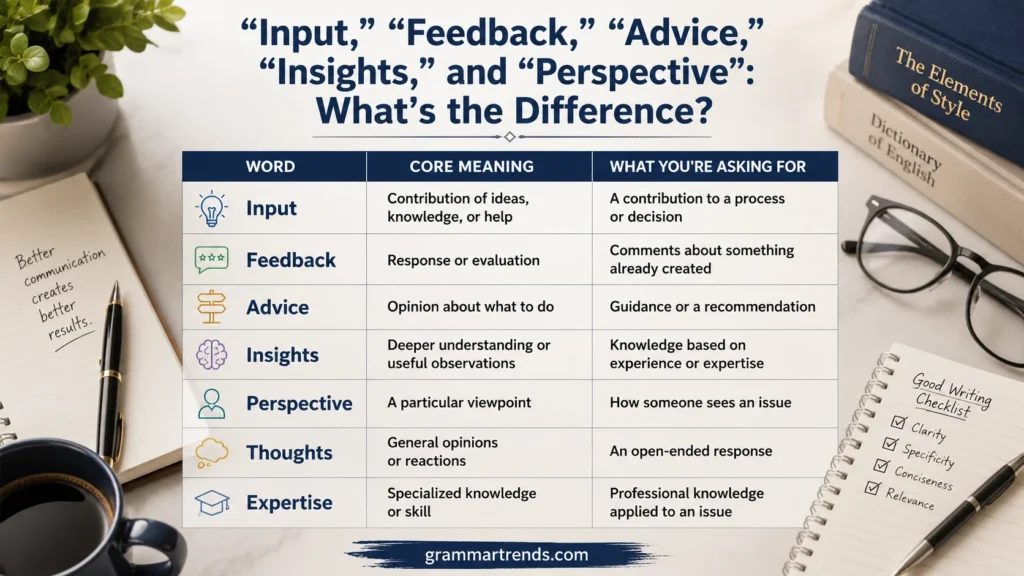
“Input,” “Feedback,” “Advice,” “Insights,” and “Perspective”: What’s the Difference?
This is where many professional-writing guides oversimplify the issue.
These words overlap, but they don’t mean exactly the same thing.
| Word | Core Meaning | What You’re Asking For |
| Input | Contribution of ideas, knowledge, or help | A contribution to a process or decision |
| Feedback | Response or evaluation | Comments about something already created |
| Advice | Opinion about what to do | Guidance or a recommendation |
| Insights | Deeper understanding or useful observations | Knowledge based on experience or expertise |
| Perspective | A particular viewpoint | How someone sees an issue |
| Thoughts | General opinions or reactions | An open-ended response |
| Expertise | Specialized knowledge or skill | Professional knowledge applied to an issue |
Cambridge’s Business English Dictionary specifically uses input for help, ideas, or knowledge contributed to a project or organization.
Meanwhile, advice is tied to what someone recommends you do.
That gives you a useful rule:
Don’t choose a synonym because it sounds impressive. Choose it because it describes the response you actually need.
If you need ideas
Use:
I’d appreciate your input on the proposal.
If you need criticism
Use:
I’d appreciate your feedback on the proposal.
If you need a recommendation
Use:
I’d appreciate your advice on the proposal.
If you need expert analysis
Use:
I’d value your insights on the proposal.
If you need someone’s viewpoint
Use:
I’d value your perspective on the proposal.
If you simply want an opinion
Use:
I’d appreciate your thoughts on the proposal.
That distinction makes professional communication sharper.

Formal vs. Conversational Alternatives
Not every professional situation calls for formal language.
A useful tone ladder looks like this:
More Formal
- I would value your insights on this issue.
- I would value your perspective on this matter.
- Your expertise would be valuable here.
These work well with executives, specialists, clients, and unfamiliar professional contacts.
Professional and Neutral
- I’d appreciate your thoughts on this.
- I’d welcome your input on this.
- Your feedback would be very helpful.
These are excellent choices for everyday workplace communication.
More Conversational
- Could you please share your thoughts on this?
- I’d be grateful for your advice on this.
- Could I get your take on this?
The last option is the most casual of the nine. It’s natural in American workplace English when you already have a comfortable professional relationship.
Examples in Professional Emails
A good phrase becomes much easier to understand when you see it inside a realistic message.
Asking a Manager for Input
Subject: Project Timeline
Hi Jordan,
I’ve prepared two options for the revised project timeline. I’d like to move forward with the first option, but I would value your perspective on this before we finalize the schedule.
Thanks for taking a look.
This works because the writer gives context and explains exactly what kind of response they want.
Asking a Coworker to Review a Proposal
Hi Maya,
I’ve attached the updated proposal. I’d appreciate your thoughts on the pricing section, particularly the revised estimates.
Thanks!
The request is specific. The recipient doesn’t have to guess what to review.
Asking an Expert for Guidance
Hi Dr. Lee,
We’re reviewing the technical requirements for the new system. Your expertise would be valuable here, especially regarding the security considerations.
I’d appreciate any recommendations you can share.
The wording recognizes the person’s specialized knowledge.
Requesting Feedback on a Draft
Hi Alex,
I’ve completed the first draft of the report. Your feedback would be very helpful, particularly regarding the organization of the findings section.
If possible, could you review it before Thursday?
This is more precise than simply saying, “I would appreciate your input.”
Asking a Mentor for Advice
Hi Morgan,
I’m deciding whether to take on the new client project. Given your experience with similar accounts, I’d be grateful for your advice on the best approach.
I’d especially like your thoughts on the workload and timeline.
Here, advice makes sense because the writer wants help making a decision.
How to Ask for Input Without Sounding Demanding
A polite phrase alone won’t guarantee a good email. The rest of the request matters too.
Be Specific About What You Need
Compare:
I’d appreciate your input.
with:
I’d appreciate your input on the revised delivery timeline.
The second version is better because the reader knows what to consider.
A vague request creates unnecessary mental work. A specific request points the reader toward the answer.
Give the Recipient a Clear Question
Instead of:
What do you think?
Try:
Could you share your thoughts on the proposed launch date?
The second question is easier to answer because it has a defined subject.
Respect the Recipient’s Time
If you need a response by a particular date, say so.
If possible, I’d appreciate your feedback by Thursday afternoon.
That’s clearer than:
I need your feedback ASAP.
A reasonable deadline gives the recipient useful information without creating unnecessary pressure.
Explain Why Their Opinion Matters
This can make a request feel more purposeful.
Given your experience with similar projects, I’d value your perspective on the proposed approach.
Now the request has a clear reason.
Don’t Hide the Request
Busy professionals often scan emails rather than read every word.
Put the important request somewhere easy to find:
Could you review the pricing section and share your thoughts by Friday?
That’s much easier to process than burying the request inside a long paragraph.
Common Mistakes to Avoid
Using “Input” When You Actually Need Feedback
If you’ve created something and want someone to evaluate it, feedback may be more precise.
I’d appreciate your input on my report.
is acceptable.
But:
I’d appreciate your feedback on my report.
clearly signals that you want evaluation.
Using “Advice” When You Only Want an Opinion
Advice usually implies guidance about what to do.
I’d appreciate your advice on which option to choose.
That works.
But if you simply want to know what someone thinks about a design, use:
I’d appreciate your thoughts on the design.
Being More Formal Than Necessary
Professional doesn’t mean stiff.
Compare:
I would be most grateful if you would kindly provide your considered perspective regarding the aforementioned proposal.
with:
I’d appreciate your thoughts on the proposal.
The second sentence wins. It says the same essential thing without dressing it up in unnecessary language.
Making the Request Too Vague
Avoid:
I’d appreciate your input on this matter.
when the reader has no idea which part of the matter concerns you.
Instead:
I’d appreciate your input on the revised budget assumptions.
Specificity is often more valuable than formality.
Asking Without Providing Context
A reader can’t give useful input if they don’t understand the issue.
Instead of:
Could you share your thoughts?
Try:
Could you share your thoughts on whether we should move the launch date to September 15?
Now the person knows what decision you’re considering.
Using “I Need Your Input” in Every Situation
“I need your input” isn’t automatically rude. However, it can sound more direct because it emphasizes your need rather than the recipient’s contribution.
A softer version might be:
I’d appreciate your input on this.
Or, if you want collaboration:
I’d welcome your input on this.
The best option depends on your workplace culture and relationship with the recipient.
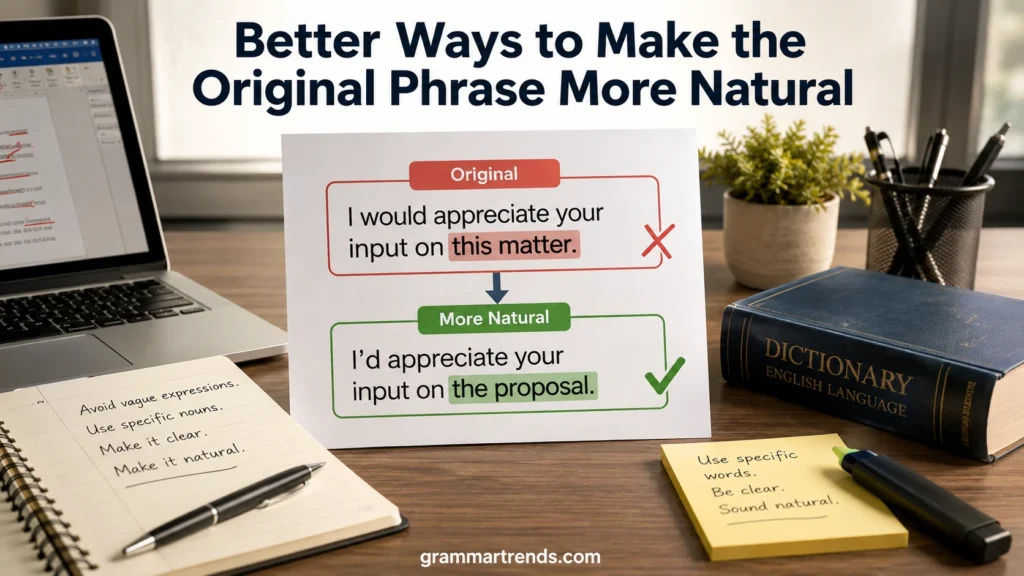
Better Ways to Make the Original Phrase More Natural
You don’t always need to replace “I would appreciate your input on this matter.”
Sometimes, you simply need to make it more specific.
Original
I would appreciate your input on this matter.
More Natural
I’d appreciate your input on the proposal.
Removing “this matter” makes the sentence more concrete.
More Specific
I’d appreciate your input on the proposed timeline.
Now the recipient knows exactly what you want them to consider.
More Collaborative
I’d welcome your input before we finalize the plan.
This emphasizes participation.
More Expert-Focused
I’d value your insights on the technical requirements.
This recognizes specialized knowledge.
More Direct
Could you share your thoughts on the revised proposal?
This clearly asks the recipient to respond.
More Guidance-Focused
I’d be grateful for your advice on how we should proceed.
This tells the reader that you’re looking for direction.
The lesson is worth remembering:
Specific language usually sounds more natural than unnecessarily formal language.
Short Alternatives for Emails and Workplace Messages
When you’re writing a quick email or workplace message, you may not need a long sentence.
Here are useful short alternatives:
- I’d appreciate your input.
- I’d value your thoughts.
- I’d welcome your perspective.
- Could you share your thoughts?
- What are your thoughts on this?
- I’d appreciate your feedback.
- I’d value your advice.
- Your expertise would be helpful here.
- Could I get your take on this?
You can also make these phrases more useful by adding a clear subject:
I’d appreciate your feedback on the final draft.
I’d value your thoughts on the proposed schedule.
Could you share your perspective on the client request?
Your expertise would be helpful as we review the technical requirements.
A short request doesn’t have to be vague.
Case Study: Choosing the Right Phrase for a Project Decision
Imagine a project manager has two possible launch dates. They need feedback from three different people.
The first person is the department manager.
The second is a technical specialist.
The third is a coworker who will handle customer communication.
Using the same phrase for all three would be easy. It wouldn’t necessarily be the best approach.
For the Department Manager
I would value your perspective on the proposed launch dates.
Why? The manager can provide a broader strategic viewpoint.
For the Technical Specialist
I would value your insights on whether the earlier date is technically realistic.
Why? The specialist’s expertise matters more than a general opinion.
For the Coworker
Could I get your take on how customers might respond to the earlier launch?
Why? This is an informal professional relationship, and the writer wants a practical opinion.
The underlying request is similar in all three cases. The wording changes because the type of contribution changes.
That’s the real skill behind professional alternatives.
Case Study: Asking for Help With a Difficult Client
Suppose a client has rejected a proposal and asked for significant changes.
You could write:
I would appreciate your input on this matter.
That’s grammatical, but it doesn’t reveal much.
A better version might be:
I’d be grateful for your advice on how we should respond to the client.
Now the recipient knows you’re seeking guidance.
If you’re asking a legal or compliance specialist, you could write:
Your expertise would be valuable here as we assess the client’s requested changes.
If you’re asking a coworker to review your revised response:
I’d appreciate your feedback on the draft response before I send it.
Each sentence targets a different need.
Read more: 11 Professional Ways to Say “I Want to” Without Sounding Too Direct
Case Study: Asking for Feedback on a Presentation
Suppose you’ve prepared a presentation for an important meeting.
You could say:
I’d appreciate your input on the presentation.
That’s fine.
But you can make the request much more useful:
I’d appreciate your feedback on the opening section and the final recommendations.
Now the recipient knows exactly what to examine.
If you’re asking a senior colleague for strategic judgment:
I’d value your perspective on whether the recommendations are persuasive enough.
If you’re asking a subject expert to verify technical accuracy:
I’d value your insights on the technical claims in slides five through eight.
This approach saves time for everyone.
A Simple Formula for Writing Better Requests
When you’re unsure how to phrase your request, use this structure:
Polite request + specific subject + desired response + deadline when necessary
For example:
I’d appreciate your feedback on the revised proposal, particularly the pricing section, by Thursday if possible.
Or:
I’d value your perspective on the two proposed timelines before we make a final decision.
Or:
Could you share your thoughts on the attached draft when you have a chance?
This formula works because it answers the questions your recipient is likely to have:
- What do you need?
- What should I review?
- What kind of response do you want?
- When do you need it?
Professional Phrase Selection Guide
Use this quick guide when you’re deciding which alternative to choose.
| If you want… | Best phrase |
| A general opinion | I’d appreciate your thoughts on this. |
| A contribution to a decision | I’d welcome your input on this. |
| Evaluation of your work | Your feedback would be very helpful. |
| A recommendation | I’d be grateful for your advice on this. |
| Expert analysis | I’d value your insights on this issue. |
| A person’s viewpoint | I’d value your perspective on this matter. |
| Specialized knowledge | Your expertise would be valuable here. |
| A direct response | Could you please share your thoughts on this? |
| A casual professional opinion | Could I get your take on this? |
My Personal Experience With an English Specialist
My experience with an English specialist was very useful and helped me improve my communication skills. I learned that professional English doesn’t need to be complicated or overly formal. The specialist taught me how to choose simple, clear, and natural expressions that fit different situations.
I also learned the difference between input, feedback, advice, insights, and perspective. Understanding these small differences helped me express my ideas more accurately. I became more confident when writing emails, asking questions, and communicating with colleagues.
Overall, working with an English specialist helped me understand that good communication is about choosing the right words for the right situation. It made my English sound more natural, professional, and confident.
FAQs
1. Is “I would appreciate your input on this matter” professional?
Yes. It’s a polite and professional way to ask someone for their opinion, advice, or feedback. It works well in emails, meetings, workplace discussions, and formal requests.
2. What is a more natural way to say “I would appreciate your input”?
You can say, “I’d value your perspective on this” or “I’d appreciate your thoughts on this.” Both sound professional without feeling overly formal.
3. Can I use this phrase in a business email?
Absolutely. The phrase fits business emails when you want to invite someone to share their knowledge or opinion. It’s especially useful when addressing a manager, colleague, client, or subject-matter expert.
4. How can I ask for input without sounding too formal?
Try a warmer expression such as “I’d love to hear your thoughts on this” or “Could you share your perspective?” These options still sound respectful while creating a more conversational tone.
5. What can I say when asking an expert for advice?
When speaking to an expert, you can say, “I’d value your expertise on this matter” or “Your insights would be very helpful here.” These phrases recognize the person’s knowledge while making your request clear.
6. Is “I seek your input” too formal?
It can sound somewhat formal, especially in everyday workplace communication. It’s appropriate for official correspondence, reports, or formal requests, but “I’d appreciate your thoughts” usually feels more natural in ordinary professional conversations.
Conclusion
Asking for someone’s opinion doesn’t have to sound stiff, repetitive, or overly formal. The right expression depends on who you’re speaking to, the situation, and the level of formality you need. In a workplace email, you might want to sound respectful and direct, while a conversation with a colleague may call for something warmer and more natural.
Whether you want to appreciate someone’s expertise, request valuable feedback, invite a fresh perspective, or ask for practical advice, choosing the right words can make a noticeable difference. Phrases such as “I’d value your perspective,” “I’d appreciate your thoughts,” and “Your expertise would be helpful” allow you to make your request without sounding demanding.
The key is to match your wording to the context. A well-chosen phrase shows that you respect the other person’s knowledge and genuinely want their contribution. Once you understand these subtle differences, you can confidently ask for input in emails, meetings, workplace discussions, and other professional situations.

Emma Brooke brings 15 years of experience in the Department of English Language and Literature at the University of California, Berkeley, where she has taught and mentored students across courses in British and American literary traditions, critical theory, and narrative form. Her expertise spans 19th- and 20th-century fiction, poetic prosody, postcolonial literatures, and digital humanities, with a focus on how narrative voice shapes cultural meaning. Emma’s work has been presented at international conferences and published in peer-reviewed venues, reflecting her deep commitment to rigorous literary scholarship and accessible teaching.