

The 11 Professional Ways to Say “I Want to” in English guide helps you choose natural, clear phrases for emails, speech, and professional writing.
When you want to express a desire or wish, “I want to” is a straightforward phrase, but professional English offers other ways to say the same idea. In everyday speech, English speakers use many expressions naturally, and learning alternative phrases can make your English speech more colourful. “I’m eager to”, “I would like to”, “I’m motivated to”, “I’m inclined to”, and “I am interested in” can fit different situations. In email writing, “I would like to” sounds more professional, while “I’m eager to” can show strong interest. This mix can help you sound natural without making your language too formal or complicated.
You can learn and understand the individual meaning of each option by reviewing “I am keen on”, “I’m enthusiastic about”, “I am committed to”, “I’m determined to”, “I’m dedicated to”, and “I am intent on”. These synonyms show different levels of interest, effort, and commitment, so choose the option that works best for your purpose. “I’m motivated to” can show a reason to act, while “I am committed to” and “I’m determined to” can show stronger purpose. If you’re worried about sounding too informal, this list can teach you ways to say “I want” instead. The article can include these options to explain how English expressions, simple English, and informal English work across everyday speech and professional situations. These several practical choices can help you keep your speech and writing clear..
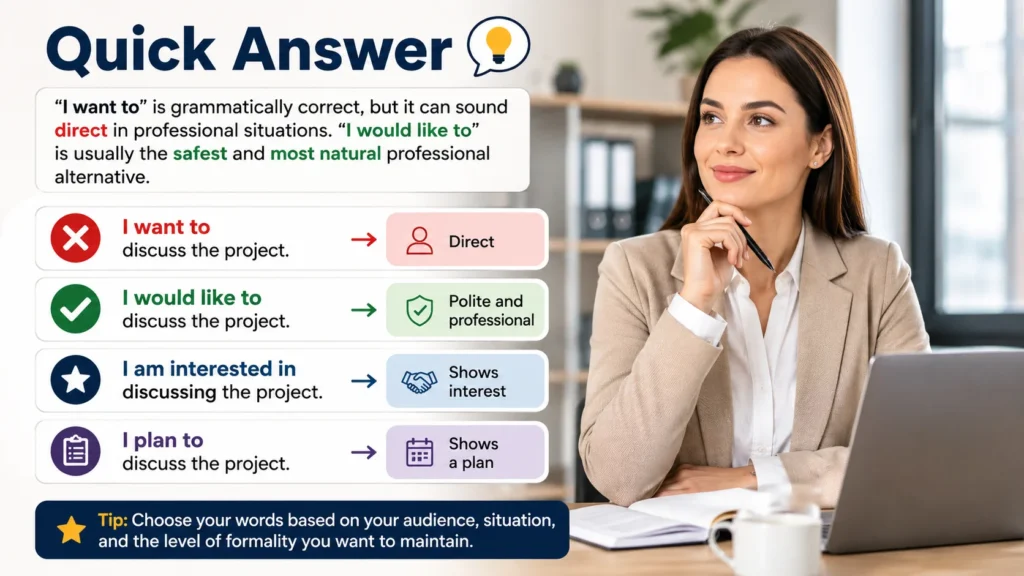
Quick Answer
“I want to” is grammatically correct, but it can sound direct in professional situations. “I would like to” is usually the safest and most natural professional alternative.
For example:
- I want to discuss the project. → Direct
- I would like to discuss the project. → Polite and professional
- I am interested in discussing the project. → Shows interest
- I plan to discuss the project. → Shows a plan
Best choice: Use “I would like to” for most professional emails, requests, and workplace situations.
What Is the Most Professional Way to Say “I Want to”?
For most professional situations, “I would like to” is the safest and most versatile choice.
Cambridge Dictionary explains that “would like” is used to express what someone wants politely, especially when making offers and requests. When followed by a verb, it takes the to-infinitive: “I would like to discuss,” “I would like to apply,” or “I would like to learn.”
However, “I would like to” isn’t the only option.
The best expression depends on what you’re actually trying to communicate:
| If you mean… | Use… |
| A polite desire or request | I would like to |
| Genuine interest | I am interested in |
| Strong enthusiasm | I am eager to |
| A specific plan | I plan to |
| A firm intention | I intend to |
| A goal | I aim to |
| Dedication | I am committed to |
| Strong determination | I am determined to |
| Seeking an opportunity | I am looking to |
| Formal intention | I wish to |
| Requesting an opportunity | I would appreciate the opportunity to |
That’s an important distinction. Professional English isn’t about making every sentence sound formal. It’s about making your meaning precise.
11 Professional Ways to Say “I Want to”
I Would Like to
“I would like to” is the most useful all-purpose alternative to “I want to” in professional communication.
It softens a statement without making it vague. That’s why it works particularly well when you’re making a request, introducing a topic, or expressing what you’d prefer to do.
Compare:
I want to schedule a meeting.
with:
I would like to schedule a meeting.
The second sentence feels more courteous and less demanding.
Cambridge specifically identifies “would like” as a polite way to express what someone wants, particularly in offers and requests.
Examples:
- I would like to discuss the proposal.
- I would like to schedule a meeting for next week.
- I would like to learn more about the position.
- I would like to request additional information.
- I would like to speak with the hiring manager.
Best for:
- Professional emails
- Business correspondence
- Customer service
- Meetings
- Job applications
- Formal requests
Grammar tip
Use:
I would like to + base verb
- I would like to discuss.
- I would like to apply.
- I would like to learn.
- I would like to request.
Don’t write:
- ❌ I would like discuss the issue.
- ✅ I would like to discuss the issue.
Cambridge’s grammar guidance confirms that a verb following “would like” requires to before the infinitive.
I Am Interested in
Use “I am interested in” when you want to show genuine interest in an opportunity, subject, position, project, or activity.
This phrase differs from “I want to” because it doesn’t necessarily suggest that you’ve already made a decision. Instead, you’re signaling that something has caught your attention and you’d like to explore it.
For example:
I am interested in learning more about the position.
This sounds appropriate when you’re contacting a recruiter because you want additional information before deciding whether to apply.
Examples:
- I am interested in learning more about the program.
- I am interested in joining your team.
- I am interested in discussing a possible partnership.
- I am interested in exploring this opportunity.
- I am interested in applying for the position.
Best for:
- Job applications
- Networking
- Business inquiries
- Career discussions
- Professional opportunities
Important grammar rule
“Interested in” is followed by a noun or an -ing form, not an infinitive.
Correct:
I am interested in joining the team.
Incorrect:
I am interested in to join the team.
The British Council explains that prepositions are followed by a noun or a gerund such as an -ing form.
So remember:
interested in + noun/gerund
- interested in the position
- interested in working
- interested in learning
- interested in discussing
I Am Eager to
Sometimes you don’t merely want to do something. You’re genuinely excited about doing it.
That’s where “I am eager to” works well.
It communicates enthusiasm, willingness, and strong interest.
Compare:
I want to contribute to the project.
I am eager to contribute to the project.
The second version sounds more energetic. It tells the reader that you’re not simply willing to participate. You’re looking forward to it.
Examples:
- I am eager to contribute to the team.
- I am eager to learn more about the company.
- I am eager to discuss the next steps.
- I am eager to apply my experience to this role.
- I am eager to take on new responsibilities.
Best for:
- Job interviews
- Cover letters
- Career opportunities
- New projects
- Professional introductions
When not to use it
Don’t force “eager” into routine situations.
For example:
I am eager to receive the updated invoice.
That sentence isn’t grammatically wrong. It simply sounds unusually enthusiastic about an invoice.
A more natural option would be:
I would appreciate receiving the updated invoice.
The lesson is simple: match the emotional strength of the phrase to the situation.
I Plan to
Use “I plan to” when you have a specific future action in mind.
This is different from simply wanting something.
Consider:
I want to finish the report this week.
This expresses desire.
Now compare:
I plan to finish the report this week.
This sounds like you’ve made an actual plan.
Examples:
- I plan to submit the report on Friday.
- I plan to attend the conference.
- I plan to speak with the client tomorrow.
- I plan to review the documents this afternoon.
- I plan to complete the training next month.
Best for:
- Project updates
- Work schedules
- Future actions
- Team communication
- Personal development plans
Why this distinction matters
If your manager asks what you’re going to do next, “I plan to” gives them useful information about your intended action.
If you say “I want to,” you’re only describing your preference.
That’s a small grammatical difference with a meaningful practical effect.
I Intend to
“I intend to” expresses a clear or firm intention.
It sounds more formal than “I plan to,” so it works particularly well in professional, official, or serious contexts.
For example:
I intend to complete the review by Friday.
The sentence suggests that completing the review is a definite intention rather than a vague wish.
Examples:
- I intend to follow up with the client tomorrow.
- I intend to complete the project this month.
- We intend to expand the service next year.
- I intend to address the issue during the meeting.
- I intend to continue developing my professional skills.
Best for:
- Formal business writing
- Official statements
- Professional plans
- Policy-related communication
- Serious commitments
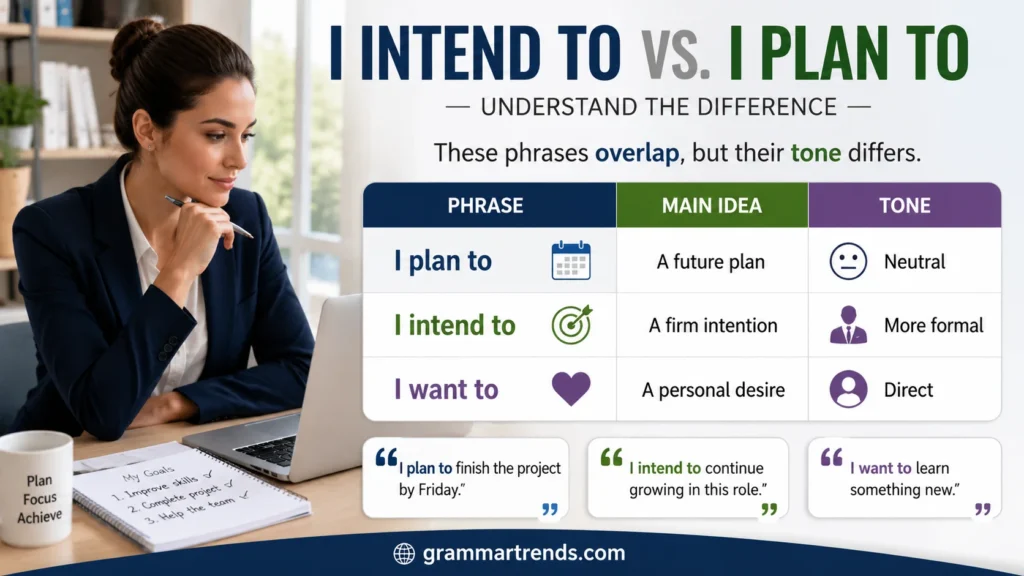
“I intend to” vs. “I plan to”
These phrases overlap, but their tone differs.
| Phrase | Main idea | Tone |
| I plan to | A future plan | Neutral |
| I intend to | A firm intention | More formal |
| I want to | A personal desire | Direct |
If you’re writing a normal email to a colleague, “I plan to” often sounds more natural.
If you’re making a formal statement about what you expect to do, “I intend to” may fit better.
I Aim to
Use “I aim to” when you’re talking about a goal, target, or desired outcome.
It shifts the focus away from personal desire and toward achievement.
For example:
I want to improve customer satisfaction.
is straightforward.
But:
I aim to improve customer satisfaction.
sounds like you’re identifying a professional objective.
Examples:
- I aim to improve the team’s response time.
- I aim to strengthen my communication skills.
- We aim to complete the project by September.
- I aim to provide consistent support to our customers.
- The company aims to expand its services.
Best for:
- Performance goals
- Professional development
- Business plans
- Project objectives
- Strategic communication
A useful distinction
Think of “want” as desire and “aim” as direction.
A desire says:
I want to become a better writer.
An aim says:
I aim to become a more effective professional writer.
The second sentence presents the idea as a goal you’re working toward.
I Am Committed to
When you want to show strong dedication, “I commit to” sounds more determined than “I want to.”
For example:
I want to improve customer service.
says that improvement is something you desire.
“I will improve customer service.”
signals responsibility and dedication.
Examples:
- I am committed to delivering high-quality work.
- I am committed to supporting the team.
- I am committed to improving customer satisfaction.
- We are committed to maintaining high standards.
- I am committed to continuous professional development.
Best for:
- Leadership communication
- Company statements
- Long-term goals
- Professional responsibilities
- Performance discussions
Grammar point
Be careful with the structure.
Use:
committed to + noun or -ing form
Correct:
I’m focused on improving the process.
Incorrect:
I am committed to improving the process.
Although “to” often introduces an infinitive, in “committed to” it functions as a preposition. That’s why the following verb takes the -ing form.
I Am Determined to
Use “I am determined to” when you want to communicate strong resolve.
This phrase suggests that you’re prepared to work through difficulties rather than simply hoping something happens.
Examples:
- I am determined to meet the deadline.
- I am determined to improve my performance.
- I am determined to find a practical solution.
- We are determined to achieve our goals.
- I am determined to develop stronger leadership skills.
Best for:
- Challenging goals
- Interviews
- Career development
- Difficult projects
- Motivational statements
“Determined” is stronger than “eager”
These two expressions can both sound positive, but they emphasize different things.
Eager focuses on enthusiasm.
I am eager to learn.
Determined focuses on resolve.
I’m determined to succeed.
A person can be eager without facing a major challenge. Determination becomes especially useful when persistence matters.
I Am Looking to
“I am looking to” is common in modern professional English, especially when someone is seeking an opportunity, change, partnership, employee, or solution.
Examples:
- I am looking to expand my professional network.
- I am looking to develop my technical skills.
- We are looking to hire additional staff.
- I am looking to discuss potential collaboration.
- We are looking to improve our customer support process.
Best for:
- Networking
- Recruitment
- Career development
- Business development
- Professional conversations
A subtle meaning difference
“I am looking to” often implies that you’re actively seeking something.
Compare:
I want to change careers.
with:
I am looking to change careers.
The second sentence suggests that you’re considering options and perhaps taking steps toward the change.
That’s why it works naturally in networking conversations.
I Wish to
“I wish to” is a formal alternative that expresses a desire or intention.
Examples:
- I wish to discuss this matter further.
- I wish to request additional information.
- I wish to withdraw my application.
- I wish to clarify the terms of the agreement.
- I wish to express my appreciation.
Best for:
- Formal letters
- Official correspondence
- Administrative communication
- Highly formal business contexts
However, don’t assume that more formal automatically means better.
In everyday American professional English, this can sound stiff:
I wish to discuss the matter with you.
A more natural version is often:
I would like to discuss the matter with you.
Use “I wish to” when the formal tone genuinely fits the situation.
I Would Appreciate the Opportunity to
This phrase works especially well when you aren’t merely saying what you want. You’re asking for the chance to do something.
For example:
I would appreciate the opportunity to discuss my qualifications further.
That sentence works naturally in a job application or interview follow-up.
Examples:
- I would appreciate the opportunity to discuss the position further.
- I would appreciate the opportunity to speak with your team.
- I would appreciate the opportunity to contribute to the project.
- I would appreciate the opportunity to explain my proposal.
- I would appreciate the opportunity to discuss possible collaboration.
Best for:
- Job applications
- Interviews
- Networking
- Business proposals
- Professional introductions
It sounds respectful because it recognizes that the other person controls the opportunity.
Read more: 10 Other Ways to Say “I Can’t Make It”
Professional Ways to Say “I Want to” in an Email
Email communication makes tone especially important because the reader can’t hear your voice.
A sentence that sounds neutral when spoken can look surprisingly blunt on a screen.
When you want to request a meeting
Direct:
I want to schedule a meeting with you.
More professional:
I would like to schedule a meeting with you.
More specific:
I would like to schedule a brief meeting to discuss the project timeline.
The third version works particularly well because it tells the reader why you’re requesting the meeting.
When you want to discuss an issue
Direct:
I want to discuss the issue.
Professional:
I would like to discuss the issue.
Collaborative:
I’d like to discuss possible solutions.
The best choice depends on your purpose. If you simply need a conversation, “I would like to” works.If you’re emphasizing collaboration, “I’d like to discuss” may fit better.
When you want more information
Try:
- I would like to learn more about the program.
- I’d like to learn more about the position.
- I would appreciate additional information about the application process.
- I would appreciate the opportunity to discuss the details further.
Notice how each sentence adds a slightly different shade of meaning.
When you want to propose an idea
Instead of:
I want to suggest a new approach.
You could write:
I would like to suggest a new approach.
Or:
I would like to propose an alternative approach.
The second version is especially useful when you’re presenting a concrete business idea.
Professional Ways to Say “I Want to” in a Job Interview
Job interviews require a careful balance.
You don’t want to sound timid. At the same time, you don’t want every answer to sound demanding or self-centered.
To show enthusiasm
I am eager to contribute to the team.
To show interest
I am interested in developing my skills in this area.
To describe a goal
I aim to build a long-term career in this field.
To communicate dedication
I am committed to continuous professional development.
To express interest in the opportunity
I would appreciate the opportunity to contribute to your organization.
A strong interview answer usually does more than announce what you want. It connects your goal to the role, organization, or value you can provide.
Instead of:
I want to grow my career.
Try:
I aim to develop my leadership skills while contributing to the team’s long-term goals.
The second answer gives the interviewer something concrete to work with.
Professional Ways to Say “I Want to” at Work
Workplace communication doesn’t always require formal language.
In fact, overly polished phrases can sometimes sound unnatural.
Consider these examples:
I want to review the report before the meeting.
Before then, I plan to go through it carefully.
I’d also like to make any necessary changes beforehand.
All three can work.
The difference lies in what you want to emphasize.
| Sentence | What it emphasizes |
| I want to review the report. | Personal desire |
| I plan to review the report. | Future plan |
| I would like to review the report. | Polite intention |
| I intend to review the report. | Firm intention |
| I aim to review the report. | Goal-oriented action |
This is why replacing every “I want to” with one phrase isn’t a good strategy.
Meaning should guide word choice.
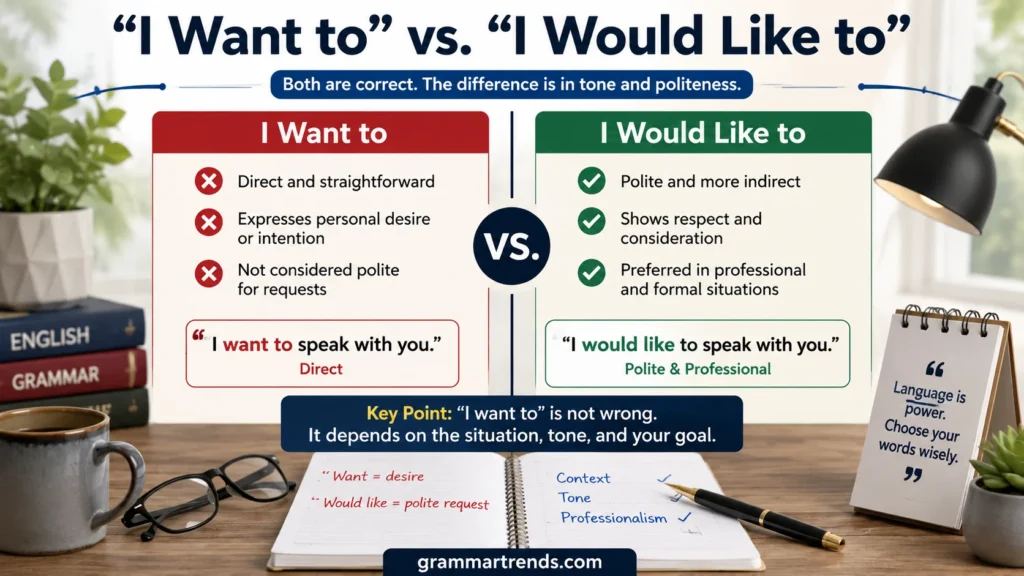
“I Want to” vs. “I Would Like to”
This is probably the most important comparison in the entire topic.
Many English learners assume that “I want to” is wrong or rude in professional English. That’s too broad.
“I want to” is grammatically correct.
Cambridge Dictionary defines want as expressing a wish for something or a plan of action. It also notes that “want” isn’t used for polite requests, which helps explain why “I would like” often sounds better when you’re asking someone for something.
Compare:
I want to speak with you.
I would like to speak with you.
The first is direct. The second is more polite and indirect.
That doesn’t make the first sentence grammatically incorrect.
When “I want to” works perfectly
You can comfortably use it in:
- Casual conversations
- Personal statements
- Friendly workplace discussions
- Informal messages
- Situations where directness is appropriate
For example:
I want to grab lunch before the meeting.
That’s completely natural in a casual workplace conversation.
When “I would like to” works better
Choose it when you’re:
- Making a formal request
- Writing to someone you don’t know well
- Contacting a client
- Applying for a position
- Communicating with an organization
- Asking for an opportunity
The difference isn’t correct vs. incorrect.
It’s mostly direct vs. more polite and context-sensitive.
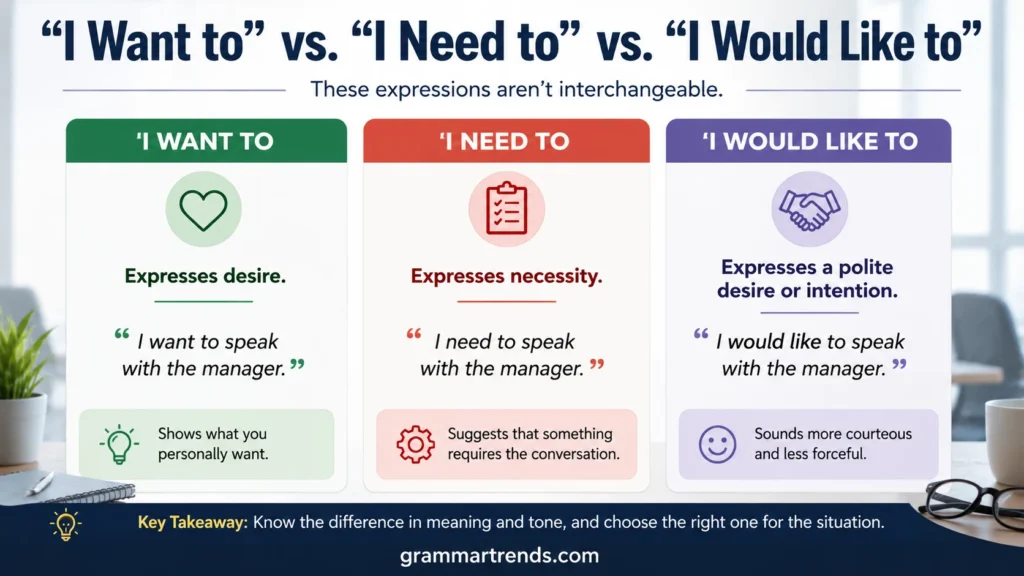
“I Want to” vs. “I Need to” vs. “I Would Like to”
These expressions aren’t interchangeable.
I want to
Expresses desire.
I want to speak with the manager.
I need to
Expresses necessity.
I need to speak with the manager.
The second sentence suggests that something requires the conversation.
I would like to
Expresses a polite desire or intention.
I would like to speak with the manager.
That sounds more courteous and less forceful.
| Phrase | Core meaning | Example |
| I want to | Desire | I want to discuss the issue. |
| I need to | Necessity | I need to discuss the issue. |
| I would like to | Polite desire | I would like to discuss the issue. |
Choosing among them isn’t just a style decision. It changes the message.
Common Mistakes When Using Professional Alternatives
Making every sentence overly formal
You don’t need to replace every “I want to” with “I wish to.”
For example:
I wish to ask you about lunch.
This sounds unnecessarily formal.
A natural alternative would be:
I would like to ask you about lunch.
Or simply:
Can we talk about lunch?
Professional doesn’t mean complicated.
Using “interested in” with the wrong verb form
Avoid:
❌ I am interested in to apply.
Use:
✅ I am interested in applying.
The preposition in is followed by a noun or gerund.
Using “committed to” incorrectly
Avoid:
❌ I am committed to improve the process.
Use:
✅ I am committed to improving the process.
Again, to functions as part of the prepositional phrase “committed to.”
Treating every alternative as an exact synonym
This is one of the biggest mistakes.
Consider these sentences:
- I am interested in joining the company.
- I am eager to join the company.
- I plan to join the company.
- I intend to join the company.
- I am committed to joining the company.
They don’t all mean the same thing.
The first expresses interest. The second shows enthusiasm. The third indicates a plan. The fourth signals firm intention. The fifth communicates dedication.
Choosing a phrase that is too strong
Suppose a colleague asks whether you might help with a project.
You say:
I am determined to help.
That sounds far stronger than necessary.
A natural response might be:
I would be happy to help.
Good professional communication doesn’t just avoid rudeness. It also avoids unnecessary intensity.
Case Study: Choosing the Right Phrase in a Real Workplace Situation
Imagine that Maya works in marketing and wants to contact her manager about a new campaign idea.
Her first draft says:
I want to discuss a new campaign idea.
There’s nothing grammatically wrong with it.
However, Maya wants to sound collaborative rather than demanding.
She could write:
I would like to discuss a new campaign idea.
That’s polite and straightforward.
If she has already developed a clear proposal, she could make the message more specific:
I would like to propose a new campaign approach for the fall launch.
Now suppose she wants to emphasize the goal:
I aim to develop a campaign that improves customer engagement.
Or perhaps she wants to emphasize commitment:
I am committed to developing a campaign that supports our customer engagement goals.
Each version works because it communicates a different idea.
The lesson: don’t search for a fancy synonym. Find the phrase that tells the truth about your intention.
Quick Comparison of 11 Professional Alternatives
| Professional phrase | Tone | Main meaning | Example |
| I would like to | Polite | Desire/request | I would like to discuss the proposal. |
| I am interested in | Neutral | Interest | I am interested in joining the team. |
| I am eager to | Enthusiastic | Strong interest | I am eager to contribute. |
| I plan to | Practical | Future plan | I plan to submit the report. |
| I intend to | Formal | Firm intention | I intend to complete the review. |
| I aim to | Goal-focused | Objective | I aim to improve performance. |
| I am committed to | Strong | Dedication | I am committed to improving quality. |
| I am determined to | Strong | Resolve | I am determined to meet the target. |
| I am looking to | Professional | Seeking | I am looking to expand my network. |
| I wish to | Formal | Desire/intention | I wish to request further information. |
| I would appreciate the opportunity to | Polite | Seeking an opportunity | I would appreciate the opportunity to discuss the role. |
Best Professional Alternatives by Situation
If you’re unsure which phrase to use, start with the situation rather than the word “want.”
For a formal email
I would like to
I would like to discuss the proposal.
For a job application
I am interested in
I am interested in applying for the position.
For an interview
I am eager to
I am eager to contribute to your team.
For a professional goal
I aim to
I aim to strengthen my leadership skills.
For a project plan
I plan to
I plan to complete the analysis by Friday.
For a firm intention
I intend to
I intend to follow up with the client tomorrow.
For long-term dedication
I am committed to
I am committed to improving the team’s performance.
For a difficult objective
I am determined to
I am determined to find a practical solution.
For seeking an opportunity
I am looking to
I am looking to expand my professional network.
For official writing
I wish to
I wish to request additional information.
For requesting an opportunity
I would appreciate the opportunity to
I would appreciate the opportunity to discuss my qualifications.
Professional Ways to Say “I Want to” Without Sounding Robotic
There is another trap worth avoiding: over-formal language can sound less human than simple English.
Imagine receiving this email:
I wish to avail myself of the opportunity to discuss the aforementioned proposal.
It may be technically understandable, but it doesn’t sound like natural modern American business English.
Now compare:
I would like to discuss the proposal with you.
The second version is clearer, shorter, and more natural.
Good professional writing doesn’t try to impress the reader with vocabulary. It makes the message easy to understand.
That principle matters especially in emails.
Instead of:
I wish to bring to your attention the fact that I intend to conduct a review.
Write:
I plan to review the issue.
Shorter doesn’t mean less professional.
Often, it means more confident.
A Simple Decision Guide
When you want to replace “I want to,” ask yourself one question:
What am I actually trying to communicate?
If the answer is “I want this politely,” use:
I would like to
If the answer is “I’m genuinely interested,” use:
I am interested in
If the answer is “I’m excited about this,” use:
I am eager to
If the answer is “This is my plan,” use:
I plan to
If the answer is “This is my firm intention,” use:
I intend to
If the answer is “This is my goal,” use:
I aim to
If the answer is “I’m dedicated to this,” use:
I am committed to
If the answer is “I won’t give up on this,” use:
I am determined to
If the answer is “I’m actively seeking this,” use:
I am looking to
If the answer is “I need a very formal expression,” use:
I wish to
If the answer is “I want the chance to do this,” use:
I would appreciate the opportunity to
This approach makes your writing more precise without making it unnecessarily complicated.
FAQs
1. What is a professional way to say “I want to”?
You can say “I would like to” in most professional situations. It sounds polite, natural, and respectful.
2. Is “I want to” too informal for professional English?
Not always. “I want to” is grammatically correct, but “I would like to” often sounds more polished in emails and workplace conversations.
3. What can I say instead of “I want to” in an email?
Try “I would like to,” “I’m interested in,” “I’m eager to,” or “I’m keen to” depending on what you want to communicate.
4. How can I express strong desire professionally?
Use phrases such as “I’m eager to,” “I’m enthusiastic about,” or “I’m determined to.” These show stronger interest or motivation.
5. What phrase shows commitment instead of “I want to”?
“I am committed to,” “I’m dedicated to,” and “I’m determined to” work well when you want to emphasize serious commitment.
6. Which alternative to “I want to” is the most versatile?
“I would like to” is one of the safest choices because it works well in professional emails, conversations, requests, and formal writing.
Conclusion
Conclusion
Knowing different ways to say “I want to” gives you more flexibility in English. While the original phrase is simple and correct, alternatives such as “I would like to,” “I’m eager to,” “I’m interested in,” “I’m motivated to,” and “I am committed to” can help you match your words to the situation. Some expressions sound polite and professional, while others show enthusiasm, determination, or commitment. The key is to choose the phrase that best reflects what you actually mean. With regular practice, these expressions can become a natural part of your everyday conversations, emails, workplace communication, and professional English.

Emma Rose has spent 15 years in the English Department at the University of California, Los Angeles (UCLA), guiding students through British and American literary classics, critical theory, and narrative techniques. Her scholarly focus includes 19th- and 20th-century fiction, the art of poetry, postcolonial writing, and digital humanities particularly how storytelling voice influences cultural perspectives. Emma has presented her research at major international conferences and published in respected academic journals, underscoring her dedication to both high-level scholarship and engaging teaching.