
15 Polite Ways to Say “It’s Okay” in Any Situation can help you find the right words when someone feels worried, guilty, upset, or anxious.
Although “It’s okay” is simple, kind, and universally understood, repeating the same phrase can make your message feel plain, distant, or impersonal. The right words can completely change the tone of a conversation and make your communication feel warmer, genuine, caring, and meaningful. From my experience, different expressions can help you comfort someone, ease tension, reassure others, and show empathy with a more thoughtful touch.
The words we choose can offer reassurance, patience, emotional support, kindness, and care while helping us understand someone’s feelings, accept their mistakes, and provide support without judgment. Whether you’re comforting a friend, supporting a loved one, replying at work, or responding professionally in an email, the right alternative depends on the situation, relationship, and desired tone. Using warm, gentle, human, empathetic, or professional expressions can strengthen relationships, build trust, and help you connect with people more naturally.
Quick Answer: Polite Alternatives to “It’s Okay”
Here are some of the most useful alternatives to “It’s okay”:
| Alternative | Best Used For | Tone |
| No problem | Small mistakes, favors, apologies | Friendly |
| That’s perfectly fine | Professional and everyday situations | Warm and polite |
| Don’t worry about it | Reassuring someone | Casual and caring |
| It’s all good | Informal conversations | Relaxed |
| No big deal | Minor problems | Casual |
| That’s quite alright | Polite or formal conversations | Formal |
| No need to apologize | Responding to an apology | Reassuring |
| It happens | Small mistakes and accidents | Understanding |
| No harm done | Problems without serious consequences | Reassuring |
| I’m not bothered | Showing that something didn’t upset you | Direct |
| You’re fine | Reassuring someone personally | Casual |
| Nothing to worry about | Concerns and minor problems | Reassuring |
| It’s perfectly okay | General reassurance | Warm |
| We’re good | Resolving minor disagreements | Casual |
| Please don’t worry | Professional or personal reassurance | Polite |
The important thing isn’t simply memorizing these phrases. You should understand why and when each one works.
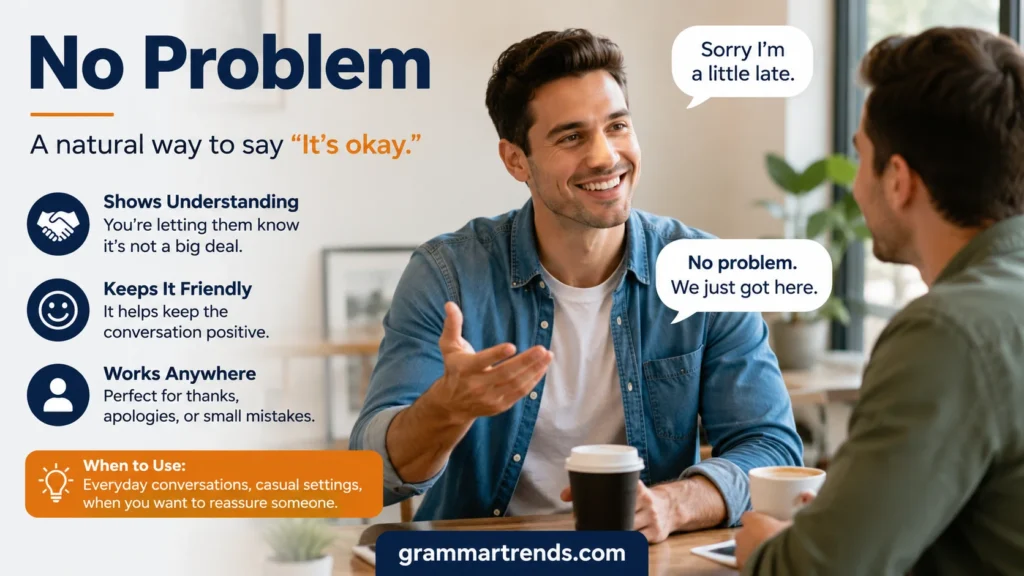
No Problem
“No problem” is one of the most natural ways to say “It’s okay.” People use it constantly in everyday American English.
It tells someone that whatever happened hasn’t created a meaningful difficulty for you.
For example:
“Sorry I’m a little late.”
“No problem. We just got here.”
You can also use “no problem” after someone thanks you.
“Thanks for helping me with that.”
“No problem.”
That makes the expression slightly broader than “It’s okay.” It can mean “That didn’t inconvenience me,” “You’re welcome,” or “There’s nothing to worry about,” depending on context.
When to Use “No Problem”
Use it when:
- Someone apologizes for a minor issue.
- Someone thanks you.
- Someone asks for a small favor.
- A minor inconvenience occurs.
- You want to keep the conversation relaxed.
Is “No Problem” Professional?
Yes. “No problem” works in many workplace conversations, especially when the interaction feels friendly and informal.
For example:
“Sorry for sending this so late.”
“No problem. I’ll review it tomorrow.”
However, a more formal environment may call for “That’s perfectly fine” or “Certainly.”
That’s Perfectly Fine
If you want a polite alternative that works in both professional and personal settings, “That’s perfectly fine” is an excellent choice.
The word “perfectly” strengthens the reassurance. Instead of merely saying something is acceptable, you’re emphasizing that you don’t see a problem with it.
For example:
“I won’t be able to attend the meeting this afternoon.”
“That’s perfectly fine. We can send you the notes.”
This phrase sounds particularly useful when you want to reassure someone without becoming overly casual.
When to Say “That’s Perfectly Fine”
It works well when:
- Someone changes a plan.
- Someone apologizes for a minor issue.
- Someone asks whether something is acceptable.
- A coworker needs flexibility.
- You want to sound professional but approachable.
“That’s Fine” vs. “That’s Perfectly Fine”
These expressions are similar, but “That’s perfectly fine” usually sounds warmer.
Compare:
“That’s fine.”
with:
“That’s perfectly fine. Take your time.”
The second version provides more reassurance.
Don’t Worry About It
“Don’t worry about it” directly addresses someone’s concern.
If a person feels guilty about making a mistake, this expression can help them relax.
“I’m sorry I forgot to bring the documents.”
“Don’t worry about it. You can bring them tomorrow.”
The phrase has a friendly, conversational quality. It’s especially common when you know the other person well.
When “Don’t Worry About It” Works Best
Use it when:
- Someone feels guilty.
- Someone apologizes.
- A minor mistake has occurred.
- Someone thinks they’ve inconvenienced you.
- You want to calm an unnecessary concern.
Be Careful With Serious Problems
Context matters.
Imagine someone says:
“I accidentally deleted the entire project.”
Responding with “Don’t worry about it” may sound insensitive if the problem has serious consequences.
Instead, you could acknowledge the problem:
“It’s okay. Let’s see what we can recover.”
That response reassures the person while still taking the situation seriously.
It’s All Good
“It’s all good” is a highly casual way to say “It’s okay.”
It communicates that there isn’t any lingering problem or hard feelings.
For example:
“Sorry about what happened yesterday.”
“It’s all good. Don’t worry about it.”
You’ll hear this expression frequently in relaxed conversations, text messages, and social situations.
When to Use “It’s All Good”
It’s suitable for:
- Friends
- Family
- Casual coworkers
- Text messages
- Informal conversations
Is “It’s All Good” Professional?
Usually, you should avoid it in formal emails, official correspondence, and highly professional situations.
For example, instead of:
“It’s all good. We can fix it.”
A workplace email could say:
“That’s perfectly fine. We can correct it.”
The meaning remains similar, but the second version sounds more polished.
No Big Deal
“No big deal” means that something isn’t important enough to cause concern.
It’s particularly useful for minor problems.
“Sorry I spilled some water on the table.”
“No big deal. I’ll wipe it up.”
The expression can make a small mistake feel less embarrassing.
When to Use “No Big Deal”
You can use it for:
- Minor accidents
- Small delays
- Simple mistakes
- Tiny inconveniences
- Casual favors
Watch the Context
The phrase becomes risky when the other person considers the situation serious.
For example, if someone says:
“I completely missed your important presentation.”
Saying:
“No big deal.”
could sound as though you don’t care.
A better response might be:
“It’s okay. I know things come up.”
The lesson is simple: match the size of your reassurance to the size of the problem.
That’s Quite Alright
“That’s quite alright” offers a more formal alternative to “It’s okay.”
It sounds calm, courteous, and somewhat traditional.
For example:
“I’m sorry for interrupting you.”
“That’s quite alright.”
This phrase can work particularly well when you want to remain respectful without sounding overly emotional.
Where “That’s Quite Alright” Fits
Consider it for:
- Professional conversations
- Customer service
- Polite face-to-face interactions
- Formal or semi-formal communication
“Quite Alright” vs. “Perfectly Fine”
Both expressions communicate acceptance, but they have slightly different flavors.
“That’s perfectly fine” sounds more modern and conversational.
“That’s quite alright” sounds more formal and restrained.
If you’re writing to a customer, either could work. For a casual text to a friend, “That’s quite alright” may sound unnecessarily formal.
No Need to Apologize
When someone says “I’m sorry,” you don’t always need another general phrase such as “It’s okay.”
“No need to apologize” directly responds to the apology.
“I’m sorry I couldn’t call you last night.”
“No need to apologize. I understand.”
This expression can feel especially reassuring because it tells the other person that you don’t expect them to feel guilty.
When to Say “No Need to Apologize”
Use it when:
- The person hasn’t actually done anything serious.
- The mistake was understandable.
- Circumstances were outside their control.
- You genuinely aren’t upset.
When It May Not Be Appropriate
If someone caused serious harm, immediately saying “No need to apologize” could minimize the situation.
Sometimes the better response is:
“I appreciate your apology.”
That acknowledges what happened without pretending the issue doesn’t matter.
It Happens
“It happens” recognizes that mistakes and accidents are part of everyday life.
Instead of focusing on blame, you’re accepting that something went wrong.
“I can’t believe I forgot the appointment.”
“It happens. Don’t beat yourself up.”
This phrase often carries a quiet sense of understanding.
When “It Happens” Works Well
It’s useful after:
- Forgetting something
- Making a small error
- Arriving late
- Dropping or breaking something minor
- Making an awkward mistake
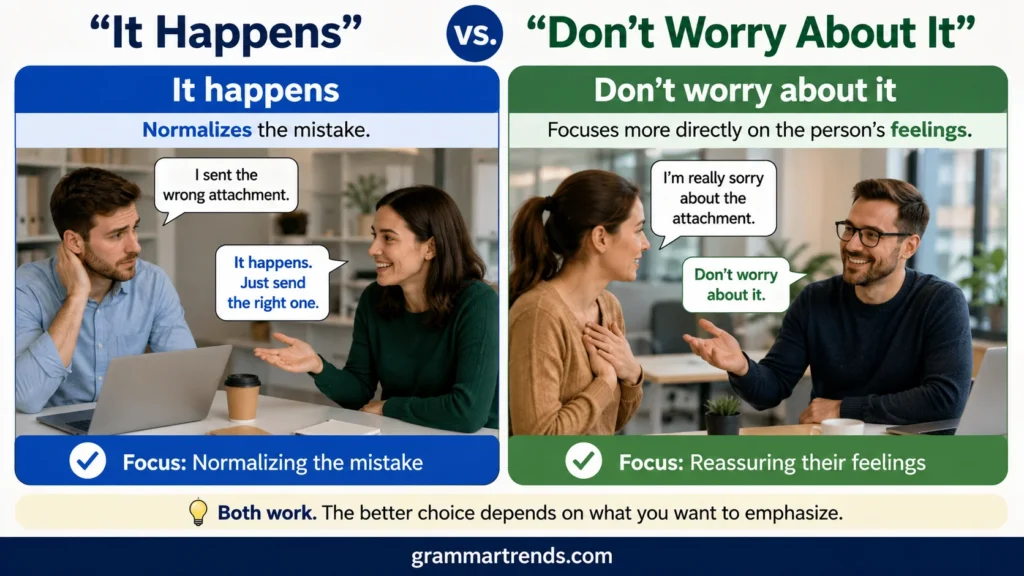
“It Happens” vs. “Don’t Worry About It”
The two expressions overlap, but they emphasize different things.
“It happens” normalizes the mistake.
“Don’t worry about it” focuses more directly on the person’s feelings.
For example:
“I sent the wrong attachment.”
“It happens. Just send the right one.”
Or:
“I’m really sorry about the attachment.”
“Don’t worry about it.”
Both work. The better choice depends on what you want to emphasize.
No Harm Done
“No harm done” means that something went wrong but didn’t cause meaningful damage or lasting trouble.
For example:
“I accidentally moved your files into the wrong folder.”
“No harm done. I found them.”
The expression works especially well when the outcome matters more than the mistake itself.
When to Use “No Harm Done”
You can use it for:
- Minor accidents
- Small misunderstandings
- Temporary inconveniences
- Mistakes that were quickly corrected
It reassures someone by essentially saying, “The mistake happened, but everything turned out fine.”
A Useful Distinction
Compare these:
“No problem.”
Focuses on whether the situation inconvenienced you.
“No harm done.”
Focuses on whether the situation caused damage or consequences.
That small distinction makes the phrase useful in specific situations.
Read more: 15 Polite Ways to Say You Don’t Like Something
I’m Not Bothered
“I’m not bothered” tells someone that you aren’t upset, annoyed, or concerned about something.
For example:
“Would you mind if we started a little later?”
“I’m not bothered.”
This phrase is more personal than “It’s okay.” You’re describing your own emotional response.
When “I’m Not Bothered” Works
It’s useful when:
- Someone worries they have annoyed you.
- Someone asks about a minor inconvenience.
- You’re genuinely comfortable with a change.
- You want to explain that something doesn’t upset you.
Tone Matters
Depending on your voice, “I’m not bothered” can sound warm or indifferent.
Compare:
“I’m not bothered at all. Take your time.”
with:
“I’m not bothered.”
The first sounds reassuring. The second may sound brief or detached.
When speaking, your tone can carry as much meaning as the words themselves.
You’re Fine
“You’re fine” reassures the person rather than describing the situation.
For example:
“Sorry! I thought I was standing in your way.”
“You’re fine.”
It essentially means “You haven’t done anything wrong” or “You don’t need to worry.”
When to Use “You’re Fine”
This expression works well when:
- Someone feels embarrassed.
- Someone thinks they’ve inconvenienced you.
- Someone apologizes for something minor.
- Someone worries about breaking a social rule.
A Note About Tone
“You’re fine” can sound comforting when delivered warmly.
However, a short or irritated delivery may make it sound dismissive.
That’s why adding a few words can help:
“You’re absolutely fine. Don’t worry about it.”
That version leaves much less room for misunderstanding.
Nothing to Worry About
“Nothing to worry about” is another strong reassurance phrase.
It tells someone that a situation doesn’t require their concern.
“I was worried that I caused a problem.”
“There’s nothing to worry about.”
This phrase works particularly well when someone has been overthinking a small issue.
When to Use It
Use it when:
- Someone is anxious about a minor mistake.
- Someone thinks they’ve caused trouble.
- You want to reassure a customer or coworker.
- A situation looks worse than it actually is.
In professional settings, you can soften it further:
“There’s nothing to worry about. We’ve already taken care of it.”
That sounds reassuring without brushing aside the person’s concern.
It’s Perfectly Okay
Sometimes “It’s okay” needs a little more emphasis.
That’s where “It’s perfectly okay” works well.
The word “perfectly” makes the reassurance stronger.
“Would it be okay if I rescheduled our meeting?”
“Yes, it’s perfectly okay.”
This phrase sounds warm and accepting without becoming overly casual.
When to Use “It’s Perfectly Okay”
It’s suitable for:
- Personal conversations
- Workplace discussions
- Apologies
- Schedule changes
- Requests
- Minor mistakes
It also works when you want to make it clear that someone doesn’t need to feel guilty.
We’re Good
“We’re good” is a casual expression that often means “There isn’t a problem between us anymore.”
It has an important relationship-focused meaning.
For example:
“I’m sorry about what I said earlier.”
“It’s okay. We’re good.”
Here, you’re not merely accepting an apology. You’re reassuring the other person that the relationship hasn’t been damaged.
When to Use “We’re Good”
It works well after:
- Minor disagreements
- Arguments
- Misunderstandings
- Apologies
- Awkward moments
Is “We’re Good” Formal?
No. It’s strongly conversational.
Use it with:
- Friends
- Family
- Close coworkers
- People you’re comfortable with
For a formal business relationship, something like “There’s no issue” or “Everything is fine” may be more appropriate.
Please Don’t Worry
“Please don’t worry” provides reassurance while sounding more polite and deliberate than “Don’t worry about it.”
For example:
“I’m concerned that the delay may have caused problems.”
“Please don’t worry. We’ve adjusted the schedule.”
The phrase can work particularly well in professional communication because it doesn’t sound overly casual.
When to Use “Please Don’t Worry”
Consider it for:
- Customers
- Colleagues
- Clients
- Formal conversations
- Someone who feels anxious or guilty
It can also sound warm in personal conversations.
“Please don’t worry about bringing anything. We have everything we need.”
How to Choose the Right Alternative to “It’s Okay”
Choosing a synonym isn’t enough. You need to consider the situation, relationship, seriousness of the issue, and tone you want to create.
Think of these expressions as different tools in a toolbox. A screwdriver may be useful, but you wouldn’t use it to hammer a nail.
The same principle applies to language.
When Someone Apologizes
Try:
- No problem.
- No need to apologize.
- Don’t worry about it.
- It’s perfectly okay.
- That’s perfectly fine.
Example:
“I’m sorry I forgot to reply.”
“No problem. I know you’ve been busy.”
When Someone Makes a Small Mistake
Try:
- It happens.
- No harm done.
- That’s perfectly fine.
- No big deal.
Example:
“I accidentally printed the wrong document.”
“No harm done. We can print the right one.”
In a Professional Conversation
Choose:
- That’s perfectly fine.
- That’s quite alright.
- Please don’t worry.
- No problem.
Example:
“Would it be possible to move our appointment to Friday?”
“That’s perfectly fine.”
With Friends and Family
Natural casual choices include:
- It’s all good.
- No big deal.
- Don’t worry about it.
- We’re good.
- No problem.
These expressions usually sound more relaxed and spontaneous.
Polite Ways to Say “It’s Okay” by Formality
Not every phrase carries the same level of formality.
| Expression | Formality | Typical Setting |
| That’s quite alright | High | Formal conversation |
| Please don’t worry | Medium-high | Workplace or personal |
| That’s perfectly fine | Medium | Professional and everyday |
| It’s perfectly okay | Medium | General conversation |
| No problem | Medium | Everyday communication |
| No need to apologize | Medium | Apologies |
| Don’t worry about it | Casual | Everyday speech |
| It happens | Casual | Minor mistakes |
| It’s all good | Very casual | Friends and family |
| No big deal | Very casual | Small problems |
| We’re good | Very casual | Relationships and disagreements |
The table reveals an important point: “polite” and “formal” aren’t the same thing.
A phrase can be extremely polite while still sounding casual.
For example, “No problem” is polite in many situations. It’s simply less formal than “That’s quite alright.”
Polite Ways to Say “It’s Okay” in an Email
Email communication requires slightly more care because the reader can’t hear your voice.
A phrase that sounds warm when spoken might look abrupt on a screen.
Professional Example: Minor Delay
“I’m sorry for the delay in sending the report.”
A suitable response:
“That’s perfectly fine. Thank you for keeping me updated.”
This version accepts the delay without making the person feel guilty.
Professional Example: Schedule Change
“Would it be possible to reschedule our meeting?”
A natural response:
“That’s perfectly fine. Friday afternoon works for me.”
It’s clear, polite, and direct.
Professional Example: Small Mistake
“I noticed that I attached the wrong document.”
A helpful response:
“No problem. Please send the correct version when you have a chance.”
The response doesn’t exaggerate the mistake. It also gives the conversation a clear next step.
Phrases That Sound Too Casual in Formal Emails
Avoid these when you need a polished professional tone:
- It’s all good.
- No big deal.
- We’re good.
- It happens.
They’re not inherently rude. They simply belong more naturally in casual speech.
“It’s Okay” vs. “It’s Fine” vs. “No Problem”
These expressions often overlap, but they aren’t identical.
| Expression | What It Usually Communicates |
| It’s okay | General acceptance or reassurance |
| It’s fine | Acceptance of a situation or choice |
| No problem | The situation didn’t cause difficulty |
| Don’t worry about it | The other person shouldn’t feel concerned |
| No big deal | The issue is minor |
| It happens | Mistakes are normal |
| No harm done | Nothing serious resulted from the mistake |
Consider this example:
“Sorry I forgot your book.”
You could answer:
“It’s okay.”
You accept the mistake.
“No problem.”
The mistake didn’t cause you significant inconvenience.
“Don’t worry about it.”
You want the person to stop feeling guilty.
“It happens.”
You’re emphasizing that forgetting things is normal.
“No big deal.”
You’re saying the problem is very minor.
The differences are subtle, but they help you sound much more natural.
Common Mistakes When Saying “It’s Okay”
Even a polite phrase can create the wrong impression when you use it in the wrong situation.
Using an Overly Casual Phrase Professionally
Imagine a client apologizes for a scheduling problem.
You reply:
“It’s all good.”
That may sound friendly. However, if the relationship is formal, “That’s perfectly fine” would probably fit better.
Minimizing a Serious Problem
Imagine a coworker says:
“I accidentally deleted the customer database.”
Responding with:
“No big deal.”
would be inappropriate unless you genuinely know that the data can be restored easily.
A better response would acknowledge the seriousness:
“It’s okay. Let’s figure out what happened and see what we can recover.”
Ignoring Someone’s Feelings
Sometimes people don’t need you to dismiss the problem. They need you to acknowledge their feelings.
Instead of:
“It’s fine.”
Try:
“It’s okay. I understand why you’re concerned.”
That small addition can make your response much more compassionate.
Repeating the Same Expression
If you say “No problem” every time someone apologizes, thanks you, or asks for something, your speech may start to sound repetitive.
English gives you plenty of alternatives.
Switch between:
- No problem.
- That’s perfectly fine.
- Don’t worry about it.
- No need to apologize.
- It happens.
Choose the one that actually matches the situation.
Real-Life Examples of Polite “It’s Okay” Alternatives
The best way to understand these expressions is to see them in natural conversations.
When Someone Arrives Late
Person: “Sorry I’m ten minutes late.”
You: “No problem. I haven’t been waiting long.”
This works because the delay is relatively minor.
When Someone Makes a Typing Mistake
Person: “Sorry, I typed the wrong number.”
You: “That’s perfectly fine. Just correct it when you can.”
The response reassures the person without making the mistake sound important.
When Someone Forgets Something
Person: “I completely forgot to bring the charger.”
You: “It happens. We can share mine.”
This works because you acknowledge the mistake while offering a practical solution.
When Someone Feels Guilty
Person: “I feel bad that I made you wait.”
You: “Don’t worry about it. I had plenty of time.”
The second sentence provides a concrete reason for the reassurance.
After a Minor Disagreement
Person: “I’m sorry I got annoyed earlier.”
You: “It’s okay. We’re good.”
This combination works naturally among friends or people who have a comfortable relationship.
In a Workplace Conversation
Coworker: “I won’t have the report ready until tomorrow.”
You: “That’s perfectly fine. Tomorrow works.”
This sounds professional while keeping the conversation relaxed.
With a Customer
Customer: “I’m sorry for changing my order.”
Employee: “Please don’t worry. We can update it for you.”
The response is courteous and solution-focused.
A Simple Guide to Choosing the Best Phrase
When you’re unsure what to say, ask yourself one question:
What am I trying to reassure this person about?
If you’re reassuring them that they didn’t inconvenience you, say:
“No problem.”
If you’re reassuring them that their mistake isn’t serious, say:
“No big deal.”
If you’re trying to reduce guilt, say:
“Don’t worry about it.”
If you’re accepting an apology, say:
“No need to apologize.”
If you’re normalizing a mistake, say:
“It happens.”
If you’re emphasizing that no damage occurred, say:
“No harm done.”
If you’re speaking professionally, say:
“That’s perfectly fine.”
If you’re resolving a personal disagreement, say:
“We’re good.”
This approach helps you choose words based on meaning rather than memorization.
My Experience as an English Expert
In my experience working with English, I’ve noticed that people often think “It’s okay” is enough for every situation. I used to see this quite often in everyday conversations, especially when someone was apologizing or feeling embarrassed about a small mistake. But over time, I learned that the words we choose can change the entire feeling of a conversation. Saying “No problem” to a friend can sound relaxed and friendly, while “That’s perfectly fine” feels much more natural when you’re speaking with a coworker or responding professionally. These small differences may seem minor, but they can make your English sound much more natural.
One thing I always tell English learners is not to memorize phrases without understanding the situation. I’ve seen people use “Don’t worry about it” when someone is dealing with a serious problem, and instead of sounding comforting, it can come across as dismissive. In those moments, I prefer to acknowledge the person’s feelings first and then offer reassurance. For me, learning these expressions has never been just about finding synonyms for “It’s okay.” It’s about understanding tone, context, emotion, and relationships so your words actually match the moment. That’s what makes everyday English sound genuine, thoughtful, and human.
FAQs
1. What is a polite way to say “It’s okay”?
You can say “No problem,” “That’s fine,” “No worries,” or “It’s quite alright.” The best choice depends on who you’re talking to and what happened.
2. How can I say “It’s okay” professionally?
In a professional setting, try “That’s perfectly fine,” “No problem at all,” or “There’s no need to worry.” These expressions sound respectful without being too casual.
3. What can I say when someone apologizes?
You can respond with “No need to apologize,” “It happens,” or “No harm done.” These phrases reassure the person and show that you aren’t holding the mistake against them.
4. How do I comfort someone by saying “It’s okay”?
When someone is upset, use warmer expressions such as “Everything is going to be fine,” “You don’t need to worry,” or “I understand.” These words can feel more caring than simply saying “It’s okay.”
5. Is “It’s all good” polite to say?
Yes, “It’s all good” is friendly and reassuring. However, it works best in casual conversations with friends, family, or people you know well rather than in very formal situations.
6. What is another way to say “It’s okay” without repeating it?
You can use expressions such as “No big deal,” “I’m not bothered,” “It’s forgiven,” or “Don’t worry about it.” Changing your wording can make your conversations sound more natural and genuine.
Conclusion
Saying “It’s okay” may be simple, but the words you choose can make a real difference. Sometimes a quick “No problem” is all someone needs, while other moments call for a warmer “Don’t worry about it” or “No harm done.” The key is to consider the person, situation, and tone before you respond. With these alternatives, you can sound more natural, thoughtful, and reassuring without relying on the same phrase every time. Whether you’re comforting a friend, responding at work, or helping someone move past a mistake, a few well-chosen words can make your message feel much more genuine.

Emma Rose has spent 15 years in the English Department at the University of California, Los Angeles (UCLA), guiding students through British and American literary classics, critical theory, and narrative techniques. Her scholarly focus includes 19th- and 20th-century fiction, the art of poetry, postcolonial writing, and digital humanities particularly how storytelling voice influences cultural perspectives. Emma has presented her research at major international conferences and published in respected academic journals, underscoring her dedication to both high-level scholarship and engaging teaching.