
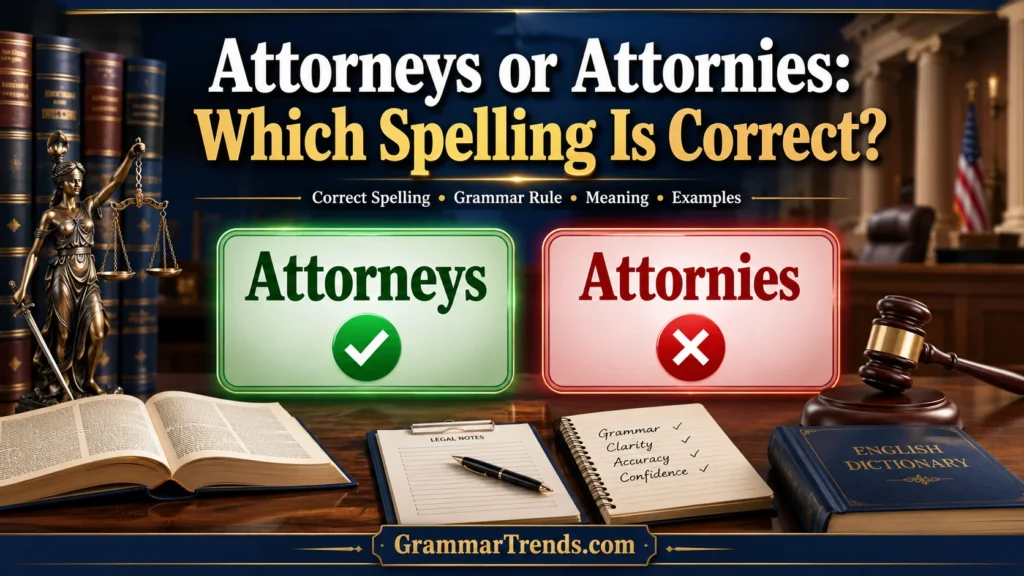
Attorneys or Attornies create confusion because Many people see Attornies, Attorneys, attornies, and attorneys that look similar at first glance, yet the difference often appears tricky. This common mistake leaves readers especially likely to feel unsure, stuck, or wondering about the correct spelling while typing mid-sentence, suddenly paused, and it creates doubt, leading to a clear search for the right version, overall meaning, and the best way of trying to remember proper usage under plural rules in the English language, where words ending in y cause mistakes.
If you have written or read enough examples, you have probably noticed a lot of cases where both forms sometimes appear online, and this article will clear things, help you understand the choice between them so you can write confidently at work.
In this guide, you will learn the meaning, mistakes, useful tips, plenty of examples, and every context where patterns follow different pluralization habits. The confusion arises because Understanding the distinction is important in formal documents, professional communication, and legal writing, where accuracy reflects credibility, attention, and detail.
A believable spelling is not always the only one considered standard, and the contrast shows a misspelling happens when a form ignores the rule for changing a word from -ey to -eys rather than -ies. The error results from a consonant pattern seen in parties and cities, making it quite common among learners and even native speakers who rely on pronunciation instead of spelling conventions.
In legal contexts, using the right term is essential because it refers to qualified professionals, law representatives, and licensed practitioners who provide advice. Whether sending an email, preparing a report, communicating professionally, or choosing the right form, it ensures clarity, precision, and professionalism.
Quick Answer
Here’s the short version:
| Word | Correct? |
| Attorneys | ✅ Correct |
| Attornies | ❌ Incorrect |
The plural form of attorney is attorneys.
Why?
Because the word ends with a vowel + y pattern.
In English grammar:
- If a word ends in consonant + y, change the y to ies
- If a word ends in vowel + y, simply add s
Since attorney ends with ey, you only add s.
Correct Examples
- One attorney
- Two attorneys
- Several attorneys attended the hearing
Incorrect Examples
- Two attornies
- The attornies filed a lawsuit
Simple rule. Big difference.
Why People Confuse “Attornies” and “Attorneys”
English spelling can feel like driving through fog with broken headlights. Some rules make perfect sense. Others look like they were invented during a coffee shortage.
The confusion around attorneys usually comes from three major causes.
The “IES” Pattern Feels Familiar
Most people learn this grammar rule early in school:
| Singular | Plural |
| City | Cities |
| Baby | Babies |
| Lady | Ladies |
So when writers see attorney, their brain automatically assumes:
- attorney → attornies
That instinct feels logical. Unfortunately, it skips one important detail.
The Hidden Vowel Rule Changes Everything
The actual grammar rule depends on the letter before the “y.”
If a consonant comes before the y:
Change y → ies
Examples:
- party → parties
- family → families
- country → countries
If a vowel comes before the y:
Just add s
Examples:
- key → keys
- monkey → monkeys
- journey → journeys
- attorney → attorneys
That tiny vowel changes the entire plural form.
The Internet Repeats Misspellings Constantly
Misspellings spread online like weeds in a neglected garden.
You’ll find “attornies” in:
- Social media posts
- Blog comments
- Informal forums
- Low-quality websites
- Auto-generated content
When people repeatedly see the wrong spelling, it starts to feel correct through familiarity alone.
That’s called the illusion of truth effect. The more often you see something, the more believable it appears.
Unfortunately, grammar doesn’t work by popularity vote.
What Is an Attorney?
Before diving deeper into spelling rules, it helps to understand the word itself.
An attorney is a licensed legal professional authorized to represent clients in legal matters.
Attorneys:
- Give legal advice
- Represent clients in court
- Draft legal documents
- Negotiate settlements
- Interpret laws and regulations
In the United States, attorneys must:
- Complete legal education
- Pass the bar exam
- Receive a license to practice law
Without that license, someone may study law yet still cannot legally act as an attorney.
Attorney vs Lawyer: What’s the Difference?
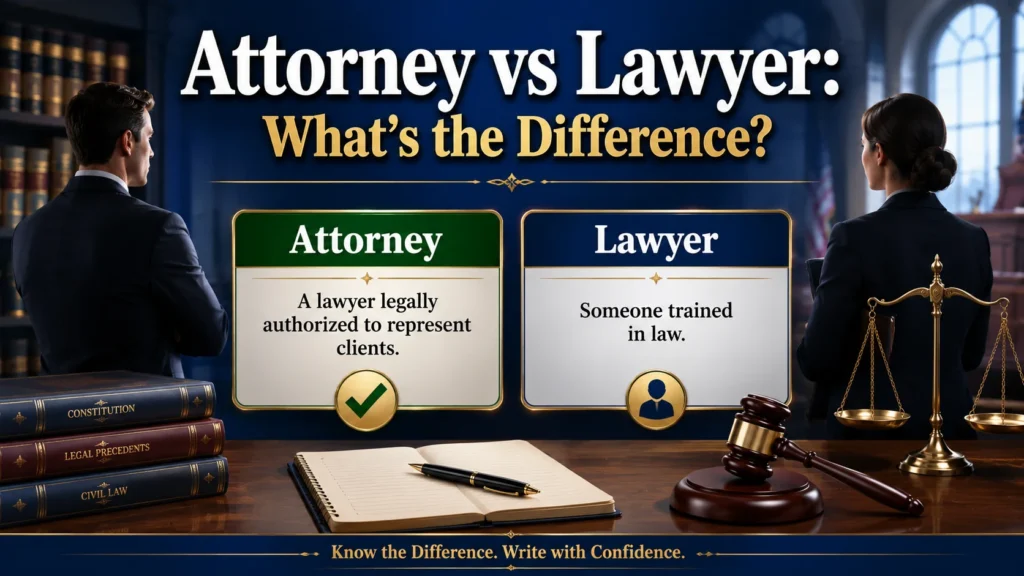
People often use attorney and lawyer interchangeably. In casual conversation, that’s usually fine. Technically, though, there’s a subtle distinction.
| Term | Meaning |
| Lawyer | Someone trained in law |
| Attorney | A lawyer legally authorized to represent clients |
Think of it this way:
Every attorney is a lawyer, but not every lawyer is an attorney.
For example:
- A law school graduate who never passed the bar exam may still be called a lawyer
- An attorney has the legal authority to practice law in court
In real-world usage, however, the lines blur constantly.
Common Types of Attorneys
The legal field branches into dozens of specialties.
Criminal Defense Attorneys
Represent people accused of crimes.
Corporate Attorneys
Handle business contracts, mergers, and compliance.
Divorce Attorneys
Focus on family law and marital disputes.
Immigration Attorneys
Help clients with visas, citizenship, and immigration cases.
Personal Injury Attorneys
Represent accident victims seeking compensation.
Tax Attorneys
Handle complex tax disputes and planning.
Intellectual Property Attorneys
Protect trademarks, patents, and copyrights.
Each specialty requires deep expertise. Law isn’t a one-size-fits-all profession.
Why “Attorneys” Is Grammatically Correct
Grammar rules may seem dry at first glance. Yet once you understand the mechanics, spelling becomes far easier.
Here’s the rule that matters.
The English Pluralization Rule
Rule 1: Consonant + Y → Replace Y With IES
Examples:
- baby → babies
- city → cities
- party → parties
Rule 2: Vowel + Y → Add S
Examples:
- toy → toys
- key → keys
- monkey → monkeys
- attorney → attorneys
Since the letter before the y in attorney is e, which is a vowel, the correct plural becomes:
attorney + s = attorneys
Not attornies.
Words That Follow the Same Pattern as Attorney
Here are similar examples that use the exact same grammar structure.
| Singular | Correct Plural |
| Attorney | Attorneys |
| Journey | Journeys |
| Monkey | Monkeys |
| Valley | Valleys |
| Donkey | Donkeys |
| Key | Keys |
| Toy | Toys |
Notice the pattern?
Each word contains a vowel before the y.
Words That Actually Use “IES”
Now compare those with true consonant + y words.
| Singular | Correct Plural |
| Lady | Ladies |
| Country | Countries |
| City | Cities |
| Baby | Babies |
| Family | Families |
The difference becomes crystal clear once you separate vowel endings from consonant endings.
Is “Attornies” Ever Correct?
No.
Formal English does not accept it.
Legal writing always uses the correct spelling.
Academic work requires the standard form.Journalists also avoid this misspelling.
Professional communication should always use the correct version.
“Attornies” is simply a spelling mistake.
You may still encounter it online because:
- People type quickly
- Spellcheck misses context
- Many websites publish unedited content
- Search engines index user-generated errors
But dictionaries, style guides, and legal publications consistently recognize only one accepted plural form:
Attorneys
Attorneys in American English vs British English
Some English words change spelling depending on region.
Examples:
- color vs colour
- organize vs organise
- center vs centre
So does that happen with attorneys?
No.
The spelling remains the same in both American and British English.
American Usage
In the United States, attorney is extremely common.
Examples include:
- Attorney General
- District attorney
- Defense attorney
American legal culture heavily uses the word in professional titles and court systems.
British Usage
The United Kingdom tends to prefer:
- solicitor
- barrister
- lawyer
Still, the word attorney exists in British legal history and specific legal contexts.
Most importantly:
- British English still spells the plural as attorneys
- Never attornies
Does Regional English Change the Spelling?
No.
Whether you’re writing in:
- the US
- the UK
- Canada
- Australia
- New Zealand
…the correct spelling remains identical.
Real-World Examples of “Attorneys” Used Correctly
Grammar rules stick better when you see them in action.
Here’s how professionals use the word in everyday communication.
In Legal Documents
Legal writing depends on precision. A single typo can damage credibility instantly.
Correct Examples
- “The attorneys reviewed the contract.”
- “Plaintiff’s attorneys filed the motion.”
- “Defense attorneys argued the evidence was insufficient.”
Law firms almost never tolerate spelling errors in official paperwork.
In Professional Emails
Imagine receiving this email:
“Our attornies will contact you shortly.”
That typo immediately weakens confidence.
Now compare it with:
“Our attorneys will contact you shortly.”
Small difference. Huge impact.
Professional writing lives and dies on details.
In News Headlines
Major publications consistently use attorneys correctly.
Examples:
- “Attorneys Challenge New State Law”
- “Defense Attorneys Cross-Examine Witness”
- “Corporate Attorneys Warn About Compliance Risks”
Journalists rely on editorial standards that eliminate misspellings before publication.
In Academic Writing
Universities expect grammatical accuracy.
A misspelled legal term in:
- essays
- dissertations
- research papers
- scholarship applications
…can lower perceived professionalism quickly.
Academic readers notice these details immediately.
In Everyday Conversation
Even casual communication benefits from correct spelling.
Examples:
- “The attorneys settled the case.”
- “Several attorneys attended the conference.”
- “Her attorneys negotiated the agreement.”
Correct usage becomes second nature once the rule clicks.
Read more: Midday or Mid-Day: Which Spelling Is Correct in Modern English?
Common Grammar Mistakes Related to “Attorney”
Misspelling attorneys is only one issue writers face.
Several related mistakes appear constantly.
Confusing Singular and Plural Forms
| Incorrect | Correct |
| The attorneys arrived | The attorneys arrived |
| Three attorney attended | Three attorneys attended |
| The attorneys is here | The attorneys are here |
Agreement matters just as much as spelling.
Apostrophe Mistakes
This area trips people up constantly.
Attorney’s
Singular possessive
Example:
- “The attorney’s office”
Meaning:
- One attorney owns the office
Attorneys’
Plural possessive
Example:
- “The attorneys’ meeting”
Meaning:
- Multiple attorneys share the meeting
Attorneys
Simple plural
Example:
- “The attorneys arrived early.”
No possession involved.
Other Common Legal Misspellings
| Incorrect | Correct |
| Attornies | Attorneys |
| Laywer | Lawyer |
| Definately | Definitely |
| Seperation | Separation |
| Judgement* | Judgment** |
Note: Both judgement and judgment exist, though judgment dominates in American legal English.
Why Correct Spelling Matters More Than You Think
Some people shrug off spelling mistakes as minor details. In reality, they shape how readers judge competence.
Fair or unfair, language affects credibility.
Professional Credibility
Imagine hiring a law firm whose homepage says:
“Our attornies have decades of experience.”
Would you trust them fully?
Probably not.
Typos create friction. They signal carelessness.
In law, finance, healthcare, and academia, trust matters enormously.
Academic Consequences
Students often underestimate spelling errors.
Yet instructors frequently associate:
- grammar accuracy
- vocabulary precision
- structural clarity
…with overall effort and intelligence.
One misspelling won’t ruin a paper. Repeated mistakes absolutely can.
Workplace Communication
Professional emails shape first impressions quickly.
Correct:
“Our attorneys reviewed the agreement.”
Incorrect:
“Our attornies reviewed the agreement.”
One version sounds polished.
The other sounds rushed.
Tiny details carry disproportionate weight.
Why Search Volume Doesn’t Make a Word Correct
Popularity doesn’t determine grammar.
Millions of people also search:
- definately
- seperate
- recieve
Yet those remain incorrect spellings.
Language evolves over time, yes. Still, standard spelling conventions exist for clarity and consistency.
Without them, communication becomes chaos.
Easy Memory Trick to Remember “Attorneys”
Need a quick shortcut?
Use this:
If a vowel comes before the y, just add s.
That single sentence solves countless spelling problems.
Compare Attorney With Familiar Words
| Word | Plural |
| Toy | Toys |
| Key | Keys |
| Journey | Journeys |
| Attorney | Attorneys |
The pattern stays consistent.
Once you notice it, the spelling becomes obvious.
A Simple Visual Shortcut
Break the word apart:
- attorney
- vowel before y
- add s
Done.
No complicated memorization required.
Attorneys vs Lawyers vs Attorneys-at-Law
Legal terminology evolved over centuries, which explains why several similar terms exist today.
Are These Terms Interchangeable?
In modern conversation, usually yes.
Most people casually use:
- attorney
- lawyer
…to mean the same thing.
Still, subtle differences remain in legal systems and professional contexts.
Historical Meaning of “Attorney-at-Law”
Historically, an attorney-at-law was someone formally appointed to act on another person’s behalf in legal matters.
The term comes from Old French roots connected to:
- appointment
- representation
- delegation of authority
Over time, the shorter term “attorney” became standard.
Which Term Sounds More Professional?
Context matters.
“Attorney”
Often sounds:
- formal
- legalistic
- courtroom-focused
“Lawyer”
Feels:
- broader
- conversational
- more flexible
Law firms frequently choose “attorney” because it signals official legal authority.
Correct vs Incorrect Usage Examples
Here’s a side-by-side breakdown.
| Incorrect Sentence | Correct Sentence |
| The attornies filed the case. | The attorneys filed the case. |
| Several attornies attended court. | Several attorneys attended court. |
| Our attornies reviewed the contract. | Our attorneys reviewed the contract. |
| The company hired three attornies. | The company hired three attorneys. |
Patterns become easier to spot once you see them repeatedly.
Mini Case Study: How One Misspelling Hurt Credibility
A small consulting website once published a legal services page containing repeated uses of “attornies.”
Visitors noticed immediately.
The consequences included:
- lower trust
- reduced professional appearance
- negative comments
- weaker conversion rates
After correcting the spelling and improving the content quality, engagement metrics improved noticeably within weeks.
Why?
Because polished language signals expertise.
Readers associate careful writing with careful work.
Expert Insight on Legal Writing Accuracy
Many legal writing instructors emphasize the same principle:
“Precision is the foundation of legal communication.”
Legal documents depend heavily on:
- clarity
- exact wording
- consistency
- grammatical accuracy
Even small errors can create confusion or weaken persuasive writing.
That’s why attorneys spend enormous amounts of time reviewing contracts, briefs, and filings.
Details matter.
Quick Grammar Recap
Here’s the rule in its simplest form.
| Word | Correct? |
| Attorneys | ✅ Yes |
| Attornies | ❌ No |
Why?
- Attorney ends in vowel + y
- Vowel + y words add s
- Therefore:
- attorney → attorneys
Simple once you know the rule.
FAQs
1. Which is correct: Attorneys or Attornies?
Attorneys is the correct plural form of attorney. Attornies is a misspelling and should not be used in standard English.
2. Why is “Attornies” incorrect?
The word attorney ends with a vowel (e) followed by y, so you simply add -s to make it plural. You do not change the y to ies.
3. What does “Attorneys” mean?
Attorneys are qualified legal professionals who are licensed to represent clients, provide legal advice, and handle legal matters in court or other legal settings.
4. When should I use “Attorneys”?
Use Attorneys whenever you’re referring to more than one attorney in legal documents, emails, business writing, reports, or everyday communication.
5. Why do people mistakenly write “Attornies”?
Many people confuse the spelling because words like cities and parties change y to ies. However, attorney follows a different pluralization rule because the y comes after a vowel.
6. How can I remember the correct spelling?
Remember this simple rule: if a word ends in a vowel + y, just add -s. Since attorney ends in ey, the correct plural is attorneys, not attornies.
Conclusion
Although Attorneys or Attornies may look similar, only Attorneys is correct in standard English. The confusion usually comes from applying the wrong plural rule, but the spelling is straightforward once you know that attorney ends in a vowel + y, so you simply add -s. Using the correct form makes your writing look more polished and professional, especially in legal, academic, and business contexts. Whenever you refer to more than one attorney, choose Attorneys with confidence and avoid Attornies, which is considered a spelling mistake.

Emma Rose has spent 15 years in the English Department at the University of California, Los Angeles (UCLA), guiding students through British and American literary classics, critical theory, and narrative techniques. Her scholarly focus includes 19th- and 20th-century fiction, the art of poetry, postcolonial writing, and digital humanities particularly how storytelling voice influences cultural perspectives. Emma has presented her research at major international conferences and published in respected academic journals, underscoring her dedication to both high-level scholarship and engaging teaching.