
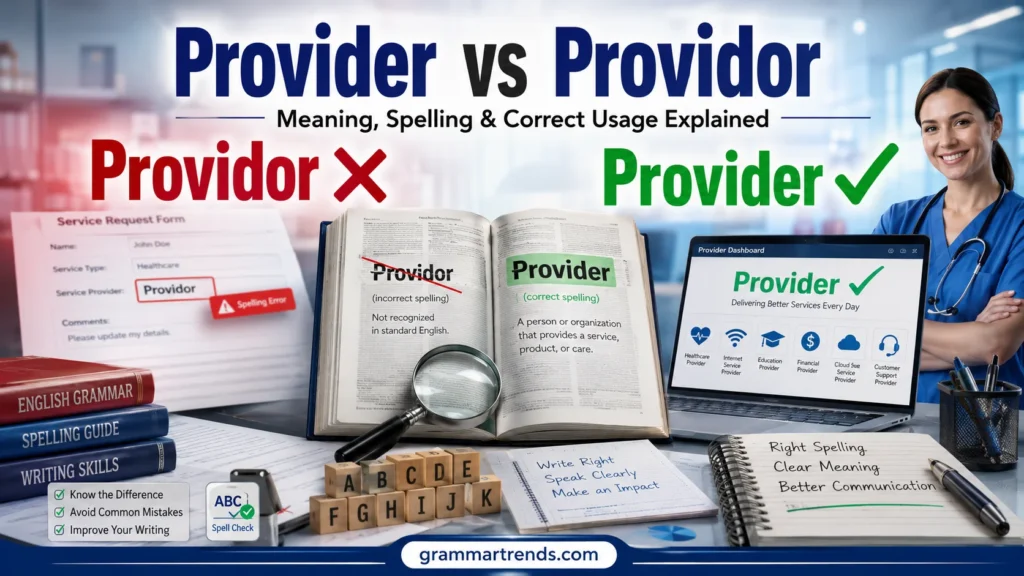
Provider vs Providor is a spelling question that confuses many English learners and writers. At first glance, both words look correct because English has many nouns ending in -er and -or. However, only one spelling is accepted in modern English.
A provider is a person, company, or organization that provides a service, product, support, or care. You will commonly see the word in healthcare, internet services, education, insurance, finance, and many other industries. Providor, on the other hand, is simply a misspelling of provider and is not recognized as the standard spelling in modern English.
Many people accidentally type providor when writing quickly, filling out forms, sending emails, or searching online. Since the two spellings look almost identical, it’s easy to second-guess yourself. Fortunately, the rule is simple: provider is always the correct spelling, while providor should be avoided in nearly every situation.
In this guide, you’ll learn the difference between provider and providor, their meaning, origin, correct usage, common mistakes, and plenty of real-world examples. By the end, you’ll know exactly which spelling to use and avoid making this common English language mistake.
Quick Answer
If you’re wondering whether provider or providor is correct, the answer is simple: provider is the only correct spelling in modern English. It refers to a person, company, or organization that provides products, services, care, or support. Providor is a common misspelling and is not recognized as standard English. To avoid errors in professional, academic, or everyday writing, always use provider. A helpful memory tip is to link it to the verb provide—if someone provides something, they are a provider.
What “Provider” Actually Means in Provider vs Providor Confusion
The word provider is a standard English noun. It comes from the verb provide, which means to supply something needed.
At its core, a provider is:
A person, company, or system that supplies something others need or use.
That “something” can be physical, digital, or even abstract like care or support.
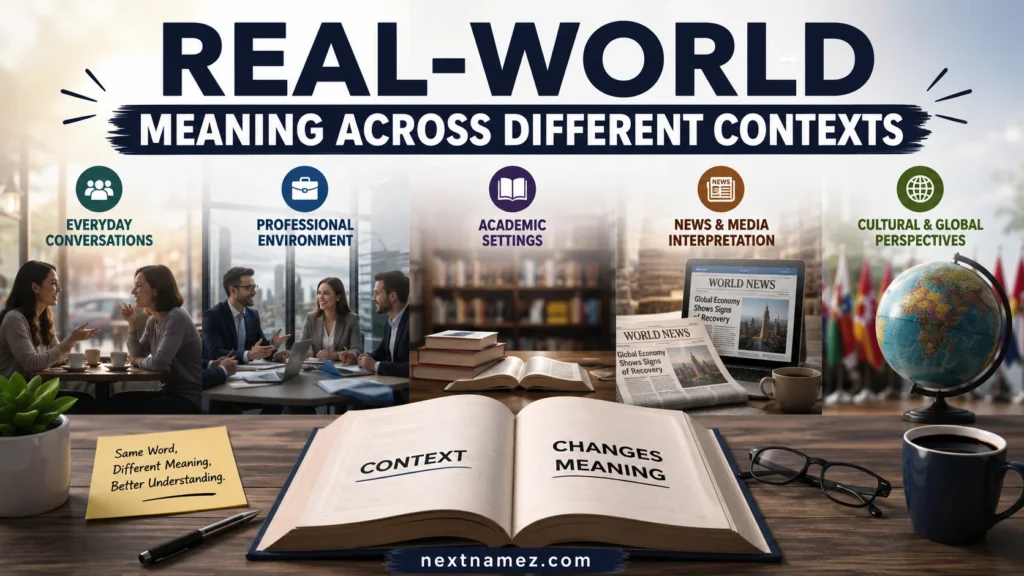
Real-World Meaning Across Different Contexts
The word provider shows up in many industries. Let’s break it down.
Healthcare
A doctor, nurse, or clinic can be a healthcare provider.
Example:
- Your family doctor acts as your primary healthcare provider.
Technology
Internet companies or cloud platforms are service providers.
Example:
- Your ISP (Internet Service Provider) connects you to the web.
Business
Companies that supply goods or services are providers too.
Example:
- A software provider delivers tools that businesses rely on daily.
Social and Family Context
The word also applies to people who support families financially or emotionally.
Example:
- A parent may be the main provider for a household.
Common Collocations With Provider
You’ll often see “provider” paired with specific words:
- service provider
- internet provider
- healthcare provider
- content provider
- solution provider
- financial provider
These combinations matter because they clarify exactly what is being supplied.
Is “Providor” a Real Word in Provider vs Providor Debate
Let’s be direct: “providor” is not a correct English word.
It does not appear in standard dictionaries, grammar references, or professional writing guides.
It is simply a misspelling of provider.
Why “Providor” Is Incorrect
English spelling can be tricky, especially with words ending in -er or -or. But in this case, the correct form is fixed.
Here’s the truth:
- Correct: provider
- Incorrect: providor
There is no alternative accepted spelling in modern English.
Dictionary Status Check
Major dictionaries confirm only one valid spelling.
| Source | Entry for “Provider” | “Providor” Listed? |
| Merriam-Webster | Yes | No |
| Cambridge Dictionary | Yes | No |
| Oxford Learner’s Dictionaries | Yes | No |
This absence is important. If a word isn’t recognized in major dictionaries, it isn’t standard English.
Common Causes of the Misspelling “Providor”
So why do people still type it?
Sound-Based Confusion
English pronunciation often misleads writers. “Provider” sounds like it could end in “-or,” especially when spoken quickly.
Typing Habits
Fast typing leads to swapped letters. The “e” and “o” are close enough in sound to get mixed.
Influence of Similar Words
Words like:
- director
- actor
- supervisor
all end in “-or,” so people assume provider follows the same pattern.
Autocorrect Errors
Some keyboards “correct” unfamiliar typing into incorrect but familiar patterns.
Why People Confuse Provider vs Providor
This confusion isn’t random. It follows a pattern seen across English spelling mistakes.
Sound-Based Spelling Errors in English
English is not a phonetic language. That means words don’t always look like they sound.
For example:
- “tough” sounds like “tuf”
- “colonel” sounds like “kernel”
So when people hear provider, they guess the spelling instead of remembering it.
-er vs -or Ending Confusion
Many English words end in either -er or -or, and both sound similar.
Examples:
- teacher (correct -er)
- actor (correct -or)
- provider (correct -er)
There’s no strict rule you can rely on, so memorization matters.
Digital Communication Speed
People type quickly on phones and laptops. That speed leads to:
- swapped vowels
- skipped letters
- phonetic guesses
“Providor” often comes from this fast, informal typing style.
How to Correctly Use “Provider” in Sentences
Now let’s use the word correctly in real communication.
Basic Sentence Structures
Here are simple but correct examples:
- The company is a leading provider of cloud services.
- She works as a healthcare provider in a busy clinic.
- This app is a content provider for news updates.
Notice how natural the word fits into each sentence.
Formal Usage Examples
In professional writing, “provider” often appears in structured contexts.
- The organization acts as a financial provider for small businesses.
- We selected a global service provider for infrastructure support.
- The hospital partners with multiple healthcare providers.
These sound clean and industry-ready.
Informal Usage Examples
In everyday speech or writing:
- My internet provider is too slow today.
- She found a better service provider online.
- We switched providers last month.
Short, direct, and natural.
Common Prepositions Used With Provider
You’ll usually see these patterns:
- provider of
- provider for
- provider to
Examples:
- A provider of educational tools
- A provider for rural communities
- A provider to enterprise clients
Each preposition slightly shifts meaning, so context matters.
Common Incorrect Usage Patterns to Avoid
Mistakes happen, but some are more common than others.
Writing “Providor” Instead of “Provider”
This is the most frequent issue. Always replace it with:
- provider (correct)
A quick mental trick:
If it looks like “actor,” it’s still not “providor.”
Read more: Pedantic vs Semantic: Complete Guide for Clear Communication
Overgeneralizing “Provider” for Everything
Not every supplier is a provider.
For example:
- A grocery store is a retailer, not always a provider
- A manufacturer is not always called a provider
Using the right word improves clarity.
Confusing Provider With Supplier
These words overlap but aren’t identical.
- Provider → focuses on service or access
- Supplier → focuses on physical goods
Using Provider When a Better Word Exists
Sometimes, precision matters.
Instead of:
- “We chose a provider for parts”
You might say:
- supplier
- vendor
- distributor
depending on context.
Provider vs Similar Terms Explained Clearly
Understanding related terms helps you write more accurately.
Provider vs Supplier
| Term | Focus | Example |
| Provider | Services or access | Internet provider |
| Supplier | Physical goods | Parts supplier |
Vendor vs Provider
| Term | Focus | Example |
| Provider | Ongoing service | Cloud provider |
| Vendor | Seller in transactions | Marketplace vendor |
Provider vs Distributor
| Term | Focus | Example |
| Provider | Service delivery | Healthcare provider |
| Distributor | Product movement | Electronics distributor |
Key Difference Summary
Think of it like this:
- Provider → gives access or service
- Supplier → gives raw goods
- Vendor → sells products
- Distributor → moves products through channels
Quick Memory Tricks to Remember Provider vs Providor
Let’s make this stick.
Break It Down
Provider = provide + er
You provide something → you are a provider.
Association Trick
Think:
“I provide, therefore I am a provider.”
Simple logic wins here.
Visual Cue Method
Picture someone handing over a service card labeled “provider.”
Now imagine “providor.” It looks off because it is.
Your brain remembers patterns better than rules.
Practice Section: Test Your Understanding
Let’s lock it in.
Fill in the Blank
- The internet ______ is down today.
- She works as a healthcare ______.
- This company is a leading service ______.
Answers:
- provider
- provider
- provider
Correct the Sentence
- The providor offers cloud storage.
- We changed our providor last year.
- He is a trusted health providor.
Correct versions:
- provider
- provider
- provider
Spot the Error
- The company acts as a providor of IT solutions. ❌
- The company acts as a provider of IT solutions. ✔️
Summary: Provider vs Providor at a Glance
Let’s bring it all together.
Key Takeaways
- Provider is the only correct spelling
- Providor is always incorrect
- The word describes someone or something that supplies services or access
- Context matters more than complexity
- Simpler alternatives may sometimes fit better
FAQs
Is providor a real English word?
No. Providor is considered a misspelling of provider. Modern English dictionaries recognize provider as the correct spelling.
Which spelling is correct: provider or providor?
Provider is the correct spelling. It refers to a person, business, or organization that supplies services, products, care, or support. Providor should be avoided in standard writing.
Why do people spell provider as providor?
People often write providor by mistake because many English words end in -or, such as actor and creator. Typing quickly or relying on pronunciation can also lead to this common spelling error.
Is providor acceptable in professional or academic writing?
No. Professional documents, business emails, academic papers, and official publications should always use provider. Using providor may appear as a spelling mistake and reduce your credibility.
What does provider mean?
A provider is someone or an organization that provides something to others, such as healthcare, internet access, education, insurance, financial services, or other products and services.
How can I remember the correct spelling?
A simple trick is to connect provider with the verb provide. Since the verb ends in -ide, the correct noun is provider, not providor. Remembering the base word makes the correct spelling much easier to recall.
Conclusion
The confusion between provider vs providor is understandable, but the correct choice is simple. Provider is the only accepted spelling in modern English and is widely used to describe a person, company, or organization that supplies products, services, care, or support. In contrast, providor is merely a misspelling and should be avoided in both professional and everyday writing.
Whenever you’re writing an email, filling out a form, creating business content, or searching online, remember that provider is the standard and trusted spelling. Linking it to the verb provide is an easy way to remember the correct form. By using provider consistently, you’ll write with greater accuracy, confidence, and professionalism while avoiding one of the most common English spelling mistakes.

Mia Rose brings fifteen years of experience at The University of Edinburgh’s English Literature department, leading students through explorations of classic and contemporary texts, literary theory, and narrative design. Her academic interests center on Victorian and modernist fiction, poetic rhythms, postcolonial storytelling, and digital approaches to literary study—with a keen eye on how voice and perspective frame cultural dialogue. Mia has delivered talks at prestigious global conferences and authored articles in scholarly journals, showcasing her commitment to meaningful research and lively classroom engagement.