
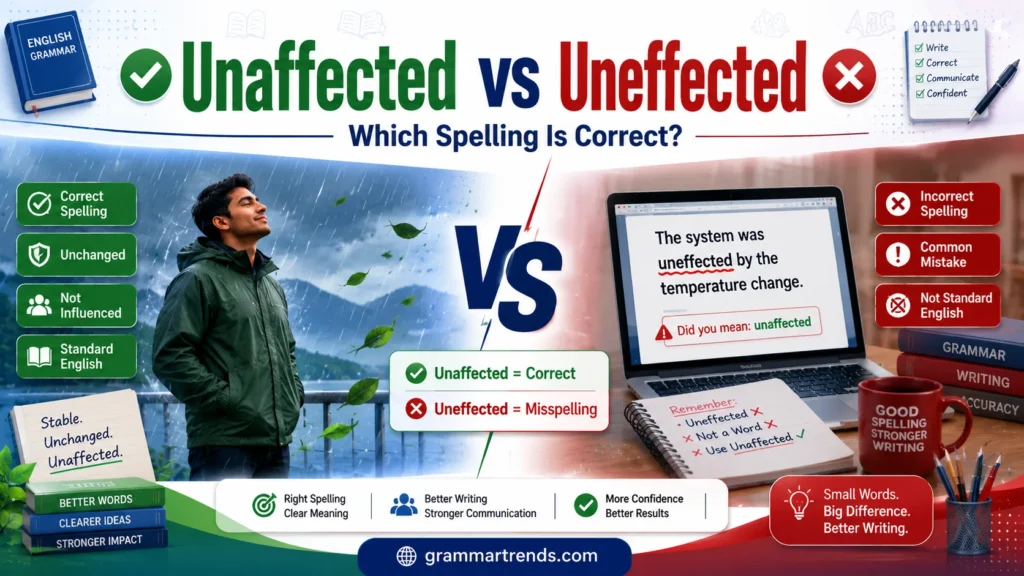
Unaffected vs Uneffected is a common spelling confusion that catches many English learners and even experienced writers. Since the two words look almost identical, it’s easy to assume they’re interchangeable. However, only unaffected is a standard English word in most contexts, while uneffected is generally considered a misspelling and is not accepted in modern English dictionaries.
Understanding the difference is important because using the correct spelling makes your writing clearer and more professional. Unaffected describes someone or something that remains unchanged or uninfluenced by an event, situation, or condition. In contrast, uneffected is almost always an incorrect substitute for unaffected.
In this guide, you’ll learn the meaning of unaffected, why uneffected is incorrect, common mistakes to avoid, practical examples, and simple tips to help you choose the right word with confidence in everyday writing.
Quick Answer You Can Trust
Let’s keep this simple.
- Unaffected → correct spelling
- Uneffected → incorrect spelling (common mistake)
The confusion usually comes from mixing up affect and effect, two words that already confuse most English speakers.
If you remember nothing else, remember this:
You build the correct word from “affect,” not “effect.”
That one shift clears up most of the problem.
What “Unaffected” Actually Means in English
The word unaffected describes something that stays the same even after something happens around it.
In plain English, it means:
- Not changed
- Not influenced
- Not emotionally or physically disturbed

Core idea behind “Unaffected”
Think of it like this:
Imagine rain falling all around you, but you stay dry under a strong umbrella. You remain unaffected by the rain.
That’s the idea the word carries.
Where people use “Unaffected” in real life
You’ll see it in:
- Emotional reactions
- Business outcomes
- Environmental changes
- Health and physical conditions
- Market or financial conditions
Simple examples of “Unaffected”
Here’s how it looks in real sentences:
- She stayed unaffected by the criticism and continued her work.
- The small town remained unaffected by the storm.
- His confidence appeared unaffected after the loss.
- Prices stayed unaffected despite market changes.
Notice something? The word always signals stability or resistance to change.
Is “Uneffected” a Real Word in English?
Let’s clear this up without confusion.
Short answer
No. Uneffected is not a recognized standard English word.
What dictionaries say
Major references like:
- Oxford English Dictionary
- Merriam-Webster
- Cambridge Dictionary
do not list uneffected as a valid entry.
Instead, writing tools and grammar checkers flag it as:
- Misspelling
- Typo of “unaffected”
Why people still write “uneffected”
This mistake usually comes from three patterns:
Sound-based spelling
People hear the word and assume it follows “effect” → “uneffected.”
Overthinking the root word
Writers try to stay close to “effect,” but English doesn’t work that way here.
Fast typing errors
On keyboards, doubling letters becomes a common habit.
What happens when you use it incorrectly
Even though people might understand your meaning, it can:
- Lower writing credibility
- Look like a spelling mistake in academic writing
- Trigger grammar flags in tools like Grammarly or Word
In professional settings, that matters more than people think.
Why “Unaffected” Is the Correct Form
Let’s break it down logically.
Word structure
The correct form comes from:
- “un-” = not
- “affected” = influenced or changed
So:
un + affected = unaffected
Simple, clean, and grammatically consistent.
Why “uneffected” doesn’t work
English doesn’t build this word from “effected.”
Why?
Because:
- “Effected” means “brought about” (formal usage)
- It doesn’t represent “being influenced” in the same way
So attaching “un-” to “effected” creates a meaningless construction in standard English.
A Quick Grammar Reality Check: Affect vs Effect
This is where most confusion begins.
Let’s simplify it.
Affect (verb)
Means to influence something.
- The weather affected my mood.
- Stress affects sleep quality.
Effect (noun, mostly)
Means result or outcome.
- The effect of the rain was flooding.
- The new policy had a strong effect.
Why this matters for “unaffected”
The correct word connects to “affect”, not “effect.”
That’s why:
- unaffected = not affected
- uneffected = incorrect formation
What about “effected”?
This word does exist, but it means something different:
- “Effected” = brought into existence or caused something to happen
Example:
- The manager effected a new policy change.
So you can’t simply swap it into “unaffected.”
How to Use “Unaffected” in Real Sentences
Now let’s make this practical.
Everyday usage
- He stayed unaffected by the noise outside.
- I remained unaffected by the rumor.
Academic writing
- The results remained unaffected by external variables.
- The theory stays unaffected under these conditions.
Business communication
- Sales were unaffected by seasonal changes.
- The system remained unaffected during the update.
Emotional context
- She appeared unaffected, but her silence told a different story.
Common Mistakes Writers Make
Let’s look at where people go wrong.
Mistake: Writing “uneffected”
This happens when:
- You rely on pronunciation
- You assume symmetry in spelling rules
Fix it by remembering:
👉 There is only one correct form: unaffected
Mistake: Confusing unaffected with effected
This creates meaning problems.
Wrong idea:
- “The situation was uneffected by changes.”
Correct:
- “The situation was unaffected by changes.”
Mistake: Overusing the word
Sometimes writers repeat “unaffected” too much.
Better alternatives:
- unchanged
- stable
- untouched
- neutral
- intact
Unaffected vs Uneffected vs Related Words: Clear Comparison Table
| Word | Correct? | Meaning | Usage |
| Unaffected | Yes | Not influenced or changed | Standard English |
| Uneffected | No | Not valid word | Avoid entirely |
| Affected | Yes | Influenced or changed | Common usage |
| Effected | Yes | Caused or brought about | Formal contexts |
Memory Tricks to Remember the Correct Spelling
Let’s make this stick.
Trick: Think “Affect = Action”
If something acts on something else, it “affects” it.
So the opposite becomes:
un + affected = unaffected
Trick: Remove the “E” confusion
If you see “effect,” pause.
Ask:
- Am I talking about influence? → use affect
- Am I talking about result? → effect
Trick: One-second rule
Before you write it, quickly check:
“Can I replace it with ‘not affected’?”
If yes → unaffected is correct.
Real-World Writing Examples
Let’s see how this works in different contexts.
News writing example
- Despite the earthquake, nearby regions remained unaffected.
Scientific writing example
- The compound remained unaffected by heat exposure at 100°C.
Social media example
- I stayed unaffected and kept scrolling.
Professional report example
- Revenue remained unaffected despite market fluctuations.
Read more: TM Meaning in Text: How to Use It Correctly?
Case Study: The Editing Mistake That Changed Credibility
A junior content writer once submitted a business report using “uneffected” multiple times.
What happened?
- The editor flagged every instance
- The document lost credibility in review
- The revision delay slowed publication by two days
The issue wasn’t meaning. The issue was perception.
One small spelling error made the writing look careless, even though the analysis was strong.
That’s the real impact of small grammar mistakes.
How to Avoid This Mistake in Real Writing
Let’s make this practical.
Use grammar tools wisely
Tools like Grammarly or Word underline “uneffected” instantly. Don’t ignore it.
Slow down on homophones
Words like affect/effect deserve extra attention.
Read your sentence aloud
If it sounds off, it usually is.
Keep a mental checklist
Before finalizing:
- Did I use “affected” correctly?
- Did I accidentally type “uneffected”?
Expert Insight on Language Accuracy
Linguists often point out a simple truth:
“Most writing errors don’t come from lack of knowledge. They come from speed and assumption.”
That fits this case perfectly.
People assume English behaves logically. It doesn’t always.
So careful spelling matters more than instinct.
FAQs
What is the difference between unaffected and uneffected?
Unaffected is the correct word and describes something that remains unchanged or not influenced. Uneffected is generally considered an incorrect spelling in modern English.
Is uneffected a real English word?
In standard dictionaries and everyday English usage, uneffected is not accepted as the proper form. Most writers should use unaffected instead.
When should I use unaffected in a sentence?
Use unaffected when describing a person, object, result, or situation that has not been changed by an event, action, or condition.
Why do people confuse unaffected and uneffected?
The confusion happens because both words look very similar and share the same prefix and word structure, making them easy to mix up.
Can using uneffected affect writing quality?
Yes. Using uneffected can make writing appear less accurate and may distract readers from your intended meaning.
How can I remember the correct word?
Think of unaffected as the opposite of affected. Since affected is the standard word, unaffected is the standard opposite form.
Is unaffected commonly used in professional writing?
Yes. Unaffected appears frequently in academic writing, business communication, journalism, reports, and everyday English.
Conclusion
Understanding Unaffected vs Uneffected is important for clear and accurate communication. While the two forms may appear similar at first glance, only unaffected is widely accepted in modern standard English. Knowing the correct meaning, usage, and context helps avoid confusion, strengthens writing skills, and improves reader understanding. Once you recognize this distinction, choosing the right word becomes much easier and more natural in everyday writing.

Emma Rose has spent 15 years in the English Department at the University of California, Los Angeles (UCLA), guiding students through British and American literary classics, critical theory, and narrative techniques. Her scholarly focus includes 19th- and 20th-century fiction, the art of poetry, postcolonial writing, and digital humanities particularly how storytelling voice influences cultural perspectives. Emma has presented her research at major international conferences and published in respected academic journals, underscoring her dedication to both high-level scholarship and engaging teaching.