
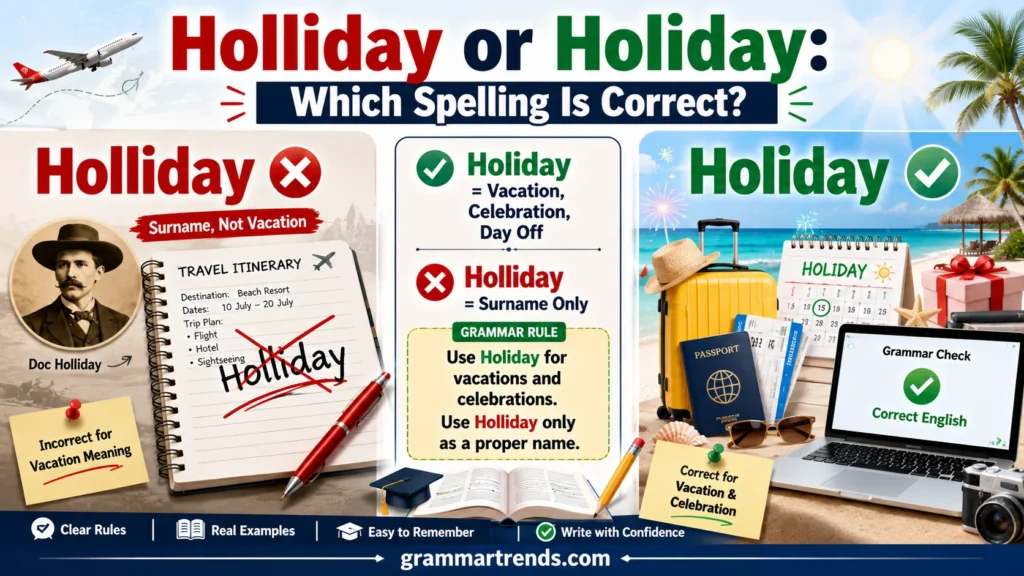
Holiday or Holliday confuses many English writers because the two words look almost identical. Whether you’re writing an email, planning a vacation, posting on social media, or creating professional content, it’s easy to wonder which spelling is correct.
The answer depends on what you mean. Holiday is the correct English word for a vacation, public holiday, or celebration. Holliday, on the other hand, is not a standard English word—it is a surname found in names such as Doc Holliday and some family or business names.
This confusion often happens because people type quickly, notice different spellings online, or assume that the extra “l” is acceptable. Since Holliday appears as a proper name, many writers mistakenly use it when they actually mean holiday. As a result, spelling errors frequently appear in business emails, travel articles, school assignments, captions, and everyday messages.
In this guide, you’ll learn the difference between holiday and Holliday, understand when each spelling is appropriate, discover why the confusion happens, and see practical examples that make the distinction easy to remember. Once you know the simple rule, you’ll be able to use the correct spelling confidently in every situation.
Holliday or Holiday: Quick Answer You Actually Need
Let’s cut straight to it.
- Holiday = correct spelling for vacation, celebration, or public day off
- Holliday = usually a surname, not a common English word
So if you’re writing about travel, school breaks, Christmas, or time off work, you always use:
Holiday
The double “l” version belongs mostly to names like Doc Holliday or family surnames.
That’s it. Simple rule. But the interesting part is why this mistake happens so often.
What “Holiday” Really Means in English
The word holiday is far more flexible than most people realize. It doesn’t just mean “vacation.” Its meaning shifts depending on context, region, and even culture.
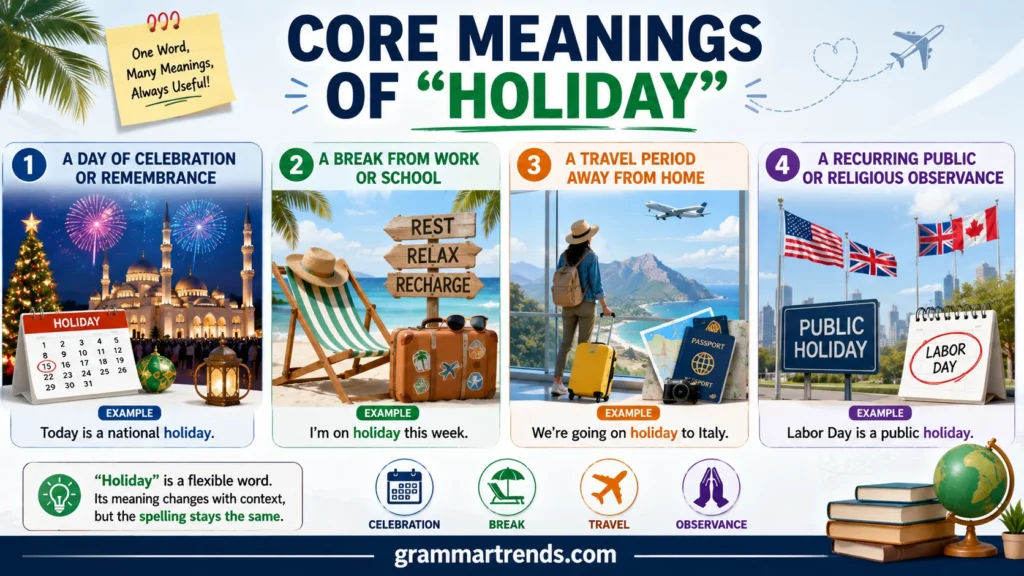
Core meanings of “holiday”
- A day of celebration or remembrance (like Christmas or Eid)
- A break from work or school
- A travel period away from home
- A recurring public or religious observance
Examples in real sentences
- “We’re taking a summer holiday in July.”
- “Today is a national holiday.”
- “Schools close for winter holidays.”
Notice something? The word adapts easily, but the spelling never changes.
Where the Word “Holiday” Comes From
To really understand spelling, you need to know origin.
The word holiday comes from the Old English phrase:
“hālig dæg” meaning “holy day.”
Over time, something interesting happened:
- “Holy day” → religious meaning only
- Gradually → became any special day off
- Eventually → evolved into modern “holiday”
Key transformation
| Stage | Form | Meaning |
| Old English | hālig dæg | Religious day of rest |
| Middle English | holy day | Church festivals |
| Modern English | holiday | Vacation or public break |
The spelling simplified over centuries. But the meaning expanded massively.
Why People Write “Holliday” by Mistake
This is where things get interesting. People don’t randomly invent spelling errors. There’s usually a reason.
Main causes of confusion
1. Surname influence
Names like Doc Holliday make people think the double “l” is normal. But surnames often follow different rules.
2. Sound-based spelling
When spoken quickly, “holiday” can sound like it has a double consonant in some accents.
3. Overgeneralization
English learners often double letters incorrectly because other words do it:
- ball
- letter
- coffee
So the brain assumes “holiday” might follow the same pattern.
4. Autocorrect and informal typing
Typing fast on phones leads to repeated letters without noticing.
Read more: Inexcusable vs Unexcusable: What’s the Correct Word?
Holiday vs Holliday: The Real Difference
Let’s make this crystal clear.
Holiday (correct word)
- Common noun
- Used globally
- Refers to time off or celebrations
- Appears in dictionaries and academic writing
Holliday (proper noun only)
- A family name
- Used in biographies, history, or fiction
- Not interchangeable with “holiday
Quick Comparison Table
| Word | Type | Meaning | Can you use it for vacation? |
| Holiday | Common noun | Break or celebration | Yes |
| Holliday | Proper noun | Surname | No |
British English vs American English Usage
Here’s where people get even more confused.
The spelling stays the same in both versions:
Holiday = universal spelling
But the meaning changes depending on where you are.
In British English
- “Holiday” usually means vacation
- Example: “I’m going on holiday to Spain.”
In American English
- “Holiday” often means public celebration
- Example: “Thanksgiving is a holiday.”
Important insight
There is no version of English where “holliday” is correct for vacations or celebrations.
Common Mistakes With “Holliday or Holiday”
Let’s break down real errors people make every day.
Mistake patterns
- Adding extra “l” → holliday
- Missing plural form → holiday vs holidays confusion
- Mixing with names → assuming spelling rule applies universally
Incorrect examples
- ❌ “We are going on holliday next week.”
- ❌ “Happy hollidays!”
- ❌ “Christmas holliday starts soon.”
Correct versions
- ✔ “We are going on holiday next week.”
- ✔ “Happy holidays!”
- ✔ “Christmas holiday starts soon.”
Holiday in Everyday Writing
The word appears everywhere once you start noticing it.
Education
- School holiday schedules
- Term breaks
- Academic calendars
Workplace
- Paid holidays
- Annual leave policies
- Public holiday closures
Travel industry
- Holiday packages
- Holiday destinations
- Holiday bookings
Digital communication
- “Happy holidays” messages
- Social media greetings
- Seasonal marketing campaigns
The word is deeply embedded in modern communication.
Simple Memory Tricks to Avoid Mistakes
You don’t need grammar rules memorized forever. You just need shortcuts.
Easy tricks
1. One-L rule
Holiday has one L like “light.”
2. “Holy day” trick
Think:
holy → holiday (same structure, simplified spelling)
3. Vacation mindset
Vacation feels light. So the word stays light too.
4. Quick test
Ask yourself:
“Am I talking about a person or a break?”
If it’s a break → always “holiday”
Is “Holliday” Ever Correct? Yes, But Only Here
Let’s be precise.
“Holliday” is correct only when it is:
- A surname
- A historical figure’s name
- A fictional character name
Example usage
- “Doc Holliday was a famous gunfighter in the American West.”
- “The Holliday family moved to Texas in the 1800s.”
Outside names, it does not belong in standard writing.
How Spellcheck Handles It
Modern tools help, but they are not perfect.
What usually happens
- “holliday” is flagged as incorrect
- “holiday” is accepted automatically
- Name recognition may override errors in special contexts
The hidden risk
Spellcheck won’t save you if:
- You intentionally accept wrong suggestions
- You’re writing informal text quickly
- You rely fully on autocorrect without reviewing
Case Study: Why Writers Still Get It Wrong
Let’s look at a realistic scenario.
Scenario: Student writing an essay
A student writes:
“During summer holliday, I visited my grandparents.”
What went wrong?
- Fast typing led to double “l”
- No proofreading step
- Familiarity with surnames influenced spelling
Correction process
Identify the context
→ vacation, not a name
Apply the spelling rule
→ only one “l” is needed
See it in a sentence
✔ During the summer holiday, I visited my grandparents.
Lesson learned
Most spelling errors are not ignorance. They are habit-based mistakes.
Usage Patterns in Real English Writing
Even though we don’t rely on exact statistics here, usage patterns are very clear in published English:
- “Holiday” appears consistently in formal writing, news, education, and travel content
- “Holliday” appears almost exclusively in personal names and historical references
- Professional editors treat “holiday” as a fixed spelling with no variants
In simple terms:
One is vocabulary. The other is identity.
FAQs
1. Is “holiday” or “Holliday” the correct spelling?
If you’re referring to a vacation, public holiday, or celebration, holiday is the correct spelling. Holliday is typically a surname and should only be used when it is part of a person’s or organization’s official name.
2. Why do people confuse “holiday” and “Holliday”?
The confusion happens because the words differ by only one letter. Seeing Holliday in names of people, businesses, or places can make writers think it is an alternative spelling of holiday, even though it isn’t.
3. Is “Holliday” accepted as a dictionary word for a vacation?
No. Standard English dictionaries define holiday as the word for a vacation or a day of celebration. Holliday is recognized as a proper noun, not a common noun with the same meaning.
4. Can I write “Happy Hollidays” in a greeting?
No. The correct greeting is “Happy Holidays.” Writing “Happy Hollidays” is considered a spelling mistake unless you’re intentionally referring to someone whose last name is Holliday.
5. Does British English use “Holliday” instead of “holiday”?
No. Both British and American English use holiday for vacations and public holidays. The spelling does not change based on the region.
6. When is it correct to use “Holliday”?
Use Holliday only when it is part of a proper name, such as Doc Holliday or a business, school, or location that officially uses that spelling.
7. How can I remember the difference between “holiday” and “Holliday”?
A simple trick is to remember that holiday is the everyday English word you’ll use for trips, celebrations, and time off. If the word refers to a person or official name, Holliday may be correct.
Conclusion
Although holiday or Holliday look almost identical, they serve different purposes in English. Holiday is the correct spelling for vacations, public holidays, celebrations, and time away from work or school. Holliday is a proper surname and should only be used when referring to a specific person, family, or organization with that name.
Understanding this small difference helps you avoid common spelling mistakes and makes your writing more accurate. Whether you’re sending a holiday greeting, planning a vacation, writing an email, or creating online content, choosing the correct spelling shows attention to detail and keeps your communication clear and professional.

Emma Brooke brings 15 years of experience in the Department of English Language and Literature at the University of California, Berkeley, where she has taught and mentored students across courses in British and American literary traditions, critical theory, and narrative form. Her expertise spans 19th- and 20th-century fiction, poetic prosody, postcolonial literatures, and digital humanities, with a focus on how narrative voice shapes cultural meaning. Emma’s work has been presented at international conferences and published in peer-reviewed venues, reflecting her deep commitment to rigorous literary scholarship and accessible teaching.