
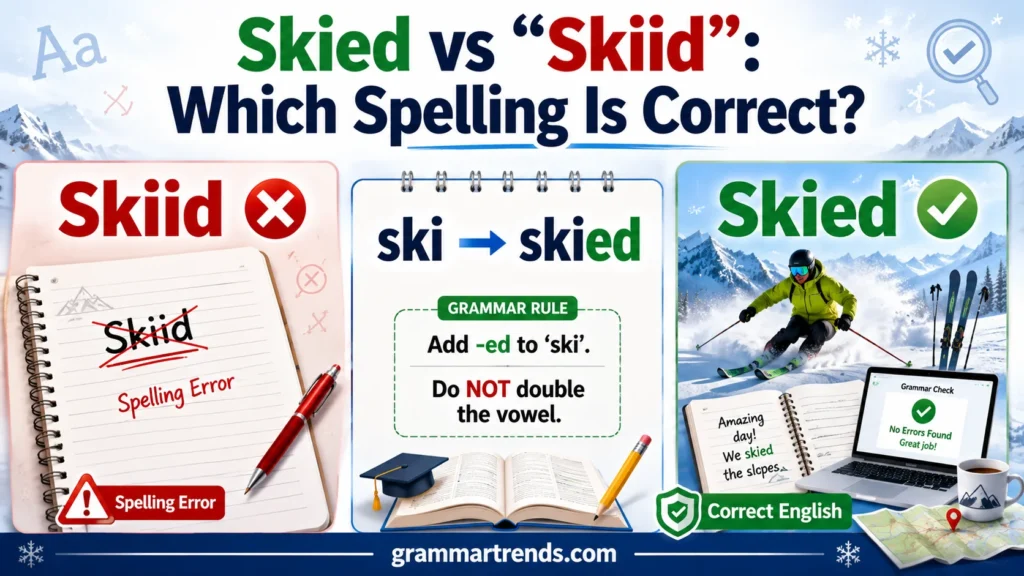
Skied vs “Skiid” confuses writers in travel blogs, essays, captions, emails, yet skied is correct past tense and skiid is wrong rule applied.
As a writer, I have noticed skiid and skied often confuse learners, students, bloggers, and even native speakers during writing in travel blogs, school essays, social media posts, captions, emails, articles, and formal professional contexts. This confusing spelling issue creates unnecessary doubt, hesitation, and confusion when people do a search on past-tense grammar rules for short verbs ending sounds. Many feel unsure, start second-guessing, and look for a clear answer, but the rule stays simple, definitive, and correct: skied is the proper accepted standard form, while skiid is an incorrect spelling mistake, error, and wrong form not found in dictionaries, exams, or guides.
The reason this happens is linked to how the verb ski ends in a vowel i, and when adding -ed, English follows fixed patterns. In both British and American usage, the same rule applies, so spelling does not change.This explanation helps users learn, understand, and use the word correctly, especially when they feel a mid-sentence pause, write a caption after a skiing trip, or see their confidence drop. With steady learning process, writers can avoid common mistakes, stay confident, and never second-guess in winter sports writing, posting activities, or future writing.
Skied vs Skiid: Quick Answer Without Confusion
Let’s keep this simple.
- Skied → Correct past tense and past participle of ski
- Skiid → Incorrect spelling, not recognized in dictionaries
- Standard English usage → Only “skied” is accepted everywhere
Simple examples:
- I skied down the mountain yesterday.
- She has skied in the Alps many times.
- ❌ I skiid down the slope (incorrect)
That’s the whole foundation. Everything else explains why.
What “Skied” Actually Means in English
The verb “ski” refers to traveling over snow using skis. When you shift it into past tense, it becomes “skied.”
This follows normal English verb grammar rules.
Core meanings of “skied”:
- Past action: You went skiing before now
- Completed experience: You have done skiing at some point
- Descriptive history: Someone participated in skiing regularly in the past
Example usage in real context:
- He skied professionally before joining the coaching team.
- They skied through fresh powder after the storm.
- I’ve skied only once, but I loved it.
Notice something important here: nothing about the spelling changes the meaning. Only tense does.
Why “Skiid” Looks Wrong But Still Confuses People
Here’s where things get interesting.
Your brain tries to make English consistent. So when you see:
- “ski” (base form)
- “skied” (past form)
Some people expect a pattern like:
- “ski” → “skiid”
That instinct feels logical, but English doesn’t work that way.
Why this mistake happens:
- Misleading pronunciation assumptions
- Overgeneralizing patterns like “need → needed”
- Typing errors from fast writing
- Visual symmetry expectations (double letters “look right” to some readers)
However, English spelling is historical, not mathematical. It resists clean patterns.
The Grammar Rule Behind “Skied”
English uses predictable verb rules, even when exceptions feel confusing.
Regular verb rule:
Most verbs form past tense by adding -ed
Examples:
- play → played
- jump → jumped
- snow → snowed
“Ski” follows this same system.
Step-by-step transformation:
- Base form: ski
- Add “-ed”: ski + ed
- Result: skied
There is no doubling of vowels or consonants.
Why no doubling happens:
English only doubles letters in specific stress patterns (like “stop → stopped”). “Ski” doesn’t meet those conditions.
So the spelling stays clean: skied.
The Origin of the Word “Ski” and Why It Matters
Understanding where “ski” comes from helps explain its spelling stability.
The word comes from Old Norse and Norwegian “ski,” meaning a wooden plank or snow runner.
Key linguistic facts:
- Origin language: Old Norse / Norwegian
- Meaning: Wooden snow travel device
- Entered English: 19th century
- Spelling adopted: unchanged (“ski” stayed intact)
English didn’t modify the base word much. That’s why its verb forms remain straightforward.
Skied vs Skiid in American and British English
Some spelling debates depend on region. This one doesn’t.
The truth:
- Both American English and British English use “skied”
- Neither accepts “skiid”
- No regional spelling variation exists
Why this matters:
People often assume differences like:
- color / colour
- traveled / travelled
But “skied” is standardized globally in English.
So no matter where you write it, the rule stays identical.
Read more: Columbarium vs Columbary: Meaning, Usage, and Real Difference
Common Mistakes with Skied and Skiid
Even strong writers slip up here. Let’s look at real-world errors.
Frequent misspellings:
- skiid (most common)
- skii’d (attempted phonetic form)
- skiedd (overcorrection)
- skieed (double vowel confusion)
Why these happen:
- Autocorrect guessing incorrectly
- Speech-to-text mishearing
- Overthinking spelling rules
- Typing too quickly on mobile keyboards
Quick reality check:
If it doesn’t look like “skied,” it’s almost certainly wrong.
How to Use “Skied” Correctly in Sentences
Now let’s make this practical.
Simple past tense examples:
- I skied all weekend in northern Pakistan.
- She skied for the first time last winter.
- They skied down steep slopes in fresh snow.
Present perfect examples:
- I have skied in three different countries.
- He has skied since childhood.
- We have skied those mountains before.
Past participle usage in context:
- The trail was skied by experienced athletes early in the morning.
- These slopes have been skied by professionals for decades.
Even in passive constructions, the spelling never changes.
Comparison Table: Skied vs Skiid
| Feature | Skied | Skiid |
| Correct spelling | Yes | No |
| Recognized in dictionaries | Yes | No |
| Grammar compliance | Fully correct | Incorrect |
| Used in formal writing | Yes | Never |
| Acceptable in exams | Yes | Marked wrong |
| Native speaker usage | Standard | Rare error |
This table makes it crystal clear. Only one version survives real-world writing.
Why English Rejects “Skiid”: Linguistic Breakdown
English spelling follows historical and structural patterns, not phonetic logic alone.
Key linguistic reasons:
No vowel doubling rule here
English rarely doubles vowels in verb conjugation.
Morphological consistency
English prefers:
- ski → skied
not - ski → skiid
Historical stability
Borrowed words often keep their original structure.
Linguist insight:
“English spelling reflects history more than sound.”
That’s why “skied” survives unchanged while “skiid” never enters formal use.
Skied in Real-World Contexts
Let’s see how “skied” appears outside grammar explanations.
Sports journalism:
- “The athlete skied the course in record time.”
Travel blogs:
- “We skied through untouched powder in the Alps.”
Instruction manuals:
- “Beginners who have skied before should start on intermediate slopes.”
Everyday conversation:
- “I skied last winter and nearly fell every five minutes.”
These examples show how natural the word feels when used correctly.
Common Confusions Linked to Skied vs Skiid
This mistake doesn’t happen in isolation. It connects to broader spelling confusion.
Related tricky cases:
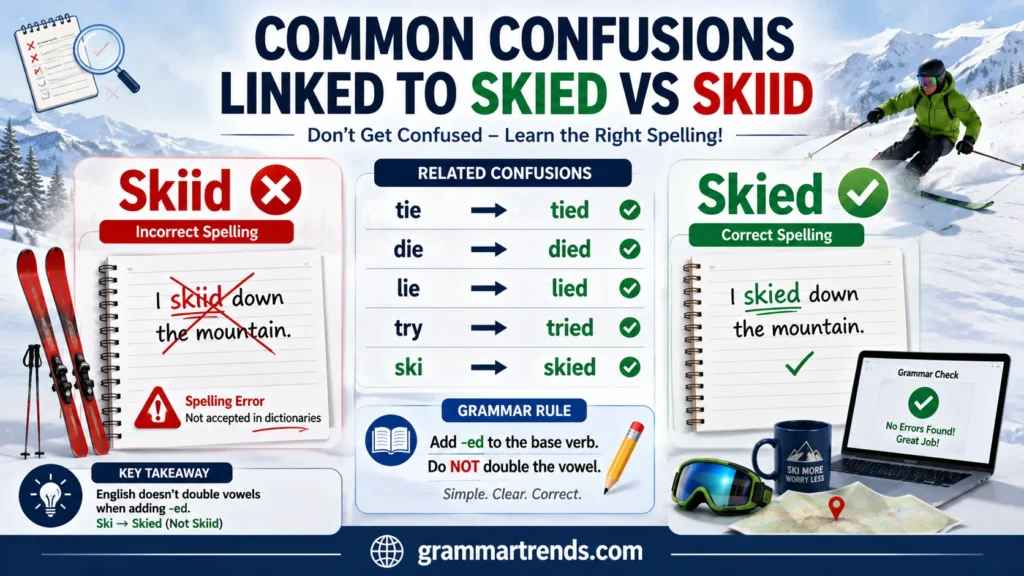
- tie → tied (not tiied)
- die → died (not diid)
- lie → lied (not liid)
What these teach us:
English avoids doubling vowels even when pronunciation suggests it.
Once you recognize this pattern, “skied” becomes obvious.
Memory Trick to Never Forget “Skied”
Here’s a simple mental shortcut.
The rule:
“Add -ed, never double vowels.”
Easy memory anchor:
Think of it like this:
- ski + ed = skied
- not ski + id = skiid (wrong)
Visual trick:
Picture skis on snow, not letters doubled in confusion.
Simple mental associations like this stick longer than grammar rules alone.
Case Study: How Learners Correct “Skiid” Mistakes
Let’s look at a typical learning scenario.
Situation:
A student writes:
“I skiid in the mountains last year.”
Correction process:
- Teacher identifies incorrect vowel doubling
- Explains regular verb rule (-ed suffix)
- Shows comparison with “played” and “jumped”
- Student rewrites correctly: “I skied in the mountains last year.”
Outcome:
After repetition, the learner stops overapplying vowel doubling logic.
Lesson:
Pattern recognition beats memorization.
Why This Small Spelling Matters More Than You Think
At first glance, “skied vs skiid” looks minor. But it reveals something bigger.
It shows how English:
- Keeps historical structure
- Rejects over-logical spelling fixes
- Follows pattern-based verb rules
- Resists phonetic guessing
If you understand this one word, you improve accuracy across dozens of similar verbs.
Frequently Asked Questions
1. Is “skied” or “skiid” the correct spelling?
The correct spelling is skied. The form skiid is incorrect and is not recognized in standard English dictionaries or style guides.
2. Why doesn’t “ski” become “skiid” in the past tense?
English simply adds -ed to the verb ski, forming skied. There’s no rule that requires doubling or adding another i.
3. Is “skiid” accepted in British or American English?
No. Both British English and American English use skied as the standard past tense and past participle of ski.
4. How can I remember the correct spelling of “skied”?
Think of other verbs that simply take -ed, such as play → played or stay → stayed. Likewise, ski → skied. Just add -ed.
5. Can I use “skied” in formal writing?
Yes. Skied is appropriate for every type of writing, including academic papers, travel articles, business communication, news reports, and professional documents.
6. What are some examples of “skied” in a sentence?
Here are a few examples:
- We skied in the Alps during our winter vacation.
- She skied for the first time last December.
- They skied down the mountain despite the fresh snowfall.
7. Why is it important to use “skied” instead of “skiid”?
Using the correct spelling improves your credibility and keeps your writing polished. Whether you’re writing a travel blog, school essay, social media caption, or email, skied shows that you understand standard English spelling conventions.
Conclusion
The choice between skied vs skiid is simpler than it may seem. The only correct past tense of ski is skied, created by adding -ed to the base verb. Skiid is a spelling error and isn’t accepted in British or American English.
Remembering this rule can save you from common writing mistakes, whether you’re describing a ski vacation, writing a school assignment, posting on social media, or creating professional content. Once you know that ski follows the standard -ed pattern, you’ll never have to guess again. Stick with skied, and your writing will remain accurate, natural, and professional every time.

Emma Rose has spent 15 years in the English Department at the University of California, Los Angeles (UCLA), guiding students through British and American literary classics, critical theory, and narrative techniques. Her scholarly focus includes 19th- and 20th-century fiction, the art of poetry, postcolonial writing, and digital humanities particularly how storytelling voice influences cultural perspectives. Emma has presented her research at major international conferences and published in respected academic journals, underscoring her dedication to both high-level scholarship and engaging teaching.