Title vs Tittle often confuses writers because the two words look almost identical but have completely different meanings and uses in English. Many students, writers, editors, and English learners assume they are simply different spellings of the same word, but that is not true.
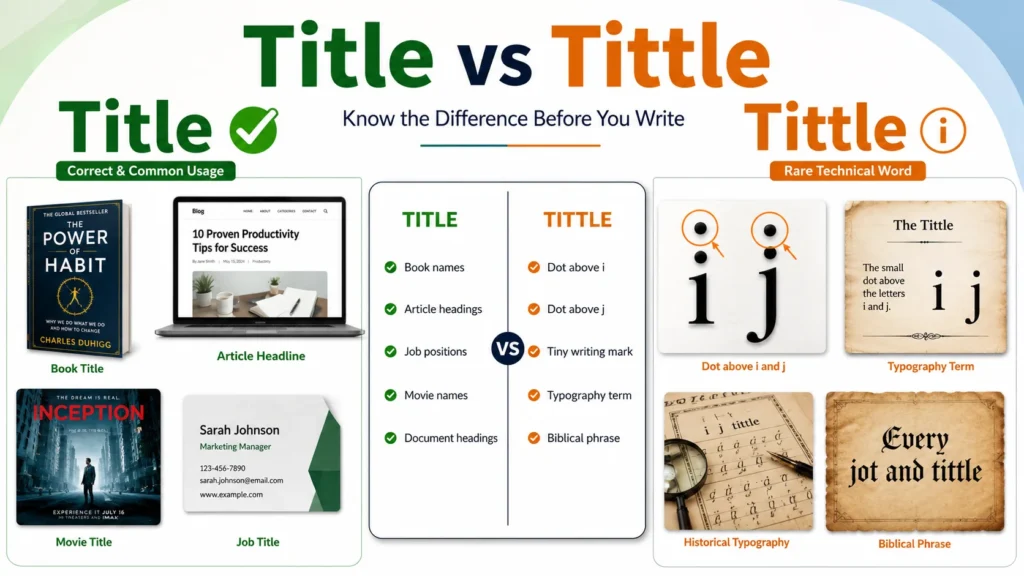
Title is the correct word for the name of a book, article, movie, document, or heading, and it can also refer to a person’s rank or position. Tittle, on the other hand, is a real but uncommon English word that refers to a tiny mark in writing, such as the dot above the letters i and j, or a very small amount.
Understanding the difference between these words through clear definitions, pronunciation, grammar rules, and practical examples helps eliminate confusion. By learning when to use each term correctly, you can avoid spelling mistakes, improve writing accuracy, strengthen your vocabulary, and communicate more clearly in both academic and everyday English.
Quick Answer
If you’re talking about:
- The name of a book
- A movie heading
- A blog headline
- A professional position
- A document heading
…the correct word is title.
The word tittle refers to a tiny mark in writing, especially the dot above lowercase letters like “i” and “j.”
For most people, title is the word they need 99.9% of the time.
Title vs Tittle Comparison Table
| Word | Meaning | Common Usage | Modern Relevance |
| Title | Name, heading, rank, ownership | Everyday English | Extremely common |
| Tittle | Tiny mark in writing | Technical or biblical usage | Rare |
That’s the short version. Now let’s break it down properly.
What Does “Title” Mean?
The word title plays a major role in modern English. You see it everywhere. Books have titles. Movies have titles. People hold job titles. Even legal property documents use the word.
In simple terms, a title identifies something.
Definition of Title
A title is:
A name, heading, label, or designation given to something or someone.
The word comes from the Latin titulus, which meant inscription or label.
Today, it carries several meanings depending on context.
Common Meanings of “Title”
| Context | Meaning | Example |
| Books & Articles | Name of written work | The title of the article was catchy. |
| Employment | Professional rank | Her job title is Marketing Director. |
| Legal Ownership | Ownership rights | He transferred the car title yesterday. |
| Sports | Championship status | The team defended its title successfully. |
| Honorifics | Formal labels | Doctor is a professional title. |
The versatility of the word explains why it appears constantly in speech and writing.
Common Contexts Where “Title” Appears
The word “title” isn’t limited to publishing. It stretches across industries and everyday life.
Titles in Publishing
Every article, novel, essay, or report needs a title. A strong title grabs attention instantly.
For example:
- Atomic Habits
- The Great Gatsby
- How to Start a Business Online
Without titles, readers would struggle to identify content quickly.
Job Titles
Businesses use titles to establish hierarchy and responsibility.
Examples include:
- Software Engineer
- Chief Executive Officer
- Content Strategist
- Sales Manager
Job titles also affect hiring, salary expectations, and professional identity.
Titles in Law
Legal ownership often relies on titles.
Examples:
- House title
- Car title
- Land title
In this context, “title” means documented ownership rights.
Examples of “Title” in Real Sentences
Seeing words in action makes everything clearer.
Here are practical examples using “title” correctly.
- The title of the movie spoiled the ending.
- She changed the title of her blog post twice.
- His official title is Senior Financial Analyst.
- That book has one of the best titles ever written.
- The company awarded her a new leadership title.
- The article title improved click-through rates by 42%.
- They transferred the property title last week.
- Her title sounds impressive but she prefers simple introductions.
- The documentary won several international titles.
- You should rewrite the title to make it clearer.
Notice something interesting?
Every sentence connects “title” to identification, naming, or recognition.
That’s the core meaning.
What Does “Tittle” Mean?
Now comes the strange little cousin of “title.”
Unlike “title,” the word tittle rarely appears in modern conversation. Many native English speakers never encounter it at all.
Still, it’s a legitimate word with a fascinating history.
Definition of Tittle
A tittle is:
A very small mark, stroke, or distinguishing point in writing.
Most commonly, it refers to:
- The dot above a lowercase “i”
- The dot above a lowercase “j”
Tiny detail. Huge confusion.
The Origin of the Word “Tittle”
The word traces back to Medieval Latin titulus, meaning inscription or superscription.
Over time, English narrowed the meaning dramatically. Instead of referring to labels or headings like “title,” it became associated with tiny written marks.
That shift explains why the two words look related but function differently today.
Language evolves in weird ways sometimes.
Why Most People Never Use “Tittle”
Here’s the truth:
Outside of specialized writing, you almost never need this word.
Modern English rarely requires it because people usually say:
- Dot
- Mark
- Stroke
- Accent mark
Instead of “tittle.”
That’s why many people assume “tittle” is simply a misspelling of “title.”
In everyday communication, it almost always is.
Example Sentences Using “Tittle”
Although rare, the word still appears in correct English.
Here are legitimate examples:
- The student forgot the tittle above the lowercase “i.”
- Medieval scribes carefully preserved every jot and tittle.
- Typography experts discussed the placement of each tittle.
- The handwritten font featured unusually large tittles.
- Removing the tittle changed the readability of the character.
These examples sound more technical because the word belongs mainly to typography and linguistics.
Read more: Wheaten vs Wheat: The Real Difference and Correct Usage
Title vs Tittle: The Main Differences
At first glance, these words seem interchangeable. They’re not.
The differences become obvious once you compare meaning, usage, and context side by side.
Difference in Meaning
This is the biggest distinction.
| Word | Core Meaning |
| Title | Name, heading, rank |
| Tittle | Tiny written mark |
One identifies something important.
The other describes a microscopic detail in writing.
Completely different jobs.
Difference in Frequency
“Title” appears constantly in modern English.
“Tittle” barely shows up outside specialized discussions.
A quick glance at books, blogs, magazines, and websites proves it immediately.
You could read thousands of articles without encountering “tittle” once.
Meanwhile, “title” appears everywhere.
Difference in Pronunciation
These words sound similar enough to confuse people.
Pronunciation Guide
| Word | Pronunciation |
| Title | TIE-tul |
| Tittle | TIT-ul |
The subtle vowel difference often disappears in fast speech or regional accents.
That’s one reason spelling mistakes happen so often.
Why People Mistype “Title” as “Tittle”
Spelling confusion rarely happens randomly. Usually, there’s a pattern behind it.
In this case, several factors contribute to the mistake.
Fast Typing Habits
When people type quickly, they often double letters accidentally.
The word “title” becomes “tittle” because the fingers linger too long on the “t” key.
Simple muscle memory error.
Phonetic Confusion
English pronunciation doesn’t always match spelling logically.
Words like these create trouble because they sound close enough that people rely on instinct instead of accuracy.
Similar examples include:
- Then vs than
- Affect vs effect
- Principal vs principle
English loves tiny distinctions with huge meaning changes.
Autocorrect Problems
Ironically, autocorrect sometimes causes the mistake instead of fixing it.
Because “tittle” is technically a valid word, spellcheck may not flag it.
That creates dangerous false confidence.
The sentence looks correct mechanically even though the meaning is wrong contextually.
How to Remember the Correct Spelling
Grammar tricks don’t need to feel boring. Sometimes a simple mental shortcut works better than memorizing definitions.
Memory Trick for “Title”
Think about this:
A title is big and important, so it stays simple.
Only one “t” appears in the middle.
Short. Clean. Easy to recognize.
Memory Trick for “Tittle”
A tittle refers to something tiny.
The extra “t” represents the tiny extra mark.
Small detail. Small distinction.
Funny enough, the spelling mirrors the meaning.
Real-Life Analogy That Makes It Stick
The confusion between title and tittle resembles mistakes like:
- Desert vs dessert
- Stationary vs stationery
- Lose vs loose
One tiny letter changes the entire meaning.
It’s like putting salt instead of sugar in coffee. Looks similar at first. Tastes wildly different later.
Common Mistakes Writers Make With Title and Tittle
Many spelling mistakes don’t cause serious damage. This one can.
Using “tittle” incorrectly makes writing appear careless immediately.
Mistakes in Headlines
Imagine seeing this:
“Best Tittle Ideas for YouTube Videos”
Most readers would assume the writer lacks proofreading skills.
That hurts credibility instantly.
Mistakes in Professional Documents
Using “tittle” instead of “title” in resumes, proposals, or contracts looks especially bad.
Examples:
- Job tittle
- Article tittle
- Property tittle
Even one typo can undermine professionalism.
Fair or unfair, readers judge quickly.
Is “Tittle” Ever Correct in Modern English?
Yes. Rarely, but yes.
The word survives in a few specific contexts.
Typography
Designers and typographers still use the term when discussing letterforms.
For example:
- Font spacing
- Character design
- Calligraphy structure
The dot above an “i” remains a tittle technically.
The Famous Phrase “Jot and Tittle”
This expression appears in biblical translations, especially Matthew 5:18.
The phrase means:
The smallest detail.
A “jot” referred to a tiny Hebrew letter.
A “tittle” referred to a small distinguishing mark.
Together, they emphasized precision and completeness.
Even today, people occasionally say:
“Every jot and tittle.”
It sounds old-fashioned but still carries weight.
Tittle in Linguistics and Editing
Some editors and language scholars use the term academically.
Examples include discussions about:
- Diacritical marks
- Handwriting systems
- Historical manuscripts
- Orthography
Outside these areas, the word stays mostly dormant.
How Readers Judge Spelling Instantly
Studies in digital psychology consistently show that readers form impressions within seconds.
A typo in a headline creates doubt immediately.
People start wondering:
- Is this trustworthy?
- Was this proofread?
- Is the information accurate?
One tiny spelling issue can snowball into credibility problems.
Best Practices for Titles and Headlines
Want cleaner writing? Use these habits consistently.
Smart Editing Checklist
- Read headlines aloud
- Use grammar-checking software
- Proofread slowly
- Check homophones separately
- Review important documents twice
Helpful Editing Tools
| Tool | Purpose |
| Grammarly | Grammar and spelling |
| Hemingway Editor | Readability improvement |
| Microsoft Editor | Contextual proofreading |
| Google Docs | Basic spellcheck |
None are perfect though.
Human review still matters most.
Correct and Incorrect Usage Examples
Sometimes the fastest way to learn comes through comparison.
Correct Examples
| Sentence | Correct? |
| The title of the article was compelling. | Yes |
| She earned a new job title last month. | Yes |
| He lost the title during the championship match. | Yes |
| The tittle above the “i” was missing. | Yes |
Incorrect Examples
| Incorrect Sentence | Why It’s Wrong |
| I liked the tittle of your book. | Should be “title” |
| Her professional tittle changed. | Should be “title” |
| That article tittle sounds confusing. | Should be “title” |
These mistakes happen because “tittle” sounds believable enough to slip past casual proofreading.
Similar Word Mix-Ups People Confuse
English contains dozens of nearly identical words that create headaches.
Here are some of the most common.
Principle vs Principal
| Word | Meaning |
| Principle | Rule or belief |
| Principal | School leader or primary |
Affect vs Effect
| Word | Meaning |
| Affect | Usually a verb |
| Effect | Usually a noun |
Then vs Than
| Word | Meaning |
| Then | Time sequence |
| Than | Comparison |
Compliment vs Complement
| Word | Meaning |
| Compliment | Praise |
| Complement | Completes something |
Stationary vs Stationery
| Word | Meaning |
| Stationary | Not moving |
| Stationery | Writing materials |
Tiny spelling shifts create massive meaning changes.
That’s part of what makes English both fascinating and frustrating.
Mini Quiz: Can You Choose the Correct Word?
Ready to test yourself?
Fill in the Blank
The ______ of the movie sounded interesting.
- Title
- Tittle
She received a new job ______ yesterday.
- Title
- Tittle
The lowercase “i” needs its ______.
- Title
- Tittle
Medieval scholars preserved every jot and ______.
- Title
- Tittle
Answers
| Question | Correct Answer |
|---|---|
| Movie heading | Title |
| Job position | Title |
| Dot above “i” | Tittle |
| Biblical phrase | Tittle |
If you got all five right, your grammar radar works perfectly.
Key Takeaways
- “Title” is the correct spelling in most situations
- “Tittle” is a real but uncommon English word
- A title names or identifies something
- A tittle refers to a tiny written mark
- The words sound similar but mean entirely different things
- “Jot and tittle” remains the most famous modern usage of “tittle”
- Careful proofreading prevents this common mistake
FAQs
1. What is the main difference between title and tittle?
The main difference is meaning. Title is a name or heading, while tittle is a tiny dot or small mark like the dot over “i”.
2. Why do people confuse title vs tittle?
People confuse them because they look almost the same in spelling, but their meanings are completely different in English grammar.
3. Where do we usually use “title”?
We use title for book names, headings, academic or professional designations, and legal ownership references.
4. Is “tittle” commonly used in daily English?
No, tittle is rarely used in everyday writing. It mostly refers to a very small mark or insignificant detail.
5. Can “title” be used as a verb?
Yes, title can be used as a verb meaning to give something a name or designation.
6. What does a tittle represent in writing?
A tittle represents a small dot or mark, such as the dot above the lowercase letter “i”.
7. How can learners avoid confusing these words?
By understanding their meanings clearly, practicing usage, and focusing on spelling differences in reading and writing.
Conclusion
The confusion between title vs tittle mainly happens because the words look similar but serve very different purposes in English. Title is widely used in everyday communication for names, headings, and designations, while tittle refers to a very small mark that appears in writing. Once learners understand the meaning difference, spelling distinction, and correct usage, it becomes much easier to avoid mistakes. Consistent reading practice and attention to context help improve clarity in writing and strengthen overall grammar skills.

Emma Brooke brings 15 years of experience in the Department of English Language and Literature at the University of California, Berkeley, where she has taught and mentored students across courses in British and American literary traditions, critical theory, and narrative form. Her expertise spans 19th- and 20th-century fiction, poetic prosody, postcolonial literatures, and digital humanities, with a focus on how narrative voice shapes cultural meaning. Emma’s work has been presented at international conferences and published in peer-reviewed venues, reflecting her deep commitment to rigorous literary scholarship and accessible teaching.