
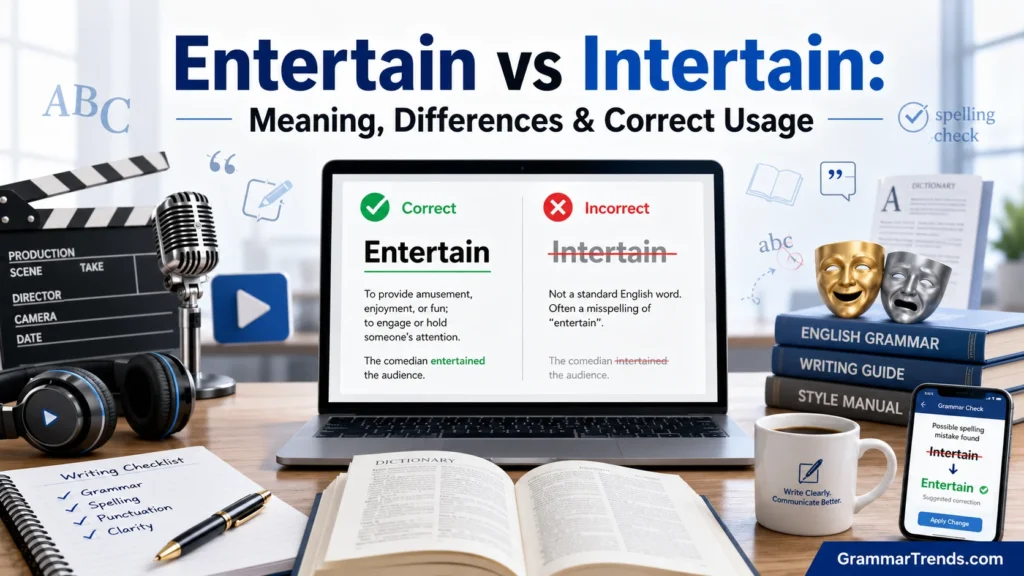
Entertain vs Intertain often creates confusion because the two words look similar, but only one is correct in standard English. Knowing the difference helps improve spelling, grammar, and everyday writing while avoiding common mistakes.
Entertain is the correct and commonly used word. It means to provide amusement, enjoyment, or fun through activities such as movies, music, sports, storytelling, and other forms of entertainment. It can also mean keeping an audience engaged, capturing attention, or even considering an idea.
Intertain, on the other hand, is not a standard English word. It is sometimes used as a neologism to describe interactive, immersive experiences involving virtual reality (VR), augmented reality (AR), interactive games, or other digital experiences where people become active participants instead of passive spectators. However, it is rarely used in formal or professional writing.
When comparing Entertain vs Intertain, always use Entertain in academic, business, and everyday communication. Understanding this distinction improves clarity, accuracy, and content creation, ensuring your writing follows standard English usage and avoids common spelling errors.
Quick Answer: Is It “Entertain” or “Intertain”?
If you’re writing in standard English, the correct word is entertain.
The spelling intertain is not accepted in formal English dictionaries as a standard word. In nearly every case, it’s a typo or spelling mistake.
Quick Comparison Table
| Word | Correct Spelling? | Meaning | Should You Use It? |
| Entertain | Yes | To amuse, host, engage, or consider | Yes |
| Intertain | No | Usually a misspelling of entertain | No |
You’ll see “entertain” in:
- Books
- Newspapers
- Academic writing
- Professional emails
- Movies and TV reviews
- Business communication
Meanwhile, “intertain” mainly appears in:
- Typing mistakes
- Search engine typos
- Social media posts
- Informal online comments
That distinction matters more than you think.
A single spelling error can make polished writing look rushed. Readers notice it immediately. Employers do too.
What Does “Entertain” Mean?
The word entertain carries several meanings depending on context. That versatility explains why it appears so often in everyday English.
Common Meanings of “Entertain”
To Amuse or Provide Enjoyment
This is the most common meaning.
Examples:
- The comedian entertained the audience for two hours.
- Good movies entertain people emotionally and mentally.
- Street performers entertained tourists downtown.
In this sense, entertain means:
- To make someone laugh
- To keep attention
- To provide enjoyment
- To engage emotionally
To Host Guests
“Entertain” can also refer to hospitality.
Examples:
- They entertained clients at a luxury restaurant.
- We entertained relatives over the holidays.
- She enjoys entertaining guests at home.
Business professionals often use this meaning in formal settings.
To Consider an Idea or Possibility
Here’s where English gets interesting.
“Entertain” does not always mean fun or amusement. It can also mean to think seriously about something.
Examples:
- The board entertained several proposals.
- He entertained the idea of moving abroad.
- Scientists entertained multiple theories.
This usage appears frequently in:
- Academic writing
- Business discussions
- Legal language
- Political reporting
The Origin of the Word “Entertain”
The word comes from Old French and Latin roots connected to:
- Holding attention
- Maintaining relationships
- Supporting or hosting someone
Over time, English narrowed and expanded the meaning simultaneously. Strange, right?
Today, “entertain” blends several ideas:
- Engagement
- Attention
- Enjoyment
- Consideration
- Hospitality
That layered meaning makes it one of those flexible English verbs that adapts to context.
Is “Intertain” a Real Word?
In standard English, no.
Most dictionaries do not recognize “intertain” as a proper word.
That means:
- It should not appear in formal writing
- It should not replace “entertain”
- It is considered incorrect spelling
Still, millions of people search for “intertain” every year. Why?
Because English pronunciation creates confusion.
Why People Misspell “Entertain” as “Intertain”
Several factors cause this spelling mistake.
Similar Pronunciation
When spoken casually, “entertain” can sound close to:
- inner-tain
- inter-tain
Fast speech blurs vowel sounds. That leads many people to type the word exactly how they hear it.
Phonetic Spelling Habits
English learners often spell words based on pronunciation.
For example:
- Separate → seperate
- Definitely → definately
- Entertain → intertain
The brain tries to simplify sound patterns. Unfortunately, English rarely rewards that strategy.
Fast Typing and Autocorrect
Sometimes fingers move faster than the brain.
Typing on phones increases errors because:
- Small keyboards create mistypes
- Predictive text fails occasionally
- Users skip proofreading
You’ve probably seen this happen in texts or comments sections.
Is “Intertain” Ever Acceptable?
Technically, yes — but only in unusual situations.
Cases Where “Intertain” Might Appear Intentionally
Brand Names
A company could intentionally spell a name creatively for marketing.
Example:
- Intertain Media
- Intertain Studios
Brands often bend language rules for memorability.
Fictional or Creative Writing
Authors occasionally invent spellings for:
- Fantasy worlds
- Character names
- Stylized dialogue
Still, those are exceptions. They do not make “intertain” a correct standard word.
How To Use “Entertain” Correctly in a Sentence
Using “entertain” properly becomes easy once you understand its role as a verb.
“Entertain” as an Action Verb
Here are simple examples:
- The magician entertained the children.
- Netflix entertains millions worldwide.
- The host entertained guests all evening.
The action centers on:
- Engaging
- Amusing
- Hosting
- Holding attention
“Entertain” as Mental Consideration
Examples:
- She entertained the proposal carefully.
- Investors entertained several offers.
- The committee entertained new ideas.
This version sounds more formal and analytical.
Verb Forms of “Entertain”
| Verb Form | Example Sentence |
| Entertain | I entertain clients regularly. |
| Entertains | She entertains visitors often. |
| Entertained | They entertained us yesterday. |
| Entertaining | The documentary is entertaining. |
Notice something important:
“Entertaining” can function as an adjective too.
Example:
- That podcast is entertaining.
English loves multifunctional words.
Real-Life Examples of “Entertain” in Different Contexts
Understanding context helps you avoid awkward wording.
Entertainment Industry Examples
The entertainment industry practically runs on this word.
Examples:
- Movies entertain audiences emotionally.
- Musicians entertain fans live on stage.
- Video creators entertain viewers online.
Streaming platforms compete fiercely for attention because entertainment fuels engagement.
Business Examples
Corporate professionals use “entertain” differently.
Examples:
- The company entertained investors at dinner.
- Executives entertained international clients.
- Sales teams entertain partners during conferences.
In business, the word often implies:
- Hospitality
- Relationship-building
- Networking
Academic Examples
Academic usage sounds more intellectual.
Examples:
- Researchers entertained alternate explanations.
- Historians entertained competing theories.
- The court entertained new evidence.
This meaning focuses on consideration rather than amusement.
Entertain vs Entertainment: Important Difference
Many writers confuse these words because they share the same root.
However, they function differently.
| Word | Part of Speech | Meaning |
| Entertain | Verb | To amuse, host, or consider |
| Entertainment | Noun | Something that provides enjoyment |
Examples
Correct:
- The singer entertained the crowd.
- The concert provided entertainment.
Incorrect:
- The singer entertainment the crowd.
One word performs the action. The other names the experience.
That distinction matters.
Read more: “Nonresponsive vs Unresponsive” Difference and Correct Usage
Common Mistakes People Make With “Entertain”
Even experienced writers slip up occasionally.
Here are the most common problems.
Misspelling “Entertain” as “Intertain”
This remains the biggest issue.
Incorrect:
- The movie will intertain audiences.
Correct:
- The movie will entertain audiences.
A simple spelling mistake can:
- Hurt professionalism
- Damage credibility
- Confuse readers
Proofreading solves most of these errors quickly.
Using the Wrong Meaning
Some people assume “entertain” always means amusement.
Not true.
Example of Mental Consideration
- The judge entertained the argument carefully.
The judge was not amused. The judge considered the argument seriously.
Context changes meaning dramatically.
Incorrect Verb Tense
Verb tense errors appear often in casual writing.
| Incorrect | Correct |
| He entertain us yesterday. | He entertained us yesterday. |
| She entertaining guests now. | She is entertaining guests now. |
| They entertains people online. | They entertain people online. |
Small grammar fixes create smoother writing instantly.
Overusing the Word
Repeating “entertain” excessively weakens flow.
Instead, vary vocabulary naturally.
Better Alternatives
- Engage
- Amuse
- Captivate
- Delight
- Occupy
- Fascinate
Example:
Instead of:
- The show entertained viewers and entertained critics.
Try:
- The show captivated viewers and impressed critics.
Much cleaner.
Simple Trick To Remember the Correct Spelling
Here’s an easy memory device.
The “Enter” Trick
The word entertain begins with “enter.”
Think:
“Performers ENTER a stage to entertain people.”
That visual sticks surprisingly well.
Words Commonly Confused With “Entertain”
English contains several related words with overlapping meanings.
Understanding the differences improves precision.
Entertain vs Amuse
| Word | Meaning | Tone |
| Entertain | Hold attention or provide enjoyment | Broad |
| Amuse | Cause laughter or fun | Lighthearted |
Example:
- A thriller entertains viewers.
- A joke amuses people.
Not all entertainment is funny.
A horror movie entertains differently than a comedy special.
Entertain vs Engage
| Word | Meaning | Typical Context |
| Entertain | Enjoyment or attention | Media |
| Engage | Deep involvement | Education/business |
Example:
- Teachers engage students intellectually.
- Sitcoms entertain audiences casually.
Some content does both.
Great documentaries engage and entertain simultaneously.
Entertain vs Delight
“Delight” suggests stronger emotional pleasure.
Example:
- The chef delighted guests with dessert.
- The musician entertained the crowd.
Delight feels warmer and more emotional.
Entertain vs Distract
This distinction matters psychologically.
Distract
Moves attention away temporarily.
Entertain
Creates positive engagement intentionally.
Scrolling endlessly on social media often distracts more than it entertains.
There’s a difference.
Why “Intertain” Keeps Appearing Online
You’d think spellcheck would eliminate the mistake completely.
Not even close.
Social Media Prioritizes Speed
People post quickly. Accuracy drops.
On platforms like:
- TikTok
- X
Users prioritize speed over proofreading.
Typos spread like weeds.
English Pronunciation Is Inconsistent
English spelling rules feel chaotic sometimes.
Compare:
- Enough
- Through
- Though
- Tough
None follow the same pronunciation logic consistently.
That inconsistency creates endless spelling confusion.
Should You Ever Use “Intertain”?
For professional or academic writing, no.
Avoid it completely.
Situations Where It Looks Unprofessional
- Blog posts
- Essays
- Cover letters
- Emails
- Resumes
- Business reports
Readers notice spelling mistakes instantly because the brain recognizes familiar word patterns fast.
One typo can distract from otherwise excellent writing.
Acceptable Exceptions
Rare exceptions include:
- Brand names
- Fictional names
- Usernames
- Stylized art projects
Even then, the spelling appears intentional rather than accidental.
Case Study: How One Letter Changes Credibility
Imagine two headlines:
Version A
“Top Movies That Entertain Every Audience”
Version B
“Top Movies That Intertain Every Audience”
Which one feels trustworthy?
Most readers subconsciously trust Version A immediately.
Why?
Because polished spelling signals:
- Attention to detail
- Authority
- Professionalism
- Competence
Tiny details shape perception online.
How Spellcheck Tools Handle “Intertain”
Modern grammar tools usually flag the mistake quickly.
Popular Tools That Correct It
- Grammarly
- Microsoft Word
- Google Docs
- Hemingway Editor
- ProWritingAid
Still, spellcheck is not perfect.
Sometimes tools miss errors when:
- The typo resembles another valid word
- Context becomes unclear
- Sentences contain slang
That’s why manual proofreading still matters.
Helpful Synonyms for “Entertain”
Using synonyms improves readability and avoids repetition.
| Synonym | Best Use Case |
| Amuse | Humor |
| Engage | Attention and involvement |
| Captivate | Strong fascination |
| Delight | Emotional pleasure |
| Occupy | Filling time |
| Fascinate | Deep curiosity |
| Charm | Pleasant attraction |
| Impress | Strong positive reaction |
Examples of “Entertain” Used Naturally
Seeing real examples helps cement understanding.
Casual Conversation
- That podcast really entertained me during the drive.
- We entertained friends over the weekend.
Professional Writing
- The board entertained several merger proposals.
- Executives entertained potential investors.
Academic Writing
- Researchers entertained multiple interpretations of the data.
- Philosophers entertained competing theories for centuries.
Media and Pop Culture
- Streaming services compete to entertain global audiences.
- Viral creators entertain millions daily.
Why Correct Spelling Matters More Online
The internet moves fast. Readers judge faster.
Research in digital communication consistently shows users form impressions within seconds.
Spelling affects:
- Trust
- Click-through rates
- Reader confidence
- Brand authority
Even strong content loses impact when basic errors appear repeatedly.
Think of spelling like clean clothing at an interview.
People notice.
FAQs
What is the main difference between Entertain and Intertain?
Entertain is the correct English word, while Intertain is a modern, non-standard term linked with interactive experiences.
Is Intertain a real English word?
No, Intertain is not part of standard English. It is considered a creative or neologism-based word.
When should we use Entertain?
Use Entertain when talking about providing fun, amusement, or enjoyment through movies, music, sports, or storytelling.
What does Intertain usually refer to?
Intertain refers to interactive entertainment like VR games, AR experiences, and digital participation platforms.
Why do people get confused between Entertain and Intertain?
The confusion happens due to a small spelling change—just one letter—but it creates a completely different meaning.
Is Intertain used in professional writing?
Generally no. It is mostly used in tech-related or creative discussions, not formal English writing.
Can both words be used in the same context?
Not really. Entertain is for passive enjoyment, while Intertain focuses on interactive participation experiences.
Conclusion
Understanding Entertain vs Intertain helps avoid common language mistakes and improves clarity in communication. While Entertain remains the standard word used for amusement, enjoyment, and traditional media like movies and music, Intertain reflects a modern idea of interactive, tech-driven experiences. Choosing the right word depends on context, audience, and purpose, especially when writing for clear and engaging communication.

Emma Brooke brings 15 years of experience in the Department of English Language and Literature at the University of California, Berkeley, where she has taught and mentored students across courses in British and American literary traditions, critical theory, and narrative form. Her expertise spans 19th- and 20th-century fiction, poetic prosody, postcolonial literatures, and digital humanities, with a focus on how narrative voice shapes cultural meaning. Emma’s work has been presented at international conferences and published in peer-reviewed venues, reflecting her deep commitment to rigorous literary scholarship and accessible teaching.