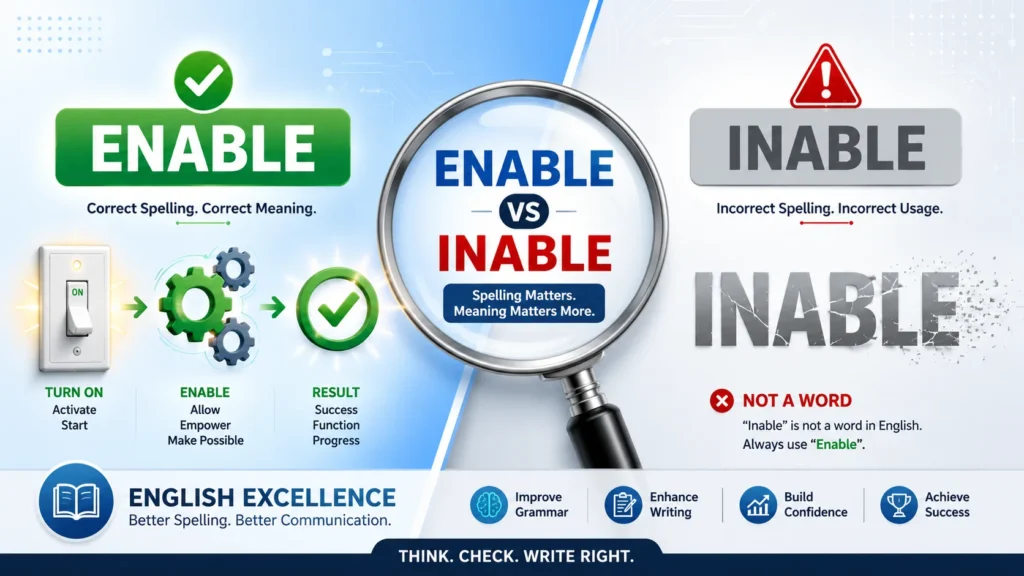
People often feel confused about Enable vs Inable because both words look similar, yet only one is correct in modern English today.
In my experience with professional writing and language learning, many writers pause when they see enable and inable in emails, essays, or online content. The correct and proper word is enable, while inable is an incorrect word, an invalid word, and a term that is rarely recognized in the English language. This type of word confusion, grammar confusion, and confusion about proper word choice can quietly affect communication, writing clarity, and professional communication.
Many people still wonder, “is inable a word” or “is it inable or unable,” and that brief hesitation often breaks the flow of sentences during editing or proofreading. A clear understanding of grammar rules, language rules, and proper English helps improve sentence flow, writing flow, writing style, and overall polished communication in books, literature, and even professional essays.
How Enable Improves Communication
The word enable means the act of giving someone or something the ability, power, or authority to do something more effectively. In everyday contexts, a new software or software update can enable users to complete tasks more efficiently and help a person achieve goals faster. In business and technology context, companies use enable tools to improve communication skills, support users, and convey message clearly.
It is important to remember that inable has no meaning as a standard English word, although some people use it informally in different ways to describe the opposite of enable, such as disable, prevent, or hinder.
Writers who use accepted English vocabulary, correct usage, and better wording can avoid writing mistakes, spelling errors, and other common mistakes. When you explore the deeper nuances of enable usage, context in sentences, business context, social support, and everyday communication, the pattern becomes an easy fix that improves writing skills, vocabulary, language usage, and effective communication in modern English.
Why People Confuse “Enable” and “Inable”
English spelling sometimes behaves like a maze with moving walls.
People often assume that adding “in-“ to a word automatically creates its opposite.
For example:
- active → inactive
- complete → incomplete
- capable → incapable
So naturally, someone might think:
- enable → inable
Seems reasonable, right?
The problem is that English evolved from multiple languages over centuries. Rules that work in one place often break somewhere else.
Another reason for confusion comes from typing habits. People frequently mean to write unable, but their fingers produce inable instead.
Search engines process thousands of searches every month involving:
- enable vs inable
- is inable a word
- inable meaning
- enable meaning
- unable vs inable
Most users aren’t trying to study language history. They simply want the correct word.
Quick Answer: Is “Inable” a Real Word?
Technically, yes.
Practically, not really.
The word inable existed in older forms of English and occasionally appears in historical texts. However, modern English speakers almost never use it.
If you use it in an email, school paper, business document, or article, readers will usually assume you made a mistake.
Most people actually intend to write unable.
Enable vs Inable vs Unable: Quick Comparison Table
| Word | Part of Speech | Meaning | Modern Usage | Example |
| Enable | Verb | To make possible | Very common | The update enabled dark mode |
| Inable | Adjective | Not able (historical use) | Rare/obsolete | Rare in modern English |
| Unable | Adjective | Not capable of doing something | Extremely common | She was unable to attend |
This distinction matters because choosing the wrong word changes how readers interpret your message.
What Does “Enable” Mean?
The word enable means to give someone or something the ability, means, permission, or opportunity to do something.
Think of enable as opening a door.
The action itself does not walk through the door. Instead, it creates access.
Common meanings of enable include:
- Making something possible
- Giving permission
- Providing resources
- Activating features
- Supporting functionality
For example:
“The scholarship enabled her to attend college.”
The scholarship did not attend classes for her. It created the opportunity.
Similarly:
“The software update enabled voice recognition.”
The update created capability.
Real-Life Examples of “Enable”
Technology examples
- Turning on Bluetooth enables wireless connections.
- Security settings enable two-factor authentication.
- Cloud storage enables file sharing across devices.
Workplace examples
- Better communication tools enable team collaboration.
- Training programs enable employees to learn new skills.
- Flexible schedules enable remote work.
Education examples
- Online platforms enable distance learning.
- Digital libraries enable faster research.
- Tutors enable students to improve weak subjects.
Daily life examples
- GPS apps enable easier travel.
- Glasses enable clearer vision.
- Ramps enable wheelchair access.
What Does “Inable” Mean?
Historically, inable referred to being unable or lacking ability.
You might still find the word inside:
- Historical literature
- Archived texts
- Old dictionaries
- Linguistic discussions
However, language evolves.
Some words survive.
Others quietly fade away.
“Inable” largely belongs in the second category.
Why “Inable” Sounds Correct
The confusion doesn’t happen because people are careless.
It happens because English trains your brain to expect certain patterns.
Look at these examples:
| Word | Opposite Form |
| active | inactive |
| complete | incomplete |
| capable | incapable |
| visible | invisible |
Now look at:
| Expected Pattern | Actual Word |
| enable → inable | enable → unable |
The brain notices patterns and predicts outcomes. Sometimes those predictions fail.
Why “Unable” Is Usually the Word You Need
When people type inable, they usually mean unable.
The word unable means:
not having the ability, power, or capacity to do something
Examples:
- She was unable to finish the report.
- We were unable to reach customer support.
- He was unable to attend the meeting.
Notice how natural these sound.
Now compare them to inable:
- She was inable to finish the report.
- We were inable to reach support.
Most readers would immediately think the sentence contains an error.
Incorrect vs Correct Examples
| Incorrect | Correct |
| I am inable to attend | I am unable to attend |
| We were inable to login | We were unable to log in |
| She became inable to continue | She became unable to continue |
| They were inable to help | They were unable to help |
Enable vs Unable: The Comparison Most People Actually Need
Most people searching enable vs inable eventually discover that they really need enable vs unable.
These words often appear in opposite contexts.
| Feature | Enable | Unable |
| Meaning | Makes something possible | Cannot do something |
| Word type | Verb | Adjective |
| Common use | Yes | Yes |
| Function | Creates ability | Indicates lack of ability |
Examples:
Enable:
The update enabled mobile payments.
Unable:
Customers were unable to complete payments.
One creates capability.
The other removes it.
Read more: Mather vs Mother: What’s the Difference?
How to Use “Enable” Correctly in Sentences
The easiest way to use enable correctly is to think of it as providing a bridge.
Something helps another thing happen.
Professional examples
- New software enabled faster reporting.
- Strong leadership enabled company growth.
- Automation enabled cost reductions.
Technology examples
- The setting enables automatic backups.
- Voice commands enable hands-free control.
- Encryption enables secure communication.
Everyday examples
- A flashlight enabled us to find the keys.
- Extra savings enabled the family to travel.
- Better weather enabled outdoor activities.
Common Mistakes People Make With Enable and Inable
Tiny mistakes create surprisingly large problems.
Mistake: Writing “Inable” Instead of “Unable”
Fast typing causes this issue often.
Many people type:
“I am inable to join the meeting.”
Correct version:
“I am unable to join the meeting.”
Mistake: Assuming Every “In-” Prefix Means Negation
This creates confusion beyond enable and inable.
Look at these examples:
| Word | Actual Meaning |
| Inform | To provide knowledge |
| Invaluable | Extremely valuable |
| Inflammable | Easily set on fire |
Language rarely follows perfectly straight lines.
Mistake: Treating Enable and Unable as Interchangeable
Incorrect:
The software was enabled to load files.
Better:
The software enabled file loading.
Or:
The software was able to load files.
Memory Tricks That Make the Difference Easy
Memory shortcuts help because they attach meaning to simple ideas.
Remember “Enable”
Think:
E = Empower
Enable empowers something.
Examples:
- Enable features
- Enable users
- Enable functions
Remember “Unable”
Think:
UN = Not
Unable means not able.
Examples:
- Unable to attend
- Unable to continue
- Unable to access
Examples of Enable, Unable, and Inable in Context
Words become clearer when you see them in action.
Workplace examples
Enable
Better project software enabled faster communication.
Unable
The manager was unable to attend the conference.
Inable
The manager was inable to attend.
This last example looks awkward because modern English rarely uses it.
Academic examples
Enable
Digital textbooks enable flexible learning.
Unable
Several students were unable to complete the exam.
Technology examples
Enable
Enable notifications to receive updates.
Unable
Users were unable to access accounts.
Daily conversation examples
Enable
Extra practice enabled him to improve.
Unable
She was unable to find her keys.
Case Study: How One Small Word Creates Confusion in Business Communication
Imagine receiving this email:
“We are inable to process your request.”
You would probably pause.
Did the sender mean:
- Unable?
- Disabled?
- Something else?
That tiny interruption matters.
Communication experts frequently discuss the importance of reducing friction in writing. Even small word errors slow readers down.
A cleaner version removes confusion:
“We are unable to process your request.”
The message becomes immediate and clear.
Quick Visual Diagram
ENABLE
↓
Creates ability
↓
Makes action possible
UNABLE
↓
Lacks ability
↓
Prevents action
INABLE
↓
Historical term
↓
Rarely used today
Interesting Language Facts
Fact: English contains over one million words
Researchers estimate English continues adding new vocabulary while old words disappear.
Fact: Some words become obsolete naturally
Examples include:
- Thou
- Peradventure
- Forsooth
- Inable
Language behaves almost like a living organism. Words appear, change shape, gain popularity, and sometimes fade away.
Fact: Search engines process millions of spelling corrections daily
Many common searches involve:
- your vs you’re
- affect vs effect
- then vs than
- enable vs inable
Can “Inable” Ever Be Correct?
Technically yes.
Practically no.
You might encounter inable in:
- Historical writings
- Academic language studies
- Older books
- Dictionary records
For example:
“The soldier became inable to continue.”
Older texts sometimes used wording like this.
Modern writers would say:
“The soldier became unable to continue.”
Unless you are discussing language history, avoid using inable.
Mini Practice Quiz
Choose the correct word.
Fill in the blanks
The software update _____ users to customize notifications.
Sarah was _____ to attend the meeting.
The accessibility feature _____ voice commands.
The team was _____ to complete the project on time.
Answers
- enabled
- unable
- enables
- unable
FAQs
Is “inable” a real English word?
No, inable is not a standard or widely accepted word in modern English. The correct word is usually enable or unable, depending on the sentence context.
What does “enable” mean?
Enable means to give someone or something the ability, power, or authority to do something. It is commonly used in technology, business, and everyday communication.
Why do people confuse enable and inable?
People confuse these words because their spelling looks similar. In fast writing, emails, or editing, many writers second-guess the correct form and accidentally use inable.
Is “unable” the opposite of “enable”?
Not exactly. Unable describes a lack of ability, while the opposite action of enable is usually expressed with words like disable, prevent, or hinder.
Can I use “inable” in professional writing?
It is better not to use inable in professional writing because it is considered an incorrect or invalid word in standard English usage.
How can I avoid this spelling mistake?
A simple way is to remember that enable is the accepted English word. Proofreading, reading more often, and checking grammar tools can also improve writing clarity.
Where is the word “enable” commonly used?
The word enable is often used in software, technology, business communication, education, and social support contexts where someone or something gains the ability to perform tasks.
Conclusion
Understanding the difference between Enable vs Inable is easier once you know that enable is the correct and accepted English word, while inable is generally considered incorrect in modern usage. Using the right word improves communication, strengthens writing flow, and helps your content sound more polished and professional. Whether you are writing emails, essays, or business content, choosing accurate vocabulary can make your message clearer and more effective.

Emma Brooke brings 15 years of experience in the Department of English Language and Literature at the University of California, Berkeley, where she has taught and mentored students across courses in British and American literary traditions, critical theory, and narrative form. Her expertise spans 19th- and 20th-century fiction, poetic prosody, postcolonial literatures, and digital humanities, with a focus on how narrative voice shapes cultural meaning. Emma’s work has been presented at international conferences and published in peer-reviewed venues, reflecting her deep commitment to rigorous literary scholarship and accessible teaching.