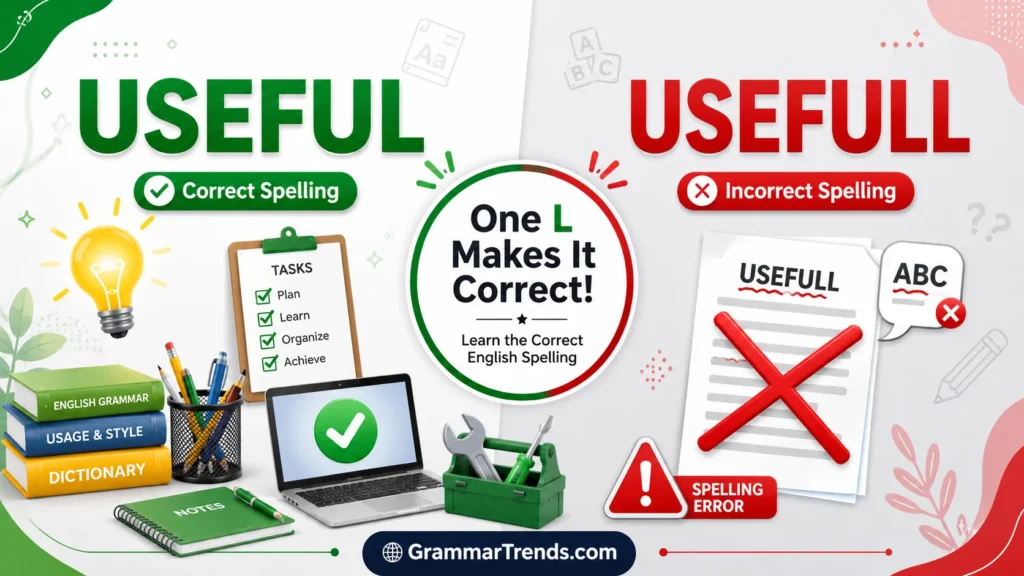
Useful vs Usefull shows confusion in the English language, where the words look similar in writing, but only one form is valid and correct.
In the English language, many words look similar, making them seem interchangeable. A common example is Useful vs Usefull. Many people assume both spellings are correct, but useful is the only accepted spelling. Usefull is an incorrect spelling and is not recognized in standard English.
The word useful is a correct adjective that means something is helpful, beneficial, or has practical use. Its correct spelling is well established in English, while usefull is simply a spelling mistake. The meaning becomes clear when you use the correct spelling, making this an easy rule to remember: useful is always correct, and usefull is always wrong.
In everyday writing, many learners become confused, but Useful vs Usefull clearly demonstrates that only useful is the correct adjective in standard English. It describes something that is helpful, beneficial, or has practical use, whereas usefull is an incorrect spelling with no accepted meaning. Using the correct spelling ensures clear communication and accurate writing.
Quick Answer: Is It “Useful” or “Usefull”?
If you’re looking for a fast answer, here it is:
| Word | Correct? |
| Useful | ✅ Yes |
| Usefull | ❌ No |
The correct spelling is useful.
The word usefull is considered a spelling error in standard English writing. Dictionaries, educational institutions, professional style guides, and grammar references recognize useful only.
If you’re writing:
- an email
- a school paper
- a blog post
- a report
- a social media caption
- a resume
Use useful, not usefull.
Think of it like putting an extra wheel on a bicycle. It doesn’t improve anything. It simply doesn’t belong there.
What Does “Useful” Mean?
The word useful describes something that has practical value or helps you accomplish something.
In plain English, if something helps you solve a problem or makes life easier, it is useful.
Simple definition
Useful: Being helpful, practical, or serving a purpose.
Examples:
- “This tutorial was useful.”
- “Your advice was useful.”
- “The app includes useful features.”
Word origin and structure
To understand the spelling, break the word apart:
Use + ful = Useful
The base word is:
Use
The suffix is:
-ful
The suffix -ful means:
“full of” or “having qualities of.”
Examples:
| Root Word | Word Created | Meaning |
| Help | Helpful | Full of help |
| Care | Careful | Full of care |
| Use | Useful | Full of usefulness |
| Power | Powerful | Full of power |
Notice something?
Most of these use only one l.
Common situations where people use useful
People use the word every day across different situations.
Daily conversation
- “That flashlight became useful during the storm.”
- “Your suggestion was useful.”
School and education
- “The textbook provides useful examples.”
Business
- “The report contains useful information.”
Technology
- “The software includes useful tools.”
Is “Usefull” a Real Word?
The short answer is no.
Usefull is not accepted as a standard English word.
You won’t find it listed as a proper spelling in dictionaries.
People usually write usefull because the mistake feels logical.
After all, words like these exist:
- full
- beautiful
- wonderful
Your brain notices full and thinks:
“Maybe useful should work the same way.”
Unfortunately, English loves surprise plot twists.
Why people accidentally add another “l”
Several things create confusion:
Pronunciation doesn’t help
Useful and usefull sound nearly identical.
Pattern assumptions
People see:
- full
- fully
- handful
Then they assume every similar word follows that structure.
Typing habits
Fast typing often creates accidental doubling.
Similar spelling patterns that create confusion
| Correct | Incorrect |
| Useful | Usefull |
| Helpful | Helpfull |
| Careful | Carefull |
| Powerful | Powerfull |
| Beautiful | Beautifull |
| Wonderful | Wonderfull |
You can see a pattern emerging.
The extra l sneaks in repeatedly.
Why English Creates This Confusion
English behaves a little like a garage full of tools collected over hundreds of years. Some fit neatly in their places. Others seem like someone tossed them into random drawers.
The suffix -ful creates confusion because it follows a specific rule.
Understanding the “-ful” suffix rule
When -ful acts as a suffix, it usually keeps one l.
Examples:
| Word | Correct Spelling |
| Helpful | One L |
| Useful | One L |
| Careful | One L |
| Powerful | One L |
| Thoughtful | One L |
The suffix itself becomes:
-ful
Not:
-full
Why words ending in “-full” are different
Sometimes full appears as a complete standalone word.
Examples:
- The glass is full.
- The room looks full.
- The parking lot is full.
In these examples, full remains its own word.
When it becomes a suffix attached to another word, the spelling usually changes.
The exception people misunderstand
Some words keep the full form because of their historical development.
Examples:
- handful
- mouthful
- spoonful
These words evolved differently.
That’s why English sometimes feels like a rulebook with handwritten notes in the margins.
Read more: Waring vs Wearing: What’s the Real Difference?
Useful vs Usefull: Side-by-Side Comparison
Here is a direct comparison.
| Feature | Useful | Usefull |
| Correct English spelling | Yes | No |
| Found in dictionaries | Yes | No |
| Suitable for formal writing | Yes | No |
| Suitable for school assignments | Yes | No |
| Suitable in business communication | Yes | No |
| Recommended by grammar guides | Yes | No |
The winner isn’t even close.
How To Use “Useful” Correctly in Sentences
Knowing the definition is helpful. Seeing real usage makes things stick.
Useful in everyday conversations
Daily speech uses the word naturally.
Examples:
- “Your map turned out to be useful.”
- “This knife is useful while camping.”
- “That tip saved me time and proved useful.”
- “The umbrella became useful during the rainstorm.”
Useful in academic writing
Students and researchers use the word frequently.
Examples:
- “The study provides useful evidence.”
- “Researchers collected useful data.”
- “The article contains useful findings.”
Useful in professional communication
Workplaces rely heavily on the word.
Examples:
- “The meeting produced useful ideas.”
- “The report contains useful recommendations.”
- “The presentation offered useful insights.”
Useful in technology discussions
Technology reviews use it constantly.
Examples:
- “The application includes useful features.”
- “The software offers useful tools.”
- “The update introduced useful improvements.”
Real Sentence Examples Using “Useful”
Examples work like mental fingerprints. They help concepts stay in memory.
Everyday examples
- This recipe turned out to be useful.
- Your directions were useful.
- The flashlight became useful after sunset.
- That shortcut proved useful.
Workplace examples
- The data analysis revealed useful patterns.
- The training session offered useful strategies.
- The manager shared useful feedback.
- The dashboard displays useful metrics.
Student examples
- The study guide contains useful notes.
- Flashcards are useful for memorization.
- The teacher provided useful examples.
Technology examples
- The app has useful customization tools.
- The update added useful security features.
- Voice search became useful during driving.
Writing examples
- Strong headlines create useful structure.
- Editing tools provide useful suggestions.
- Transitional words create useful flow.
Common Mistakes People Make With “Useful”
Spelling errors often happen because people rely on instinct.
Unfortunately, instinct occasionally drives into a ditch.
Adding an unnecessary extra “l”
Wrong:
❌ Usefull
Correct:
✅ Useful
This remains the most common mistake.
Mixing spelling and pronunciation
Pronunciation rarely guarantees spelling accuracy.
Consider these words:
| Word | Pronunciation Challenge |
| Knife | K is silent |
| Island | S is silent |
| Useful | Single L despite expectations |
English sometimes treats letters like background actors. They appear on screen but never say anything.
Assuming every “-ful” word follows the same pattern
Many writers overgeneralize.
They think:
- Full = two Ls
- Therefore useful = two Ls
That shortcut leads straight into an error.
Relying too heavily on autocorrect
Autocorrect helps. It isn’t perfect.
Sometimes it misses context.
Sometimes it changes words incorrectly.
Good writing still needs human attention.
Easy Tricks To Remember the Correct Spelling
Memory tricks work because they attach information to something simple.
The one-L rule
Most -ful suffix words use one l.
Examples:
- helpful
- careful
- useful
- powerful
- successful
Memory shortcut
“Full keeps two Ls. Useful only borrows one.”
This tiny phrase can save you from several spelling mistakes.
Visual pattern technique
Correct:
Use + ful = Useful
Incorrect:
Use + full = Usefull
Picture the second l getting removed like extra luggage before a flight.
Words Commonly Confused Alongside Useful
The same mistake appears across several words.
| Correct | Incorrect |
| Helpful | Helpfull |
| Careful | Carefull |
| Successful | Successfull |
| Beautiful | Beautifull |
| Wonderful | Wonderfull |
Learn one pattern and suddenly several spelling issues disappear.
That is like fixing one leak and discovering you repaired half the roof.
Does “Usefull” Ever Work in Any Situation?
Almost never in standard English.
Still, there are unusual situations where you might see it.
Typos and accidental spelling errors
Typing mistakes happen constantly.
Someone writes quickly:
“That guide was usefull.”
The mistake slips through.
Creative writing
Authors occasionally break rules intentionally.
They might alter spellings to show:
- accents
- unusual speech patterns
- fictional dialects
Usernames and brand names
Sometimes people intentionally use altered spelling:
Examples:
- UsefullTech
- UsefullGaming
- UsefullSolutions
Those become names rather than dictionary words.
Mini Practice Quiz
Try these exercises.
Fill in the blank
“This article was extremely ______.”
Answer:
✅ Useful
Choose the correct spelling
Which one is right?
- Useful
- Usefull
Answer:
✅ Useful
Correct the sentence
Original:
“Your suggestion was very usefull.”
Correct version:
✅ “Your suggestion was very useful.”
Case Study: Why One Letter Can Affect Credibility
Imagine two candidates applying for the same job.
Candidate one writes:
“I gained useful experience during my internship.”
Candidate two writes:
“I gained usefull experience during my internship.”
Everything else remains identical.
Which candidate appears more polished?
Tiny details matter.
A study from recruiters and hiring professionals repeatedly shows that spelling mistakes can hurt first impressions because readers often connect language accuracy with attention to detail.
One extra letter might seem tiny. Yet tiny details can punch above their weight.
Expert Perspective
“Good writing isn’t about using complicated words. It is about making ideas clear.”
Strong writing depends on clarity.
Correct spelling helps readers trust the message instead of getting distracted by mistakes.
Key Takeaways: Useful vs Usefull
Before you leave, here is the short version:
- Useful is the correct spelling.
- Usefull is incorrect in standard English.
- Most -ful suffix words use one l.
- Pronunciation creates confusion because both versions sound similar.
- Learning the pattern helps prevent other spelling mistakes.
- Small spelling errors can affect credibility in school and professional settings.
Language sometimes behaves like a road full of unexpected turns. Once you learn where the sharp corners sit, the journey becomes smoother.
And in this case, the road sign is simple:
Always choose useful.
FAQs on Useful vs Usefull
1. What is the correct spelling: useful or usefull?
The correct spelling is useful. The form usefull with two “l” letters is incorrect in standard English.
2. Why is usefull considered wrong?
Because it does not follow English spelling rules. Only useful is accepted in correct grammar and dictionaries.
3. What does the word useful mean?
Useful means something that is helpful, practical, or beneficial in real life or a situation.
4. Why do people get confused between useful vs usefull?
They look and sound similar, so learners often assume both spellings are correct, but only one is valid.
5. Can I use usefull in formal writing?
No. In formal or academic writing, only useful should be used. Usefull is a spelling mistake.
6. How can I remember the correct spelling?
Just remember: useful = one “l” = correct. There is no double “l” version in standard English.
7. Is useful an adjective?
Yes, useful is an adjective used to describe something helpful or beneficial.
Conclusion
Understanding the difference between Useful and Usefull is simple once you know the spelling rule. Useful is the only correct spelling in standard English and is used to describe something that is helpful, beneficial, or has practical use. Usefull is a common spelling mistake and should never be used in formal or informal writing. Remember that the suffix -ful is added with only one l, making useful the correct choice every time. Using the right spelling will improve your writing and help you communicate more clearly.

Mia Rose brings fifteen years of experience at The University of Edinburgh’s English Literature department, leading students through explorations of classic and contemporary texts, literary theory, and narrative design. Her academic interests center on Victorian and modernist fiction, poetic rhythms, postcolonial storytelling, and digital approaches to literary study—with a keen eye on how voice and perspective frame cultural dialogue. Mia has delivered talks at prestigious global conferences and authored articles in scholarly journals, showcasing her commitment to meaningful research and lively classroom engagement.