
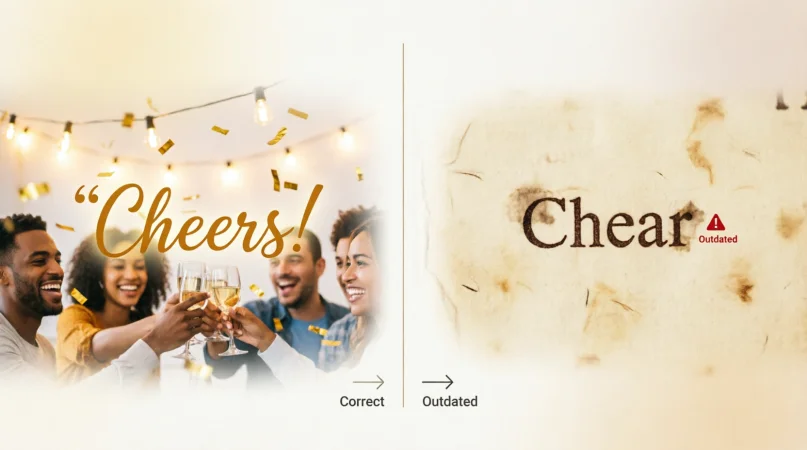
Cheers vs Chear confuses many writers because both words sound similar, but one small vowel change completely affects the correct spelling and meaning in written English.
I still remember sitting in an English class, my fingers hovering over the keyboard, unsure whether to write cheer or chear. In spoken English, both seem identical, but in written communication, especially in emails, essays, social media posts, and formal writing, this tiny difference becomes very important.
Even a small spelling error, writing mistake, or incorrect spelling can reduce your credibility, create confusion, and make readers doubt your language skills. These small moments often cause hesitation and lead to second-guessing while typing.
From my experience with new learners, these kinds of spelling traps create mental blocks. Writers freeze for a second, overthink, and sometimes lose confidence. But once you understand the simple pattern recognition behind the word, it becomes much easier.
The simple rule is this: Cheers is the correct, modern, and commonly used English expression. It is used to show joy, gratitude, goodwill, congratulations, celebration, greetings, and even while making a toast or saying thank you in a friendly way.
You will often hear a cheering crowd, sports fans, or audiences shouting with excitement, applause, and encouragement. This is where the word cheer also comes from, meaning to support, encourage, or express happiness in a positive way.
On the other hand, chear is an old, obsolete spelling that is rarely used today. It appears in very old texts or historical dictionaries, but in modern English, it is considered incorrect usage and should be avoided completely.
The key takeaway is simple: always choose cheers in modern writing. Paying attention to context, meaning, grammar, and spelling rules helps improve your writing skills, clarity, proofreading ability, and communication confidence, making your English more accurate and professional.
Quick Answer: Is It “Cheers” or “Chear”?
If you want the fast answer, here it is:
Cheers is the correct word in modern English.
Chear is an outdated spelling that rarely appears outside historical texts and older literature.
Here’s the simplest breakdown:
| Word | Correct Today? | Meaning | Common Usage |
| Cheers | Yes | Thanks, celebration, toast, farewell | Everyday English |
| Chear | Rare | Historical spelling of cheer | Old texts |
| Chears | No | Misspelling | Incorrect |
So if you’re writing:
“Cheers for helping me.”
You’re correct.
If you’re writing:
“Chear for helping me.”
You’re using an obsolete spelling.
If you’re writing:
“Chears for helping me.”
That’s simply a spelling error.
For most writers, the rule is easy:
Use “cheers.” Ignore “chear.” Avoid “chears.”
What Does “Cheers” Mean?
The word cheers carries more than one meaning. That’s part of the reason it appears so often in everyday language.
Unlike many words that stay in one lane, cheers wears different hats depending on context.
“Cheers” As a Toast
This is probably the first meaning that comes to mind.
People raise glasses before drinking and say:
“Cheers!”
The word expresses:
- Celebration
- Good wishes
- Friendship
- Shared happiness
Examples:
- Everyone lifted their glasses and shouted, “Cheers!”
- Cheers to another successful year.
- Cheers to new beginnings.
This usage goes back centuries and developed as a ritual of goodwill before drinking.
“Cheers” As a Way to Say Thank You
This use surprises many American readers because it appears more frequently in British English and Australian English.
Examples:
- Cheers for helping me move.
- Cheers for the update.
- Cheers for sending the files.
In this context, cheers simply means:
Thanks
Short, friendly, and casual.
“Cheers” As a Friendly Goodbye
People also use it to end messages.
Examples:
- Cheers, Sarah
- Talk later. Cheers.
- Have a great weekend. Cheers.
Think of it as a warmer version of:
- Bye
- Take care
- Thanks
What Does “Chear” Mean?
Here’s where things get interesting.
Technically, chear isn’t completely imaginary.
It actually existed.
Centuries ago, people used chear as an older spelling of cheer.
Language evolves constantly. Spellings change over time.
Words that once looked normal can eventually become outdated.
The Historical Meaning of “Chear”
Historically, chear referred to:
- Joy
- Comfort
- Mood
- Encouragement
Writers used it in ways that now look unusual.
For example:
“His words brought great chear.”
Modern English would write:
“His words brought great cheer.”
Why You Rarely See “Chear” Today
English gradually standardized spelling.
Over time:
Chear → Cheer
The modern form replaced the older one.
Today, if someone writes chear, readers usually assume:
- A typo
- A spelling mistake
- Autocorrect failure
Places You May Still Find “Chear”
You can still encounter it in:
- Historical books
- Archived newspapers
- Poetry
- Classical literature
- Old legal records
For example, older texts from the 1600s and 1700s often used spellings that look unusual today.
Examples:
- Musick → Music
- Publick → Public
- Chear → Cheer
Language loves remodeling itself.
Cheers, Cheer, and Chear: Understanding the Difference
Many people accidentally mix these words because they sound similar.
Here’s a cleaner comparison.
| Word | Part of Speech | Meaning | Example |
| Cheer | Verb/Noun | Encourage or express happiness | Fans cheer loudly. |
| Cheers | Interjection/Noun | Thanks, toast, farewell | Cheers for the help. |
| Chear | Obsolete spelling | Historical form of cheer | Found in older texts |
Let’s see them in action.
Cheer
- The crowd began to cheer.
- Her speech lifted everyone’s cheer.
Cheers
- Cheers for picking up dinner.
- Cheers to your success.
Chear
- The old manuscript used the word chear.
Notice something?
Only one of these appears naturally in modern daily writing:
Cheers
Why People Confuse Cheers, Chear, and Chears
Spelling mistakes rarely happen because people don’t know words.
Usually, the brain simply takes shortcuts.
Sound-Based Spelling Errors
English pronunciation creates traps.
Consider these:
- Their
- There
- They’re
Or:
- Brake
- Break
Or:
- Flour
- Flower
Now add:
- Cheer
- Cheers
- Chear
- Chears
The sounds overlap enough to create confusion.
Fast Typing Creates Problems
Typing quickly often produces mistakes.
A message intended as:
“Cheers for your help.”
Suddenly becomes:
“Chears for your help.”
One tiny slip changes everything.
Social Media Makes Mistakes Spread
People copy what they see online.
If someone repeatedly sees:
“Chears bro”
They may assume it’s correct.
Spelling mistakes can spread like weeds in a garden.
Read more: Distress vs Duress: The Real Difference Most People Get Wrong
How To Use “Cheers” Correctly in Sentences
Understanding definitions helps.
Using real examples helps even more.
Cheers in Everyday Conversations
Examples:
- Cheers for picking up coffee.
- Cheers for helping me today.
- Cheers for the advice.
Cheers in Text Messages
Examples:
- Got it. Cheers.
- Cheers for the reminder.
- Cheers mate.
Cheers in Emails
Examples:
Informal email closing:
Cheers,
Michael
Friendly workplace message:
Cheers for sending the report.
Cheers During Celebrations
Examples:
- Cheers to your promotion.
- Cheers to ten years of friendship.
- Cheers to a fresh start.
How To Use “Chear” Correctly If You Encounter It
Modern writing almost never requires chear.
Still, there are a few exceptions.
Historical Writing
Suppose you’re discussing old manuscripts.
You might write:
The original document used the spelling “chear.”
Literary Analysis
Students analyzing older texts sometimes preserve original spelling.
Example:
The poet repeatedly used “chear” throughout the passage.
Quoting Historical Sources
Writers shouldn’t alter direct quotations.
For example:
“Bring good chear unto thy companions.”
Changing spelling inside direct quotes may create inaccuracies.
Real Sentence Examples: Correct vs Incorrect Usage
Examples make mistakes easier to spot.
| Incorrect | Correct |
| Chears for your support. | Cheers for your support. |
| Chear everyone. | Cheer everyone. |
| Everyone said chear. | Everyone said cheers. |
| Chears to success. | Cheers to success. |
| Chear for helping me. | Cheers for helping me. |
Common Mistakes Writers Make
Writers often repeat the same patterns.
Recognizing them helps you avoid them.
Writing “Chears” Instead of “Cheers”
This happens because people type words exactly as they hear them.
Incorrect:
“Chears everyone!”
Correct:
“Cheers everyone!”
Treating “Chear” Like Modern English
People occasionally discover chear online and assume it’s acceptable today.
It usually isn’t.
Modern writing favors:
Cheer
or
Cheers
Using “Cheers” in Very Formal Writing
“Cheers” sounds friendly.
That’s great for casual communication.
It can feel too relaxed in highly formal situations.
Less appropriate:
Cheers, Attorney Wilson
More formal:
Sincerely, Attorney Wilson
Or:
Kind regards, Attorney Wilson
Context matters.
Regional Differences: How “Cheers” Changes Around the World
English behaves differently depending on where you are.
A word that’s common in one country might sound unusual elsewhere.
British English
In Britain, cheers often means:
- Thanks
- Goodbye
- Appreciation
Examples:
- Cheers for the help.
- Cheers mate.
British speakers use it constantly.
American English
Americans usually associate cheers with drinking.
Examples:
- Cheers to your success.
Using it as “thanks” sounds less common.
Australian English
Australians frequently use:
“Cheers mate”
It often means:
- Thanks
- Goodbye
- Appreciation
Canadian English
Canada tends to blend British and American influences.
People may use:
- Cheers as a toast
- Cheers as thanks
Usage varies.
Mini Case Study: How One Letter Changed a Professional Email
Imagine this situation.
A freelance designer sends a message:
Chears for reviewing my proposal.
The client notices it instantly.
The mistake doesn’t destroy credibility. Still, small spelling errors create friction.
Now compare:
Cheers for reviewing my proposal.
Cleaner.
Professional.
Polished.
Tiny details shape perception.
One misplaced letter sometimes works like spinach stuck between your teeth. Everything else looks fine. Still, people notice it.
Quick Memory Trick: Never Confuse Cheers and Chear Again
Try this:
Cheers ends with “S” because people usually say it socially.
Picture a group raising glasses.
Multiple people.
Shared moment.
Cheers
Simple memory devices work because they attach meaning to images.
Key Takeaways: Use “Cheers,” Skip “Chear”
Language changes constantly.
Words evolve. Spellings disappear. New expressions emerge.
Chear belonged to an earlier version of English. Today it mostly survives inside old books and historical writing.
For modern communication, the rule stays simple:
✓ Cheers for helping me
✓ Cheers to success
✓ Cheers, David
✗ Chears for helping me
✗ Chear everyone
When uncertainty shows up, remember the easiest shortcut:
If you’re writing modern English, choose “cheers.”
That one small decision keeps your writing cleaner, clearer, and easier for readers to trust.
FAQs About Cheers vs Chear
Is “cheers” the correct spelling in modern English?
Yes, cheers is the correct and commonly used spelling in modern-English. People use it in casual-language, greetings, toasts, and social conversations to express joy, gratitude, goodwill, or congratulations.
What does “chear” mean?
Chear is an old, rare, and obsolete-word found mostly in older British-English texts and some historical dictionary entries. Today, most dictionaries mark it as incorrect in normal writing and modern usage.
Why do people confuse cheer and chear?
Many people confuse these words because their pronunciation and sound are almost the same in spoken-English. The only visible difference is the spelling, which can easily create a spelling-trap during typing or fast email-writing.
Can using the wrong spelling affect credibility?
Yes, a small spelling-error or writing-mistake can affect your credibility, especially in emails, essays, social-media posts, or professional communication. Strong grammar, clarity, and accurate-writing help readers trust your message.
When should I use the word “cheers”?
Use cheers when expressing thankfulness, encouragement, or friendly social-expression. It also works well while raising a glass, celebrating success, or offering support in a relaxed setting.
Is “chear” ever acceptable today?
You may still see chear in historical books, poems, or very old written-English sources, but it is not suitable for normal modern-English communication. In current English-language standards, cheers and cheer are the preferred forms.
How can I avoid spelling mistakes like cheer vs chear?
Practice proofreading, improve vocabulary, follow spelling-rules, and always check the context before sending messages. Over time, pattern-recognition, learning, and regular editing will improve your writing-skills and reduce common mistakes.
Conclusion
The confusion around Cheers vs Chear usually comes from their similar pronunciation, but the correct-word in modern usage is clearly cheers or cheer. While chear survives in older texts and historical language records, it no longer fits standard written-English. Understanding the meaning, usage, and proper word-choice helps improve communication-skills, strengthen confidence-building, and prevent embarrassing spelling mistakes in everyday writing.

Mia Rose brings fifteen years of experience at The University of Edinburgh’s English Literature department, leading students through explorations of classic and contemporary texts, literary theory, and narrative design. Her academic interests center on Victorian and modernist fiction, poetic rhythms, postcolonial storytelling, and digital approaches to literary study—with a keen eye on how voice and perspective frame cultural dialogue. Mia has delivered talks at prestigious global conferences and authored articles in scholarly journals, showcasing her commitment to meaningful research and lively classroom engagement.