
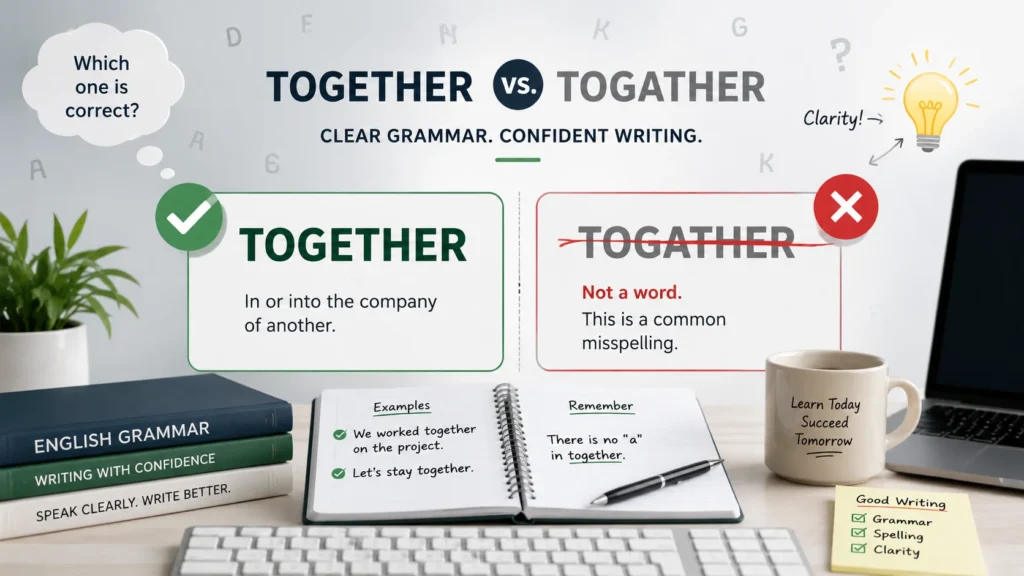
If you’ve ever wondered whether togather or together is the correct spelling, you’re not alone. This is one of the most common spelling mistakes I come across, especially in emails, social media posts, blog comments, and online searches. Because both words sound similar when spoken quickly, many people assume they’re interchangeable, but only one is correct.
During my 15 years of teaching English and years of writing online content, I’ve seen students, bloggers, and even experienced professionals accidentally type togather while writing in a hurry. It’s an easy mistake to make, but one that can affect the clarity and professionalism of your writing if it goes unnoticed.
The correct spelling is together, while togather is simply a misspelling and is not recognized in standard English. Once you understand why this mistake happens and learn a simple memory trick, you’ll find it much easier to remember the correct form every time.
In this guide, you’ll learn the meaning of together, why togather is incorrect, common examples, grammar rules, pronunciation, and practical tips to help you avoid this spelling mistake with confidence.
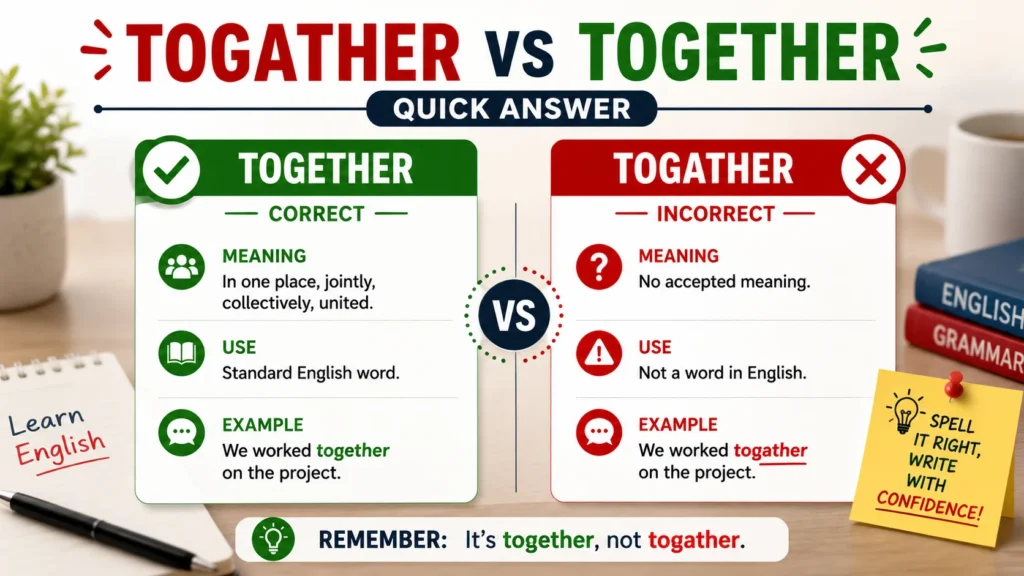
Quick Answer: Is It Togather or Together?
If you only need the short version, here it is:
| Word | Correct? | Meaning | Use |
| Together | ✅ Yes | In one place, jointly, collectively, united | Standard English |
| Togather | ❌ No | No accepted meaning | Spelling mistake |
Correct:
We worked together on the project.
Incorrect:
We worked togather on the project.
Think of it this way. Writing togather is similar to writing seperate instead of separate. The word may look familiar, though standard English does not recognize it.
What Does “Together” Mean?
The word together carries several meanings depending on how you use it. Most people immediately think of two people standing side by side. However, the word reaches much further than physical closeness.
It can describe:
- Unity
- Cooperation
- Relationships
- Organization
- Emotional stability
- Shared activity
- Collective effort
Context changes everything.
Together as an Adverb
Most often, together acts as an adverb. In that role, it describes actions occurring jointly or collectively.
Examples:
- We studied together for the final exam.
- The musicians performed together.
- The team worked together to solve the problem.
- They traveled together during summer vacation.
Notice something interesting here.
The focus is not merely on proximity. The emphasis sits on shared action.
Imagine building a puzzle. Twenty people might stand in the same room. Yet if only two people actively assemble the pieces, those two people are working together.
Together as an Adjective
Sometimes together behaves differently.
In informal speech, it can describe a person who appears organized or emotionally balanced.
Examples:
- She seems very together today.
- He is surprisingly together under pressure.
- Despite the chaos, she stayed together.
In this sense, the word doesn’t mean physically united. Instead, it suggests:
- Calmness
- Self-control
- Stability
- Organization
Different Meanings Based on Context
The same word can quietly shift meaning.
| Context | Meaning | Example |
| Relationships | Connected romantically | They’re together now |
| Teamwork | Working jointly | We solved it together |
| Physical location | In one place | Everyone sat together |
| Emotional state | Organized mentally | She keeps herself together |
Language works a little like a Swiss Army knife. One tool performs several jobs.
Why Do People Write “Togather” Instead of “Together”?
You might assume people simply misspell the word randomly.
Actually, several interesting reasons explain why this error happens.
Pronunciation Creates Confusion
Spoken English often plays tricks on the ears.
The pronunciation of together is:
tə-ˈge-thər
When people speak quickly, sounds blend into one another.
Instead of hearing:
to-geth-er
Someone may mentally process:
to-gath-er
That tiny shift creates the spelling mistake.
Human brains love patterns. When a sound resembles something familiar, your brain fills in missing pieces automatically.
Typing Habits and Muscle Memory
Fast typing introduces strange mistakes.
Consider how many times you type every day:
- Emails
- Messages
- Search queries
- Social media posts
- Work documents
After thousands of repetitions, fingers begin acting before conscious thought catches up.
Sometimes your fingers take shortcuts.
Mobile Devices Increase Errors
Phone keyboards create another layer of confusion.
Small keys lead to:
- Missed letters
- Swapped letters
- Autocorrect mistakes
- Predictive text issues
Many people write rapidly without proofreading.
The result?
Tiny errors sneak through.
Similar English Words Mislead the Brain
English creates hidden traps because many words share similar structures.
Examples:
| Word | Ending Pattern |
| Gather | -ather |
| Rather | -ather |
| Father | -ather |
| Together | -ether |
Your brain notices patterns automatically.
It may think:
If gather uses “ather,” together probably does too.
Nice theory.
Wrong answer.
The Origin and History of “Together”
Words carry history with them. Some travel hundreds or thousands of years before reaching modern English.
Together has surprisingly old roots.
Etymology of Together
The word developed from Old English.
It combines:
- to
- gædere
The old form meant:
in company
in one place
at the same time
As English evolved through Middle English, pronunciation and spelling gradually shifted.
Eventually, together became standardized.
How Meaning Changed Over Time
The core meaning remained remarkably stable.
Early meanings included:
- In company
- In union
- Simultaneously
Modern meanings expanded to include:
- Emotional unity
- Teamwork
- Organization
- Relationships
Language evolves slowly. Words stretch over time like elastic bands while keeping their basic shape.
How to Pronounce Together Correctly
Correct pronunciation helps prevent spelling mistakes.
Phonetic pronunciation:
tə-ˈge-thər
Breakdown:
tə
Soft opening sound.
ge
Main stressed syllable.
ther
Ending sound.
You can think of it visually:
To + get + her
This trick helps many learners remember the spelling.
A Simple Memory Trick
Imagine this sentence:
Friends get together.
Notice something useful.
The word get already appears inside together.
Visual learners often remember words faster when they connect them to images or mini stories.
Read more: Stopped or Stoped? The Correct Spelling Rule Most People Get Wrong
Examples of “Together” Used Correctly in Real Situations
Learning grammar rules helps.
Seeing them in action helps more.
Everyday Conversation Examples
Examples:
- We ate lunch together.
- They walked home together.
- Let’s watch the movie together.
- Everyone laughed together.
Short sentences make patterns easier to notice.
Work and Business Examples
Examples:
- Our departments worked together on the campaign.
- We put the proposal together last week.
- The executives met together before the presentation.
- Teams achieved better results together.
School and Academic Examples
Examples:
- Students studied together for exams.
- We completed the assignment together.
- The group researched together.
- Everyone presented together.
Relationship Examples
Examples:
- They’ve been together for six years.
- We moved in together recently.
- The couple traveled together.
- They stayed together through difficult times.
Creative Examples
Examples:
- The colors blended together beautifully.
- Every part of the story came together perfectly.
- Clouds gathered together in the distance.
A Small Case Study: One Misspelled Word, One Big Impression
Imagine two job applicants sending emails.
Applicant One writes:
I look forward to working togather with your team.
Applicant Two writes:
I look forward to working together with your team.
The difference seems tiny.
Yet employers often notice spelling because writing reflects attention to detail.
One missing letter can quietly affect first impressions.
That doesn’t mean spelling mistakes define intelligence. Far from it.
Even skilled writers make errors.
Still, careful proofreading helps.
“Good writing isn’t about using bigger words. It’s about using the right words.”
Common Expressions and Phrases With “Together”
English uses together in many everyday expressions.
Phrasal Verbs Using Together
| Phrase | Meaning | Example |
| Put together | Assemble something | I put together the furniture |
| Bring together | Unite people or ideas | The event brought everyone together |
| Get together | Meet socially | We got together yesterday |
| Hold together | Stay intact | The bridge still holds together |
| Stick together | Remain united | Families should stick together |
Everyday Expressions
Common examples:
- Together forever
- Pull together
- Live together
- Work together
- Grow together
- Stay together
- Stand together
These expressions appear constantly in movies, books, conversations, and songs.
Synonyms of Together and When to Use Them
Repeating the same word repeatedly weakens writing.
Synonyms create variety.
However, context matters.
Synonyms for Collective Action
| Word | Best Use |
| Jointly | Formal communication |
| Cooperatively | Team projects |
| Collectively | Groups |
| Simultaneously | Same-time events |
| United | Shared goals |
Examples:
- The companies acted jointly.
- Students worked cooperatively.
- The committee voted collectively.
Synonyms for Emotional Meaning
| Word | Context |
| Stable | Emotional state |
| Organized | Personal habits |
| Balanced | Lifestyle |
| Composed | Stressful situations |
Examples:
- She remained composed.
- He stays organized.
- They live balanced lives.
Mistakes Writers Make With “Together”
Some mistakes appear repeatedly.
Using Togather
Incorrect:
We should work togather.
Correct:
We should work together.
Confusing Together and Altogether
These words look similar though they mean different things.
| Word | Meaning |
| Together | In union |
| Altogether | Entirely or completely |
Examples:
Correct:
We traveled together.
Correct:
The movie was altogether disappointing.
Related Spelling Mistakes
English contains many repeat offenders.
Examples:
Incorrect → Correct
- Seperate → Separate
- Definately → Definitely
- Occured → Occurred
- Recieve → Receive
- Togather → Together
Easy Ways to Remember the Correct Spelling
Memory tricks work because they create shortcuts.
Memory Technique: To + Get + Her
Break the word apart:
Together
To + Get + Her
Build a tiny story:
Friends get together.
Simple ideas often stick best.
Memory Technique: Visual Association
Picture several friends sitting around one table.
Underneath the image imagine:
We sit together.
Visual memories often outlast plain memorization.
Memory Technique: Use Repetition in Context
Write:
- We learn together.
- We study together.
- We grow together.
Repeated exposure strengthens memory naturally.
My Personal Experience
Over the years, I’ve found that togather is one of those spelling mistakes that usually happens because people rely on how a word sounds rather than how it’s actually spelled. In my 15 years of teaching English, I’ve corrected this error in classroom assignments, blog drafts, and workplace emails. A simple tip that works well is to remember the phrase “get together.” Once learners connect together with get, the correct spelling becomes much easier to remember, and the mistake rarely appears again.
FAQs
Is “togather” a real English word?
No, “togather” is not a real word in the English-language. It is considered a misspelling or typing-error of the correct word “together.”
Which spelling is correct: together or togather?
The correct spelling is always “together.” Spell-check and grammar-check tools also mark “togather” as wrong.
Why do people confuse together and togather?
The confusion happens because both words sound alike when spoken quickly. Fast-typing, online-writing, and social-media replies also increase spelling mistakes.
What does the word “together” mean?
“Together” means people or things are connected, combined, associated, or in the same place with each other.
Can I use “togather” in formal writing?
No, you should avoid using “togather” in academic-writing, professional-writing, emails, articles, and workplace communication because it is incorrect.
How can I avoid spelling mistakes like togather?
You can avoid spelling-errors by proofreading your content, using spelling-checker tools, reading carefully, and slowing down while typing.
Is “together” used in British and American English?
Yes, “together” is the standard and proper spelling in both British and American English usage.
Conclusion
Understanding the difference between “together” and “togather” is simple once you know the correct spelling rules. “Together” is the proper and officially accepted word, while “togather” is only a typo or misspelling. In today’s internet-era, where people type quickly and communicate across digital platforms, small spelling-details can make a big difference in professionalism, clarity, and communication. Using the correct form helps your writing look more polished, accurate, and trustworthy for readers.
References
- Oxford English Dictionary (OED). Together. Oxford University Press.
- Merriam-Webster Dictionary. Together. Merriam-Webster.
- Cambridge Dictionary. Together. Cambridge University Press.
- Collins English Dictionary. Together. HarperCollins Publishers.
- The American Heritage Dictionary of the English Language (5th ed.). Houghton Mifflin Harcourt.
- Michael Swan. Practical English Usage (4th Edition). Oxford University Press, 2016.
- Bryan A. Garner. Garner’s Modern English Usage (5th Edition). Oxford University Press, 2022.
- The Chicago Manual of Style (18th Edition). University of Chicago Press.
- The Associated Press Stylebook (Latest Edition). AP News.
- The Oxford Guide to English Grammar. Oxford University Press.
- The Cambridge Grammar of the English Language. Cambridge University Press.
- Etymonline. Together – Word Origin and Etymology. (Used for the historical origin and development of the word.)

Mia Rose brings fifteen years of experience at The University of Edinburgh’s English Literature department, leading students through explorations of classic and contemporary texts, literary theory, and narrative design. Her academic interests center on Victorian and modernist fiction, poetic rhythms, postcolonial storytelling, and digital approaches to literary study—with a keen eye on how voice and perspective frame cultural dialogue. Mia has delivered talks at prestigious global conferences and authored articles in scholarly journals, showcasing her commitment to meaningful research and lively classroom engagement.