
If you want a formal tone, 11 Formal Synonyms for “On the Bright Side” can help you choose a positive expression that sounds natural and polished.
From my experience, using formal phrases such as optimistically speaking, with a silver lining, in a favorable vein, and on the plus side can give your writing a more hopeful outlook. Each synonym offers a different perspective, allowing you to replace an informal phrase without sounding forced. A constructive manner can highlight something good within a difficult context, while an advantageous perspective can present a challenge in a promising and uplifting light.
Reviewing this list gives you a clearer picture of how these expressions work. This article can teach you a formal way to say the same idea, helping you learn another way to express optimism without appearing insincere. To some extent, these expressions can make your writing feel naturally polished. Keep reading to find the right expression for your situation and understand how the synonyms mentioned fit different contexts.
Quick Answer
Here are the strongest alternatives at a glance:
| Formal synonym | Best use | Tone |
| From a positive perspective | Reports, business, academic writing | Professional |
| From a favorable standpoint | Analysis and formal discussion | Formal |
| On the positive side | General professional writing | Neutral |
| A positive aspect is | Reports and evaluations | Objective |
| One advantage is | Business and academic writing | Analytical |
| The positive aspect is | Formal analysis | Objective |
| Fortunately | Favorable events or outcomes | Reassuring |
| Encouragingly | Progress reports and results | Optimistic |
| More positively | Analytical comparisons | Formal |
| From an optimistic perspective | Future possibilities | Thoughtful |
| There is a positive outcome | Reports and evaluations | Objective |
The important thing is that these expressions aren’t interchangeable in every sentence. Some emphasize a benefit. Others introduce good news or signal optimism.

What Does “On the Bright Side” Mean?
“On the bright side” is an idiomatic expression used to draw attention to something positive in an otherwise negative, disappointing, or difficult situation.
For example:
The project was delayed. On the bright side, we now have more time to fix the remaining issues.
The speaker isn’t pretending that the delay is good. Instead, they’re pointing out a benefit that came from an unfavorable situation.
That distinction matters.
The expression usually involves positive reframing. You recognize the problem while directing attention toward something useful, favorable, or encouraging.
Consider another example:
I didn’t get the position. On the bright side, the interview helped me understand what employers are looking for.
The rejection remains disappointing. However, the experience produced something valuable.
Is “On the Bright Side” Formal?
Yes, “on the bright side” can appear in both spoken and written English. It isn’t grammatically incorrect or automatically inappropriate for professional communication.
Still, context matters.
In a casual conversation, you might naturally say:
On the bright side, we finished the difficult part.
In a formal report, a more precise expression may work better:
From a positive perspective, the team completed the most challenging phase.
The second version sounds more analytical. It also tells the reader exactly what kind of positive framing you’re using.
For that reason, knowing several formal ways to say “on the bright side” gives you more control over your writing.
11 Formal Synonyms for “On the Bright Side”
From a Positive Perspective
“From a positive perspective” is one of the safest formal alternatives to “on the bright side.”
It works because it focuses on how a situation can be viewed, rather than suggesting that the entire situation is positive.
For example:
The implementation required additional resources. From a positive perspective, it improved the reliability of the system.
This construction fits naturally into business reports, academic writing, presentations, evaluations, and professional correspondence.
It also gives you room to discuss both sides of an issue.
Use it when:
- You’re analyzing a complicated situation.
- You want to acknowledge a drawback before identifying a benefit.
- You’re writing a report or formal document.
- You want a professional alternative that still sounds natural.
Example:
The initial results were below expectations. From a positive perspective, the findings revealed several areas that require further investigation.
This sounds measured rather than overly cheerful. That’s often exactly what formal writing needs.
From a Favorable Standpoint
When you want a more analytical tone, “from a favorable standpoint” can be an excellent choice.
“Standpoint” refers to a particular position or way of looking at something. Therefore, this phrase emphasizes the angle from which you evaluate a situation.
For example:
From a favorable standpoint, the revised policy provides employees with greater flexibility.
The phrase works particularly well in business, legal, academic, and policy-related writing.
However, there’s a small trade-off. It sounds more formal than everyday speech. You probably wouldn’t say it to a friend discussing a delayed vacation.
Best contexts include:
- Business analysis
- Policy discussions
- Academic writing
- Formal evaluations
- Strategic reports
Example:
From a favorable standpoint, the restructuring creates opportunities for long-term efficiency.
Here, the writer isn’t simply saying something is good. The writer is evaluating the restructuring from a particular perspective.
On the Positive Side
“On the positive side” is probably the closest straightforward replacement for “on the bright side.”
It keeps the original structure while replacing the metaphorical bright with the more direct positive.
For example:
The new process takes longer. On the positive side, it reduces the number of errors.
This phrase is useful because it sounds professional without becoming stiff.
It works especially well when you’re presenting both disadvantages and advantages.
The software requires additional training. On the positive side, it provides more detailed reporting capabilities.
Compared with “from a positive perspective,” this expression feels slightly more conversational. That makes it a useful middle ground.
A Positive Aspect Is
Sometimes you don’t need an idiom at all. You simply need to identify the favorable part of a situation.
That’s where “a positive aspect is” becomes useful.
A positive aspect is the reduction in processing time.
This construction sounds objective and works well in reports, evaluations, reviews, and analytical writing.
It also prevents your writing from sounding artificially upbeat. Instead of telling the reader to “look on the bright side,” you’re simply identifying a positive feature.
For example:
The transition required considerable planning. A positive aspect is that the new system has reduced administrative work.
This is particularly effective when you want to maintain a neutral professional tone.
One Advantage Is
If the positive point represents a specific benefit, “one advantage is” may be better than a broad synonym for “on the bright side.”
For example:
The equipment is expensive. One advantage is its low maintenance requirement.
The word advantage is more precise than “positive.”
It tells the reader that you’re identifying something that makes the option more useful, effective, or desirable.
This phrase works well in:
- Business proposals
- Product comparisons
- Academic essays
- Technical reports
- Decision-making documents
- Evaluations
Consider this example:
The new software has a higher initial cost. One advantage is that it can automate several manual processes.
That’s stronger than simply saying:
On the bright side, the software is useful.
The first sentence identifies a measurable benefit. The second only offers a general positive impression.
The Positive Aspect Is
“The positive aspect is” works when the reader already understands the situation being discussed.
For example:
The project experienced several delays. The positive aspect is that the additional testing identified problems before launch.
This expression has a formal, analytical feel. It’s particularly useful when you’re evaluating an outcome after discussing its drawbacks.
The choice between “a positive aspect is” and “the positive aspect is” depends on what you’re communicating.
- A positive aspect is → introduces one of several possible benefits.
- The positive aspect is → focuses on a particular benefit already relevant to the discussion.
For example:
A positive aspect is the improved response time.
versus:
The schedule changed unexpectedly. The positive aspect is that the team gained additional preparation time.
That small difference can make your writing more precise.
Fortunately
“Fortunately” is another useful formal alternative, but it doesn’t function as a direct replacement in every situation.
It usually introduces a favorable event or outcome.
For example:
The delivery was delayed. Fortunately, the customer had already adjusted the schedule.
The word signals relief because something favorable happened despite an unfavorable circumstance.
That’s slightly different from “on the bright side,” which often introduces a positive interpretation or benefit.
Compare these:
The meeting was canceled. On the bright side, I had time to finish the report.
The meeting was canceled. Fortunately, I had already completed the report.
The first sentence focuses on a positive perspective. The second emphasizes a favorable circumstance.
Fortunately works especially well when the positive development actually happened.
Encouragingly
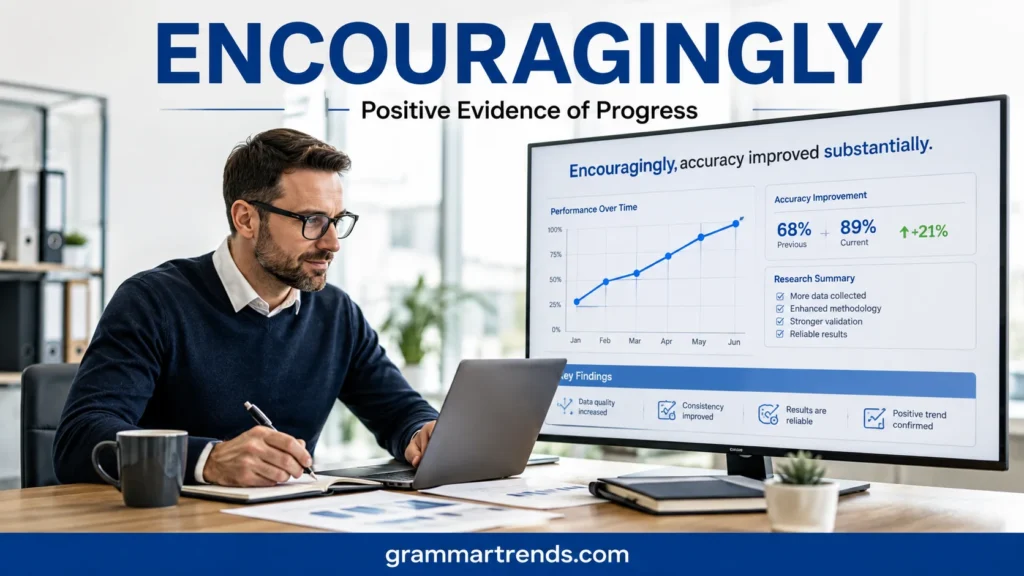
When you’re discussing progress, evidence, results, or developments, “encouragingly” can be more precise than “on the bright side.”
For example:
Encouragingly, customer satisfaction increased during the final quarter.
The word tells readers that the information gives them a reason to feel optimistic.
It works especially well in:
- Progress reports
- Research summaries
- Business updates
- Performance reviews
- Project evaluations
- Formal presentations
Consider:
The first stage produced mixed results. Encouragingly, the second trial showed a substantial improvement in accuracy.
This sounds evidence-based rather than emotionally positive.
That’s an important distinction in professional writing.
More Positively
“More positively” can introduce a more favorable interpretation after you’ve presented a concern or negative finding.
For example:
The initial response was limited. More positively, repeat customers showed increased engagement.
This construction works best when the sentence or paragraph already establishes a comparison.
It’s less useful as a standalone replacement because it often depends on something mentioned immediately before it.
For instance:
The initial results were disappointing. More positively, the follow-up analysis identified a clear improvement.
The transition works because the reader can immediately see the contrast.
Use this phrase when you want to shift the analytical focus rather than simply announce that something is good.
From an Optimistic Perspective
“From an optimistic perspective” emphasizes a hopeful interpretation of a situation.
For example:
From an optimistic perspective, the setback may encourage the organization to develop a more efficient strategy.
This phrase works best when the positive point involves possibility, expectation, or future improvement.
That’s different from “one advantage is,” which normally points to a concrete benefit.
Compare:
One advantage is the lower operating cost.
This is factual and specific.
From an optimistic perspective, the investment could create new opportunities.
This is more forward-looking.
Use this alternative carefully. If your writing needs to sound highly objective, “one advantage is” or “a positive aspect is” may be stronger.
There Is a Positive Outcome
For formal reports and evaluations, “there is a positive outcome” can provide a direct and objective alternative.
For example:
Although the initial trial failed, there is a positive outcome: the testing exposed several critical weaknesses.
The expression works especially well when the positive point is an actual result rather than simply a viewpoint.
You can also make it more specific:
Although the project exceeded its original timeline, there is a positive outcome: the final system performs more reliably than expected.
This style is particularly useful when discussing setbacks without losing sight of what was achieved.
Formal vs. Informal Alternatives to “On the Bright Side”
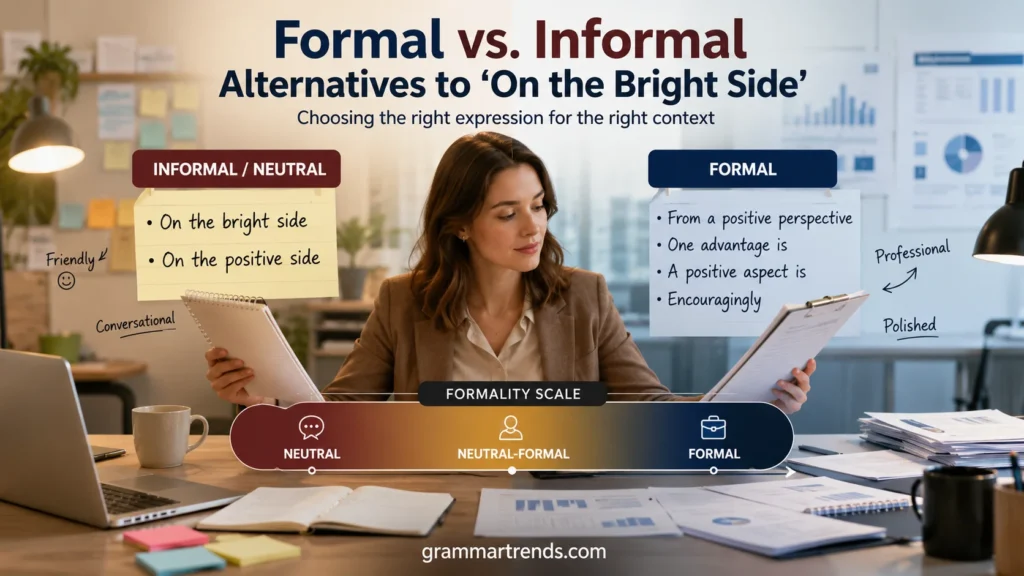
Not every alternative needs to sound extremely formal. In fact, overly formal language can make simple ideas harder to understand.
| Expression | Formality | Best context | Main focus |
| On the bright side | Neutral | Everyday conversation | Positive perspective |
| On the positive side | Neutral-formal | General writing | Positive point |
| From a positive perspective | Formal | Reports and analysis | Interpretation |
| One advantage is | Formal | Business and academic writing | Concrete benefit |
| A positive aspect is | Formal | Reports and evaluations | Favorable feature |
| Fortunately | Neutral-formal | Professional communication | Favorable event |
| Encouragingly | Formal | Results and progress | Reason for optimism |
| From a favorable standpoint | Formal | Analytical writing | Evaluation |
| From an optimistic perspective | Formal | Future-oriented writing | Hopeful interpretation |
The key lesson is simple: formal doesn’t automatically mean better.
A good writer chooses the phrase that matches the meaning.
How to Choose the Right Formal Synonym for “On the Bright Side”
The easiest way to choose an alternative is to ask yourself what you actually want to communicate.
When You Want to Highlight a Specific Benefit
Choose:
- One advantage is
- A positive aspect is
- The positive aspect is
These phrases work when the favorable point has a clear, identifiable benefit.
The system requires more training. One advantage is its improved accuracy.
When You Want to Reframe a Difficult Situation
Choose:
- From a positive perspective
- On the positive side
- From an optimistic perspective
These alternatives work when you want to show that a difficult situation has another way of being viewed.
The launch was postponed. From a positive perspective, the team now has more time for testing.
When You Want to Introduce Good News
Choose:
- Fortunately
- Encouragingly
These are particularly effective when you have an actual favorable event or development.
Encouragingly, the revised procedure reduced processing errors.
When You Want an Analytical Tone
Choose:
- From a favorable standpoint
- A positive aspect is
- One advantage is
- There is a positive outcome
These choices keep the focus on evidence, outcomes, and evaluation.
Examples of Formal Synonyms in Professional Writing
The best way to understand these alternatives is to see them in realistic situations.
Business Example
Imagine a company has discovered that a new system costs more than expected.
A casual sentence might say:
On the bright side, the system should save us money later.
A more professional version could be:
One advantage is that the system is expected to reduce long-term operating costs.
The second version works better because it identifies the actual benefit.
Academic Example
Suppose a research project produces fewer responses than expected.
Instead of:
On the bright side, the responses we received were detailed.
You could write:
From a positive perspective, the responses provided detailed qualitative information.
This version sounds more appropriate for academic analysis because it identifies the value of the available evidence.
Workplace Example
A project might miss a deadline while completing an important quality check.
A manager could write:
The project did not meet the original deadline. However, from a positive perspective, the additional review helped identify several issues before implementation.
The sentence acknowledges the problem without allowing the positive point to sound forced.
Customer Service Example
Suppose an order arrives late but remains in excellent condition.
Instead of:
On the bright side, your order arrived safely.
A professional response could say:
Fortunately, the package arrived in excellent condition despite the delivery delay.
This works because “fortunately” highlights the favorable outcome.
Report-Writing Example
A formal report might state:
The first implementation phase required additional resources. Encouragingly, subsequent testing showed improved efficiency and fewer processing errors.
That’s more informative than simply saying:
On the bright side, things improved.
The stronger version tells the reader what improved and why that improvement matters.
Case Study: Choosing the Right Expression
Imagine a company introduces a new customer-support platform. The rollout takes three weeks longer than planned.
The situation contains both negative and positive information:
- The launch was delayed.
- Employees needed additional training.
- Initial costs increased.
- Testing revealed several technical problems.
- The final version performed more reliably.
- Customer response times improved after implementation.
Now look at how different expressions change the emphasis.
| Sentence | What it emphasizes |
| On the bright side, testing revealed technical problems. | Conversational positive framing |
| On the positive side, testing revealed technical problems. | Neutral contrast |
| From a positive perspective, the delay allowed additional testing. | Positive interpretation |
| One advantage is that the additional testing improved reliability. | Concrete benefit |
| Encouragingly, response times improved after implementation. | Positive evidence |
| Fortunately, the major technical issues were identified before launch. | Favorable outcome |
There isn’t one universally “best” phrase. The right choice depends on the information you want the reader to notice.
“On the Bright Side” vs. “On the Positive Side”
These two expressions are close cousins.
“On the bright side” sounds more idiomatic and conversational. It has a warmer, more personal quality.
“On the positive side” removes the metaphor and states the idea directly.
Compare:
On the bright side, we have more time to prepare.
On the positive side, we have more time to prepare.
Both sentences work. The second one feels slightly more neutral.
For professional writing, “on the positive side” can therefore be a useful middle-ground option when you don’t want to sound overly formal.

“On the Bright Side” vs. “From a Positive Perspective”
These phrases perform similar jobs, but their emphasis differs.
“On the bright side” sounds like you’re encouraging someone to notice a favorable point.
“From a positive perspective” sounds like you’re analyzing the situation through a particular lens.
For example:
The project was delayed. On the bright side, we have more time to improve it.
This sounds supportive and conversational.
The project was delayed. From a positive perspective, the additional time allows for more extensive testing.
This sounds analytical and professional.
If you’re writing an academic paper or formal report, the second option will usually fit more naturally.
Common Mistakes When Replacing “On the Bright Side”
Replacing an idiom with a formal expression doesn’t automatically improve your writing. Context still matters.
Using an Alternative That Sounds Too Formal
A sentence can be grammatically correct and still sound awkward.
For example:
From a favorable standpoint, my weekend plans changed.
That sounds unnecessarily stiff for ordinary conversation.
A natural alternative would be:
On the bright side, my plans changed and I finally had time to relax.
Use formal vocabulary when the context calls for it. Don’t dress up simple sentences just to make them sound impressive.
Treating Every Alternative as a Perfect Synonym
This is one of the biggest mistakes.
“Fortunately” focuses on a favorable event.
“One advantage is” identifies a benefit.
“From a positive perspective” describes a way of interpreting a situation.
“Encouragingly” signals promising evidence.
They overlap, but they aren’t identical.
Choosing the most precise expression makes your writing much stronger.
Using “Fortunately” Without a Favorable Event
Consider:
The project was expensive. Fortunately, it has several useful features.
This isn’t necessarily wrong, but the connection is weak.
A better choice might be:
The project was expensive. One advantage is that it has several useful features.
“Fortunately” works better when something favorable happened:
The project experienced several technical problems. Fortunately, the team identified them before launch.
Read more: 11 Other Ways to Say “I’m Happy for You”
Forcing Positivity Into Serious Situations
Positive reframing has limits.
If you’re discussing a serious failure, loss, or major problem, immediately saying “on the bright side” can sound dismissive.
Formal writing often handles these situations better by acknowledging the problem first.
For example:
The first trial did not meet the required performance standard. However, the results identified several technical weaknesses that can now be addressed.
This approach sounds balanced. It doesn’t pretend that failure is good.
Which Formal Synonym Is Best?
The best choice depends on your purpose.
| If you want to… | Best choice |
| Sound professional and natural | From a positive perspective |
| Highlight a concrete benefit | One advantage is |
| Identify a favorable feature | A positive aspect is |
| Introduce good news | Fortunately |
| Discuss promising results | Encouragingly |
| Sound analytical | From a favorable standpoint |
| Present a positive interpretation | From an optimistic perspective |
| State a favorable result | There is a positive outcome |
| Make a simple professional contrast | On the positive side |
For most professional situations, “from a positive perspective” is the most flexible option.
When you’re pointing to a measurable or specific benefit, however, “one advantage is” often provides greater precision.
Why Precision Matters in Formal Writing
Formal writing isn’t really about using the fanciest vocabulary available.
It’s about making your meaning clear, accurate, and appropriate for the reader.
Compare these two sentences:
On the bright side, the new system is better.
One advantage is that the new system reduces processing time by 30%.
The second sentence does much more work.
It doesn’t simply say that something is “better.” It tells the reader what the benefit is and gives a measurable result.
That principle applies far beyond this particular phrase.
When you replace “on the bright side,” ask yourself:
- What exactly is positive?
- Is it a benefit, outcome, opportunity, or interpretation?
- Am I describing evidence or expressing optimism?
- Does the reader need a formal phrase or simply clearer wording?
- Would a direct statement be stronger than an idiom?
Those questions can turn a generic sentence into a useful one.
My Personal Experience as an English Specialist
As an English specialist, I’ve learned that choosing the right expression can make writing sound more natural and professional. I often use alternatives to “on the bright side” when helping learners improve formal communication.
In my experience, “from a positive perspective,” “one advantage is,” and “encouragingly” work well in professional and academic writing. Each phrase has a slightly different purpose, so I encourage learners to choose based on the context.
I’ve also learned that formal English doesn’t need to sound complicated. The best expression is usually the one that clearly presents the positive point without sounding forced. This approach helps make writing clear, polished, and natural.
FAQs
1. Is “on the bright side” formal?
Not usually. “On the bright side” is common and natural in everyday English, but more formal alternatives can work better in professional writing.
2. What is a formal way to say “on the bright side”?
You can say “in a positive light,” “from an advantageous perspective,” or “with a hopeful outlook.” The best choice depends on your sentence.
3. Can I use “on the plus side” in professional writing?
Yes, but it still sounds fairly conversational. For highly formal writing, “from an advantageous perspective” may be a better option.
4. Which synonym sounds the most natural?
“In a positive light” is one of the most natural choices because it clearly shows that you’re focusing on the favorable part of a situation.
5. Can these phrases be used in emails?
Yes. Formal alternatives such as “in a favorable vein” or “with a hopeful outlook” can fit professional emails when you want to acknowledge a positive aspect.
6. How do I choose the right synonym?
Consider your audience, tone, and context. Choose a phrase that matches the situation rather than replacing “on the bright side” word for word.
Conclusion
Choosing the right formal alternative to “on the bright side” can make your communication sound more thoughtful, professional, and natural. While the original phrase works well in everyday conversations, expressions such as “in a positive light,” “from an advantageous perspective,” “with a hopeful outlook,” and “in a promising context” can suit more formal situations.
The key is to consider the context before choosing a synonym. A professional email may need a polished expression, while a friendly conversation can still use a simpler phrase. With practice, you’ll learn which alternative fits each situation without making your writing sound overly complicated or unnatural.

Emma Rose has spent 15 years in the English Department at the University of California, Los Angeles (UCLA), guiding students through British and American literary classics, critical theory, and narrative techniques. Her scholarly focus includes 19th- and 20th-century fiction, the art of poetry, postcolonial writing, and digital humanities particularly how storytelling voice influences cultural perspectives. Emma has presented her research at major international conferences and published in respected academic journals, underscoring her dedication to both high-level scholarship and engaging teaching.