

10 Synonyms for “I Would Like to Ask” in a Formal Email helps you ask questions clearly while keeping your message professional and respectful.
In a formal email, you may ask a question without sounding too direct or casual. “I would like to ask” is correct, but professional wording can improve the professionality of your message. I often review emails before sending them, and these synonyms work best when you want to formally request information or guidance. For example, I wish to inquire, I would appreciate information, and May I ask are polite ways to say what you need.
You can also use Could you please tell me, I am interested in learning, I’m seeking information, or I would be grateful if you could tell me when you want to ask a specific question. For a polished email, I am writing to seek your guidance, Could you shed light, and I’m reaching out to ask can sound natural and respectful. Keep reading to find out how these phrases work in a formal setting, as each example is explained in the list. This approach helps you inquire, appreciate useful answers, and show that you are interested in learning, seeking help, and grateful for the reader’s time. Reaching out with the right wording makes your request clear without sounding demanding.
Quick Answer
If you need a quick option, these are some of the most useful expressions:
| Formal alternative | Best used when you want to… | Tone |
| I would like to inquire about… | Request information | Formal |
| I am writing to inquire about… | Begin a formal inquiry | Professional |
| May I ask…? | Ask a respectful question | Polite |
| Could you please clarify…? | Resolve confusion | Professional |
| I would appreciate clarification on… | Request an explanation | Formal |
| I am seeking information about… | Obtain specific details | Formal |
| I would be grateful if you could… | Ask someone to take action | Courteous |
| I am writing to request… | Make a specific request | Direct and formal |
| I am writing to seek your guidance on… | Ask for advice | Respectful |
| Could you please let me know…? | Ask for information, an update, or confirmation | Natural and professional |
One important point stands out: these phrases aren’t perfect substitutes in every sentence. A request for information isn’t the same as a request for action. Likewise, asking for clarification differs from asking for advice.
The best expression depends on what you actually need.
Is “I Would Like to Ask” Formal Enough?
Yes. “I would like to ask” is polite, grammatically correct, and appropriate for formal emails.
You don’t need to replace it every time you write a professional message. In fact, trying too hard to sound formal can make an email less natural.
Consider this example:
I would like to ask whether the meeting will take place on Friday.
There’s nothing wrong with it. It’s clear and courteous.
You could also write:
Could you please let me know whether the meeting will take place on Friday?
The second version sounds slightly more direct and natural in many workplace situations.
The real goal isn’t to make every sentence sound sophisticated. Instead, you should make your purpose immediately clear.
A useful rule
Use “ask” when it fits naturally. Choose another expression when it gives your request more precision.
That simple rule prevents a common mistake in formal writing: replacing familiar words with unnecessarily complicated alternatives.
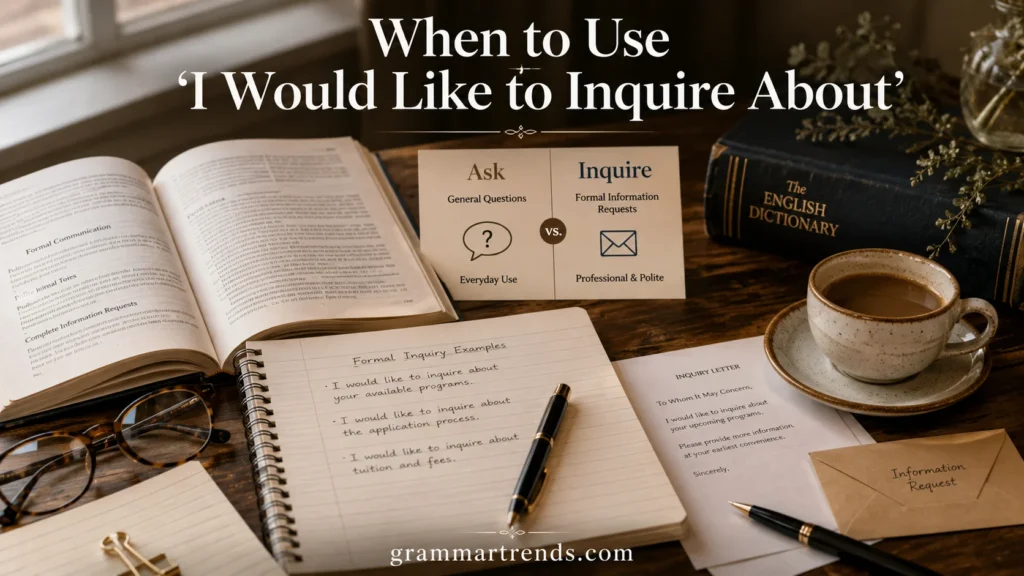
I Would Like to Inquire About
“I would like to inquire about” is one of the clearest formal alternatives to “I would like to ask.”
The verb inquire emphasizes the idea of seeking information. It works particularly well when you’re contacting a company, institution, service provider, department, or professional organization.
When to use “I would like to inquire about”
Use this phrase when you’re asking about:
- Prices
- Services
- Availability
- Requirements
- Deadlines
- Policies
- Procedures
- Applications
- Programs
- Appointments
- Products
- Business opportunities
Examples
I would like to inquire about the application requirements for the fall semester.
Could you please provide information about your current corporate training packages?
I’m also interested in learning about the availability of conference rooms next month.
The phrase works because the reader immediately understands that you’re looking for information.
“Ask” vs. “Inquire”
| “Ask” | “Inquire” |
| Broad and everyday | More formal |
| Works in almost any setting | Especially useful for formal inquiries |
| Natural in workplace conversations | Common in business correspondence |
| Can introduce questions or requests | Usually emphasizes obtaining information |
Tip: Don’t use inquire simply because you think formal writing requires fancy vocabulary. If you’re writing to a coworker about a routine matter, “Could you let me know…” may sound much more natural.
I Am Writing to Inquire About
“I am writing to inquire about” is particularly useful as the opening sentence of a formal email.
It immediately tells the recipient why you’re contacting them.
For example:
I am writing to inquire about the status of my application.
Or:
I am writing to inquire about the registration process for the upcoming conference.
This structure works especially well when you’re contacting someone you don’t know personally.
Why this phrase works
The expression combines two useful pieces of information:
- “I am writing to…” explains the purpose of the email.
- “Inquire about…” identifies what information you need.
That makes the opening efficient.
Professional example
Dear Admissions Office,
I am writing to inquire about the documents required for international applicants. Could you please confirm whether a certified copy of the transcript is necessary?
The writer doesn’t spend several sentences explaining that they’re writing an email. The purpose appears immediately.
When to choose this phrase
Use “I am writing to inquire about…” when the email itself functions as a formal inquiry.
It’s especially suitable for:
- Universities
- Government offices
- Companies
- Customer service departments
- Professional organizations
- Recruitment teams
- Financial institutions
May I Ask?
Sometimes the best alternative to “I would like to ask” is simply “May I ask?”
It’s short, respectful, and natural.
May I ask whether the deadline can be extended?
Could you please let me know when the revised schedule will be available?
I’d also appreciate knowing who I should contact regarding this issue.
The phrase can also introduce a request for permission:
May I ask for an extension until Monday?
Why “May I ask?” works
Unlike longer formal phrases, it doesn’t sound overly rehearsed. It creates a respectful tone while keeping the question concise.
It’s particularly useful when you’re asking someone who has authority or expertise.
Example in a workplace
May I ask whether you would prefer the presentation in PDF or PowerPoint format?
That’s professional without sounding cold.
When not to overuse it
If your email contains several questions, repeating “May I ask…” before each one can become awkward.
Instead, establish the context once and then ask the questions directly.
Could You Please Clarify?
When something is confusing or incomplete, “Could you please clarify?” is usually better than a general phrase such as “I would like to ask.”
The word clarify has a specific purpose: it means making something easier to understand.
Use it when:
- Instructions aren’t clear.
- Two pieces of information conflict.
- A policy needs explanation.
- A requirement seems ambiguous.
- You need more details about something already discussed.
Examples
Could you please clarify which documents I need to submit?
It would be helpful to know whether the revised policy applies to existing employees.
I would also appreciate further details about the final step in the registration process.
Notice the difference between asking and clarifying.
If you don’t know something at all, you might say:
Could you please let me know the application deadline?
If someone gave you an unclear deadline, you might say:
Could you please clarify the application deadline?
The second sentence suggests that some information already exists but needs explanation.
I Would Appreciate Clarification On
Another polished option is “I would appreciate clarification on…”
This phrase sounds professional while clearly identifying the subject that needs explanation.
I would appreciate clarification on the revised payment terms.
Could you please provide more information about the eligibility requirements?
It would also be helpful to understand how the new procedure affects existing applications.
Why it’s useful
This expression works particularly well in business and academic correspondence because it avoids sounding confrontational.
Suppose a policy document contains information that appears inconsistent. You could write:
I would appreciate clarification on the discrepancy between sections three and four of the policy.
That sounds more constructive than:
I don’t understand this policy.
The first sentence focuses on resolving the issue rather than expressing frustration.
A practical distinction
Use “Could you please clarify…?” when you want a direct question.
Use “I would appreciate clarification on…” when you want a slightly more formal statement.
Both are useful. Your choice depends largely on the tone of the message.
I Am Seeking Information About
“I am seeking information about…” is another formal alternative to “I would like to ask.”
It emphasizes that you need specific information.
I am seeking information about your internship opportunities.
Additionally, could you clarify the certification process?
It would also be helpful to know which documents are required for renewal.
Where it works best
This phrase can fit naturally in:
- Business inquiries
- Research correspondence
- Academic emails
- Professional applications
- Customer inquiries
- Requests for official information
It has a straightforward tone. There’s no need to add extra formal language around it.
Make the request specific
Avoid writing:
I am seeking information about your company.
That’s too broad unless you’re genuinely making a general inquiry.
Instead, say:
I am seeking information about your company’s graduate internship program, particularly the application timeline and eligibility requirements.
The second version gives the recipient something concrete to answer.
Specific questions produce better responses.
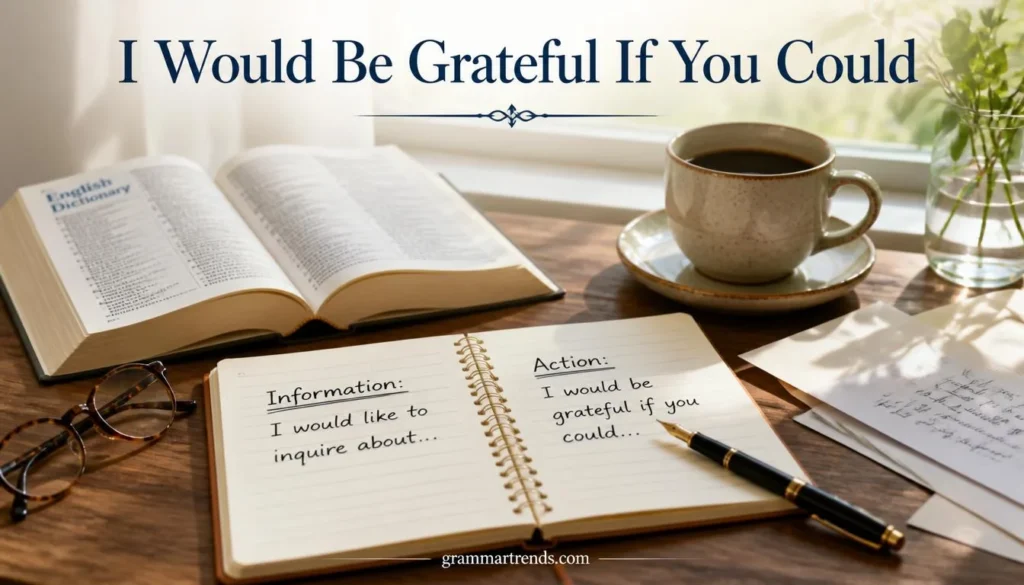
I Would Be Grateful If You Could
Sometimes you’re not simply asking a question. You want the recipient to do something.
That’s where “I would be grateful if you could…” becomes useful.
I would be grateful if you could send me the revised contract.
Could you kindly confirm that you’ve received the documents?
Additionally, I would appreciate your review of the attached proposal.
The expression combines a request with appreciation.
Information vs. action
This distinction helps you choose the right phrase:
| Your goal | Better wording |
| You want information | I would like to inquire about… |
| You need clarification | Could you please clarify…? |
| You want an action | I would be grateful if you could… |
| You want advice | I am writing to seek your guidance… |
Don’t make every request overly elaborate
For a simple workplace request, this may be enough:
Could you please send me the revised file?
You don’t need “I would be most sincerely grateful if you would kindly…”
That’s too heavy for ordinary professional communication.
Politeness works best when it feels natural.
I Am Writing to Request
“I am writing to request…” is one of the strongest choices when you need something specific.
The phrase clearly signals that the email contains a formal request.
I am writing to request a copy of the updated agreement.
Could you please provide an extension of the submission deadline?
I would also appreciate your approval of the proposed schedule.
When “request” is better than “ask”
Use request when you’re seeking:
- Approval
- Documents
- Permission
- A refund
- An extension
- A meeting
- Records
- Assistance
- A specific service
For example:
I would like to ask you for a copy of the invoice.
is understandable.
However:
I am writing to request a copy of the invoice.
is more concise and precise in a formal setting.
A crucial distinction
Ask is broad. Request usually points toward something specific you want the recipient to provide or do.
That makes request particularly useful in formal business correspondence.
I Am Writing to Seek Your Guidance On
Not every professional question needs a factual answer. Sometimes you need someone’s judgment or expertise.
In those situations, “I am writing to seek your guidance on…” is a strong alternative.
I am writing to seek your guidance on how we should proceed with the proposal.
Additionally, could you advise us on the best way to address the client issue?
Your recommendations regarding the appropriate training program would also be greatly appreciated.
Why this phrase feels respectful
The wording recognizes that the recipient has knowledge or authority that you value.
You’re not simply saying:
What should I do?
You’re framing the question professionally:
I am writing to seek your guidance on how we should proceed.
That can be especially appropriate when writing to:
- A manager
- A professor
- A supervisor
- A consultant
- A senior colleague
- A subject-matter expert
Don’t use it for basic information
If you’re simply asking when a meeting starts, there’s no need to seek someone’s guidance.
Say:
Could you please let me know what time the meeting begins?
Reserve guidance for situations where you genuinely want advice or direction.
Could You Please Let Me Know?
For everyday professional emails, “Could you please let me know?” may be one of the most useful alternatives to “I would like to ask.”
It’s polite without sounding overly formal.
Could you please let me know whether my application has been received?
I would be grateful if you could provide the start date for the next training session.
It would also be helpful to know whether the position is still available.
Why it’s so versatile
You can use this structure for:
- Updates
- Confirmation
- Availability
- Deadlines
- Decisions
- Schedules
- Next steps
- Instructions
It also works beautifully in short emails.
Hi Sarah,
Could you please let me know whether the meeting is still scheduled for Thursday?
Thanks,
James
There’s no need to dress up a simple question.
Professional writing should sound professional, not robotic.
Choosing the Right Alternative to “I Would Like to Ask”
The easiest way to choose a phrase is to identify your real purpose before writing the sentence.
Ask yourself one question:
What exactly do I want from the recipient?
When you want information, use inquire.
For an explanation or clearer details, clarify is a better choice.
If you need someone to take action, use request.
When you’re looking for advice or direction, seek your guidance works well.
If you simply need an answer, could you please let me know is a polite and natural option.
Decision guide
| Situation | Recommended phrase | Example |
| Asking about a service | I would like to inquire about… | I would like to inquire about your consulting services. |
| Opening a formal inquiry | I am writing to inquire about… | I am writing to inquire about the admission process. |
| Asking respectfully | May I ask…? | May I ask whether the deadline has changed? |
| Resolving confusion | Could you please clarify…? | Could you please clarify the submission requirements? |
| Requesting an explanation | I would appreciate clarification on… | I would appreciate clarification on the revised policy. |
| Seeking details | I am seeking information about… | I am seeking information about your training programs. |
| Requesting action | I would be grateful if you could… | I would be grateful if you could send the report. |
| Making a formal request | I am writing to request… | I am writing to request an extension. |
| Seeking advice | I am writing to seek your guidance on… | I am writing to seek your guidance on the proposal. |
| Asking for an update | Could you please let me know…? | Could you please let me know when the results will be available? |
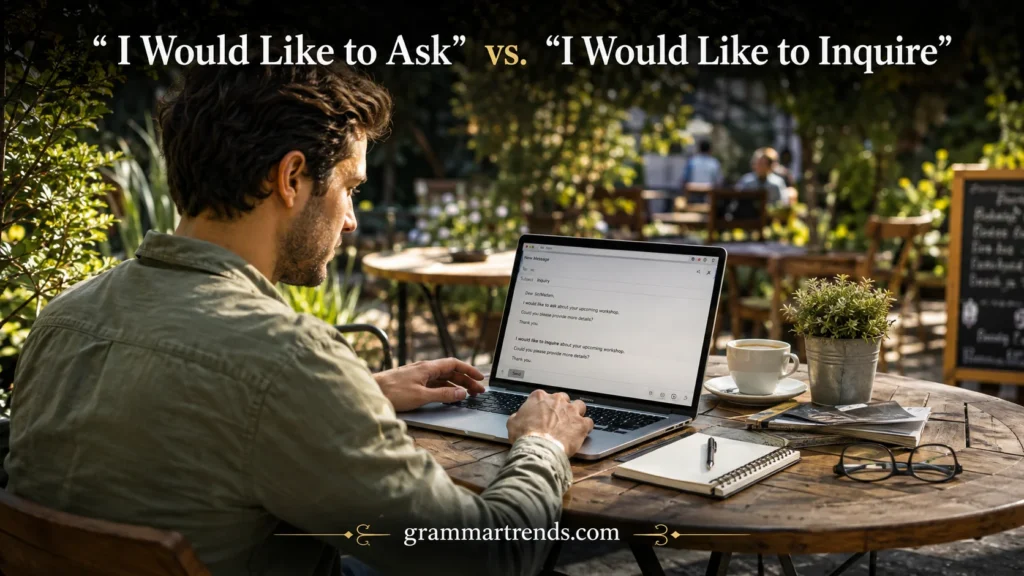
“I Would Like to Ask” vs. “I Would Like to Inquire”
These two expressions are closely related, but they aren’t identical in tone or use.
“I would like to ask” is broader.
“I would like to inquire” puts more emphasis on obtaining information.
Consider these examples:
I would like to ask about your refund policy.
I would like to inquire about your refund policy.
Both are correct.
The second sounds more like a formal business inquiry. The first sounds more neutral and conversational.
Which one should you use?
Choose “I would like to ask” when you want a simple, natural question.
Choose “I would like to inquire” when you’re making a formal inquiry, particularly with an organization or unfamiliar recipient.
There’s no universal winner.
Context decides.
“I Am Writing to Ask” Is Also Professional
Another useful point often gets overlooked: you don’t have to avoid ask just because you’re writing formally.
“I am writing to ask…” is professional and natural.
For example:
I am writing to ask whether you could provide additional information about the program.
This can sound more natural than forcing an elaborate synonym into the sentence.
Compare:
I am writing to seek clarification regarding the aforementioned requirements.
with:
I am writing to ask for clarification about these requirements.
The second version is easier to read. It also sounds more like something a real professional would write.
The lesson
Don’t confuse formal with complicated.
Clear language often makes the stronger impression.
How to Make “I Would Like to Ask” More Professional
Changing one phrase isn’t always enough to improve an email.
A strong professional request usually contains four elements:
Give brief context
Explain why you’re contacting the recipient.
I am preparing the documents for the upcoming audit.
State the request clearly
Ask for exactly what you need.
Could you please confirm which financial records should be included?
Add a reasonable timeframe
If timing matters, say so.
If possible, I would appreciate your response by Thursday.
Close courteously
A simple closing is usually enough.
Thank you for your assistance.
This structure keeps your email focused without sounding abrupt.
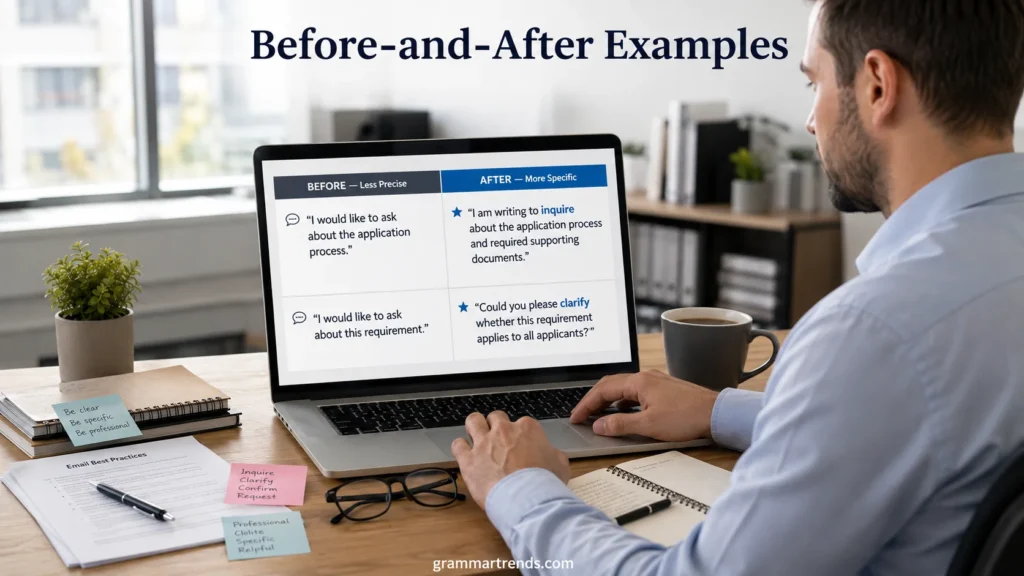
Before-and-After Examples
Seeing the difference in context makes these phrases easier to remember.
Asking about an application
Less precise:
I would like to ask about the application process.
More specific:
I am writing to inquire about the application process and required supporting documents.
The second version tells the recipient exactly what information matters.
Asking for clarification
Less precise:
I would like to ask about this requirement.
Better:
Could you please clarify whether this requirement applies to all applicants?
Now the recipient knows precisely what needs clarification.
Requesting a document
Less precise:
I would like to ask you to send the updated invoice.
Better:
I am writing to request a copy of the updated invoice.
The second version is cleaner and more direct.
Seeking professional advice
Less precise:
I would like to ask what you think we should do.
Better:
I am writing to seek your guidance on how we should proceed.
The improved version recognizes the recipient’s expertise.
Asking for an update
Less precise:
I would like to ask if there is any update.
Better:
Could you please let me know if there has been any update on the application?
The question becomes more direct and easier to answer.
Common Mistakes When Using Formal Alternatives
Knowing formal expressions isn’t enough. You also need to know when not to use them.
Using “Inquire” for every question
Not every question is an inquiry.
Could you please let me know what time lunch starts?
sounds more natural than:
I would like to inquire about what time lunch starts.
The second isn’t necessarily wrong. It simply sounds unnecessarily formal.
Using “Request” when you only need information
If you’re asking for a fact, request may change the meaning.
Instead of:
I am writing to request the application deadline.
write:
I am writing to inquire about the application deadline.
You’re seeking information rather than asking someone to perform an action.
Asking for clarification when nothing is unclear
Don’t use clarify merely because you want information.
If you’ve never received the schedule, say:
Could you please let me know when the schedule will be released?
If you’ve received two conflicting schedules, say:
Could you please clarify which schedule is correct?
That distinction makes your writing more accurate.
Making emails too formal
A sentence can be grammatically correct and still sound unnatural.
For example:
I would be most appreciative if you would be so kind as to furnish me with the requested information.
That’s technically elaborate. It’s also unnecessarily wordy.
A cleaner version is:
Could you please provide the requested information?
Shorter often wins.
A Simple Formal Email Formula
You can adapt the following structure to many professional situations:
Subject: Inquiry Regarding [Topic]
Dear [Name],
I am writing to inquire about [specific topic].
[Briefly explain the relevant context.]
Could you please let me know [specific question]?
I would appreciate your response by [date], if possible.
Thank you for your time and assistance.
Best regards,
[Your Name]
Example
Subject: Inquiry Regarding Training Schedule
Dear Ms. Carter,
I am writing to inquire about the schedule for the upcoming training program. I am particularly interested in the session dates and registration deadline.
Could you please let me know when registration closes?
Thank you for your assistance.
Best regards,
Daniel
The message works because it is clear, specific, polite, and easy to answer.
Read more: 12 Other Ways to Say “After Careful Consideration”
Case Study: Choosing the Right Phrase
Imagine that an employee needs to contact the HR department.
The employee first writes:
I would like to ask about my leave request. I submitted it last week and haven’t heard anything.
The sentence is perfectly understandable. However, the purpose is actually to request an update.
A stronger version would be:
Could you please let me know if there has been any update on my leave request submitted last week?
Now the HR team knows exactly what the employee wants.
What changed?
The writer didn’t simply replace ask with a fancier verb.
Instead, the writer identified the real purpose of the email.
That’s the key to choosing effective formal language.
Case Study: Asking for Guidance
Consider a new employee who needs advice about handling a client complaint.
A basic version might say:
I would like to ask what I should do about this complaint.
A more professional version is:
I am writing to seek your guidance on how I should respond to this client complaint.
The second sentence works because the writer isn’t simply requesting a fact. They’re asking a more experienced person for direction.
That difference changes the appropriate vocabulary.
Case Study: Requesting a Document
Suppose a customer needs a copy of an invoice.
A weakly structured request might read:
I would like to ask if you can send me my invoice.
A sharper version is:
I am writing to request a copy of my invoice.
The second sentence is shorter and more direct.
If the recipient needs additional information, the writer can add it afterward:
The invoice relates to order #4827, placed in June.
This approach gives the recipient enough information to act without forcing them to search through the entire email.
Professional Email Phrases: Quick Reference
Keep this list handy when you’re writing your next formal email:
- For general information: “I would like to inquire about…”
- For a formal inquiry: “I am writing to inquire about…”
- For a respectful question: “May I ask…?”
- For confusion: “Could you please clarify…?”
- For a formal explanation: “I would appreciate clarification on…”
- For specific details: “I am seeking information about…”
- For a polite action request: “I would be grateful if you could…”
- For a formal request: “I am writing to request…”
- For advice: “I am writing to seek your guidance on…”
- For updates or confirmation: “Could you please let me know…?”
My Personal Experience as an English Specialist
As an English specialist, I have reviewed hundreds of professional emails from students, job seekers, and business professionals. One common pattern I notice is the overuse of the phrase “I would like to ask.” While the phrase is polite and grammatically correct, it can sound repetitive when used in every email. Through my experience, I have found that alternatives such as “I would like to inquire,” “Could you please clarify,” and “I am writing to request” often make messages sound more professional and purposeful. Small wording changes can improve clarity, create a stronger first impression, and help the writer communicate more effectively. This is why I always encourage learners to choose phrases that match their specific purpose rather than relying on the same expression repeatedly.
FAQs
1. Is “I would like to ask” formal enough for an email?
Yes. “I would like to ask” is polite and suitable for most professional emails. You can also use phrases such as “I wish to inquire” or “May I ask” for variety.
2. What is a more professional way to say “I would like to ask”?
“I wish to inquire” is a strong formal alternative. You can also write “I am writing to seek your guidance” when you need advice or assistance.
3. Can I use “Could you please tell me” in a formal email?
Yes. “Could you please tell me” sounds polite, clear, and natural. It works well when you need specific information from a colleague, client, or organization.
4. Is “I’m reaching out to ask” professional?
Yes. “I’m reaching out to ask” is common in professional communication. It has a friendly tone while still sounding respectful and appropriate for business emails.
5. How can I politely ask for information in an email?
You can use “I would appreciate information”, “I’m seeking information,” or “I would be grateful if you could tell me.” Choose the phrase based on how formal you want your request to sound.
6. Which synonym should I use when asking for help?
“I am writing to seek your guidance” works especially well when you need advice or support. If you simply need an answer, “May I ask” or “Could you please tell me” may sound more natural.
Conclusion
Choosing the right phrase can make a formal email sound more natural, polite, and professional. Instead of using “I would like to ask” every time, try phrases such as I wish to inquire, May I ask, or I’m reaching out to ask. Each option gives your request a slightly different tone while keeping your message clear and respectful.
From my experience, the best choice depends on who you’re writing to and what you need. If you want a simple and polite request, Could you please tell me works well. For a more professional tone, I am writing to seek your guidance is a strong choice. The key is to choose wording that feels natural while showing respect for the reader’s time.

Mia Rose brings fifteen years of experience at The University of Edinburgh’s English Literature department, leading students through explorations of classic and contemporary texts, literary theory, and narrative design. Her academic interests center on Victorian and modernist fiction, poetic rhythms, postcolonial storytelling, and digital approaches to literary study—with a keen eye on how voice and perspective frame cultural dialogue. Mia has delivered talks at prestigious global conferences and authored articles in scholarly journals, showcasing her commitment to meaningful research and lively classroom engagement.