

The 15 Professional Ways to Say “Personal Reasons” at Work can help you explain needing time off while keeping your message professional and respectful.
When you get out of work because of personal reasons, you don’t need to share every detail. Phrases such as unforeseen personal circumstances, private matters, private situation, personal affairs, individual circumstances, personal issues, personal obligations, private matter, personal responsibilities, and personal matter offer useful synonyms to express reasons without sounding informal or insincere. These terms can help you discuss personal problems, circumstances, matters, affairs, issues, obligations, and responsibilities while protecting your privacy and avoiding unnecessary trouble at work.
In some cases, the reason may involve leaving a job, taking time to move on, or choosing to seek opportunities with a new employer. Alternatively, you may simply need a short break from your workplace. If you decide to leave, a personal reason resignation letter or resignation letter can explain your professional decision without revealing everything. This article covers writing, when to write, and what to include as you enter the next chapter of your career. Whether you’ve spent years with the same company in Australia or you’re among the people ready for a change, handling your personal reason carefully can help keep workplace relationships intact and give you greater confidence.
Quick Answer
The most natural professional alternatives to “personal reasons” are “due to personal circumstances,” “due to a personal matter,” and “due to personal obligations.” Choose the phrase that best matches your situation while keeping private details confidential.

What Does “Personal Reasons” Mean?
The phrase “personal reasons” refers to circumstances connected to your private life rather than your professional responsibilities.
Merriam-Webster defines personal as relating to or affecting a particular person. It also gives “private” and “individual” among its related meanings.
That distinction matters in professional communication.
When you say:
“I need to take Friday off for personal reasons.”
you’re communicating that something outside your work responsibilities requires your attention. You’re not necessarily saying that the matter is serious, urgent, or confidential. You’re simply choosing not to provide the details.
That can be completely appropriate.
Common situations include:
- Requesting personal leave
- Explaining an absence
- Leaving work early
- Rescheduling a meeting
- Declining an invitation
- Adjusting your work schedule
- Requesting several days off
- Explaining a resignation
- Taking time to handle family responsibilities
- Dealing with an unexpected private situation
The phrase works because it provides enough context without unnecessary disclosure.
Is “Personal Reasons” Professional?
Yes. “Personal reasons” is professional, natural, and widely understandable.
You don’t need to replace it simply because you’re writing to a manager or employer.
For example:
“I’m requesting Friday off due to personal reasons.”
This sounds perfectly acceptable.
Still, another expression may fit better when you want to communicate a particular nuance. Compare these examples:
- Personal reasons → broad and neutral
- Personal circumstances → broader and more formal
- A personal matter → one specific issue
- Personal obligations → responsibilities you need to fulfill
- Personal commitments → planned responsibilities or appointments
- Private matter → emphasizes confidentiality
- Urgent personal matter → emphasizes immediate attention
The trick isn’t finding the fanciest synonym. It’s choosing the phrase that accurately matches your situation.
The Best Professional Ways to Say “Personal Reasons”
Here’s a quick comparison before looking at each expression in detail.
| Alternative | Best Use | Tone |
| Due to personal circumstances | General workplace situations | Professional and neutral |
| Due to unforeseen personal circumstances | Unexpected situations | Formal and serious |
| Due to a personal matter | One specific private issue | Neutral and polished |
| Owing to personal obligations | Responsibilities that require attention | Formal |
| Due to family responsibilities | Family-related duties | Professional and specific |
| Because of a private matter | Situations requiring privacy | Discreet |
| To attend to a personal matter | Temporary absence | Natural and professional |
| Due to personal commitments | Planned obligations | Professional |
| Because of an urgent personal matter | Time-sensitive situations | Clear and serious |
| Due to circumstances requiring my attention | Highly private situations | Formal and discreet |
| For personal matters | Short workplace messages | Neutral |
| To address a personal matter | Handling a particular issue | Professional |
| Due to private circumstances | Sensitive situations | Formal |
| For reasons of a personal nature | Official correspondence | Very formal |
| Because of personal obligations | Responsibilities outside work | Professional |
Due to Personal Circumstances
“Due to personal circumstances” is one of the most useful professional alternatives to “personal reasons.”
It keeps the explanation deliberately broad. At the same time, it sounds slightly more formal than the original phrase.
The word circumstances suggests the conditions or situation surrounding something. Merriam-Webster defines a circumstance as a condition, fact, event, or state of affairs that accompanies or affects a situation.
That makes this phrase particularly useful when several factors may be involved.
Example:
“Due to personal circumstances, I won’t be available tomorrow.”
Another example:
“I’m requesting two days of leave due to personal circumstances.”
This wording works well when you want to maintain privacy without sounding evasive.
Best situations for this phrase
Use “due to personal circumstances” when:
- You need general wording.
- You don’t want to disclose private details.
- The situation may involve more than one factor.
- You’re writing to a manager, HR department, client, or colleague.
- You want a professional but natural tone.
Due to Unforeseen Personal Circumstances
Sometimes the situation didn’t appear on your calendar.
When something unexpected happens, “due to unforeseen personal circumstances” provides more context than simply saying “personal reasons.”
The word unforeseen signals that you didn’t anticipate the situation.
Example:
“Due to unforeseen personal circumstances, I’m unable to attend today’s meeting.”
Another example:
“I need to take tomorrow off due to unforeseen personal circumstances.”
However, don’t use “unforeseen” when the situation was planned.
If you scheduled a medical appointment three weeks ago, for example, calling it “unforeseen” would create the wrong impression.
When this phrase works best
Use it for:
- Sudden personal situations
- Unexpected absences
- Last-minute schedule changes
- Emergency-adjacent circumstances that aren’t necessarily emergencies
It sounds more serious than “due to personal circumstances,” so use it honestly.
Due to a Personal Matter
If you’re dealing with one particular issue, “due to a personal matter” often sounds better than the plural “personal reasons.”
The singular matter makes the expression feel focused.
For example:
“I need to leave early today due to a personal matter.”
This doesn’t tell the reader what the matter involves. That’s the point.
A matter can refer to something that needs to be dealt with or considered. In professional communication, that makes the expression especially useful when you need to protect your privacy.
Why this phrase works
It is:
- Short
- Clear
- Polite
- Professional
- Private
- Easy to use in emails
You can also say:
“I’m requesting the afternoon off to handle a personal matter.”
That version sounds slightly more conversational.
Owing to Personal Obligations
“Owing to personal obligations” works when you have responsibilities that require your attention.
The word obligations carries more meaning than simply “reasons.” It suggests something you need or must take care of.
For example:
“Owing to personal obligations, I’ll need to adjust my schedule on Friday.”
This could refer to family responsibilities, appointments, legal matters, important commitments, or other private duties.
The phrase sounds more formal than “due to personal reasons.”
When to use it
Choose this expression when:
- You have a responsibility outside work.
- You need to explain a schedule change.
- You’re writing a formal request.
- You want to emphasize responsibility rather than privacy.
Don’t use it when you’re simply trying to sound sophisticated. If a normal workplace email would sound better with “personal circumstances,” use the simpler option.
Due to Family Responsibilities
Sometimes you can provide a little more context without revealing anything sensitive.
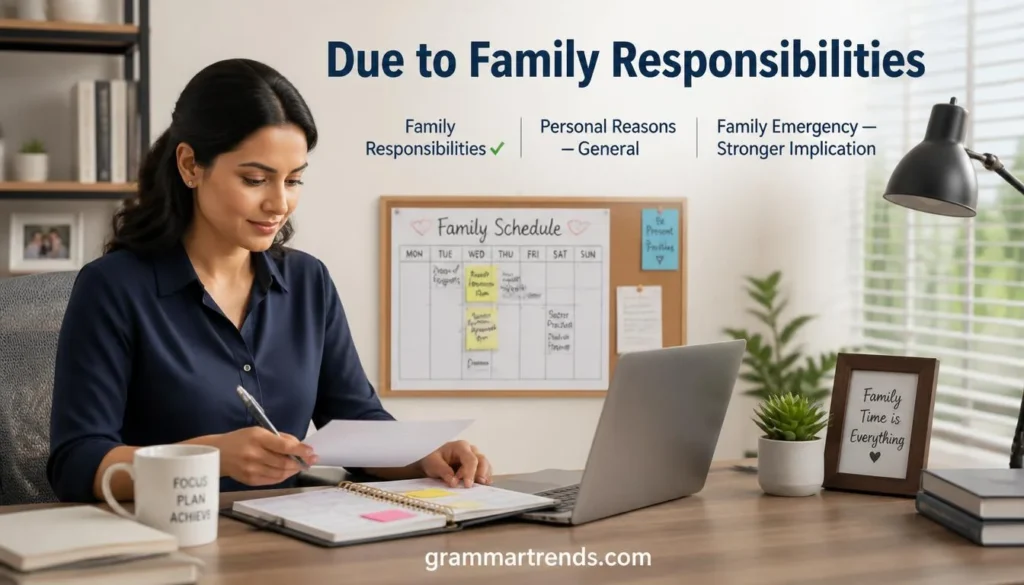
“Due to family responsibilities” does exactly that.
It tells the reader that your absence relates to family without requiring details.
For example:
“Due to family responsibilities, I won’t be able to attend the evening event.”
Or:
“I’m requesting Friday off due to family responsibilities.”
This phrase is more specific than “personal reasons.” It also avoids the stronger implication of “family emergency.”
That distinction matters.
A family responsibility doesn’t necessarily mean something went wrong. You could need to care for a child, assist a family member, attend an important family appointment, or handle another obligation.
Because of a Private Matter
If confidentiality matters most, “because of a private matter” can work well.
For example:
“I’m unable to discuss the details because of a private matter.”
Or:
“I’ll need to leave early because of a private matter.”
The word private directly emphasizes that the information isn’t something you want to share.
Still, there’s a subtle difference between personal and private.
Personal identifies something as relating to your life. Private puts more emphasis on keeping information confidential.
Compare:
“I’m unavailable due to a personal matter.”
with:
“I’m unavailable due to a private matter.”
The first sounds neutral. The second makes privacy more noticeable.
To Attend to a Personal Matter
“To attend to a personal matter” is a particularly natural choice when you need time to deal with something.
It focuses on what you need to do rather than forcing you to describe the underlying situation.
For example:
“I need to step away this afternoon to attend to a personal matter.”
Or:
“I’m requesting the morning off to attend to a personal matter.”
This wording works beautifully in workplace communication because it explains why your presence is temporarily required elsewhere.
It also sounds less bureaucratic than some formal alternatives.
A useful distinction
Compare:
“I’m absent due to personal reasons.”
with:
“I need to be away this afternoon to attend to a personal matter.”
The second sentence gives the reader a clearer picture of the practical situation. You need time away because something requires your attention.
Due to Personal Commitments
“Due to personal commitments” works especially well when the situation was planned or already scheduled.
For example:
“Due to a prior personal commitment, I won’t be able to attend the meeting.”
This phrase often sounds more appropriate than “unforeseen personal circumstances” when you knew about the situation beforehand.
Think of the difference this way:
Commitment = something you have already agreed or arranged to do.
Unforeseen circumstance = something you didn’t expect.
That simple distinction can help you choose the right phrase quickly.
Examples
Planned:
“I won’t be available Friday due to a prior personal commitment.”
Unexpected:
“I won’t be available tomorrow due to unforeseen personal circumstances.”
Both are professional. They simply communicate different situations.
Because of an Urgent Personal Matter
When something genuinely requires immediate attention, “because of an urgent personal matter” can communicate the seriousness without revealing the details.
For example:
“Because of an urgent personal matter, I need to leave the office immediately.”
This wording is stronger than simply saying “personal reasons.”
Use urgent carefully.
If you use the word too casually, people may assume you’re dealing with a crisis. That can create unnecessary concern and may invite questions you don’t want to answer.
Better practice
Use “urgent” when:
- You need to leave unexpectedly.
- You can’t reasonably postpone the matter.
- You need immediate schedule flexibility.
- The timing genuinely matters.
Don’t use it merely to make a routine request sound important.
Due to Circumstances Requiring My Attention
For highly private situations, “due to circumstances requiring my attention” provides considerable discretion.
For example:
“Due to circumstances requiring my attention, I’ll be unavailable this afternoon.”
This phrase doesn’t identify the situation as family-related, medical, financial, legal, or anything else.
It simply explains that something requires your attention.
The wording is quite formal, so it fits best in official correspondence or situations where you want to maintain a high level of discretion.
For an everyday message to a familiar coworker, it may sound unnecessarily stiff.
In that situation, “I need to attend to a personal matter” usually sounds more natural.
For Personal Matters
“For personal matters” is short and straightforward.
For example:
“I’ll be taking Friday off for personal matters.”
You may also see:
“I need to be away from work for personal matters.”
This expression works best in short messages where the reader doesn’t need additional information.
However, “for a personal matter” can sound more natural when you’re referring to one specific situation.
Compare:
- “I’m leaving early for personal matters.”
- “I’m leaving early for a personal matter.”
The second often sounds smoother because you’re referring to one immediate issue.
To Address a Personal Matter
“To address a personal matter” emphasizes the need to handle something.
For example:
“I’m requesting the morning off to address a personal matter.”
The verb address suggests that you’re dealing with, responding to, or taking care of something.
This makes the phrase useful in formal workplace communication.
It also avoids unnecessary emotional language.
You aren’t saying that the matter is terrible. You’re simply saying it needs your attention.
Good examples
“I need to reschedule our meeting to address a personal matter.”
“I’ll be unavailable for part of the afternoon while I address a personal matter.”
“I’m requesting one day of leave to address a personal matter.”
Due to Private Circumstances
“Due to private circumstances” is another discreet option.
It puts strong emphasis on confidentiality.
For example:
“Due to private circumstances, I’m unable to participate in tomorrow’s meeting.”
This expression is grammatically sound, but it can feel more formal and less conversational than “due to personal circumstances.”
That’s an important lesson in professional writing: formal doesn’t always mean better.
If your manager normally communicates with the team in a relaxed tone, overly formal language can make a simple message sound oddly distant.
For Reasons of a Personal Nature
This is one of the most formal options on the list.
For example:
“For reasons of a personal nature, I respectfully request leave from June 10 through June 12.”
The phrase can work in:
- Formal letters
- Official statements
- Administrative documents
- Highly formal correspondence
But it isn’t usually the best choice for an ordinary workplace email.
Compare:
“For reasons of a personal nature, I request Friday off.”
with:
“I’d like to request Friday off due to personal circumstances.”
The second is clearer and more natural.
Use formal language because the situation requires it, not because longer wording automatically sounds more professional.
Because of Personal Obligations
“Because of personal obligations” is useful when you need to fulfill responsibilities outside your job.
For example:
“Because of personal obligations, I’ll need to adjust my schedule next week.”
This phrase can cover many situations without revealing private details.
It works particularly well when the reader needs to understand that your absence isn’t optional or casual.
Personal obligations vs. personal commitments
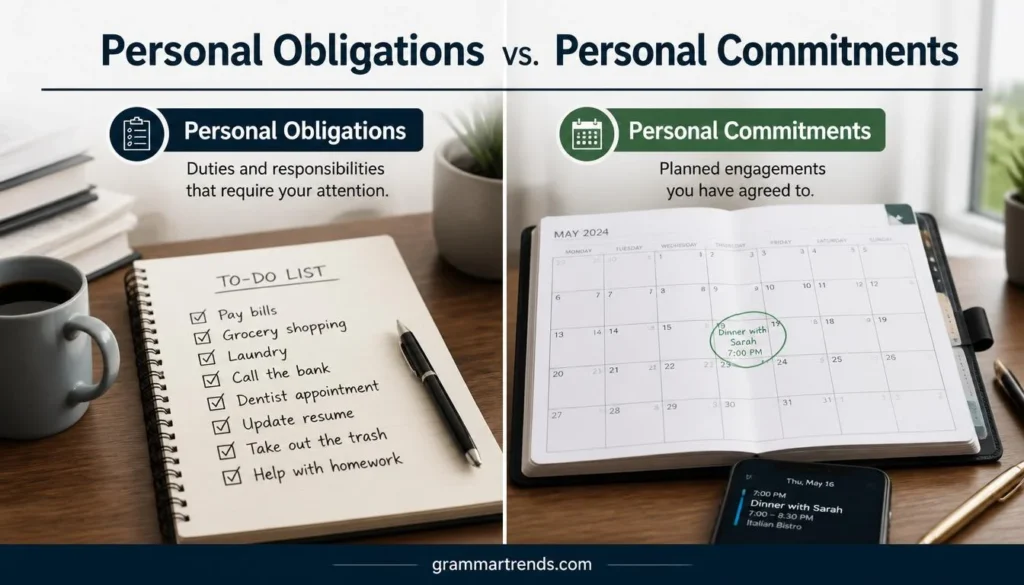
These phrases overlap, but they aren’t identical.
Personal commitments often suggest something you’ve planned or agreed to.
Personal obligations can sound stronger. They suggest responsibilities that require your attention.
For example:
“I have a prior personal commitment.”
sounds like a scheduled engagement.
Meanwhile:
“I have personal obligations to attend to.”
sounds like responsibilities that need handling.
Professional Alternatives by Situation
Choosing the right phrase becomes much easier when you start with the situation rather than the synonym.
When Requesting Time Off
Use:
- Due to personal circumstances
- Due to a personal matter
- To attend to a personal matter
- Due to personal obligations
- For personal matters
Example:
“I’d like to request Friday off to attend to a personal matter.”
When Explaining an Unexpected Absence
Use:
- Due to unforeseen personal circumstances
- Because of an urgent personal matter
- Due to circumstances requiring my attention
Example:
“Due to unforeseen personal circumstances, I’m unable to come into the office today.”
When You Want to Protect Your Privacy
Use:
- Because of a private matter
- Due to private circumstances
- Due to personal circumstances
- Due to circumstances requiring my attention
Example:
“I’m unable to provide further details because this involves a private matter.”
When Rescheduling a Meeting
Use:
- Due to personal commitments
- Due to a personal matter
- To address a personal matter
Example:
“I need to reschedule our meeting due to a personal commitment.”
When Resigning From a Job
Use:
- Due to personal circumstances
- For personal reasons
- Due to personal obligations
- For reasons of a personal nature
Example:
“After careful consideration, I’ve decided to resign from my position due to personal circumstances.”
“Personal Reasons” vs. “Personal Matters” vs. “Personal Circumstances”
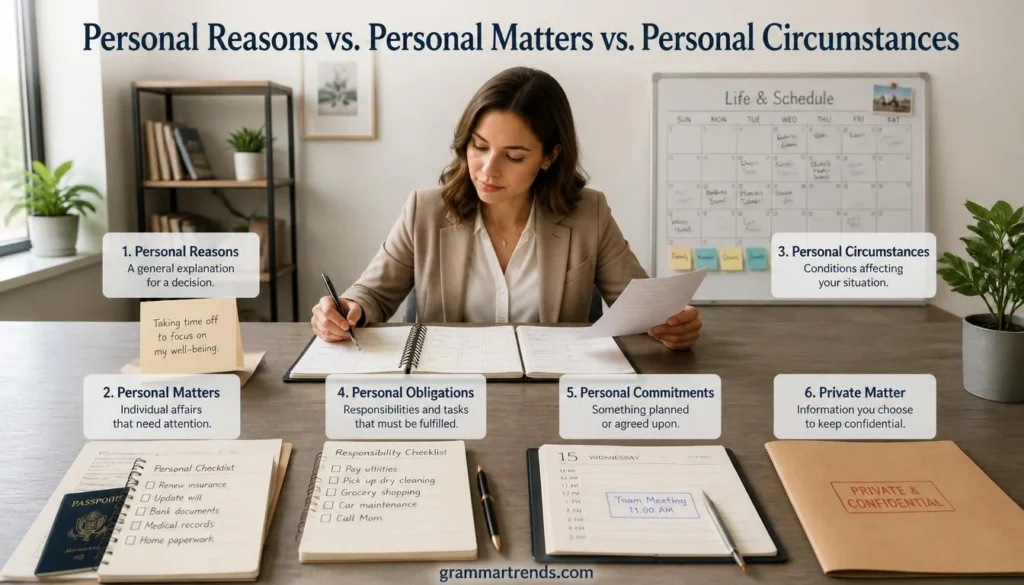
These expressions look interchangeable at first glance. They aren’t quite the same.
| Phrase | Main Idea | Example |
| Personal reasons | General explanation | “I’m leaving for personal reasons.” |
| Personal matters | Private issues or affairs | “I need time to handle personal matters.” |
| Personal circumstances | Conditions surrounding your situation | “Due to personal circumstances, I’ll be unavailable.” |
| Personal obligations | Responsibilities you need to fulfill | “I have personal obligations to address.” |
| Personal commitments | Planned responsibilities | “I have a prior personal commitment.” |
| Private matter | Something you want to keep confidential | “I need time to address a private matter.” |
The difference comes from the words surrounding personal.
Merriam-Webster’s definition of circumstance focuses on conditions, facts, events, or a state of affairs surrounding a situation.
That makes “personal circumstances” particularly useful when the exact reason involves several factors.
How to Choose the Right Professional Alternative
You can use a simple decision process.
Do you need a broad, neutral phrase?
→ Choose “due to personal circumstances.”
Are you dealing with one particular issue?
→ Choose “due to a personal matter.”
Did the situation happen unexpectedly?
→ Choose “due to unforeseen personal circumstances.”
Do you have a responsibility that requires your attention?
→ Choose “due to personal obligations.”
Was the situation already planned?
→ Choose “due to personal commitments.”
Do you want to emphasize confidentiality?
→ Choose “because of a private matter.”
Do you need to explain why you’re stepping away temporarily?
→ Choose “to attend to a personal matter.”
Is the matter genuinely urgent?
→ Choose “because of an urgent personal matter.”
Do you need maximum discretion?
→ Choose “due to circumstances requiring my attention.”
This approach keeps your wording purposeful instead of forcing every situation into the same phrase.
Professional Email Examples
A good workplace explanation usually needs more than a reason.
It should also tell the reader what they need to know next.
That might include when you’ll return, whether your work is covered, or whether you’ll remain available.
Requesting a Day Off
Subject: Leave Request for Friday
I’d like to request Friday off due to personal circumstances. I’ll complete my priority tasks beforehand and make sure anything time-sensitive is covered.
Explaining an Unexpected Absence
Subject: Unable to Attend Today
Due to unforeseen personal circumstances, I’m unable to come into the office today. I’ll keep you updated regarding my availability and will respond to urgent messages when possible.
Leaving Work Early
Subject: Early Departure Today
I need to leave early today to attend to a personal matter. I’ll finish the remaining priority tasks before I leave.
Rescheduling a Meeting
I’m sorry, but I need to reschedule our meeting due to a personal commitment. Please let me know which of the following times works best for you.
Formal Leave Request
I’m requesting leave from Monday through Wednesday due to personal obligations. I’ll ensure that my current responsibilities are addressed before my absence.
Resignation
After careful consideration, I’ve decided to resign from my position due to personal circumstances. I appreciate the opportunities and experience I’ve gained during my time with the organization.
Notice what these examples have in common.
They don’t overshare.
They also don’t leave the reader wondering what happens next.
Case Study: Choosing the Right Phrase for a Planned Appointment
Imagine that Jordan has an important appointment next Friday.
Jordan already scheduled it several weeks ago and needs three hours away from work.
A weak message might say:
“I need to leave because of unforeseen personal circumstances.”
The problem is “unforeseen.” The appointment wasn’t unexpected.
A better version would be:
“I need to leave early next Friday due to a prior personal commitment.”
That sentence accurately communicates the situation without revealing private details.
Lesson: Match the wording to the facts. Professional language works best when it’s precise.
Case Study: Handling an Unexpected Situation
Now imagine that Maria receives an unexpected private call during the workday. She needs to leave immediately.
She doesn’t want to explain the details to her team.
A suitable message would be:
“Because of an urgent personal matter, I need to leave the office immediately. I’ll provide an update regarding my availability later today.”
Here, urgent and personal matter both serve a purpose.
The message tells colleagues that the situation requires immediate attention. It doesn’t disclose private information.
Lesson: Use stronger language only when the circumstances justify it.
Read more: 9 Professional Ways to Say “I Would Appreciate Your Input on This Matter
Case Study: Writing a Formal Leave Request
Suppose Daniel needs several days away from work because of responsibilities outside his job.
He doesn’t want to provide personal details in a formal written request.
Instead of writing:
“I need time off because of some stuff happening in my life.”
he could write:
“I’m requesting leave from August 20 through August 22 due to personal circumstances.”
That’s concise, professional, and clear.
If his responsibilities are central to the request, he could write:
“I’m requesting leave from August 20 through August 22 due to personal obligations.”
Lesson: A professional phrase should protect privacy while still communicating the practical information your workplace needs.
Common Mistakes to Avoid
Professional writing isn’t about making every sentence sound formal. In fact, overly polished wording can sometimes make a simple message less natural.
Giving Too Much Personal Information
You usually don’t need to explain your private situation in detail.
Instead of:
“I need Friday off because my family situation has become complicated and I have several personal issues to deal with.”
try:
“I need Friday off due to personal circumstances.”
Then provide only the information your workplace actually needs.
Privacy isn’t unprofessional.
Using “Urgent” for Routine Situations
Calling something urgent tells the reader that immediate action matters.
Don’t use it merely to make your request sound more important.
For a routine appointment, say:
“I need to leave early due to a personal commitment.”
For a genuinely time-sensitive situation, you might say:
“I need to leave early because of an urgent personal matter.”
Choosing Overly Formal Language
Some expressions are technically professional but sound unnatural in ordinary conversation.
For example:
“For reasons of a personal nature, I shall be unavailable.”
That sounds unnecessarily stiff.
A better option:
“I’ll be unavailable due to personal circumstances.”
Clear beats complicated.
Making the Message Sound Like an Excuse
The strongest workplace messages usually combine a brief explanation with practical information.
Instead of:
“I can’t come in because of personal reasons.”
try:
“Due to a personal matter, I’ll be unavailable tomorrow. I’ll complete the client report today and respond to urgent messages when possible.”
The second version gives the reader something useful.
Is It Better to Say “Personal Reasons” or Give a Specific Reason?
There isn’t one universal answer.
The right amount of detail depends on the situation, your workplace, and what the recipient actually needs to know.
If your manager only needs to know that you’re unavailable, “personal reasons” may be enough.
If you need schedule flexibility, you might provide a little more context:
“I need to leave early to attend to a personal matter.”
If your workplace policy requires documentation for certain types of leave, a vague phrase may not satisfy the administrative requirement.
That’s an important distinction:
Professional wording doesn’t replace workplace policy.
A polished sentence can’t override a requirement to provide appropriate documentation or notice.
When in doubt, check the applicable workplace policy and give only the information required.
How Much Personal Information Should You Share?
A useful rule is:
Share the information necessary to explain the work impact, not every detail behind the situation.
For example, your manager may need to know:
- When you’ll be absent
- How long you’ll be unavailable
- Whether a deadline is affected
- Whether someone needs to cover your responsibilities
- When you’ll return
- Whether you can be contacted
They may not need to know:
- Private family details
- Personal financial information
- Sensitive relationship matters
- Detailed personal circumstances
- Other information unrelated to work
This approach keeps communication both professional and respectful.
Quick Guide to the Most Natural Alternatives
| What you mean | Best phrase |
| A general private situation | Due to personal circumstances |
| An unexpected situation | Due to unforeseen personal circumstances |
| One specific issue | Due to a personal matter |
| A responsibility | Due to personal obligations |
| A planned engagement | Due to a personal commitment |
| A family-related responsibility | Due to family responsibilities |
| A confidential issue | Because of a private matter |
| Something you need to handle | To attend to a personal matter |
| Something requiring immediate attention | Because of an urgent personal matter |
| Maximum discretion | Due to circumstances requiring my attention |
| Highly formal communication | For reasons of a personal nature |
My Personal Experience as an English Specialist
As an English specialist, I’ve learned that “personal reasons” is already a professional phrase. You don’t need to explain every private detail at work. When I help people improve workplace communication, I often recommend simple alternatives such as “due to personal circumstances,” “due to a personal matter,” or “due to personal obligations.”
For example, instead of saying:
“I can’t come to work because of personal reasons.”
you can write:
“I’m unable to come to work due to personal circumstances.”
I’ve found that the best professional wording is usually clear, brief, and honest. Choose a phrase that matches your situation, protect your privacy, and share only the information your workplace actually needs.
FAQs
1. What’s a professional way to say “personal reasons” at work?
You can say “due to unforeseen personal circumstances,” “owing to a private matter,” or “because of personal obligations.” These phrases sound professional without requiring you to reveal private details.
2. Do I have to explain my personal reasons to my employer?
Not always. In many situations, you can simply state that you have a personal matter that requires your attention. However, specific workplace policies may require additional information for certain types of leave.
3. How can I ask for time off without giving too much information?
Keep your request short and respectful. For example, you could say, “I need some time off due to personal circumstances that require my attention.” This gives your employer enough context without oversharing.
4. Is “personal reasons” too informal for a resignation letter?
No. “Personal reasons” is widely understood, but you can make your resignation letter sound more polished by writing “due to personal circumstances” or “for personal reasons that require my attention.”
5. Can I use “personal matters” in a professional email?
Yes. “Personal matters” is a natural and professional phrase for workplace communication. It works particularly well when you want to maintain privacy while clearly explaining why you need time away from work.
6. What should I avoid when explaining personal reasons at work?
Avoid giving unnecessary personal details, making vague claims that sound suspicious, or changing your explanation repeatedly. A brief, honest, and consistent statement usually comes across as more professional.
Conclusion
You don’t need to share every private detail to sound professional at work. A clear phrase such as “due to personal circumstances” can help you request time off, explain a difficult situation, or communicate your decision to leave without creating unnecessary questions.
The key is to keep your wording honest, brief, and respectful. Whether you’re dealing with a temporary issue or preparing for a new chapter in your career, choosing the right professional expression can make workplace communication much easier.
Remember, personal reasons are personal. You can set a reasonable boundary while still communicating clearly with your manager, HR team, or coworkers. The right words allow you to protect your privacy without sounding evasive or unprofessional.

Emma Rose has spent 15 years in the English Department at the University of California, Los Angeles (UCLA), guiding students through British and American literary classics, critical theory, and narrative techniques. Her scholarly focus includes 19th- and 20th-century fiction, the art of poetry, postcolonial writing, and digital humanities particularly how storytelling voice influences cultural perspectives. Emma has presented her research at major international conferences and published in respected academic journals, underscoring her dedication to both high-level scholarship and engaging teaching.