

9 Other Ways to Say “You’re the Best” shows that small changes in your word choice can make every message feel more genuine, heartfelt, and memorable.
Instead of always saying you’re the best, I like to explore other ways to say you’re the best to express appreciation, admiration, gratitude, and encouragement. The right tone, context, and communication style help build relationships, emotional connection, and stronger bonds. Whether I write a warm note, email, or personal message, I focus on kindness, respect, care, support, positive reinforcement, and thoughtful communication so my words create a lasting impression.
When I encourage a friend, coworker, family member, or romantic partner, I avoid repeating the same phrase because it can become less powerful. Instead, I use alternative phrases, best synonyms, fresh wording, and meaningful compliments that sound genuine and sound natural. A simple guide with examples, guidance, and professional communication tips can teach you how to say You are the best, All the Best, you’re phenomenal, or you’re outstanding with confidence. These choices improve communication skills, build optimism, inspire confidence, and make every conversation more personal and meaningful.
Quick Answer
Instead of saying “You’re the best,” choose a phrase that matches the situation:
- You’re amazing — casual compliments.
- I really appreciate it — sincere gratitude.
- You’ve been incredibly helpful — professional thanks.
- I couldn’t have done it without you — teamwork.
- You did an outstanding job — recognizing performance.
- You’re a lifesaver — urgent or last-minute help.
- Your support means a lot — emotional appreciation.
- You went above and beyond — exceptional effort.
- Thank you for everything — long-term gratitude.
Using a more specific compliment often feels more genuine and memorable because it recognizes exactly what the person did.
When to Use “You’re the Best”
The phrase “You’re the best” works because it’s simple and positive. It quickly lets someone know you appreciate what they did or how they treated you. Although it’s informal, it fits many everyday situations.
You might use it when someone:
- Helps you solve a difficult problem.
- Gives you thoughtful advice.
- Supports you during a stressful time.
- Completes a task that saves you time.
- Surprises you with a kind gesture.
- Celebrates your success.
- Goes out of their way to help.
For example:
Friend: I picked up your groceries while I was out.
You: You’re the best! Thanks so much.
The compliment feels natural because it expresses genuine gratitude without sounding overly formal.
When to Choose a Different Phrase Instead of “You’re the Best”
Although “You’re the best” is appropriate in many conversations, it isn’t always the strongest choice.
For example, imagine you’re writing a recommendation for a coworker. Saying “You’re the best” sounds friendly, yet it doesn’t explain what made their work exceptional. A more specific compliment leaves a stronger impression.
You should consider another phrase when you need to:
- Write a professional email.
- Recognize excellent performance.
- Thank a client or customer.
- Praise someone’s skills.
- Express heartfelt appreciation.
- Highlight a specific achievement.
Specific compliments often feel more authentic because they explain exactly what someone did well.
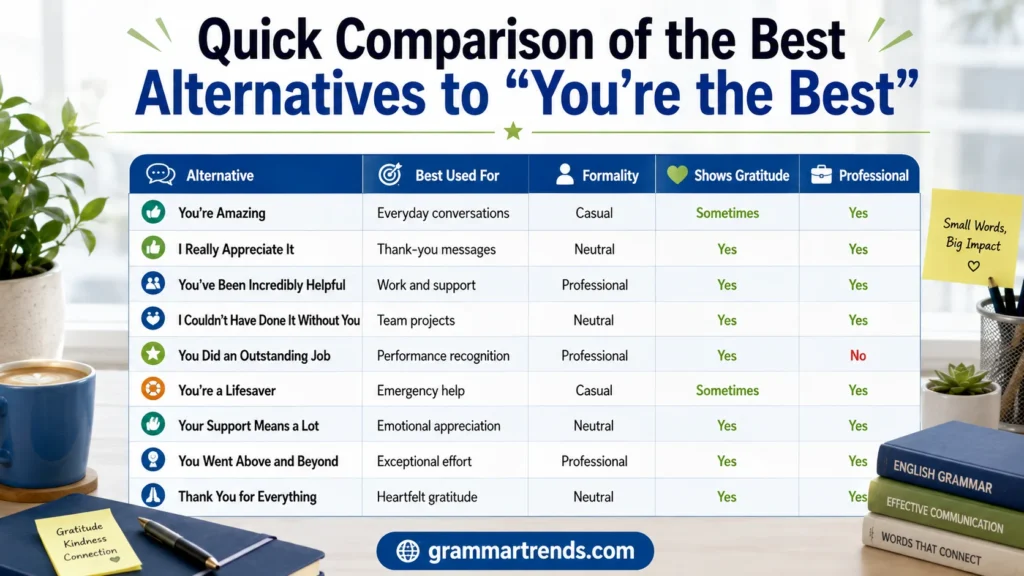
Quick Comparison of the Best Alternatives to “You’re the Best”
| Alternative | Best Used For | Formality | Professional | Shows Gratitude |
| You’re Amazing | Everyday conversations | Casual | Sometimes | Yes |
| I Really Appreciate It | Thank-you messages | Neutral | Yes | Yes |
| You’ve Been Incredibly Helpful | Work and support | Professional | Yes | Yes |
| I Couldn’t Have Done It Without You | Team projects | Neutral | Yes | Yes |
| You Did an Outstanding Job | Performance recognition | Professional | Yes | No |
| You’re a Lifesaver | Emergency help | Casual | Sometimes | Yes |
| Your Support Means a Lot | Emotional appreciation | Neutral | Yes | Yes |
| You Went Above and Beyond | Exceptional effort | Professional | Yes | Yes |
| Thank You for Everything | Heartfelt gratitude | Neutral | Yes | Yes |
This comparison shows that every alternative has its own purpose. The right choice depends on the tone you want to create.
Better Ways to Say “You’re the Best”
Instead of relying on one compliment every time, expand your vocabulary with these thoughtful alternatives.
You’re Amazing
“You’re amazing” is one of the easiest substitutes for “You’re the best.” It feels enthusiastic without sounding exaggerated.
Unlike the original phrase, this compliment focuses directly on the person’s qualities rather than simply ranking them above everyone else.
Meaning
It recognizes someone’s kindness, talent, generosity, or effort.
Best Times to Use It
- Thanking a friend
- Congratulating someone
- Responding to unexpected help
- Celebrating accomplishments
Examples
- You’re amazing for staying late to help me finish this project.
- Thanks for checking on me yesterday. You’re amazing.
- You organized the entire event by yourself. You’re amazing.
Why It Works
This phrase feels warm because it highlights the individual instead of using a broad expression. It’s especially effective when paired with a specific reason.
Instead of saying:
You’re amazing!
Say:
You’re amazing for helping everyone stay calm during the meeting.
That small addition makes the compliment much more meaningful.
I Really Appreciate It
Sometimes the simplest expressions carry the greatest impact.
“I really appreciate it” shifts the attention from the person to the action they performed. That makes your gratitude feel sincere and genuine.
Meaning
It communicates honest thankfulness for someone’s effort or kindness.
Best Situations
- Workplace emails
- Customer support
- Teacher appreciation
- Business communication
- Everyday conversations
Examples
- I really appreciate your quick response.
- I really appreciate all the time you spent helping me.
- I really appreciate your patience throughout this process.
Why This Alternative Sounds More Genuine
Many people hear “You’re the best” regularly. However, hearing exactly what someone appreciates feels much more personal.
Compare these examples.
Generic
You’re the best.
Specific
I really appreciate how quickly you handled this issue.
The second version explains why you’re thankful, making the compliment more memorable.
You’ve Been Incredibly Helpful
If you’re thanking someone for ongoing support, this phrase is often a better choice.
It acknowledges effort instead of offering general praise.
Meaning
It recognizes practical assistance that made your work or life easier.
Best Uses
- Professional emails
- Customer service
- Mentorship
- Team collaboration
- Technical support
Examples
- You’ve been incredibly helpful throughout this project.
- Thank you. You’ve been incredibly helpful from the beginning.
- Your advice has been invaluable. You’ve been incredibly helpful.
Why Professionals Prefer This Phrase
Managers, coworkers, and clients usually appreciate compliments that recognize specific contributions.
Instead of saying:
You’re the best.
Try:
You’ve been incredibly helpful by answering every question so quickly.
The second version sounds more professional while remaining warm and genuine.
I Couldn’t Have Done It Without You
Some compliments acknowledge a person’s effort. Others recognize their impact. “I couldn’t have done it without you” does both.
This phrase tells someone their contribution wasn’t just helpful. It was essential. That’s why it often feels more sincere than simply saying, “You’re the best.”
Meaning
This expression shows that another person’s support, guidance, or hard work played a major role in your success. It emphasizes teamwork and shared achievement rather than individual praise.
When to Use It
Use this phrase when someone:
- Helped you complete a difficult project.
- Supported you through a challenging situation.
- Shared valuable knowledge or expertise.
- Encouraged you when you felt discouraged.
- Played a key role in reaching a goal.
Examples
- I couldn’t have done it without you. Thanks for staying late to help.
- We finished the presentation because of your ideas. I couldn’t have done it without you.
- Your advice made all the difference. I couldn’t have done it without you.
Why It Feels So Personal
People appreciate knowing their actions mattered. This phrase does exactly that.
Instead of giving a broad compliment, it connects your success directly to the other person’s contribution. That makes the appreciation more memorable and meaningful.
Tip: Pair this phrase with a specific example to make it even stronger.
For example:
I couldn’t have done it without you. Your attention to detail helped us catch several important mistakes before the deadline.
You Did an Outstanding Job
If you want to recognize someone’s performance, this is one of the strongest alternatives to “You’re the best.”
Rather than offering general praise, it highlights the quality of the person’s work.
Meaning
This phrase acknowledges excellent performance, exceptional effort, or impressive results.
Best Situations
It works particularly well in:
- Performance reviews
- Employee recognition
- School feedback
- Volunteer appreciation
- Project evaluations
Examples
- You did an outstanding job leading today’s meeting.
- You did an outstanding job organizing the conference.
- Everyone noticed your preparation. You did an outstanding job.
Why It Works
Professional compliments carry more weight when they’re specific.
Compare these examples.
Less specific
You’re the best.
More meaningful
You did an outstanding job managing every detail of this project.
The second compliment explains exactly what impressed you.
Workplace Example
Imagine your coworker successfully manages a product launch involving several departments.
Instead of saying:
You’re the best.
You could say:
You did an outstanding job coordinating every team and keeping the project on schedule.
The compliment immediately sounds more professional and credible.
You’re a Lifesaver
Sometimes someone helps you at exactly the right moment. That’s when “You’re a lifesaver” becomes the perfect expression.
Although no one literally saved your life, the phrase communicates enormous gratitude in a lighthearted way.
Meaning
It expresses appreciation for timely help that solved an urgent problem.
Common Situations
This phrase works well when someone:
- Fixes a last-minute issue.
- Covers your work shift.
- Finds an important document.
- Gives you a ride unexpectedly.
- Solves a technical problem.
- Helps during an emergency.
Examples
- You’re a lifesaver for bringing my laptop charger.
- Thanks for fixing the printer before the meeting. You’re a lifesaver.
- You’re a lifesaver. I thought I’d miss my flight.
Why It’s So Popular
The phrase adds energy and personality to everyday conversations.
Instead of sounding formal, it feels natural and conversational.
However, avoid using it in highly formal documents or official business reports because it relies on figurative language.
Your Support Means a Lot
Not every compliment should focus on achievements. Sometimes emotional support deserves recognition too.
“Your support means a lot” communicates gratitude while also strengthening personal relationships.
Meaning
This phrase thanks someone for being dependable, encouraging, and emotionally supportive.
Best Situations
Use it when someone:
- Listens without judging.
- Offers encouragement.
- Supports your decisions.
- Helps during difficult times.
- Celebrates your achievements.
Examples
- Your support means a lot during this transition.
- Thank you for always believing in me. Your support means a lot.
- Your support means more than you know.
Why It Builds Stronger Relationships
People often remember emotional encouragement longer than practical help.
A simple acknowledgment like this lets someone know their presence made a difference.
For that reason, it’s common in graduation speeches, retirement messages, thank-you notes, and heartfelt conversations.
Read more: 9 Professional Ways to Say “Whenever It Suits You”
You Went Above and Beyond
When someone’s effort exceeds expectations, this phrase says exactly that.
It’s one of the most effective professional alternatives to “You’re the best.”
Meaning
It recognizes exceptional dedication, commitment, or service that goes beyond normal responsibilities.
Ideal Situations
This expression fits perfectly when someone:
- Exceeds project expectations.
- Delivers exceptional customer service.
- Volunteers extra time.
- Solves unexpected problems.
- Demonstrates remarkable initiative.
Examples
- You went above and beyond to help our team succeed.
- Thank you for staying late every evening. You went above and beyond.
- Your attention to every detail shows you truly went above and beyond.
Why Managers Prefer This Phrase
In professional settings, recognition should describe performance rather than offer vague praise.
“You went above and beyond” explains that someone exceeded expectations instead of simply doing what was required.
Mini Case Study
Scenario: A customer support specialist stays after business hours to resolve a client’s urgent issue.
Generic Response
You’re the best.
Better Response
You went above and beyond by staying late to ensure our issue was fully resolved. Your commitment didn’t go unnoticed.
The second compliment feels more authentic because it recognizes the person’s extra effort instead of offering a general statement.
Thank You for Everything
Sometimes a single act of kindness isn’t the whole story. A person may have supported you for weeks, months, or even years. In those moments, “Thank you for everything” feels more appropriate than “You’re the best.”
This phrase recognizes a collection of thoughtful actions instead of focusing on one event.
Meaning
It expresses deep appreciation for ongoing help, encouragement, generosity, or friendship.
Best Situations
This phrase works well when you’re thanking:
- A mentor
- A teacher
- A parent
- A close friend
- A coworker leaving the company
- A healthcare professional
- Someone who has consistently supported you
Examples
- Thank you for everything you’ve done for our team.
- I can’t thank you enough. Thank you for everything.
- Thank you for everything you’ve taught me over the years.
- You’ve always been there when I needed help. Thank you for everything.
Why This Phrase Leaves a Lasting Impression
Unlike quick compliments, this expression reflects long-term gratitude. It tells the other person that you noticed their consistent effort, not just one good deed.
Adding one sentence that explains why you’re thankful makes the message even stronger.
For example:
Thank you for everything. Your encouragement gave me the confidence to keep moving forward even when things became difficult.
How to Choose the Right Alternative to “You’re the Best”
Not every compliment fits every situation. The words you choose should match the setting, your relationship with the other person, and the message you want to send.
Before speaking or writing, ask yourself these simple questions:
- Is this conversation formal or casual?
- Am I thanking someone or praising their performance?
- Should my compliment sound warm, professional, or heartfelt?
- Can I mention exactly what the person did?
A thoughtful compliment always has more impact than a generic one.
Match the Level of Formality
Different settings call for different language.
| Situation | Best Alternative |
| Business email | I Really Appreciate It |
| Employee recognition | You Did an Outstanding Job |
| Team collaboration | I Couldn’t Have Done It Without You |
| Customer service | You Went Above and Beyond |
| Close friends | You’re Amazing |
| Family members | Your Support Means a Lot |
| Emergency assistance | You’re a Lifesaver |
| Long-term gratitude | Thank You for Everything |
Using the right tone helps your compliment sound natural instead of forced.
Be Specific Whenever Possible
One of the biggest mistakes people make is offering praise without explaining it.
Compare these examples.
Less Effective
You’re the best.
Better
You handled every customer question with patience and professionalism. Thank you for everything you did today.
The second compliment tells the recipient exactly what they did well.
Specific praise feels more genuine because it shows you’ve paid attention.
Focus on Actions Instead of Labels
Instead of describing someone with a broad statement, describe what they actually accomplished.
For example:
- Thank you for staying late to help finish the report.
- Your clear explanations made the training session easy to follow.
- You solved the issue much faster than expected.
- Your encouragement gave everyone more confidence.
These comments are more memorable because they recognize real actions.
Common Mistakes When Complimenting Someone
Even well-intended compliments can lose their impact if they’re overused or poorly chosen.
Here are several mistakes to avoid.
Using the Same Phrase Repeatedly
If every compliment sounds the same, people naturally pay less attention.
Instead of saying “You’re the best” every time, rotate between different expressions based on the situation.
Being Too General
Generic compliments don’t explain why someone deserves recognition.
For example:
❌ You’re awesome.
✅ You stayed calm during a stressful meeting and helped everyone find a solution.
The second compliment creates a stronger emotional connection.
Exaggerating Too Much
Expressions like:
- You’re perfect.
- Nobody in the world is better than you.
- You’re the greatest person ever.
may sound insincere if they don’t match the situation.
Balanced, honest praise usually carries more weight.
Ignoring Professional Tone
Workplace communication requires a little more precision.
Instead of writing:
You’re the best employee ever!
Try:
You went above and beyond on this project, and your leadership helped the entire team succeed.
Professional recognition should emphasize achievements rather than exaggeration.
Examples of Alternatives in Different Situations
The best compliment depends on where you are and who you’re speaking to.
Workplace
Professional communication should be respectful, clear, and specific.
Example
Manager:
You did an outstanding job leading today’s presentation. Your preparation made the discussion productive.
Coworker:
I couldn’t have done it without you. Thanks for helping me finish the report before the deadline.
Client:
We really appreciate your partnership. Your feedback has been incredibly helpful throughout this project.
School
Teachers and students often encourage one another through thoughtful compliments.
Example
Teacher:
You did an outstanding job on your research project. Your analysis was well organized and supported by reliable evidence.
Student:
Thank you for everything you’ve taught us this semester.
Classmate:
You’re amazing. Your notes helped me prepare for the exam.
Friends and Family
Personal relationships thrive on genuine appreciation.
Example
Friend:
You’re a lifesaver for picking me up after my car broke down.
Sibling:
Your support means a lot. Thanks for always having my back.
Parent:
I couldn’t have done it without your encouragement.
Customer Service
Customers often remember excellent service long after the interaction ends.
Example
You went above and beyond to solve my issue so quickly. I really appreciate your patience and professionalism.
That compliment recognizes both the employee’s effort and the quality of the service they provided.
Case Study: Why Specific Compliments Create a Bigger Impact
Imagine two team leaders thanking employees after completing a major project.
Team Leader A
You’re the best, everyone!
The message is friendly, but it’s broad. No one knows what stood out or why their work mattered.
Team Leader B
Thank you, everyone. You went above and beyond to meet a challenging deadline. Your teamwork, creativity, and attention to detail helped us deliver the project ahead of schedule.
Which message feels more meaningful?
Most people would choose the second one because it highlights specific actions instead of relying on a generic compliment.
“People may forget the exact words you said, but they’ll remember how your appreciation made them feel.”
The lesson is simple: the most memorable compliments are honest, specific, and connected to real actions.
“You’re the Best” vs. Other Appreciation Phrases
Many appreciation phrases sound similar at first glance, yet each one serves a different purpose. Some focus on gratitude, while others recognize exceptional performance or emotional support.
Choosing the right expression helps your message feel more genuine and appropriate for the situation.
| Expression | Tone | Best For | Professional Use | Personal Use |
| You’re the Best | Friendly | General appreciation | Sometimes | Yes |
| You’re Amazing | Enthusiastic | Complimenting someone | Sometimes | Yes |
| I Really Appreciate It | Grateful | Thank-you messages | Yes | Yes |
| You’ve Been Incredibly Helpful | Respectful | Ongoing assistance | Yes | Yes |
| I Couldn’t Have Done It Without You | Heartfelt | Teamwork and support | Yes | Yes |
| You Did an Outstanding Job | Professional | Performance recognition | Yes | Limited |
| You’re a Lifesaver | Casual | Timely help | Sometimes | Yes |
| Your Support Means a Lot | Warm | Emotional encouragement | Yes | Yes |
| You Went Above and Beyond | Appreciative | Exceptional effort | Yes | Yes |
| Thank You for Everything | Sincere | Long-term gratitude | Yes | Yes |
Which Alternative Should You Choose?
Here’s a quick guide to help you decide.
| If You Want To… | Use This Phrase |
| Thank someone for helping | I Really Appreciate It |
| Recognize excellent work | You Did an Outstanding Job |
| Praise exceptional effort | You Went Above and Beyond |
| Show heartfelt gratitude | Thank You for Everything |
| Thank a teammate | I Couldn’t Have Done It Without You |
| Appreciate emotional support | Your Support Means a Lot |
| Compliment a close friend | You’re Amazing |
| Thank someone for urgent assistance | You’re a Lifesaver |
Tips for Making Your Compliments More Genuine
The words you choose matter, but how you use them matters even more. A sincere compliment doesn’t need to be dramatic. It simply needs to be honest and specific.
Here are a few ways to make your appreciation more meaningful.
Explain Why You’re Thankful
Instead of saying:
You’re amazing.
Try:
You’re amazing because you stayed after work to help me finish the presentation.
Adding context shows that your compliment is thoughtful rather than automatic.
Mention the Impact
People enjoy knowing how their actions made a difference.
For example:
- Your advice helped me make the right decision.
- Your quick response saved us several hours.
- Your encouragement gave me the confidence to apply for the promotion.
These details make your appreciation memorable.
Be Timely
Compliments have the greatest impact when you give them soon after the event.
If someone helps you today, thank them today. Waiting too long may reduce the emotional impact.
Keep It Authentic
Avoid using exaggerated language unless it genuinely matches the situation.
Simple, honest compliments often leave the strongest impression.
For example:
I really appreciate the time you spent explaining everything.
sounds more sincere than:
You’re the greatest person who’s ever lived!
FAQs
1. What is a better way to say “You’re the Best” without sounding repetitive?
You can use phrases like “You’re outstanding,” “You’re second to none,” “Nobody compares to you,” or “You are extraordinary.” These alternatives keep your compliments fresh while still showing genuine appreciation.
2. When should I avoid using “You’re the Best”?
If you are writing a professional email, speaking to a client, or giving formal recognition, a more specific compliment often works better. Mentioning the person’s effort or achievement usually feels more meaningful.
3. Why do different compliments have a stronger impact?
People respond better to praise that feels personal and sincere. Choosing words that match the situation makes your appreciation sound more thoughtful and memorable.
4. Can I use these alternatives in workplace communication?
Yes. Many alternatives work well in professional settings. Just choose respectful language that fits the relationship and the level of formality.
5. How can I make my compliments sound more natural?
Focus on the person’s actions instead of using the same phrase every time. Adding a specific reason for your praise makes your message feel authentic and heartfelt.
6. Are these alternatives suitable for friends and family too?
Absolutely. Whether you are talking to a friend, family member, coworker, or romantic partner, using different expressions helps your appreciation feel warm, personal, and genuine.
Conclusion
Finding other ways to say “You’re the Best” is about more than expanding your vocabulary—it is about making every compliment feel genuine and personal. A thoughtful choice of words can show appreciation, strengthen relationships, and leave a lasting impression, whether you are speaking to a friend, family member, coworker, or someone special.
The next time you want to recognize someone’s effort or kindness, try a fresh expression that matches the moment instead of relying on the same phrase every time. A simple change in wording can make your message more sincere, memorable, and meaningful, helping your appreciation stand out and making the person on the receiving end feel truly valued.

Mia Rose brings fifteen years of experience at The University of Edinburgh’s English Literature department, leading students through explorations of classic and contemporary texts, literary theory, and narrative design. Her academic interests center on Victorian and modernist fiction, poetic rhythms, postcolonial storytelling, and digital approaches to literary study—with a keen eye on how voice and perspective frame cultural dialogue. Mia has delivered talks at prestigious global conferences and authored articles in scholarly journals, showcasing her commitment to meaningful research and lively classroom engagement.