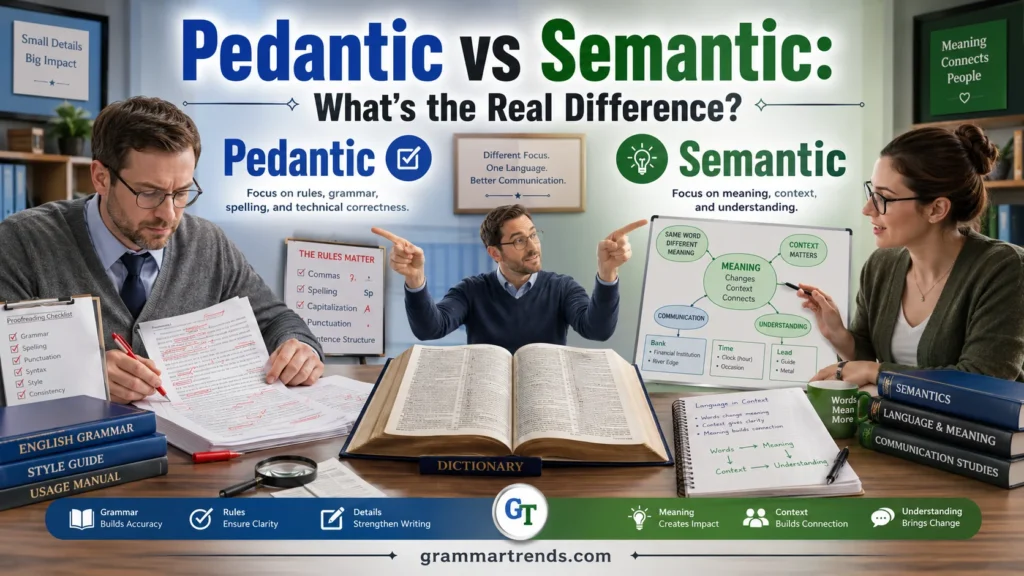
Pedantic vs Semantic often confuses writers who mix meaning and rules; both shape language, yet one focuses on form and other on meaning clearly.
Have you ever been accused of being too pedantic or semantic? These two words are often used interchangeably but actually have distinct meanings. In this article, we’ll explore the differences between pedantic and semantic, and when it’s appropriate to use each one. It’s important to note that both meanings matter in communication where a person may struggle in an argument to explain what they actually mean.
Most people have heard both words but still struggle to explain what they actually mean. You might be called pedantic or told your point is just semantic. These situations are common yet very different things. The real issue is simple: people treat pedantic vs semantic as the same, but they are not. One is about obsessing over rules, the other about understanding meaning, how ideas are used in context, and what is conveyed through language.
In real use, a pedantic person focuses on small errors, mistakes, and details rather than the overall message. A semantic view instead focuses on how words are intended and understood in context. I’ve seen this in markup, XHTML, and CSS work where even simple choices like leftcol and rightcol reflect non-semantic thinking in web design and structure.
Understanding this difference helps you communicate better and avoid misunderstandings. Once you see it clearly, using both words correctly becomes easier. A semantic approach focuses on meaning, while a pedantic approach focuses heavily on rules and format. In practice, both appear in writing, editing, and technical design decisions involving validation, markup, and structure.
Why “Pedantic vs Semantic” Gets Confused in Writing
At first glance, these words feel like cousins. They both show up in discussions about writing, editing, and language rules. But they live in different worlds.
The confusion usually comes from three things:
- Both relate to language accuracy
- Both show up in editing feedback
- Both are used by people who don’t always define them clearly
However, they don’t measure the same thing.
Think of it like this:
- Pedantic focuses on how something is written
- Semantic focuses on what something means
That distinction sounds simple, but it changes how you edit, interpret, and evaluate writing.
Here’s the core idea you should lock in early:
Pedantic = obsession with correctness details
Semantic = accuracy of meaning and interpretation
Once you see that split, everything else becomes easier.
Core Definitions You Actually Need (No Confusion, Just Clarity)
Let’s strip away unnecessary complexity and define both terms in practical writing terms.
What “Pedantic” Means in Pedantic vs Semantic Writing Contexts
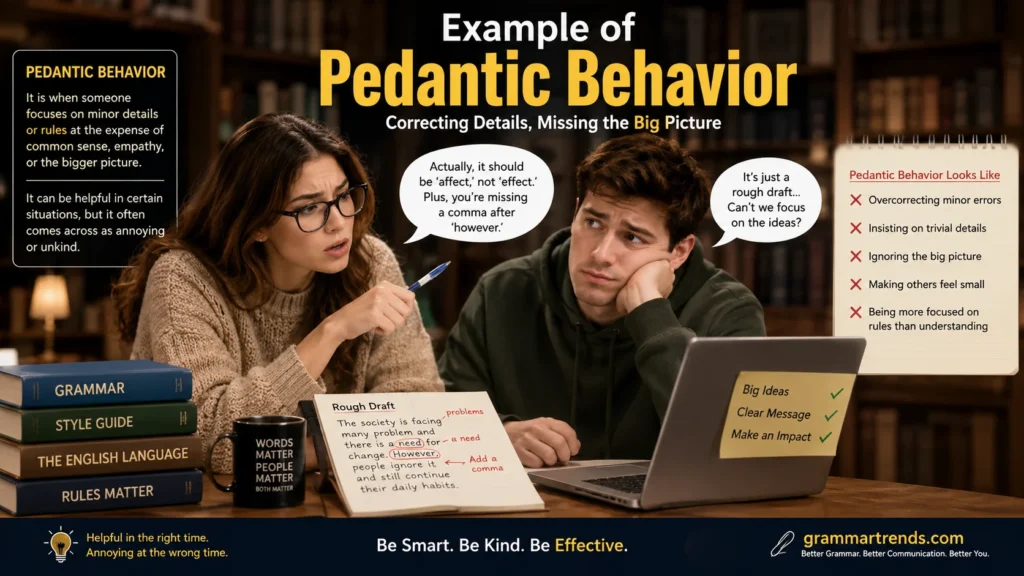
The word pedantic describes someone who focuses too heavily on minor rules, details, or technical correctness.
In writing, it usually shows up as:
- Over-correcting grammar that doesn’t affect meaning
- Fixating on style rules that don’t improve clarity
- Interrupting flow for “technical accuracy”
- Correcting things that readers don’t notice or care about
A pedantic approach often feels rigid. It prioritizes rule-following over readability.
Example of pedantic behavior:
- Changing “You can’t go” to “You are not able to go” for “formal correctness”
The meaning stays the same. The tone just becomes heavier.
A key idea:
Pedantic writing often improves technical accuracy but can hurt natural flow.
What “Semantic” Means in Pedantic vs Semantic Writing Contexts
The word semantic relates to meaning in language. It deals with how words, phrases, and sentences create understanding.
In writing, semantics focuses on:
- Whether the message is clear
- Whether words carry the intended meaning
- Whether interpretation could go wrong
- Whether ambiguity exists
Unlike pedantry, semantics doesn’t care about style rules first. It cares about understanding first.
Example of a semantic issue:
- “I saw her duck.”
This could mean:
- You saw her lower her head
- You saw her pet bird
That’s a semantic ambiguity problem.
A key idea:
Semantic writing focuses on whether the reader understands the intended message without confusion.
Pedantic vs Semantic: The Key Difference Explained Simply
Let’s make this crystal clear.
| Feature | Pedantic | Semantic |
| Focus | Rules, form, correctness | Meaning and interpretation |
| Main concern | “Is this technically correct?” | “Does this mean what I intend?” |
| Risk | Over-correction | Misunderstanding |
| Impact on writing | Can feel rigid or unnatural | Can improve clarity and precision |
| Example issue | Grammar nitpicking | Ambiguous meaning |
Here’s the simplest way to remember it:
- Pedantic = form obsession
- Semantic = meaning obsession
You can think of it like building a house:
- Pedantic is checking if every brick is perfectly aligned
- Semantic is checking if the house is actually livable
Both matter, but they’re not the same job.
How Pedantic vs Semantic Works in Real Writing Situations
Let’s move beyond definitions and look at real-world writing behavior.
When “Pedantic” Shows Up in Writing
Pedantic behavior often appears during editing or proofreading.
You’ll notice it when someone:
- Fixes contractions unnecessarily (“don’t” → “do not”)
- Enforces outdated style rules without reason
- Focuses on punctuation while ignoring clarity
- Interrupts reading flow for minor technical fixes
Real-world example:
Original:
“I’m gonna go check it.”
Pedantic correction:
“I am going to go check it.”
Nothing changes in meaning. The tone just becomes more formal and less natural.
Sometimes that’s useful. But not always.
When “Semantic” Matters in Writing
Semantic issues are deeper because they affect meaning.
They show up when:
- A sentence can be interpreted in multiple ways
- Word choice changes intent
- Structure causes confusion
- Translation loses meaning
Real-world example:
“The manager told the employee he was wrong.”
Who was wrong?
- The manager?
- The employee?
That’s a semantic problem. Grammar can be perfect, but meaning is unclear.
Side-by-Side Examples of Pedantic vs Semantic Issues
Let’s break it down with clear examples.
Pedantic Corrections That Don’t Change Meaning
| Original | “Pedantic Fix” | Issue Type |
| I can’t do it | I cannot do it | Style preference |
| Gonna go home | Going to go home | Formality change |
| It’s fine | It is fine | Tone adjustment |
Notice something important:
The meaning stays identical. Only tone or style changes.
Semantic Errors That Break Meaning
| Sentence | Problem |
| I told him I would leave tomorrow | Unclear timing reference |
| She saw the man with the telescope | Ambiguous structure |
| The teacher said the student failed because he was lazy | Unclear pronoun reference |
These are dangerous because readers may misunderstand the message entirely.
Common Misunderstandings About Pedantic vs Semantic
Many writers mix these concepts without realizing it.
Let’s fix that.
Mistaking “Pedantic” for “Correct”
Some people assume pedantic corrections automatically improve writing.
Not always.
Over-editing can:
- Remove personality
- Make writing sound robotic
- Reduce readability
Example:
- “Help me out” → “Provide assistance to me”
The second version is “correct” in a strict sense, but it feels unnatural.
Confusing Semantic Issues With Grammar Errors
Grammar and semantics are not the same thing.
- Grammar = structure rules
- Semantics = meaning and interpretation
A sentence can be grammatically perfect but semantically broken.
Example:
“Colorless green ideas sleep furiously.”
This famous linguistic sentence is grammatically correct but semantically meaningless.
Thinking Both Terms Are Interchangeable
They’re not interchangeable because they measure different layers of language.
- Pedantic = surface-level precision
- Semantic = deep meaning structure
Mixing them leads to poor editing decisions.
How Context Changes Pedantic vs Semantic Decisions
Context decides everything in writing.
Academic Writing
In academic work:
- Semantic clarity matters most
- Some pedantic precision is required
- Over-editing still weakens readability
You want balance, not rigidity.
Legal or Technical Writing
Here, semantics becomes critical.
Why?
Because small meaning changes can create legal consequences.
Example:
- “Must” vs “may” completely changes obligation level
Pedantic precision also matters here, but only to protect meaning.
Marketing and Creative Writing
Here’s where things shift.
- Semantic clarity drives engagement
- Pedantic editing often hurts tone
- Natural language performs better
Example:
- “Experience improved mobility solutions”
vs - “Move better every day”
The second version wins in most marketing contexts.
Casual Conversations
In everyday speech:
- Semantics is flexible
- Pedantry feels unnatural
- Flow matters more than correctness
People care about understanding, not perfection.
Read more: Giddy vs Gitty: Meaning, Differences and Correct Usage
Practical Examples: Pedantic vs Semantic in Action
Let’s make this real with deeper examples.
Pedantic Fix That Doesn’t Help the Reader
Original:
“We should probably go now.”
Edited:
“We should go at this moment.”
Nothing improves. The second version just feels stiff.
Semantic Fix That Improves Clarity
Original:
“After John talked to Mike, he left.”
Improved:
“After John talked to Mike, John left.”
Now the meaning is clear.
How to Improve Your Writing Using Both Concepts
You don’t need to pick one. You need balance.
Start With Semantic Clarity
Before anything else, ask:
- Does the reader understand this?
- Could this be misread?
- Is the message unambiguous?
If not, fix semantics first.
Apply Pedantic Checks Last
Once meaning is solid:
- Clean grammar
- Adjust tone
- Improve flow
But don’t overdo it.
Think of pedantry like polishing a car. You don’t repaint it every time you wash it.
Quick Mental Checklist for Writers
Before finalizing any sentence, ask:
- Does this clearly communicate meaning?
- Could this be misunderstood?
- Am I fixing something real or just being strict?
- Does this change improve readability or just style?
If it passes semantic clarity first, you’re on the right track.
FAQs
1. What is the meaning of pedantic vs semantic?
Pedantic vs semantic refers to two different language ideas: pedantic is about strict rules and small details, while semantic is about meaning in context.
2. Are pedantic and semantic the same thing?
No, they are not the same. Pedantic focuses on rules, while semantic focuses on meaning and how words are understood.
3. When do people call someone pedantic?
People call someone pedantic when they focus too much on small errors, mistakes, or technical details instead of overall message.
4. What does semantic mean in simple words?
Semantic means related to meaning of words, how ideas are conveyed through language, and how they are understood in context.
5. Can a person be both pedantic and semantic?
Yes, in some situations a person may focus on both rules and meaning, depending on how they interpret language or argument.
6. Why do people confuse pedantic vs semantic?
People confuse pedantic vs semantic because both are used in discussions about words, language, and meaning, but they refer to different ideas.
7. Is being pedantic always bad?
Not always. Being pedantic can help catch small errors, but too much focus on details may ignore overall meaning.
8. Why is semantic important in communication?
Semantic is important because it helps ensure the correct meaning of words is understood in context, avoiding misunderstandings.
Conclusion
Understanding pedantic vs semantic helps improve how we use language, interpret meaning, and handle communication. A pedantic approach focuses on strict rules and details, while a semantic approach focuses on overall meaning and context. Knowing the difference makes discussions clearer and reduces misunderstandings in both writing and speech.

Mia Rose brings fifteen years of experience at The University of Edinburgh’s English Literature department, leading students through explorations of classic and contemporary texts, literary theory, and narrative design. Her academic interests center on Victorian and modernist fiction, poetic rhythms, postcolonial storytelling, and digital approaches to literary study—with a keen eye on how voice and perspective frame cultural dialogue. Mia has delivered talks at prestigious global conferences and authored articles in scholarly journals, showcasing her commitment to meaningful research and lively classroom engagement.