
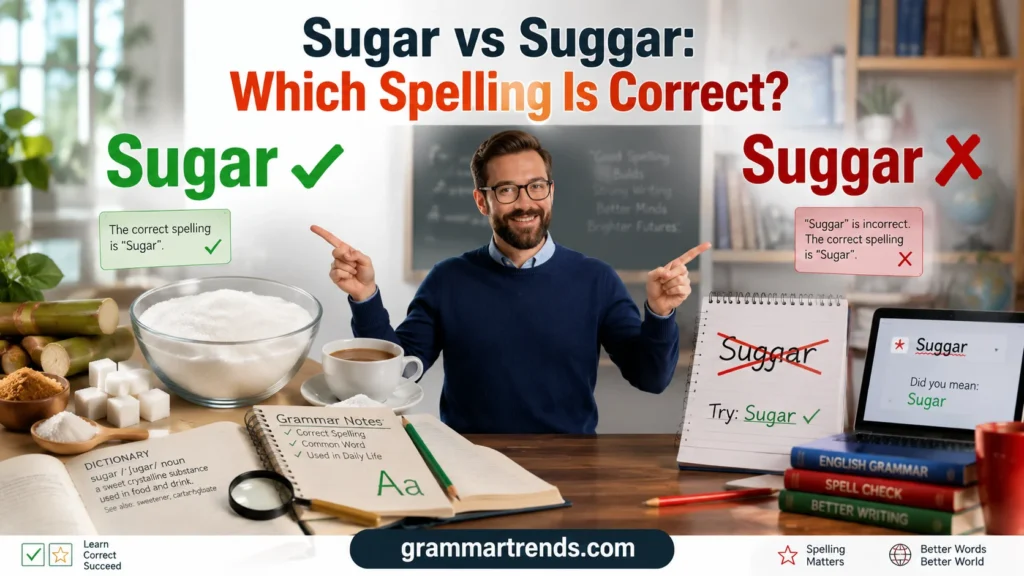
Have you ever wondered whether Sugar or Suggar is the correct spelling? You’re not alone. Many people accidentally type Suggar because it looks similar to the correct word, but Sugar is the only accepted spelling in English. While this may seem like a small typo, using the wrong spelling can create confusion, especially in writing, food science, nutrition, and everyday communication.
Sugar is a carbohydrate that naturally occurs in many foods and is widely used as a sweetener in drinks, desserts, and countless recipes. It comes in several forms, including granulated sugar, powdered sugar, and brown sugar. In contrast, Suggar has no meaning in English and is simply a common misspelling. Whenever you see it, you can safely assume it is an error rather than a separate word.
In this article, you’ll learn the difference between Sugar vs Suggar, discover why so many people confuse the two spellings, and understand how to use the correct word with confidence. We’ll also explain the difference between sugar and sugars on nutrition labels, explore the different types of sugar, and discuss their role in food, health, and daily life. By the end, you’ll know exactly which spelling is correct, why it matters, and how to avoid making this common mistake in your own writing.
What Sugar Really Means in English
Before you master spelling, it helps to understand the word itself. “Sugar” is not just something you stir into tea. It plays a huge role in language, food, and even emotion-based expressions.
Sugar as a noun
At its core, sugar refers to a sweet substance.
It usually comes from:
- Sugarcane
- Sugar beets
- Certain fruits (natural sugars like fructose)
In everyday life, you see it as:
- White table sugar
- Brown sugar
- Powdered sugar
- Raw or unrefined sugar
Quick fact table: Types of sugar
| Type of Sugar | Common Use | Texture | Sweetness Level |
| White sugar | Tea, coffee, baking | Fine crystals | Standard |
| Brown sugar | Cookies, sauces | Moist, sticky | Slightly richer |
| Powdered sugar | Frosting, desserts | Very fine powder | Fast dissolving |
| Raw sugar | Natural sweetening | Coarse crystals | Mild |
Sugar is also chemically known as sucrose, which is a carbohydrate that provides quick energy.
What “Suggar” Actually Is (And Why It’s Wrong)
Let’s be very direct here.
“Suggar” is not a real English word.
You won’t find it in:
- Oxford English Dictionary
- Merriam-Webster
- Cambridge Dictionary
It has no meaning, no grammar function, and no official usage.
So when someone writes “suggar,” they are not using slang or alternative spelling. They are simply making a spelling error.
Why that matters
English is strict in writing even when it feels flexible in speech. If you misspell a common word like sugar, readers may:
- Question your writing accuracy
- Lose trust in your content
- Misinterpret your level of English fluency
That’s why this small spelling difference actually matters more than people think.
Why People Confuse Sugar and Suggar
Now comes the interesting part. Why does this mistake happen so often?
It’s not random. There are real linguistic and psychological reasons behind it.
The pronunciation trap
Say the word out loud: “sugar.”
It sounds like:
- “shoo-gar” in some accents
- “shug-er” in casual speech
Notice something? The sound feels like it could easily support a double “g.” That illusion tricks the brain into spelling it as “suggar.”
But English spelling does not always follow sound patterns.
That’s where the confusion begins.
Fast typing and muscle memory
When people type quickly, the brain relies on habit instead of accuracy.
If you’ve ever typed:
- “definately” instead of “definitely”
- “recieve” instead of “receive”
You already understand the pattern.
“Suggar” usually appears because:
- Fingers repeat letters unconsciously
- The “g” key gets tapped twice by accident
- Autocorrect sometimes fails to correct early habits
Influence of similar words
English is full of double-letter words like:
- Beggar
- Mugger
- Hugger
So the brain subconsciously copies that structure.
But sugar does not belong in that category. It is an exception word, which makes it even more confusing.
Spelling memory mismatch
Your brain stores words in two ways:
- Sound memory (how it sounds)
- Visual memory (how it looks)
With “sugar,” those two don’t align perfectly. That mismatch creates long-term confusion.
Read more:
The Origin of the Word Sugar
Understanding where a word comes from often makes its spelling easier to remember.
“Sugar” has a long journey through languages.
It comes from:
- Sanskrit: śarkarā (meaning gravel or candy)
- Arabic: sukkar
- Old French: sucre
- Middle English: sugar
Over time, spelling changed while pronunciation evolved differently.
That’s why modern English spelling sometimes feels “illogical.”
But it’s actually historical, not random.
How to Use Sugar Correctly in Sentences
Now that spelling is clear, let’s use the word correctly in real situations.
Everyday usage examples
- I add sugar to my coffee every morning.
- She avoids sugar in her diet.
- This recipe needs two tablespoons of sugar.
Cooking and baking context
Sugar plays a key role in cooking science:
- It caramelizes when heated
- It balances acidity in sauces
- It affects texture in baked goods
Example:
- Too much sugar makes cookies overly soft and sticky.
Figurative or emotional usage
Sugar is also used in expressions:
- “She’s the sugar in his life.” (something sweet or comforting)
- “Don’t sugar-coat it.” (don’t soften the truth)
- “That moment felt like sugar.” (something pleasant or joyful)
Incorrect Usage of Suggar in Real Sentences
Let’s look at what NOT to do.
Incorrect examples:
- I need suggar for my tea ❌
- This cake has too much suggar ❌
- Suggar is bad for your health ❌
Correct versions:
- I need sugar for my tea ✔
This cake has too much sugar ✔- Sugar is bad in excess ✔
Even small spelling errors like this can make writing look unpolished.
Simple Ways to Never Misspell Sugar Again
Let’s make this stick in your memory.
Memory trick that works
Think of it like this:
Sugar is sweet. One “g” is enough.
That mental shortcut helps reinforce the correct spelling.
Visual association method
Connect the word with familiar images:
- Sugar cube
- Sugar bowl
- Sugar cane field
Each one reinforces the same spelling pattern: S-U-G-A-R
Slow typing strategy
It sounds simple, but it works.
When you type the word:
- Pause for half a second
- Visualize the correct spelling
- Then type
That small delay improves accuracy dramatically.
Common Mistakes People Make With Sugar
Here are the most frequent spelling and usage errors.
Adding extra letters
- sugarr
- suggar
- sughar
Mixing pronunciation with spelling
English is full of mismatches like:
- colonel (sounds like kernel)
- yacht (silent letters)
- sugar (soft “g” sound confusion)
Ignoring spelling correction tools
Spell check exists for a reason. Ignoring it means repeating the same mistake over and over.
Why Context Does Not Change the Spelling
Some words change meaning depending on context. Sugar does not.
No matter where you use it:
- Cooking
- Health discussions
- Emotional expressions
The spelling remains the same: sugar
There are no accepted alternatives like “suggar” in any context.
Read more: Unaffected vs Uneffected: How to Use It Confidently
Case Study: How a Simple Misspelling Affects Writing
Let’s imagine a real scenario.
A student writes:
“Too much suggar is harmful for health.”
What happens next?
- Teacher marks it incorrect
- Grammar software flags it
- Reader questions attention to detail
Now compare:
“Too much sugar is harmful for health.”
Same meaning. Completely different impression.
That single letter change affects credibility.
Health Perspective: How Much Sugar Is Too Much?
Since people often search “sugar vs suggar” alongside health topics, here’s real nutritional context.
WHO guideline
The World Health Organization recommends:
- Less than 25 grams of added sugar per day for adults
What that looks like
| Item | Sugar Content |
| 1 teaspoon sugar | ~4 grams |
| 1 soda can | ~35–40 grams |
| 1 chocolate bar | ~20–30 grams |
That means one soda can can exceed daily recommended intake.
Practice Section: Test Your Understanding
Let’s make sure this sticks.
Fill in the blank
- I like my tea with ___.
Correct the sentence
- She added too much suggar to the recipe.
Answer key
- sugar
- She added too much sugar to the recipe
Quick Reference Table: Sugar vs Suggar
| Feature | Sugar | Suggar |
| Dictionary recognized | Yes | No |
| Correct spelling | Yes | No |
| Meaning | Sweet substance | None |
| Usage in writing | Standard | Incorrect |
| Acceptable in formal English | Yes | No |
FAQs
1. Is “Suggar” a correct English word?
No. Suggar is not a recognized English word. It is simply a common misspelling of Sugar, which is the correct spelling used in dictionaries, recipes, nutrition, and everyday writing.
2. Why do people spell “Sugar” as “Suggar”?
Most people write Suggar by mistake because they pronounce the word quickly or accidentally add an extra g while typing. It’s a spelling error rather than an alternative form.
3. What does “Sugar” mean?
Sugar refers to a type of carbohydrate that gives foods a sweet taste. It occurs naturally in fruits, vegetables, and milk, and it is also added to many foods and beverages as a sweetener.
4. What is the difference between “Sugar” and “Sugars” on food labels?
On nutrition labels, Sugar usually refers to the ingredient itself, while Sugars indicates the total amount of simple sugars present in a serving, including both naturally occurring and added sugars.
5. How can I remember the correct spelling of “Sugar”?
A simple trick is to remember that Sugar contains only one g after the u. If you see Suggar with two g’s, it’s a spelling mistake.
6. Why is using the correct spelling important?
Using Sugar instead of Suggar makes your writing more accurate and professional. Correct spelling also prevents confusion in recipes, academic writing, nutrition discussions, and everyday communication.
Conclusion
The choice between Sugar vs Suggar is straightforward once you know the correct spelling. Sugar is the only valid English word and refers to the sweet carbohydrate found naturally in many foods and commonly used as a sweetener. Suggar, on the other hand, is simply a misspelling and should be avoided in both formal and informal writing.
Remembering this small spelling difference can improve your writing, reduce confusion, and help you communicate more clearly. Whether you’re reading a nutrition label, following a recipe, or writing about food and health, using Sugar correctly ensures your message is accurate and professional. A little attention to spelling goes a long way in building confidence and avoiding common English mistakes.

Emma Rose has spent 15 years in the English Department at the University of California, Los Angeles (UCLA), guiding students through British and American literary classics, critical theory, and narrative techniques. Her scholarly focus includes 19th- and 20th-century fiction, the art of poetry, postcolonial writing, and digital humanities particularly how storytelling voice influences cultural perspectives. Emma has presented her research at major international conferences and published in respected academic journals, underscoring her dedication to both high-level scholarship and engaging teaching.