As a writer exploring Giddy vs Gitty, I often see people pause wondering similar words that look and sound alike in context.
In daily writing, I notice people, especially writers, confuse giddy and gitty because they look, feel, and sound similar. The difference is simple: giddy is the correct English word, while gitty is a misspelling. The proper spelling depends on context, but in common everyday usage, giddy means excited, elated, dizzy, or lightheaded. This article explains meaning, origin, origins, definitions, nuances, helping learners on their writing journey to communicate clearly and effectively. If someone has felt nervous energy, excitement, happiness, or dizziness, they may already have used it in a sentence without noticing.
In school, work, email, essay, social media, messages, captions, assignments, online content, correct choice matters because errors, mistakes, written words affect clarity, professionalism, trust, confidence. Spellcheckers often flag gitty, and a spell checker marks it wrong, increasing confusion. This guide offers a quick answer, practical advice, real examples, tables,, insights, practice, exercises to help learn, master, improve speaking and descriptive sentences. Through search, keyword research, regional usage, informal and casual style, fast typing, spoken and close forms, choosing the correct spelling becomes easier over time. The structured approach builds understanding, learning, confidence, helping you avoid language differences and express ideas clearly.
Quick Answer
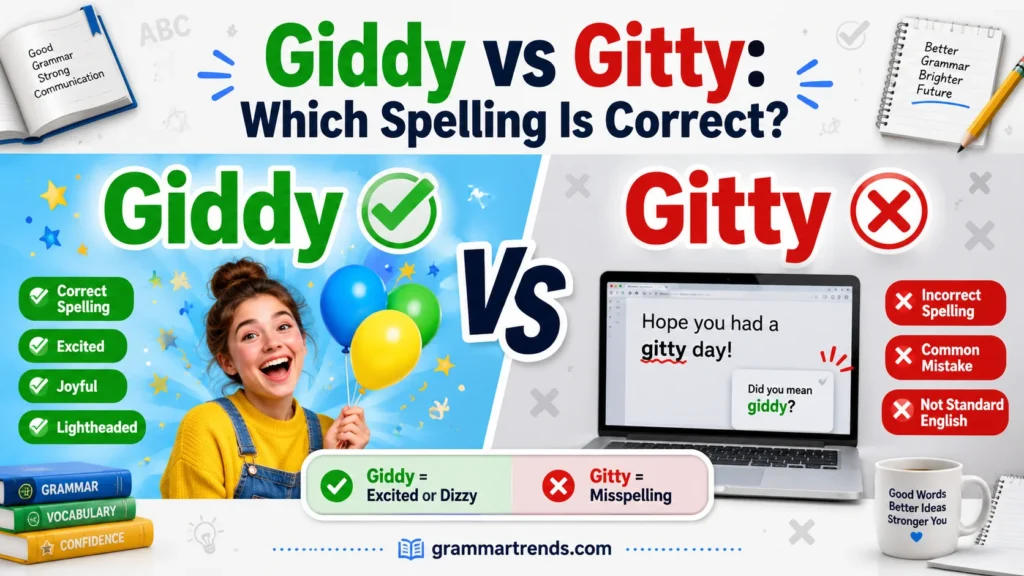
Giddy is the correct English word and means excited, joyful, lightheaded, or dizzy. Gitty is a misspelling and is not recognized as a standard English word. If you’re describing someone who feels thrilled, overwhelmed with excitement, or slightly dizzy, always use giddy.
What Does Giddy Mean? (Giddy vs Gitty Explained Correctly)
The word giddy describes a feeling of excitement, dizziness, or emotional overload. It can refer to both physical sensations and emotional states.
According to Merriam-Webster, giddy means:
“affected with vertigo or dizziness”
You can check the definition here:
But in real-life usage, the meaning expands beyond just dizziness.
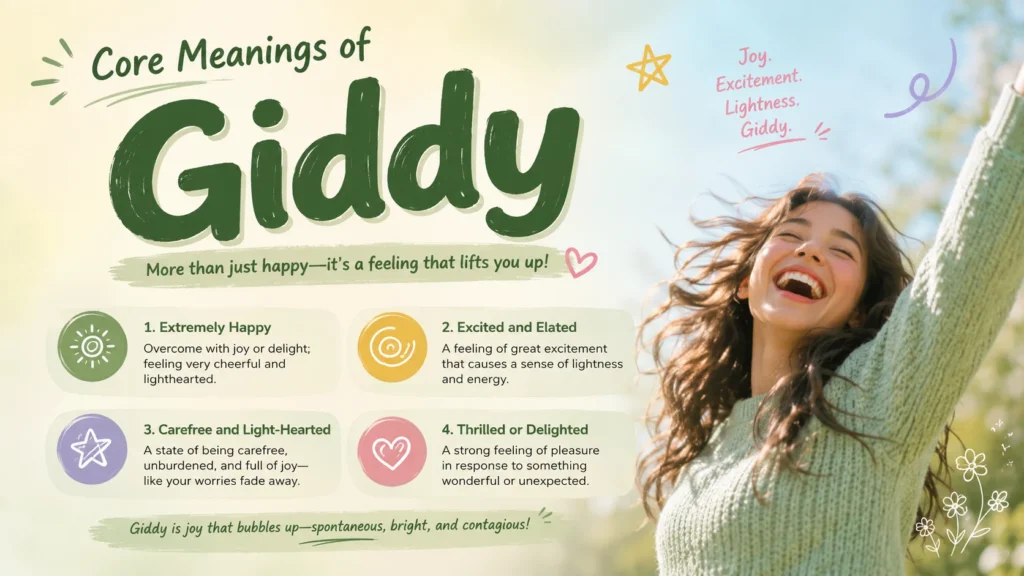
Core meanings of giddy
- Feeling lightheaded or dizzy
- Overwhelmed with excitement
- Emotionally thrilled or euphoric
- Slightly unsteady or unstable
Examples of “giddy” in real life
- She felt giddy after hearing the good news.
- I got giddy standing at the edge of the cliff.
- The crowd became giddy with excitement during the concert announcement.
Simple breakdown
Think of “giddy” as a mix of:
- Joy that makes you light
- Emotion that feels uncontrollable
- Physical dizziness in some cases
It’s a flexible word, which is why writers use it often in storytelling and everyday speech.
Origin of Giddy: Where the Word Comes From
Understanding the history of giddy helps you remember it better.
The word comes from Old English “gidig”, meaning foolish or mentally unstable. Over time, the meaning shifted.
Evolution of the word
- Old English: foolish or wild behavior
- Middle English: mentally unsteady or dizzy
- Modern English: excited, dizzy, or emotionally overwhelmed
Language naturally evolves like this. Words don’t stay frozen. They move with culture, speech, and usage.
So when you say “I feel giddy,” you’re using a word that carries centuries of meaning behind it.
Is Gitty a Real Word in Giddy vs Gitty Confusion?
Here’s where things get interesting.
Gitty is not a standard English word.
You won’t find it in:
- Oxford English Dictionary
- Merriam-Webster
- Cambridge Dictionary
Instead, it appears mainly in three situations:
1. Typing mistakes
People often type quickly and replace “giddy” with “gitty” accidentally.
2. Phonetic confusion
When spoken aloud, “giddy” and “gitty” can sound similar depending on accent or speed.
3. Informal internet usage
Some users adopt “gitty” in usernames or casual slang, but it has no formal meaning.
Important takeaway
If you use “gitty” in formal writing, readers will likely see it as:
- A spelling error
- A typo
- Or incorrect grammar
Giddy vs Gitty: Key Differences Explained Clearly
Let’s put everything side by side so you can see the difference instantly.
Comparison Table: Giddy vs Gitty
| Feature | Giddy | Gitty |
| Standard English word | Yes | No |
| Dictionary recognition | Yes | No |
| Meaning | Excited or dizzy | No accepted meaning |
| Formal writing use | Correct | Incorrect |
| Common usage | High | Rare or accidental |
This table makes it simple:
👉 If you mean emotion or dizziness, always use giddy.
How to Use Giddy in Sentences (Giddy vs Gitty in Practice)
Now let’s look at how real writers use giddy in different contexts.
Emotional excitement examples
- I felt giddy when I got my first job offer.
- She became giddy after meeting her favorite author.
- They were giddy with excitement before the trip.
Physical dizziness examples
- After spinning around, I felt giddy.
- The heat made him feel giddy and weak.
- She stood up too fast and went giddy.
Why “giddy” works so well
It captures two things at once:
- Emotional high
- Physical sensation
That dual meaning makes it powerful in storytelling and everyday speech.
Read more: MYF Meaning in Text: What It Means?
Why “Gitty” Appears in Writing (Giddy vs Gitty Errors Explained)
Even though “gitty” is incorrect, it still shows up often. Let’s break down why.
Main reasons people write “gitty”
- Fast typing on phones
- Autocorrect mistakes
- Mishearing the word
- Lack of proofreading
- Social media influence
A real-world example
A student writes:
“I felt gitty after passing the exam.”
What happened here?
- The emotion is correct
- The spelling is wrong
This small error can reduce writing credibility, especially in academic or professional contexts.
Common Mistakes in Giddy vs Gitty Usage
People don’t just confuse spelling. They also misuse context.
Mistake 1: Using “gitty” instead of “giddy”
This is the most common issue.
Incorrect:
- I feel gitty about the trip.
Correct:
- I feel giddy about the trip.
Mistake 2: Confusing giddy with similar words
Many writers mix it up with:
- Gritty → rough, tough, realistic
- Jittery → nervous or anxious
- Silly → playful or foolish
These words look or sound similar but carry different meanings.
Mistake 3: Overusing “giddy”
Sometimes writers use it too often in emotional writing.
Instead of repeating:
- giddy excitement
- giddy feeling
- giddy joy
Try variation:
- thrilled
- ecstatic
- overwhelmed
Context Matters in Giddy vs Gitty Usage
Context decides everything in grammar.
When “giddy” works best
- Storytelling
- Emotional writing
- Informal speech
- Descriptive scenes
When “gitty” never works
- Academic essays
- Business emails
- Professional communication
- Published content
Even in casual texting, “giddy” remains the correct choice.
Memory Tricks to Remember Giddy vs Gitty
Here’s a simple trick that actually works.
1. The “Joy + Dizzy” trick
Giddy = Joy that makes you dizzy
If you remember that, spelling becomes easy.
2. Double “D” reminder
Giddy has two D’s, like:
- Double excitement
- Double emotion
Gitty has no meaning, so it has no rule to remember.
3. Sound association
Say it out loud:
- Giddy → soft and emotional
- Gitty → feels “off” or incorrect
Your brain naturally picks up the difference over time.
Quick Decision Guide: Giddy vs Gitty
Use this simple checklist before writing:
- Is it in a dictionary? → use giddy
- Does it mean excitement or dizziness? → use giddy
- Unsure spelling? → default to giddy
- Writing “gitty”? → stop and correct it
Simple. Fast. Reliable.
Practice Exercises: Master Giddy vs Gitty
Let’s make this stick.
Exercise 1: Fill in the blank
- I felt ______ after winning the match.
- She became ______ when she saw the surprise.
- The roller coaster made me feel ______.
Answers: giddy, giddy, giddy
Exercise 2: Choose the correct word
- I felt (giddy / gitty) after the announcement.
- The child looked (giddy / gitty) with joy.
- He wrote (giddy / gitty) by mistake.
Answers: giddy, giddy, giddy
Exercise 3: Fix the sentence
- I feel gitty about my vacation.
- She was gitty after the concert.
Correct versions:
- I feel giddy about my vacation.
- She was giddy after the concert.
Case Study: Real Writing Impact of Giddy vs Gitty Errors
Let’s look at how small spelling mistakes affect perception.
Scenario
A freelancer submits a blog post:
“The audience felt gitty during the performance.”
Result
- Client notices spelling issue
- Credibility drops slightly
- Revision requested
Corrected version
“The audience felt giddy during the performance.”
What changed?
Nothing in meaning. Everything in perception.
That’s the power of correct spelling.
FAQs
1. What is the correct spelling: giddy or gitty?
Giddy is the correct English spelling. Gitty is generally considered a misspelling.
2. What does “giddy” mean in English?
Giddy usually means feeling excited, lightheaded, or dizzy, depending on context.
3. Is “gitty” a real English word?
In standard English, gitty is not recognized as a proper word. It is often a typing or spelling mistake.
4. Why do people confuse giddy and gitty?
Because the words look and sound similar, especially in fast typing or casual writing.
5. When should I use “giddy” in a sentence?
Use giddy when describing strong feelings like joy, excitement, or dizziness.
6. Does spellcheck detect gitty?
Yes, most spellcheck tools flag gitty as incorrect and suggest giddy instead.
7. Can using the wrong spelling affect writing quality?
Yes, using incorrect spelling like gitty can reduce clarity, trust, and professionalism in writing.
Conclusion
The difference between giddy vs gitty is straightforward: giddy is the correct spelling, while gitty is simply a misspelling. Whether you’re describing excitement, happiness, or a lightheaded feeling, choosing giddy ensures your writing is accurate and easy to understand. Remembering this simple distinction will help you avoid a common spelling mistake and communicate with greater confidence.

Emma Brooke brings 15 years of experience in the Department of English Language and Literature at the University of California, Berkeley, where she has taught and mentored students across courses in British and American literary traditions, critical theory, and narrative form. Her expertise spans 19th- and 20th-century fiction, poetic prosody, postcolonial literatures, and digital humanities, with a focus on how narrative voice shapes cultural meaning. Emma’s work has been presented at international conferences and published in peer-reviewed venues, reflecting her deep commitment to rigorous literary scholarship and accessible teaching.