
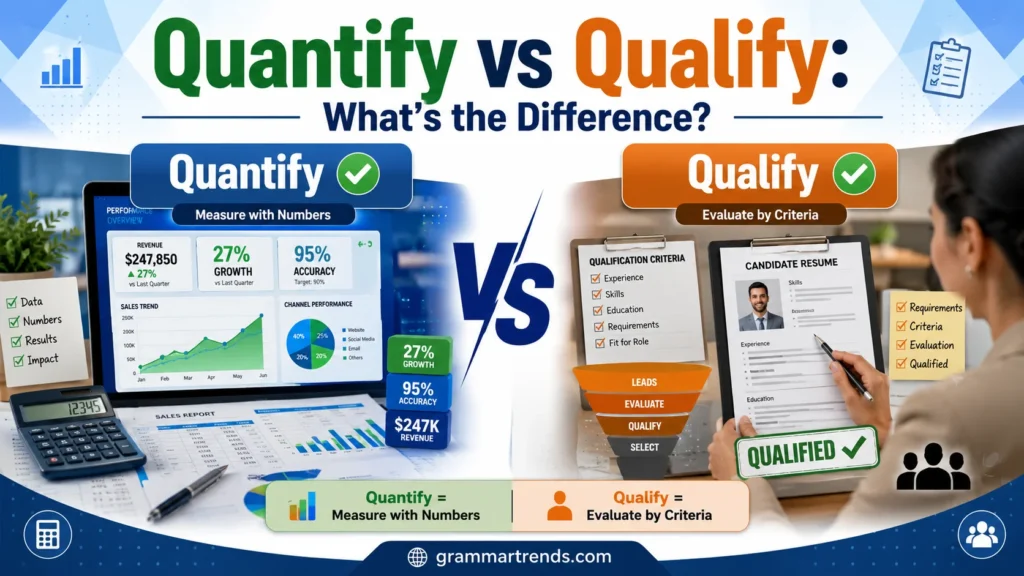
Quantify vs Qualify is a comparison that often confuses writers, job seekers, marketers, and professionals because both words frequently appear in business, hiring, sales, and everyday communication. Although they sound similar, they have very different meanings. Quantify means to measure or express something in numbers, while qualify means to describe, limit, assess, or determine whether someone or something meets specific requirements.
In today’s hiring market, marketing campaigns, sales reports, and data-driven workplaces, knowing the difference between these terms is more important than ever. Employers want candidates to quantify their achievements with percentages, revenue growth, KPIs, and measurable results, while they also need to qualify leads, products, services, and applicants based on specific criteria. Using the wrong word can confuse your message and weaken your credibility.
This guide explains the difference between quantify and qualify, when to use each word, common mistakes to avoid, real-life examples, and simple tips to help you choose the correct term with confidence. Whether you’re writing a resume, preparing for an interview, creating a marketing report, or improving your everyday English, you’ll learn exactly how to use both words correctly.
Quick Answer
Quantify means to measure something using numbers or data, while qualify means to evaluate, describe, limit, or determine whether someone or something meets certain standards. Although the words sound alike, they serve different purposes. You quantify results with statistics, percentages, or KPIs, but you qualify candidates, leads, products, or statements based on specific criteria. Knowing the difference helps you communicate more accurately in business, hiring, marketing, and everyday writing.
What Does Quantify Mean in “Quantify vs Qualify”?
When you quantify something, you assign it a number, amount, or measurable value.
You stop guessing. You start measuring.
Core idea of quantify
Quantify answers questions like:
- How much?
- How many?
- To what extent?
Simple definition
To quantify means to express something in measurable units or numerical terms.
Real-world examples of quantifying
You quantify when you:
- Track website traffic (e.g., 12,500 visitors per day)
- Measure sales growth (e.g., 18% increase)
- Count survey responses (e.g., 430 respondents)
- Record performance metrics (e.g., 95% accuracy rate)
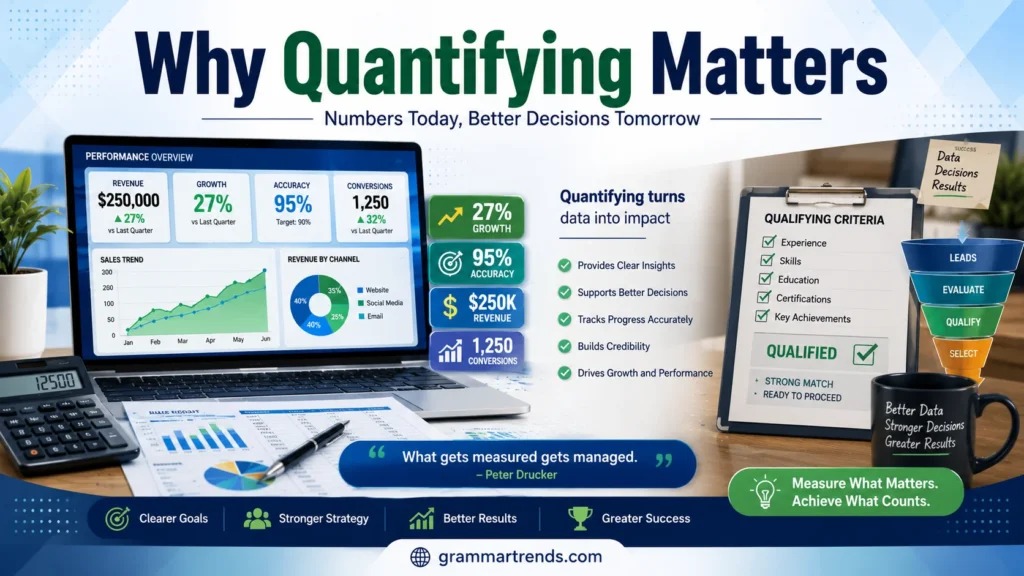
Why quantifying matters
Numbers change conversations.
A vague statement like:
“Sales improved a lot”
becomes:
“Sales increased by 27% in Q2”
Now you’re not guessing. You’re proving.
That’s why business, science, and analytics rely heavily on quantification.
As management expert Peter Drucker famously said:
“What gets measured gets managed.”
That idea sits right at the heart of quantification.
How quantifying works in communication
Quantifying does three powerful things:
- It removes ambiguity
- It builds trust
- It strengthens arguments
For example:
- Weak: “Many users liked the product.”
- Strong: “78% of users rated the product 4 stars or higher.”
One feels like opinion. The other feels like evidence.
What Does Qualify Mean in “Quantify vs Qualify”?
Now let’s flip the direction.
When you qualify something, you don’t measure it—you adjust its meaning.
You add limits, conditions, or descriptions that change how a statement should be understood.
Core idea of qualify
Qualify answers questions like:
- Under what condition?
- In what context?
- With what limitation?
Simple definition
To qualify means to restrict, clarify, or modify a statement so it is not absolute.
How qualifying changes meaning
Look at this sentence:
“The product is the best on the market.”
Now qualify it:
“The product is the best on the market for beginner users.”
You didn’t measure anything. You narrowed the claim.
That’s qualification in action.
Real-world examples of qualifying
You qualify when you:
- Add exceptions
- Narrow a claim
- Clarify conditions
- Avoid overgeneralization
Examples:
- “I like the movie, but only for its visuals.”
- “This method works, but only under controlled conditions.”
- “He is qualified, although still early in his career.”
Why qualifying matters
Without qualification, statements become risky.
For example:
- “This treatment cures all headaches.”
That’s too absolute. It invites criticism.
Now qualify it:
- “This treatment helps reduce mild headaches in most cases.”
Now it sounds responsible and accurate.
Quantify vs Qualify: Side-by-Side Breakdown
Let’s make the difference impossible to confuse.
| Feature | Quantify | Qualify |
| Main purpose | Measure with numbers | Limit or describe meaning |
| Focus | Quantity | Conditions or context |
| Output type | Data, metrics, figures | Clarified or restricted statement |
| Question answered | How much / how many | Under what condition |
| Example trigger words | number, percent, count | if, unless, except |
| Common use | analytics, science, reporting | writing, argumentation, law |
Memory trick that actually works
- Quantify = “Quantity” = Numbers
- Qualify = “Quality/Conditions” = Meaning adjustment
Simple. Easy to recall under pressure.
When to Use Quantify vs Qualify in Real Writing
This is where most people get it wrong. They don’t choose based on logic. They choose based on instinct.
Let’s fix that.
When you should quantify
Use quantify when you need:
- Proof instead of opinion
- Data-driven communication
- Performance tracking
- Scientific clarity
Example scenarios:
- Writing a business report
- Presenting research findings
- Analyzing marketing campaigns
- Tracking progress in projects
When you should qualify
Use qualify when you need:
- To avoid absolute claims
- To add nuance
- To clarify limitations
- To make statements legally or logically safe
Example scenarios:
- Writing essays
- Making arguments
- Giving opinions
- Drafting legal or formal statement
Quick decision rule
Ask yourself:
- Can I measure it? → Quantify
- Do I need to limit it? → Qualify
That one question solves 80% of confusion.
Read more: Snowball Kiss Meaning Explained: How Internet Culture Shaped It?
Common Mistakes in Quantify vs Qualify Usage
People mix these words because they deal with abstract thinking.
Let’s break down the real mistakes.
Mistake: Using “quantify” for opinions
Wrong:
“We need to quantify customer satisfaction feelings.”
Why it’s wrong:
Feelings aren’t directly measurable unless you convert them into data.
Correct:
“We need to measure customer satisfaction using ratings and surveys.”
Mistake: Using “qualify” when you mean measurement
Wrong:
“The report qualifies website traffic.”
Why it’s wrong:
You are not limiting traffic. You are measuring it.
Correct:
“The report quantifies website traffic.”
Mistake: Overcomplicating simple ideas
Sometimes writers force these words unnecessarily.
Weak:
“We must quantify the emotional tone of the feedback.”
Better:
“We must measure sentiment in the feedback using ratings.”
Fix strategy: The 3-question rule
Before using either word, ask:
- Am I measuring something?
- Am I limiting something?
- Am I just trying to sound formal?
If it’s the third one, stop. Rewrite it simply.
Quantify vs Qualify in Real-World Communication
Let’s move beyond definitions. This is how these words actually behave in different environments.
Academic writing
In research, precision matters more than style.
Quantify usage:
- Measuring sample sizes
- Reporting statistical results
- Analyzing experimental data
Example:
“The study quantified response times across 500 participants.”
Qualify usage:
- Limiting conclusions
- Defining assumptions
- Narrowing scope
Example:
“The findings apply only to controlled laboratory conditions.”
Business writing
Business communication depends on clarity and speed.
Quantify usage:
- KPIs
- Revenue tracking
- Conversion rates
Example:
“We quantified a 32% increase in lead conversions.”
Qualify usage:
- Forecasts
- Risk statements
- Strategic assumptions
Example:
“The projection is valid only if market conditions remain stable.”
Everyday communication
Even casual conversations use both words naturally.
- Quantify: “How many steps did you take today?”
- Qualify: “I liked the movie, but only the first half.”
You use both without noticing it.
Case Study: Marketing Team Using Quantify vs Qualify
Let’s bring this into a real scenario.
Situation:
A marketing team launches a new campaign.
Step 1: Quantifying performance
They track:
- 120,000 impressions
- 8,400 clicks
- 6.8% click-through rate
- 1,200 conversions
Now they have measurable success.
Without quantification, they would just say:
“The campaign performed well.”
That means almost nothing.
Step 2: Qualifying results
Now they refine interpretation:
- “Results apply primarily to mobile users.”
- “Performance drops during weekends.”
- “Data excludes paid influencer traffic.”
Now the data becomes context-aware.
Outcome
- Quantify gives them numbers
- Qualify gives them meaning
Together, they create complete understanding.
Practice Exercises: Test Your Understanding
Let’s lock it in.
Exercise 1: Choose the correct word
- We need to ___ customer engagement this month.
- The results ___ only premium users.
- The study ___ 2,000 participants.
Answers:
- Quantify
- Qualify
- Quantified
Exercise 2: Fix the sentence
Wrong:
“The report qualifies sales growth.”
Correct:
“The report quantifies sales growth.”
Exercise 3: Rewrite for clarity
Original:
“Users are happy with the app.”
Rewrite (quantified version):
“82% of users rated the app 4 stars or higher.”
Rewrite (qualified version):
“Users are generally happy with the app, especially its speed and interface.”
Why People Confuse Quantify and Qualify
This confusion isn’t random.
It comes from three sources:
- Similar spelling and rhythm
- Abstract language in education
- Overuse in academic writing
But the real issue is this:
People think both words “sound professional,” so they use them interchangeably.
That creates vague writing.
Advanced Insight: The Hidden Relationship Between Both Words
Here’s something most guides miss.
Quantify and qualify actually work together in strong communication.
- Quantify gives structure
- Qualify gives boundaries
Without quantification, you get opinion overload.
Without qualification, you get misleading certainty.
Together, they create balanced communication.
FAQs
What is the difference between quantify and qualify?
Quantify means to measure something with numbers or data, while qualify means to evaluate, describe, limit, or determine whether something meets specific requirements.
When should I use quantify?
Use quantify when talking about measurable results, such as sales growth, revenue, percentages, statistics, or performance metrics.
When should I use qualify?
Use qualify when deciding whether someone, something, or a statement meets certain conditions or standards, such as qualifying a job applicant or a sales lead.
Can quantify and qualify be used in the same sentence?
Yes. For example: You should quantify your achievements on your resume and qualify your claims with relevant evidence.
Why do people confuse quantify and qualify?
They sound similar and are often used in business and professional writing, but they have different meanings. One focuses on measurement, while the other focuses on evaluation or eligibility.
Which word is correct for resumes: quantify or qualify?
Both can be correct, depending on the context. You quantify your accomplishments with numbers, but you qualify your skills or experience to show you meet the job requirements.
Conclusion
Knowing the difference between quantify vs qualify helps you communicate with clarity and purpose. When you quantify, you bring numbers, proof, and measurable impact into your message. When you qualify, you add meaning, description, and context to those numbers.
In today’s competitive world whether in writing, marketing, or job interviews using both correctly allows you to present stronger arguments and clearer value. Quantifying shows what happened, while qualifying explains why it matters.

Mia Rose brings fifteen years of experience at The University of Edinburgh’s English Literature department, leading students through explorations of classic and contemporary texts, literary theory, and narrative design. Her academic interests center on Victorian and modernist fiction, poetic rhythms, postcolonial storytelling, and digital approaches to literary study—with a keen eye on how voice and perspective frame cultural dialogue. Mia has delivered talks at prestigious global conferences and authored articles in scholarly journals, showcasing her commitment to meaningful research and lively classroom engagement.